

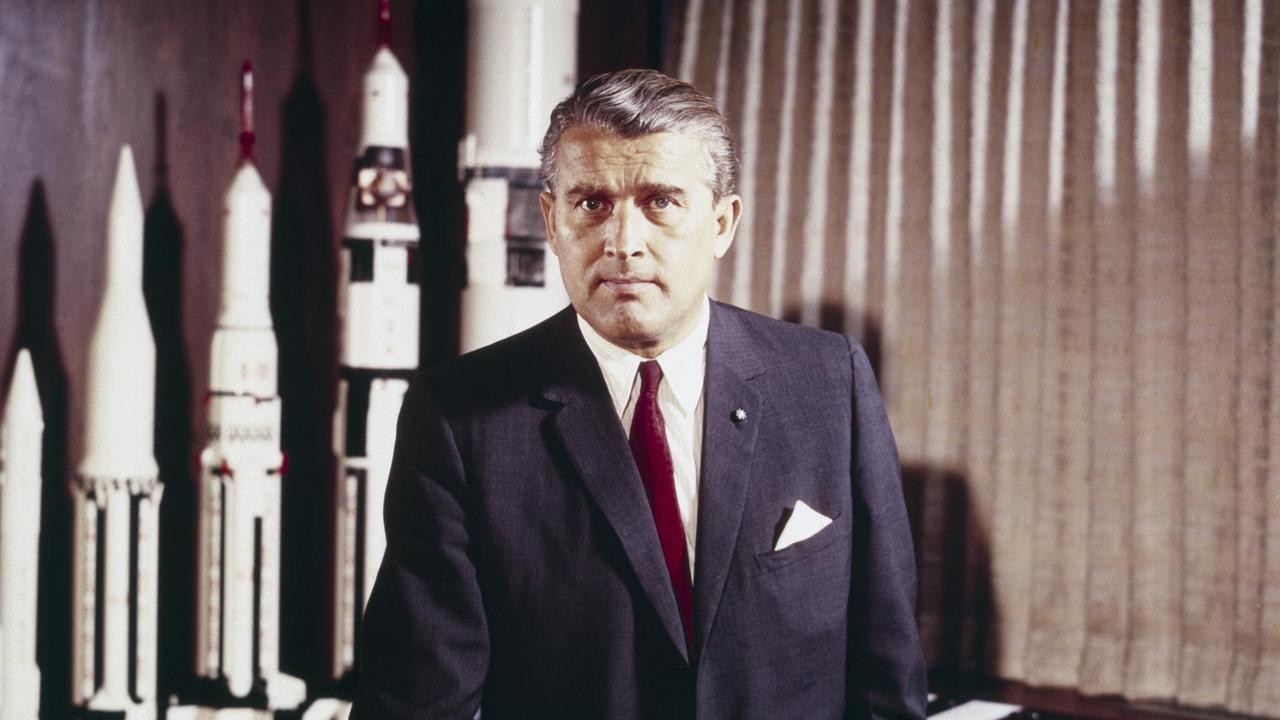

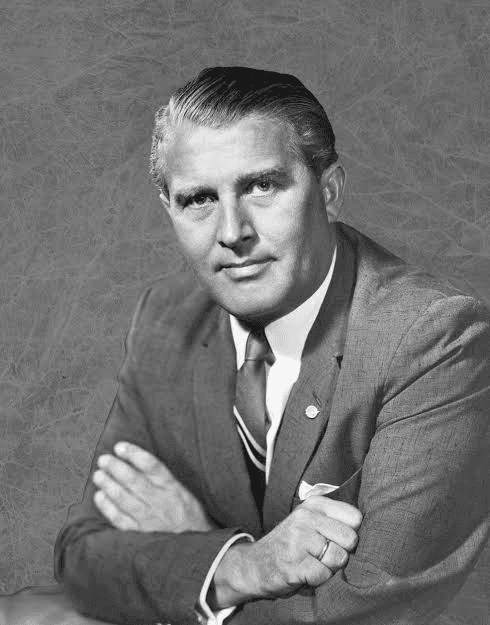
Wernher Magnus Maximilian Freiherr von Braun
Date of birth | 1912-03-23 | ||||||||
|---|---|---|---|---|---|---|---|---|---|
Date of death | 1977-06-16 | ||||||||
Father | Baron Magnus von Braun | ||||||||
Mother | Emmy von Quistorp | ||||||||
Academic education | Berlin French High School Berlin Technical University | ||||||||
Field of science | Mathematics Astrophysics Physics Engineering Astronomy | ||||||||
Wernher von Braun, as one of the 20th century’s most controversial and influential engineering figures, built a career that began with ballistic missile technologies developed in Nazi Germany and extended to the United States’ human mission to the Moon. He left behind a complex legacy shaped by the tension between his technical genius and his ethical responsibilities. ### Childhood Wernher Magnus Maximilian Freiherr von Braun was born on 23 March 1912 in the Prussian region of Germany into an aristocratic family. His father was Baron Magnus von Braun, and his mother descended from King Valdemar I of Denmark. As a child, he became fascinated by science, especially space, and developed an interest in astronomy by observing the stars through a telescope given to him by his mother. The young Wernher read works by science fiction authors such as Jules Verne and H. G. Wells and was inspired by Hermann Oberth’s 1923 scientific treatise *Die Rakete zu den Planetenräumen (The Rocket to Planetary Space)*. This fascination fueled his determination to study mathematics and physics, leading him to excel in subjects he had previously struggled with. Years later, von Braun admitted that his passion for rockets had compensated for his mediocre academic performance in school. Even at age 12, he conducted an experiment by attaching six small rocket motors to a toy wagon, causing a minor panic in the neighborhood and prompting police intervention. This anecdote reveals his early and intense curiosity about rockets. ### Education Von Braun first attended the French Lyceum in Berlin, where he was an average student, more interested in tinkering with car parts in his father’s garage than in his lessons. When his family sent him to a boarding school to instill discipline, he found opportunities to collaborate on technical projects and began to stand out. The privilege of using his mother’s telescope to study the night sky before bed planted the seeds of a lifelong passion for space. After completing secondary school, he pursued engineering studies and in the early 1930s earned undergraduate degrees in mechanical engineering and aerospace engineering at the Technical University of Berlin. At just 22 years old, he obtained his doctorate in physics from the University of Berlin on 27 July 1934, earning the title Dr. Ing. His academic rise was rapid, paralleled by his growing involvement in Germany’s emerging rocket research programs. ### Rocket Program and SS Membership in Nazi Germany Wernher von Braun began working on the German Army’s ballistic missile development program in 1932 while still a university student. Despite restrictions imposed by the Treaty of Versailles, the German Army was exploring future weapon technologies and had committed to liquid-fueled rocket research. Under the patronage of artillery officer Major Walter Dornberger, von Braun initiated secret rocket research for the military. A series of successful rocket tests in 1934 (A-2 series) established him as a central figure in German rocketry. By 1937, at age 25, he was appointed technical director at the Army’s secret Weapons Research Center in Peenemünde, where he and his team developed the design and prototype of the A-4 ballistic missile—later known as the V-2. As von Braun became involved in Nazi scientific projects, he also shaped his political position. He joined the Nazi Party in 1937 and remained a member throughout World War II. He later claimed this membership was largely due to external pressure: as a civilian leading such a strategic project under Nazi rule, saying “no” was nearly impossible. Indeed, von Braun had been raised in a traditional, conservative-prussian family and was not initially devoted to National Socialist ideology. However, the regime’s generous funding for his rocket projects made it easier for him to sympathize with it. Meanwhile, while still a university student between 1933 and 1934, he joined an SS equestrian club and was eventually commissioned as an SS officer (Untersturmführer) in 1940 on Himmler’s orders. This membership, like his party affiliation, was presented to him as a necessary step: Dornberger advised him that it was better not to refuse and avoid drawing attention. Thus, although von Braun was not an active Nazi ideologue, he rapidly ascended within the regime’s military-technical elite, demonstrating a clear loyalty toHitler’sgovernment. ### War Years and the V-2 Program During the war, von Braun’s role was critical as the centerpiece of Germany’s *Wunderwaffe* (Wonder Weapon) program. On 3 October 1942, under his leadership, his team achieved the first successful test flight of the A-4 (V-2) rocket. This success deeply impressed Hitler, who immediately approved mass production. However, by 1943, Germany’s skilled labor force had been largely diverted to the front lines and defense industries, creating severe labor shortages in factories. At this point, von Braun and other rocket program managers, together with Armaments MinisterAlbert Speer, decided to exploit the labor of prisoners from concentration camps to accelerate production. Following orders from Hitler and SS leader Heinrich Himmler, V-2 assembly lines were moved in August 1943 to the underground Mittelwerk facilities near Nordhausen, where thousands of prisoners were forced to work as slave laborers. This development, whether von Braun wished it or not, directly integrated him into a system of exploitation: he was fully aware that rocket production now depended on a concentration camp labor system. By 1944, von Braun’s relationship with the Nazi regime had become increasingly complex. In March 1944, he was abruptly arrested by the Gestapo. He was accused of having spoken in his circle about Germany’s likely defeat in the war and of stating that his true goal was to build spaceships after the war. Charged with moral treason and facing possible execution, von Braun was rescued by Dornberger and Speer, who understood that halting the rocket program would be a catastrophe for Germany. Shortly released, von Braun resumed his work but was now viewed with suspicion by the SS leadership. After the failed assassination attempt on Hitler on 20 July 1944, the Wehrmacht’s political power weakened further, and Himmler appointed SS General Hans Kammler as overall commander of the V-2 program. In the final months of the war, von Braun and Dornberger were forced to report directly to Kammler, placing them in a critical yet perilous position within the Nazi hierarchy. ### Development and Technical Features of the V-2 Ballistic Rocket Von Braun’s most significant wartime achievement was the A-4 ballistic missile, known as the V-2 rocket. The V-2 was the world’s first long-range guided ballistic missile and is considered the harbinger of modern rocket technology. Technically advanced, it stood 14 meters tall (approximately 46 feet) and weighed 12.5 tons at launch. Powered by a liquid-fueled engine (alcohol and liquid oxygen), the single-stage rocket generated about 25 tons of thrust, lifting a one-ton warhead to altitudes of 80–90 kilometers at speeds exceeding 800 km/h, and delivering it to targets up to 300 kilometers (about 190 miles) away. After its first successful test in October 1942, V-2 rockets were deployed operationally by the German army starting in September 1944. Approximately 3,000 V-2s were launched against Allied targets, primarily London and Antwerp, resulting in around 5,000 deaths and injuries. However, the V-2’s impact on the war’s outcome was limited: a single V-2 carried only a small fraction of the explosive power delivered by conventional bombing raids. In terms of cost-benefit analysis, British Prime Minister Winston Churchill’s description of the V-2 as “the enemy’s expensive and futile effort” was apt. The production history of the V-2 reveals a dark side to its engineering success. From 1943 onward, mass production took place in underground factories at Mittelwerk, where concentration camp prisoners were forced to work under brutal conditions. Workers were subjected to more than 12 hours of labor daily, with inadequate food and cruel treatment. The human cost of production was horrific: estimates suggest that approximately 20,000 prisoners died during the construction of the V-2 and other “V-weapons.” Ironically, the number of slave laborers killed in production exceeded the number of civilians killed by the rockets themselves. Although von Braun claimed after the war that he had focused solely on technical matters and was unaware of these inhumane conditions, historians emphasize that it was impossible for him to remain ignorant after personally visiting the underground facilities in August 1943. While the V-2 represented a technological triumph far ahead of its time, the ethical tragedy accompanying it has left a lasting point of controversy in von Braun’s career. ### Postwar Transfer to the United States and Operation Paperclip As World War II neared its end in Europe, von Braun and his team sought ways to surrender to the Americans. With Germany’s defeat certain, both Soviet and American intelligence agencies pursued the rocket experts at Peenemünde. In early May 1945, von Braun, along with his brother Magnus and his most trusted engineers, surrendered to American troops in the Alps. Before surrendering, they succeeded in salvaging as many technical documents and rocket components as possible from destruction. Von Braun later stated that his primary goal was to prevent his team from falling into Soviet hands and to continue working under American protection. Indeed, under the secret U.S. program known as Operation Paperclip (Ataç Operasyonu), approximately 120 German rocket engineers, including von Braun, were transferred to the United States. This program aimed to employ scientists with Nazi backgrounds in American defense projects, justified by strategic interests. [Image: U.S. Army, 1946. German Rocket Scientists at White Sands, 1946. NASA Historical Archives. Accessed 5 April 2025. https://history.nasa.gov/] In the autumn of 1945, von Braun and his team arrived in the United States. Initially stationed at Fort Bliss in Texas, they were formally granted the status of military consultants with the role of technical translators. They then began test launches at the White Sands Proving Ground in New Mexico, reassembling captured V-2 components. Von Braun did not act as a prisoner of war but as a special project leader of the U.S. Army. Between 1945 and 1950, this team analyzed V-2 technology and laid the foundation for America’s first intermediate-range ballistic missiles. In 1950, the U.S. Army relocated the team to Huntsville, Alabama, to the Redstone Arsenal, where von Braun led the design of the Redstone and Jupiter missiles under the Army Ballistic Missile Agency (ABMA). The Redstone, a liquid-fueled rocket generating 8.5 tons of thrust, became the U.S. Army’s first nuclear-capable ballistic missile in the mid-1950s. The Jupiter, a more powerful and longer-range missile, was a direct extension of von Braun’s German V-2 experience. ### Cold War and the Rise of the American Space Program During the intensifying Cold War, von Braun gradually became a public figure in the United States. The Soviet launch of Sputnik on 4 October 1957 triggered panic in the U.S., accelerating the American space program. Von Braun’s team achieved a major success on 31 January 1958 by placing Explorer-1, America’s first artificial satellite, into orbit. The Juno I rocket used in this mission was an adapted version of von Braun’s Jupiter-C missile. Thus, von Braun proved his capabilities by launching the first American satellite that put the U.S. in pursuit of the Soviets in the space race. This success also hastened the creation of a civilian space agency. When the National Aeronautics and Space Administration (NASA) was established in 1958, it was decided to convert von Braun’s military unit into a civilian organization. On 1 July 1960, the Huntsville missile center was officially transferred to NASA and renamed the George C. Marshall Space Flight Center. Von Braun was appointed its founding director and began leading efforts toward the U.S. goal of sending humans to the Moon. ### Roles at NASA and the Development of the Saturn V From 1960 to 1970, Wernher von Braun served as director of NASA’s Marshall Space Flight Center, managing the most critical projects of the American space program. His greatest engineering achievement during this period was the development of the Saturn V, the massive launch vehicle for the Apollo Moon program. Building on his V-2 experience and the accumulated knowledge from Redstone and Jupiter, von Braun was tasked with designing a far more powerful rocket for human spaceflight. The three-stage Saturn V stood 110 meters tall, had a diameter of 10 meters, and weighed approximately 2.8 million kilograms at launch. It was the largest and most powerful rocket of its time, generating 34.5 meganewtons (about 7.6 million pounds) of thrust at liftoff using five F-1 engines, capable of placing nearly 130 tons into low Earth orbit. This immense thrust was equivalent to the output of about 85 large hydroelectric power plants, making the Saturn V the “most powerful launch vehicle” ever built up to that point. Von Braun’s team at Marshall developed innovative engineering solutions in rocket motors, structural integrity, guidance, and control systems. The rocket’s first test flight, Apollo 4, was successfully conducted in 1967, and subsequent Apollo missions consistently demonstrated its performance. [Image: Dr. Wernher von Braun with Saturn V F-1 Engines, ca. 1960s. NASA Historical Archives. Accessed 5 April 2025. https://history.nasa.gov/] Von Braun’s visionary leadership was decisive in achieving the Saturn V’s near-perfect operational record. The first human-carrying Saturn V launched in 1968 with Apollo 8, placing its crew in lunar orbit. On 20 July 1969,Apollo 11, enabled by the Saturn V, landed humans on the Moon. Between 1969 and 1972, six Apollo missions used the Saturn V for crewed lunar journeys, and the rocket suffered no serious failures or malfunctions. In total, the Saturn V achieved 13 successful launches out of 13 attempts (including 11 Apollo missions and one Skylab mission), demonstrating unmatched reliability. Von Braun and his team’s meticulous engineering approach to “zero errors” ensured the Saturn V’s historic record of 32 successful launches out of 32 attempts. This success was directly linked to von Braun’s management style, which emphasized perfection and relentless testing. After the Apollo 11 Moon landing, NASA officials of the era praised von Braun’s contribution as “the man who made a nation’s dream come true.” ### Later Years and Retirement After the completion of the Apollo program, von Braun remained in his NASA role for a short time. In 1970, NASA leadership invited him to Washington, D.C., to head the agency’s planning department. Von Braun relocated from Huntsville to NASA headquarters and was assigned to plan the agency’s future for the next decade. However, he was dissatisfied with the bureaucratic environment and political constraints, and felt disillusioned as the space program lost momentum after the Moon landing. After approximately two years, he decided to retire from NASA in early 1972. He then joined the private sector as a senior executive at Fairchild Industries. Shortly afterward, health problems emerged: in 1973, he was diagnosed with advanced kidney cancer. After several years of battling the illness, he passed away on 16 June 1977 in Virginia at the age of 65. ### Engineering Approach, Vision, and Team Leadership Throughout his career, Wernher von Braun stood out for both his technical methods and visionary outlook. On one hand, his dreams of spaceflight; on the other, the disciplined engineering principles he applied to realize them, defined his leadership. Even as a student in the 1930s, he contemplated concepts such as travel to Mars,space stations, and lunar bases, viewing them as inevitable future goals. Even during the war, he told those close to him that his true aim was to build rockets that would one day reach space. In the 1950s, through popular science writings and television programs, von Braun communicated his space vision to the American public and became a key “space ambassador” in building public support for the Moon mission. A NASA historian summarized this aspect of his life: “He spent half his life convincing humanity to go to space and the other half building the vehicles to take us there.” In engineering methodology, von Braun was extremely meticulous, systematic, and data-driven. From his Peenemünde days, he remained faithful to the philosophy of “small steps first, then big leaps.” He frequently advised his engineers: “You can never be certain until you test,” insisting that every subsystem be tested repeatedly. For example, before launching the first American astronaut on the Mercury-Redstone rocket, he insisted on one final unmanned test flight, inadvertently allowing Soviet cosmonaut Yuri Gagarin to become the first human in space two months earlier. Astronaut Alan Shepard later lamented, “If von Braun had sent one more monkey, the first human in space would have been an American,” but von Braun preferred to eliminate even the smallest risk. This cautious attitude continued in the Apollo program. When NASA administrator George Mueller proposed the “all-up testing” method—testing all Saturn V stages together on the first flight—von Braun initially opposed this risky approach but later accepted the decision after higher management’s approval. He also initially resisted the use of highly energetic but difficult-to-handle liquid hydrogen in the upper stages of the Saturn rocket, but later recognized its necessity. These examples illustrate von Braun as an engineering leader who was cautious toward innovation yet open to learning. Ultimately, his “perfectionist” approach ensured that the Saturn V became history’s most reliable rocket through 13 consecutive successful missions. In team management and leadership, von Braun was both a visionary and a skilled organizer. Especially during his NASA years in Huntsville, he led and directed a large center with hundreds of engineers. He motivated his teams as “people who felt excitement and believed in the goal.” He preferred to consult with his core group of German engineers and reach consensus before making critical decisions, often persuading his entire team before taking major steps. For instance, during early Apollo planning, when NASA debated whether to land directly on the Moon or rendezvous in lunar orbit, von Braun hesitated for a long time, listening to the majority of his team. But as time ran out in 1962, he abandoned his usual approach and publicly endorsed the lunar orbit rendezvous (LOR) plan despite internal hesitation. Outside such situations, von Braun’s leadership was generally conciliatory and consensus-based; he consistently emphasized teamwork, crediting every major success to “we did it.” Even after the Apollo success, he declared, “We did it!” distributing credit among all his colleagues. Another dimension of von Braun’s management style was the innovation he introduced in communication and organizational structure. During his tenure at the Marshall Space Center, he developed unique practices to accelerate information flow and keep everyone informed. His most famous innovation was the weekly “Monday Notes” reporting system. Every Monday morning, von Braun required all unit managers to submit a one-page status report detailing problems, progress, and needs. He personally read each note, wrote his handwritten comments on them, and then distributed copies back to the relevant managers. This allowed every level of management to track both the center’s overall progress and the status of other departments weekly. This transparency created a dual effect: strengthening both vertical and horizontal communication. Unit leaders could evaluate their own work by seeing reports from other departments and von Braun’s feedback. Thanks to the Monday Notes system, von Braun earned the title “NASA’s most informed center director” and could monitor events in Huntsville even while spending long periods in Washington. Colleagues described these notes as “the most-read document” at Marshall and “the nervous system” of the organization. Another innovation in von Braun’s management was the principle of “Automatic Responsibility.” Under this principle, any engineer or manager assigned to theSaturn projectwas required, upon identifying a problem, to immediately resolve it and report it directly to upper management without waiting for hierarchical approval. This bypassed bureaucratic delays and ensured problems were addressed promptly. For example, a technical malfunction during a test would trigger an immediate report and the formation of a solution team, eliminating the habit of “first reporting to the boss and waiting for orders.” A colleague summarized this rule as “see the problem, fix it, and report it.” Additionally, to closely monitor the work of numerous subcontractors and contractors involved in the large project, von Braun implemented a method he called “Penetration.” He frequently sent expert engineers from Marshall to contractor factories to inspect production processes and identify potential quality issues before they escalated. As a result, problems that contractor managers might have hidden were exposed. For instance, engineers from Marshall detected a critical material flaw in the production of the Saturn V’s second stage using X-ray testing, uncovering dozens of critical cracks in a part the company had initially claimed had “no problem.” Von Braun used this incident to emphasize to his inspectors: “We penetrate our contractors’ operations,” highlighting how Marshall’s team achieved far superior contractor performance compared to other agencies. All these communication and management innovations became an essential part of NASA’s success in Apollo. The open communication and accountability culture established under von Braun’s leadership at Marshall became a model for other major engineering projects. ### Ethical Controversies and the Legacy of the Nazi Era Wernher von Braun’s career has left behind a complex legacy, caught between brilliant engineering achievements and the dark historical ties that created ethical dilemmas. While von Braun is remembered as the architect of the rocket that carried humanity to the Moon, he has also faced intense criticism for his indirect involvement in practices that could be considered war crimes in Nazi Germany. These ethical debates began while he was still alive and intensified after his death. His activities during the Nazi period—particularly his SS membership and his role in V-2 production using forced labor—have cast a shadow over his later reputation. After the war, Americans tended to present him as a “rocket genius” to the public, and 1950s American popular media elevated him as a scientist driven by space dreams, rarely mentioning his Nazi past. When von Braun died in 1977, most American newspapers eulogized him as a hero who sent humans to the Moon, either ignoring his Nazi Party membership and slave labor involvement or mentioning them superficially. In contrast, some European outlets, particularly in Britain, published satirical headlines such as “aimed at the stars but hit London,” highlighting his dual legacy. After von Braun’s death, debates intensified in the 1980s with the emergence of new documents. In 1984, the U.S. Department of Justice’s Office of Special Investigations (OSI) investigated von Braun’s former colleague Arthur Rudolph (responsible for Mittelwerk production), leading to the revocation of his U.S. citizenship due to his wartime role. During this investigation, many previously classified archival documents surfaced, and journalists used the Freedom of Information Act to access von Braun’s Nazi Party and SS records. In 1985, researcher Linda Hunt published a sensational article revealing von Braun’s 1947 declarations to the U.S. Army and the security investigations surrounding him. These revelations dealt a blow to von Braun’s public image. Even after death, many now viewed him not as a “well-intentioned engineer who became a Nazi out of necessity,” but as an opportunist who “made a deal with the devil for the sake of his space dream.” One commentator likened von Braun to Goethe’s Faust, stating he “sold his soul to the devil to achieve beneficial engineering projects for humanity.” From this perspective, von Braun turned a blind eye to the darkest aspects of the Nazi regime solely to advance his own ideal of space exploration, playing a moral gamble. On the other hand, von Braun’s defenders argued that he was essentially an apolitical scientist, never genuinely loyal to the Nazi ideology, and only collaborated with the regime to realize his rocket dreams. Von Braun himself, when questioned about his past in American years, defended himself by saying, “I have nothing to do with politics; I only wanted to build big rockets.” In fact, in a 1969 interview after the Moon landing, he implied a preference to be remembered for the Saturn V rather than the V-2, subtly expressing his discomfort with his Nazi past. However, historical facts show that von Braun’s personal responsibility cannot be entirely dismissed. In particular, during his personal visit to the Mittelwerk underground facilities in December 1943, he witnessed firsthand the horrific conditions endured by imprisoned workers. From that moment on, it was impossible for him to be unaware that the rockets he produced were paid for with human lives. Yet he continued to remain part of this system until the war’s end. According to his own account, his arrest by the Gestapo in March 1944 made him aware of the regime’s true face and led him to realize he had “served a bad cause.” Such personal reckonings aside, von Braun’s case has become a symbolic example of the conflict between science and ethics: how far can a scientist stray into dark paths for the sake of a noble goal? This question forms the core of the ongoing ethical debates surrounding von Braun’s legacy. Today, scholars and historians generally adopt a balanced perspective when evaluating his situation. Prominent historians like Michael J. Neufeld argue that it is incorrect to portray von Braun as either a full war criminal or a completely innocent victim; rather, he should be seen as an engineer “caught in the current but too late to find his direction.” Von Braun, due to his conservative aristocratic upbringing and career ambition, adapted relatively easily to the Nazi system but was slow to comprehend its horrors. Ultimately, he was a contradictory figure who signed his name to one of humanity’s greatest technological achievements while bearing the moral cost on his shoulders. This ethical dilemma has become the subject of novels, documentaries, and songs, and has become a case study in engineering and ethics courses. ### Academic and Cultural Impact After Death In the years following Wernher von Braun’s death, his legacy has continued to be evaluated from various angles in both academic circles and popular culture. In engineering and space history literature, von Braun is unquestionably recognized as the 20th century’s most influential rocket engineer. The technologies he developed did not end with the Apollo era but formed the foundation for subsequent generations of launch vehicles and ballistic missile designs. For example, traces of the Saturn V and von Braun’s school of thought can be found in many of NASA’s Space Shuttles and today’s heavy-lift rockets. This technical legacy is frequently emphasized by science historians. Von Braun is also studied as a model in large-scale systems engineering. His leadership during the Apollo program remains an analyzed example in project management courses, and his communication structures (like the Monday Notes) and team motivation practices are subjects of academic papers. Huntsville, Alabama—the so-called “Rocket City”—is a tangible embodiment of von Braun’s legacy. With the establishment of the Marshall Space Flight Center, what was once a small southern town transformed into a hub of high-technology industry. The rocket work von Braun and his team began there in the 1950s laid the foundation for a space industry complex that continues today. The naming of Huntsville’s largest indoor event arena as the Von Braun Center and the city’s annual hosting of the Wernher von Braun Memorial Symposium demonstrate his enduring importance in local memory. Similarly, in Germany, in his birthplace of Wirsitz (Wyrzysk) and in Berlin, where he spent his youth, plaques and small monuments commemorate von Braun. In popular culture, von Braun is portrayed both as an inspiring space pioneer and a controversial figure. The 1960 film *I Aim at the Stars* told his life story; before its release, satirical circles dubbed it with the alternate subtitle *…But Sometimes I Hit London*. Tom Lehrer’s satirical song in the 1980s drew attention to von Braun’s moral dilemma, while 1990s television series such as *From the Earth to the Moon* and *Space Race* treated his role in a more neutral, documentary-style manner. Von Braun’s name has occasionally sparked controversy in Germany due to his Nazi past; some academic circles argue that honoring him is disrespectful to the memory of concentration camp victims. In contrast, the space exploration community continues to honor him as “the visionary who led the space age.” In academia, numerous comprehensive biographies and research works on von Braun have been published. In particular, the meticulous archival research of Michael J. Neufeld objectively addresses von Braun’s reckoning with his Nazi past and his leadership in the American space program. As Neufeld himself notes, von Braun’s case remains a symbol of the endless debate on scientists’ ethical responsibilities. For engineering students, von Braun’s life is a vivid lesson on the sacrifices and boundaries required in pursuit of professional ideals. Wernher von Braun left behind both a path to the Moon and difficult questions. His legacy will always be remembered for demonstrating how humanity’s passion to reach the stars can become entangled with the darkest pages of our history.
Articles:
Books:
Others:
Wernher Magnus Maximilian Freiherr von Braun
Date of birth | 1912-03-23 | ||||||||
|---|---|---|---|---|---|---|---|---|---|
Date of death | 1977-06-16 | ||||||||
Father | Baron Magnus von Braun | ||||||||
Mother | Emmy von Quistorp | ||||||||
Academic education | Berlin French High School Berlin Technical University | ||||||||
Field of science | Mathematics Astrophysics Physics Engineering Astronomy | ||||||||
No Discussion Added Yet
Start discussion for "Wernher Magnus Maximilian Freiherr von Braun" article