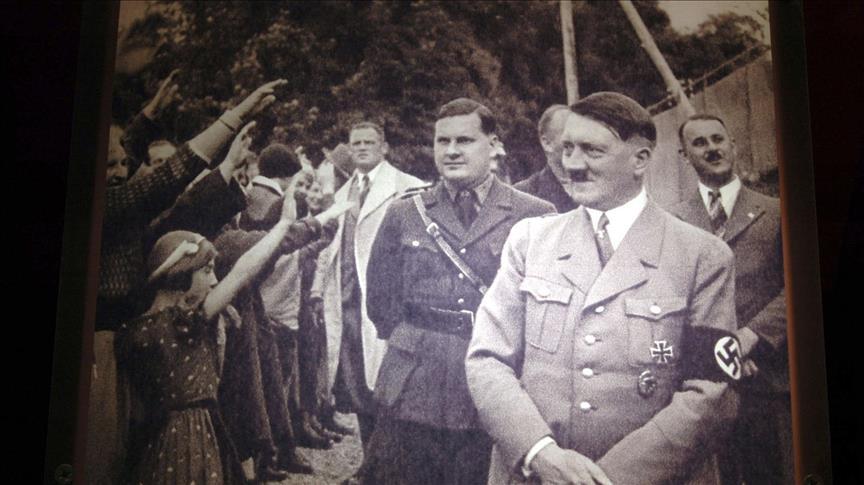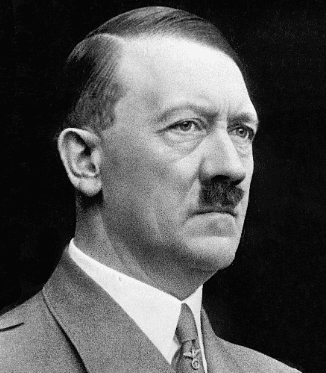

Date of Birth | 20 April 1889 | ||||||||
|---|---|---|---|---|---|---|---|---|---|
Place of Birth | Braunau am Inn, Austria-Hungary | ||||||||
Date of Death | 30 April 1945 | ||||||||
Place of Death | Berlin, Nazi Germany | ||||||||
Political Ideology | National Socialism (Nazism) | ||||||||
Party | National Socialist German Workers' Party (NSDAP) | ||||||||
Office | Chancellor of Germany (1933–1945) Head of State of Germany / Führer (1934–1945) | ||||||||
Military Service | Wars: World War I Rank: Lance Corporal (Gefreiter) German Imperial Army (1914–1918) | ||||||||
Notable Events | Holocaust Beer Hall Putsch (1923) Writing of Mein Kampf (1924) Establishment of the Nazi regime (after 1933) Outbreak of World War II (1939) | ||||||||
Adolf Hitler (1889–1945) was one of the most influential and controversial political figures of the 20th century. Appointed Chancellor of Germany in 1933, Hitler assumed the office of head of state the following year, establishing a dictatorial regime in Germany. As leader of the National Socialist German Workers Party (NSDAP), he played a central role in building a totalitarian state and developed policies that led the country into World War II. His regime, based on racist and antisemitic ideology, resulted in the deaths of millions and the implementation of the Holocaust, one of the largest mass extermination campaigns in human history.
As Germany suffered defeat in the final stages of the war, Hitler took his own life in 1945. His rise, the policies he implemented, and his legacy remain the focus of multifaceted historical and ethical debates.
Adolf Hitler was born on 20 April 1889 in the town of Braunau am Inn, within the borders of the Austro-Hungarian Empire. His father, Alois Hitler (1837–1903), worked as an Austrian customs official. His mother, Klara Pölzl (1860–1907), was a homemaker. The family belonged to the Catholic faith, but Hitler had limited interest in religious practices.
Hitler’s family had a complex structure. His father, Alois Hitler, was born out of wedlock and his surname changed several times before being officially registered as “Hitler.” Adolf had five siblings, but only his sister Paula Hitler survived into adulthood.
It is known that in the family structure, the father figure was authoritarian, strict, and disciplined, while the mother played a more affectionate and protective role. Hitler developed a strong emotional attachment to his mother and was deeply affected by her death. His childhood years were spent in Austrian towns such as Linz, Leonding, and Lambach.
Adolf Hitler’s youth was shaped by economic hardship, educational failures, and increasingly developed ideological tendencies. From childhood, Hitler showed interest in art and architecture, particularly aspiring to become a painter. In 1907 and 1908, he applied to the Vienna Academy of Fine Arts but was rejected on both occasions. These failures significantly influenced the course of his life.
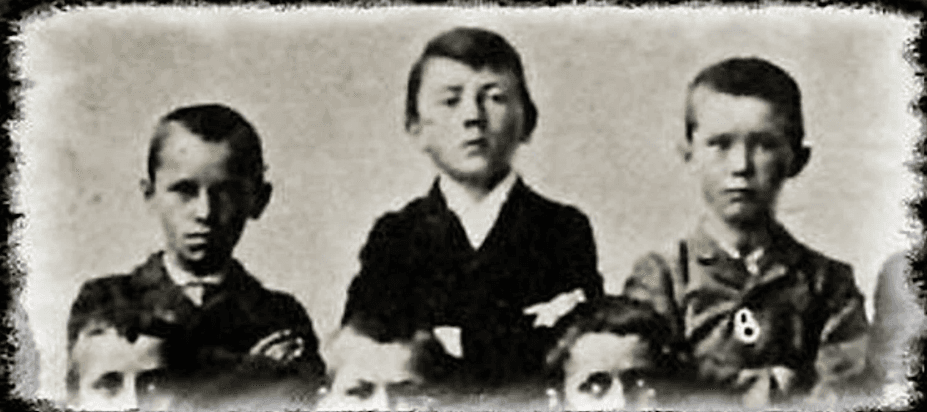
Adolf Hitler in a school photograph taken in the 1900s, standing in the center. (WorldHistory)
After his mother’s death in 1907, Hitler moved to Vienna, where he struggled to make a living through various jobs. His years in Vienna were formative for his political and ideological views. The city’s multiethnic character exposed him to rising antisemitic rhetoric, social Darwinism, German nationalism, and pan-German ideas. He was particularly influenced by antisemitic publications and political figures, and his anti-Jewish views became pronounced during this period.
Hitler also embraced views advocating the superiority of the German nation and developed a critical attitude toward the multiethnic structure of the Austro-Hungarian Empire. Although an Austrian citizen, he felt culturally aligned with Germany; this sense of belonging formed the foundation of his later political orientation.
When World War I broke out, Adolf Hitler volunteered to serve in the German army. Despite being an Austrian citizen, he was accepted into the Bavarian Army in 1914 and served on the Western Front. During the war, Hitler served in various theaters and played an active role in battles on French and Belgian territory.
Hitler served as a messenger, a role that was often dangerous as it involved carrying messages between the front lines and command. He was decorated several times for his service: awarded the Iron Cross Second Class in 1914 and the Iron Cross First Class in 1918. The Iron Cross First Class was a rare honor for a soldier of his rank.
In 1916, Hitler was wounded during the Battle of the Somme and temporarily removed from the front. In 1918, he temporarily lost his sight due to a British gas attack and received treatment in a hospital. While still in the hospital during the final days of the war, he learned of Germany’s surrender and the collapse of the imperial regime.
World War I left a profound impact on Hitler’s worldview. He interpreted the war’s outcome not as a military defeat but as a betrayal from within; this view later became a central theme in his political propaganda. Additionally, his wartime experience shaped his views on discipline, authority, and the concept of the nation.
After World War I, amid the collapse of the German Empire, the harsh terms of the Treaty of Versailles, and an economic crisis, Hitler turned to politics. In 1919, while assigned by the German Army to monitor political activities in Munich, he joined the German Workers’ Party (DAP). The party was a small movement aligned with right-wing and nationalist tendencies of the time. Hitler quickly gained attention and rose within the party due to his oratorical skills and talent for propaganda.
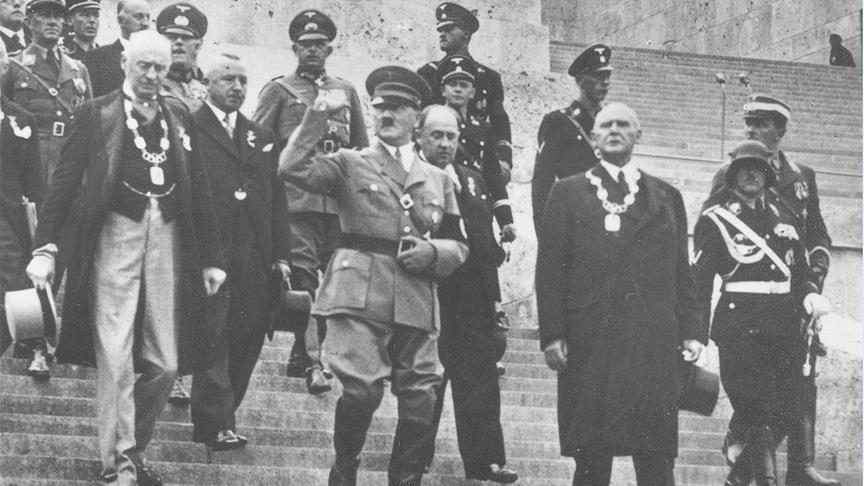
Adolf Hitler is shown descending stairs accompanied by Nazi uniformed officials and local authorities, saluting. (Anadolu Ajansı.)
In 1920, the party changed its name to the National Socialist German Workers Party (NSDAP). Its program was based on a nationalist and antisemitic ideology opposing the Treaty of Versailles, advocating the restoration of German power, and promoting the supremacy of the “Aryan race.” Hitler shaped the party’s core message during this period and became its primary ideological representative.
In 1921, Hitler was elected party leader and established absolute control over it. To strengthen the party’s organizational structure, he created a paramilitary formation called the Sturmabteilung (SA – Storm Troopers). The SA units engaged in activities to ensure security at party meetings and suppress opponents.
Mass propaganda was central to the NSDAP’s political activities. Through rallies, posters, and pamphlets, the party reached the masses; nationalist rhetoric, anti-Jewish sentiment, and social discontent were transformed into a political agenda. During this period, Hitler began developing the core ideas of his book Mein Kampf (My Struggle), which later formed the foundation of Nazi ideology.
In 1923, Adolf Hitler exploited the political and economic instability in Germany to attempt a coup to overthrow the government. This uprising, known as the “Beer Hall Putsch” (German: Hitlerputsch or München Putsch), began on 8 November 1923 in Munich. Hitler and his followers stormed a meeting attended by Bavarian state officials, forcing them to support the coup, then planned to march on Berlin to overthrow the central government.
However, the coup attempt failed the next day after police intervention. Several coup participants and police officers were killed in the ensuing clashes. Hitler was arrested and tried for “treason.” In 1924, he was sentenced to five years in prison but served only about nine months in Landsberg Prison. During this time, he wrote Mein Kampf (My Struggle), which later became the foundational text of Nazi ideology. The book outlines Hitler’s worldview, antisemitic beliefs, and political vision for Germany’s future.
After his release from prison, Hitler adopted a strategy of gaining power through legal means rather than through a coup. He reorganized the NSDAP’s structure and transformed it into an effective political movement across Germany.
In the late 1920s, the economic crisis, high inflation, and unemployment in Germany created fertile ground for increased mass support for the Nazi Party. The 1929 Great Depression significantly influenced the middle class and unemployed to turn toward Nazi ideology.
Hitler’s effective propaganda strategies, mass rallies, and the street dominance of paramilitary organizations like the SA (Sturmabteilung) enabled the NSDAP to grow rapidly. By 1932, the party had become one of the largest political movements in Germany. On 30 January 1933, President Paul von Hindenburg appointed Hitler Chancellor of Germany. Although this appointment occurred within a legal framework, it quickly paved the way for the neutralization of democratic institutions and the establishment of a totalitarian regime.
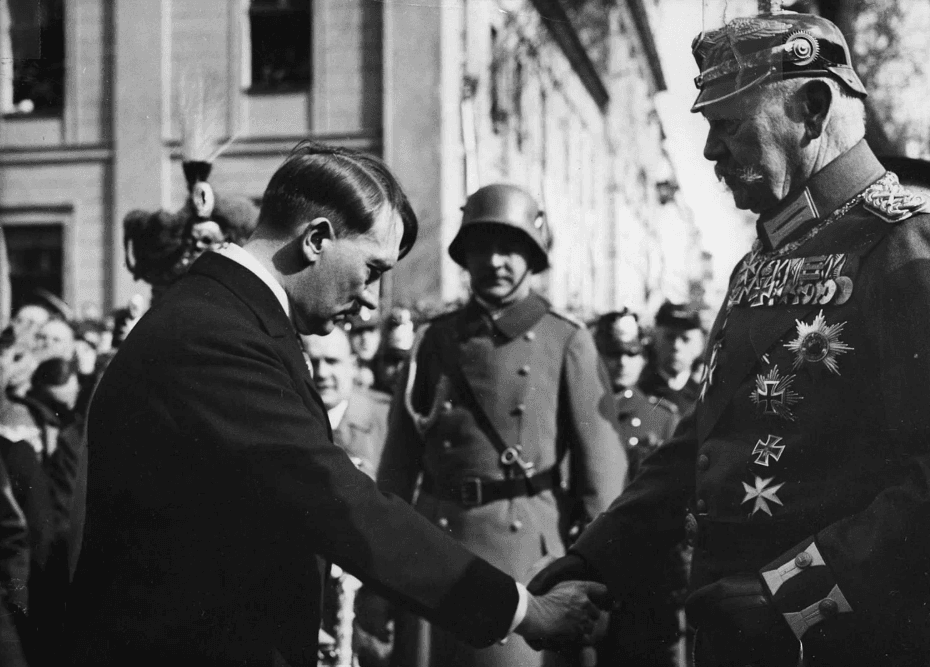
A March 1933 photograph of Adolf Hitler and German President Paul von Hindenburg. ( WorldHistory.)
Shortly after Hitler’s rise to power, the Reichstag (German Parliament) building was set on fire on 27 February 1933, creating a perception of a communist threat. In response, the Reichstag Fire Decree suspended fundamental rights and freedoms. Subsequently, the Enabling Act (Ermächtigungsgesetz), passed on 23 March 1933, transferred legislative powers to Hitler, granting him dictatorial authority.
After the death of President Hindenburg in 1934, Hitler merged the offices of Chancellor and President, assuming the title of Führer (Leader). Through control mechanisms over education, press, art, and civil society, the regime established comprehensive surveillance over the population.
During this period, under Hitler’s leadership, antisemitic laws were enacted, systematically restricting the social, economic, and legal rights of Jewish citizens. The Nazi regime implemented not only a political transformation but also an ideological, cultural, and social restructuring.
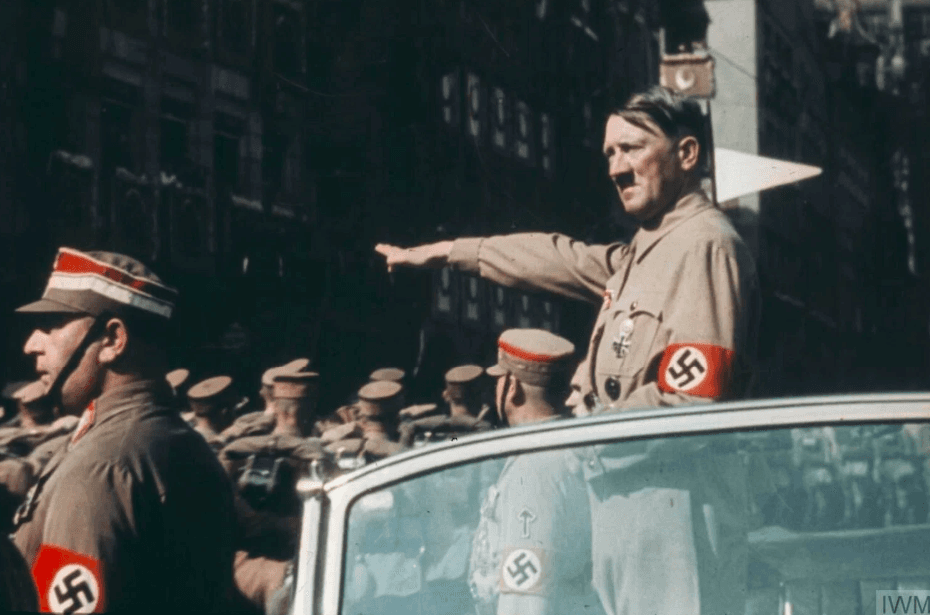
Adolf Hitler photographed in 1938 wearing the uniform of the Sturmabteilung (SA), the quasi-military wing of the German Nazi Party (NSDAP), in Nuremberg. (WorldHistory.)
One of the central components of Adolf Hitler’s political rhetoric was a racist ideology based on antisemitism. This thought structure took shape in the 1920s and became state policy after 1933. Nazi ideology viewed Jews not merely as a religious or ethnic community but as the source of Germany’s cultural, economic, and political problems. In his book Mein Kampf, Hitler defined Jews as a national threat and made this view the foundation of his systematic policies.
Shortly after coming to power in 1933, the Nazi regime began enacting discriminatory laws against Jews. In the initial phase, Jews working in public institutions were dismissed, their citizenship rights restricted, and various measures were introduced to exclude them from social life. The Nuremberg Laws, enacted in 1935, established the legal basis for these policies. Under these laws, Jews lost their German citizenship, the supremacy of the “Aryan race” was legally guaranteed, and marriages and sexual relations between Jews and Germans were prohibited.
The regime also pursued discriminatory and exclusionary policies against Roma, Slavs, Black people, the mentally or physically disabled, homosexuals, and regime opponents. Nazi ideology envisioned a biopolitical structure aimed at preserving the “racial purity” of society and initiated practices such as forced sterilization and euthanasia programs.
Media, cinema, the education system, and civil society organizations were intensively used to spread antisemitic propaganda. Materials portraying Jews as enemies were disseminated even in educational materials for children. The Kristallnacht (9–10 November 1938) marked one of the turning points where the regime’s antisemitic violence was organized on a mass scale. During this event, thousands of synagogues and Jewish businesses were destroyed, many people were arrested, and some were killed.
These policies merged with a systematic process of exclusion and targeting that laid the groundwork for the Holocaust. This race-based approach functioned as a fundamental component of the Nazi regime’s vision for reshaping society.
Adolf Hitler’s foreign policy was based on a revisionist approach aimed at reclaiming the territories Germany lost after World War I and reestablishing national power. From 1933, a systematic challenge to the restrictive provisions of the Treaty of Versailles began. Germany initiated a rearmament program; compulsory military service was reintroduced in 1935, and in 1936, the Rhineland was remilitarized and militarily occupied.
Driven by the idea of uniting German-speaking populations under a single “Greater Germany,” Hitler annexed Austria in 1938 (Anschluss), then demanded the Sudetenland region of Czechoslovakia and occupied the entire country in 1939. These developments did not provoke a strong response from Western powers, who followed a policy of appeasement (particularly Britain’s “appeasement policy”).
On 1 September 1939, Germany’s invasion of Poland triggered the start of World War II. This attack was carried out under the secret provisions of the Molotov-Ribbentrop Pact signed between Germany and the Soviet Union; according to the agreement, Poland was divided between the two countries. In response to Germany’s action, Britain and France declared war on Germany on 3 September 1939.
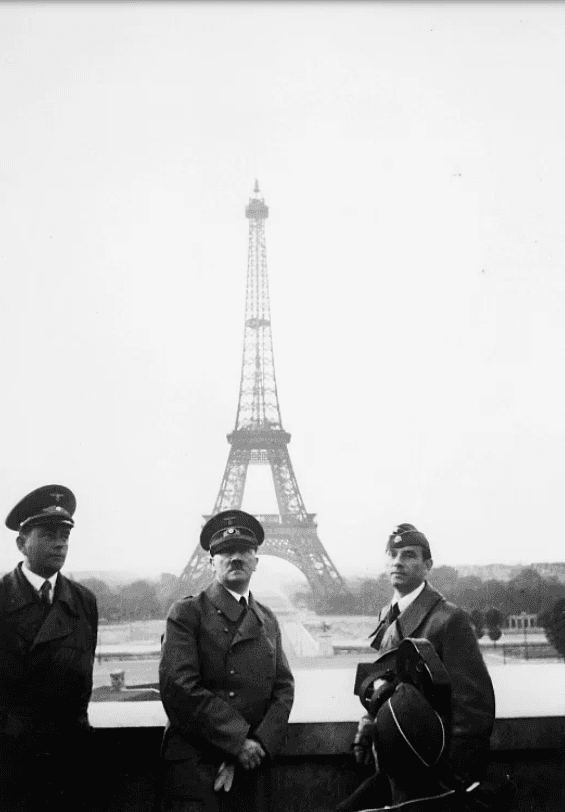
Adolf Hitler visited Paris on 23 June 1940 after the fall of France. In the photograph, architect Albert Speer is on his left and sculptor Arno Breker on his right. (WorldHistory.)
In the early stages of the war, Hitler achieved rapid and effective military successes using the “Lightning War” (Blitzkrieg) tactic. Denmark, Norway, the Netherlands, Belgium, Luxembourg, and France were quickly occupied. By 1940, Germany had established significant dominance over Western Europe, and the United Kingdom became the target of aerial bombardments. In 1941, Hitler launched Operation Barbarossa against the Soviet Union, adopting a two-front war strategy. In December of the same year, following Japan’s attack on Pearl Harbor, the United States entered the war, transforming the conflict into a global one.
Germany’s expansionist policies led to serious military and logistical problems in the later stages of the war; these developments initiated the process that would lead to Hitler’s strategic failures and the regime’s collapse.
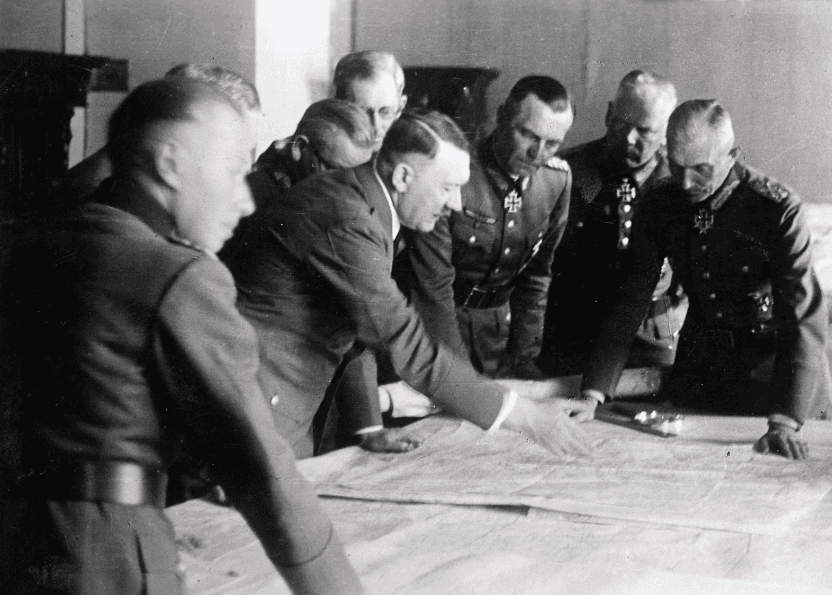
Adolf Hitler photographed with the General Staff at the Southern Army Group Headquarters in Poltava. (WorldHistory.)
Under Adolf Hitler’s leadership, the Nazi regime implemented its racist ideology not only through discriminatory laws but also through a systematic policy of extermination, culminating in the Holocaust during World War II. The Holocaust refers to the organized campaign of mass murder targeting Jews, Roma, the disabled, Slavic peoples, homosexuals, and political opponents.
The genocide process began after 1939 with the mass ghettoization of Jewish populations in territories occupied by Nazi Germany. These communities were subjected to harsh living conditions and deprived of basic necessities. By 1941, special units known as Einsatzgruppen operating in occupied Soviet territories began mass executions. These mobile death squads murdered tens of thousands of people by shooting them in villages and towns.
The central phase of the Holocaust began with the Wannsee Conference in 1942, where senior Nazi officials planned the “Final Solution” to the “Jewish Question.” A strategy was adopted to eliminate all Jews in Europe. During this period, extermination camps such as Auschwitz-Birkenau, Treblinka, Sobibor, Belzec, Chelmno, and Majdanek were constructed. Prisoners in these camps were systematically murdered in gas chambers; their bodies were burned or buried in mass graves.
Approximately six million Jews perished during the Holocaust, representing about two-thirds of Europe’s Jewish population at the time. Hundreds of thousands of Roma, mentally and physically disabled individuals, and those deemed opponents of the Nazi regime were also targeted using similar methods. The genocide encompassed not only physical annihilation but also the erasure of cultural, religious, and social identities.
The Holocaust has served as a defining example in modern historiography and international law for defining the concept of genocide; it directly influenced the United Nations’ 1948 Convention on the Prevention and Punishment of the Crime of Genocide.
Nazi Germany, which achieved rapid successes in the early years of World War II, began facing military and strategic difficulties from 1942 onward. Hitler’s 1941 invasion of the Soviet Union, Operation Barbarossa, became one of the most decisive turning points of the war. Although initial advances were made, by 1942 German forces began retreating under the resistance of the Red Army.
The Battle of Stalingrad (1942–1943) ended in a major defeat for Germany. This battle marked the point where German advances on the Eastern Front halted and retreat began. The subsequent Battle of Kursk is recorded as Nazi Germany’s final major offensive on the Eastern Front. Meanwhile, Allied forces achieved success in North Africa and invaded Italy in 1943.
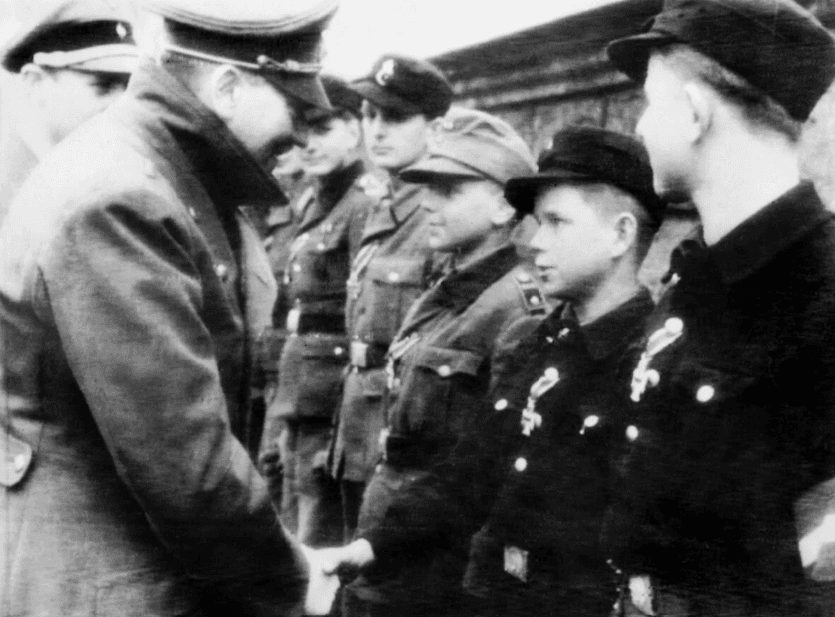
Adolf Hitler presents medals to members of the Hitler Youth, including Alfred Czech, in 1945. (WorldHistory.)
In 1944, the Allied D-Day invasion of Normandy began the occupation of France on the Western Front; Germany, now fighting a multi-front war, suffered severe military and logistical losses. While Allied forces advanced from the west, Soviet troops moved toward Berlin from the east, rapidly encircling German territory.
In the final phase of the war, Hitler remained in the Führerbunker in Berlin. During this period, his psychological condition deteriorated, and he displayed increasing distrust toward his inner circle and commanders. In April 1945, Soviet forces reached Berlin and placed the city under siege. Hitler remained in the bunker with his close associates and refused to accept the war’s end.
Adolf Hitler committed suicide in the Führerbunker in Berlin on 30 April 1945. As the Soviet Red Army entered Berlin, Hitler, who was in the bunker with Eva Braun, took his own life by his own choice. Hitler had married Eva Braun the day before his death and then killed himself by ingesting cyanide and then shooting himself. Eva Braun died solely by cyanide poisoning.
After Hitler’s death, his body and that of Eva Braun were burned with gasoline on the orders of his close associates. The remains recovered by Soviet forces were kept secret from the public for many years; identification was confirmed in the 1950s through documents and testimonies. Forensic investigations conducted in 2018 also confirmed Hitler’s date and cause of death.
With Hitler’s death, the Nazi regime effectively ended; on 7 May 1945, Germany surrendered unconditionally to the Allied Powers. This event marked the end of World War II in Europe and was proclaimed as V-E Day (Victory in Europe Day).
After the war, Nazi officials and collaborators were tried at the International Military Tribunal in Nuremberg. As a result, numerous high-ranking officials were convicted of war crimes, crimes against humanity, and genocide. Although Hitler’s death spared him from this judicial process, his responsibility has been thoroughly documented through historical records and testimonies.
Adolf Hitler’s legacy has left deep imprints on the political, legal, and social memory of the 20th century. Due to his totalitarian regime, the global war he provoked, and the Holocaust, his name is commonly associated in the modern world with destruction, violence, and dictatorship.
After the war, the crimes of the Nazi regime were adjudicated in international courts; in this process, the concepts of “genocide” and “crimes against humanity” became permanently embedded in international law. The Nuremberg Trials documented the responsibility of Hitler’s political and bureaucratic structure and marked a turning point in modern criminal law.
Historical reckoning processes regarding the Nazi era were initiated in Germany and other countries; museums, commemorative events, and educational programs aim to preserve collective memory. Hitler’s legacy is viewed as a historical warning against contemporary far right and authoritarian tendencies and is regarded as an example underscoring the importance of democratic institutions, human rights, and the rule of law.
Anadolu Ajansı. "Adolf Hitler’in Yahudi Bir Kız Çocuğuyla Çekilmiş Fotoğrafı Açık Artırmada." Accessed April 28, 2026.
Anadolu Ajansı. "Hitler'in Ölüm Tarihi ve Nedeni Doğrulandı." Anadolu Ajansı, May 16, 2018. Accessed April 19, 2025.https://www.aa.com.tr/tr/dunya/hitlerin-olum-tarihi-ve-nedeni-dogrulandi/1152288
Atatürk Ansiklopedisi. "Adolf Hitler (1889–1945)." Atatürk Kültür, Dil ve Tarih Yüksek Kurumu. Accessed April 19, 2025.https://ataturkansiklopedisi.gov.tr/bilgi/adolf-hitler-1889-1945/
The National WWII Museum. "How Did Adolf Hitler Happen?" The National WWII Museum. Accessed April 19, 2025.https://www.nationalww2museum.org/war/articles/how-did-adolf-hitler-happen
United States Holocaust Memorial Museum. "Adolf Hitler." Holocaust Encyclopedia. Accessed April 19, 2025.https://encyclopedia.ushmm.org/content/tr/article/adolf-hitler
United States Holocaust Memorial Museum. "Adolf Hitler: Önemli Tarihler." Holocaust Encyclopedia. Accessed April 19, 2025.https://encyclopedia.ushmm.org/content/tr/article/adolf-hitler-key-dates
World History Encyclopedia. "Adolf Hitler." World History Encyclopedia (Turkish Translation). Accessed April 19, 2025.https://www.worldhistory.org/trans/tr/1-19717/adolf-hitler/

Date of Birth | 20 April 1889 | ||||||||
|---|---|---|---|---|---|---|---|---|---|
Place of Birth | Braunau am Inn, Austria-Hungary | ||||||||
Date of Death | 30 April 1945 | ||||||||
Place of Death | Berlin, Nazi Germany | ||||||||
Political Ideology | National Socialism (Nazism) | ||||||||
Party | National Socialist German Workers' Party (NSDAP) | ||||||||
Office | Chancellor of Germany (1933–1945) Head of State of Germany / Führer (1934–1945) | ||||||||
Military Service | Wars: World War I Rank: Lance Corporal (Gefreiter) German Imperial Army (1914–1918) | ||||||||
Notable Events | Holocaust Beer Hall Putsch (1923) Writing of Mein Kampf (1924) Establishment of the Nazi regime (after 1933) Outbreak of World War II (1939) | ||||||||
Birth and Family
Youth and Early Influences
World War I and Military Experience
Entry into Politics and the Founding of the Nazi Party
The 1923 Coup Attempt and Trial
Rise to Power and the One-Party Era in Germany
Antisemitism and Racist Policies
Outbreak of World War II
The Holocaust and the Genocide Process
Final Years of the War and the Collapse
Death and Aftermath
Legacy