This article was automatically translated from the original Turkish version.
Yes, the title may seem provocative or even strange at first glance. But this statement is a summary of a European reflex that stretches not only to the late periods of the Ottoman Empire but all the way back to its early conquest years. The Ottoman Empire, while still just one of the beyliks in Anatolia, generated profound anxiety in Europe’s political and religious structure as soon as it crossed into the Balkans. This anxiety led over subsequent centuries to a series of crusade-like military interventions, the formation of alliances, and efforts to unite against the threat from the East.
The Ottoman advance into the Balkans was not solely driven by conquest; it was also a strategic means of defending Anatolia. Geographically, the Balkans served as a natural barrier separating and protecting Anatolia from Europe. For this reason, even though the Ottoman state did not pursue direct Islamization policies in buffer regions such as Wallachia, Moldavia and Poland, it consistently sought to maintain its political influence. These states were strategically important both as military resources and as sources of agricultural and financial contributions.
Although the Ottoman Empire’s history lasted nearly 600 years, this period can be evenly divided into two phases:
Maintaining such a long period of steady expansion was a rare achievement in world history. Unlike empires such as the Mongols, which were vast but short-lived, the Ottoman Empire systematically built a durable institutional structure, reinforced its foundations, and endured its decline for nearly as long as its period of ascent.
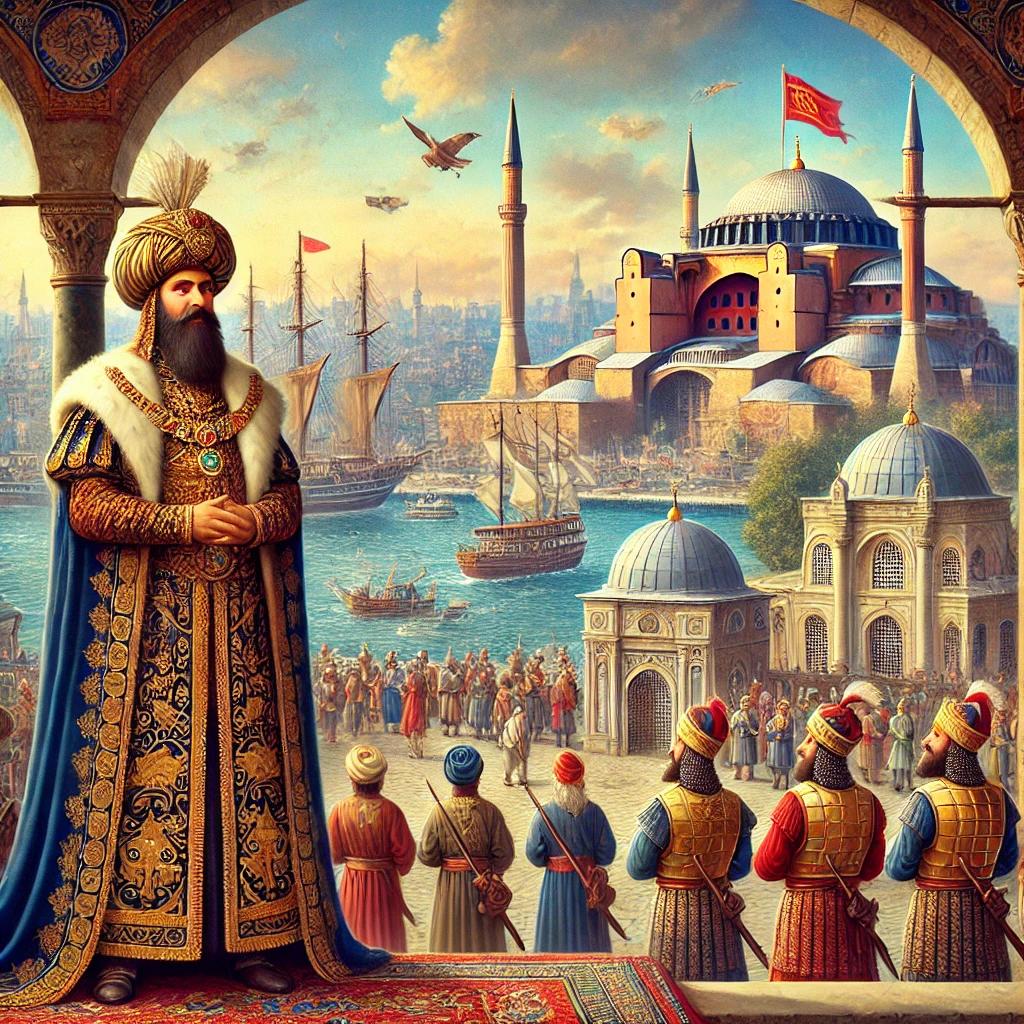
An image symbolizing the Ottoman Empire (generated by artificial intelligence)
The Second Siege of Vienna in 1683 marked a true breaking point for the Ottoman Empire. This siege, carried out during the reign of Mehmed IV, was the empire’s final major offensive toward the West. However, its failure represented the empire’s last major external setback. From that point onward, the Ottoman Empire became increasingly vulnerable to territorial losses and struggled to shift the balance of power in its favor.
If the Ottoman decline began in the 17th century, its first 200 years progressed relatively slowly. Particularly throughout the 18th century, the Ottoman Empire maintained its existence without major collapses, undertaking numerous reform attempts in various fields. However, beginning in the 19th century, especially after 1800, territorial losses accelerated dramatically, and the process of disintegration became visibly apparent.
The Ottoman collapse was not merely a matter of military or political weakness. It also stemmed from an inability to keep pace with the technological and scientific transformations occurring in the world. In the face of Europe’s major shifts—geographical discoveries, the Reformation, the Renaissance, and ultimately the Industrial Revolution—the Ottoman Empire remained for a long time in a defensive posture.
Yet, one aspect of this transformation can also be seen as shaped by Ottoman pressure. The 16th century, when Europe was geographically encircled by the Ottoman crescent—in North Africa and the Balkans—was the era when the West began seeking new routes, new ideas, and new sources of power. This encirclement contributed to the emergence of extraordinary innovations in Europe.
Today’s Muslim world also periodically experiences material and spiritual constraints. But as in history, such periods can serve as thresholds of transformation, renewal, and recovery. The Ottoman system’s endurance for centuries rested not only on military strength but also on social, cultural, and religious foundations.
One of the most important lessons from history is this:
Every rise has its test; every fall has its spark.
Destroying the Ottoman Empire was a project, but this project was the result not only of external powers but also of internal decay over time. Nevertheless, the empire’s vision at its founding, its order during expansion, and its resistance during collapse continue to be cited as examples in political and social analysis today.
Perhaps the greatest need for today’s Muslim societies to recover is to once again anchor themselves in those resilient foundations inherited from history.
Şimşirgil, Ahmet. Kayı IX: Osmanlı Tarihi – Sonun Başlangıcı. İstanbul: Timaş Yayınları, 2020.
Şimşirgil, Ahmet. Kayı VI: Osmanlı Tarihi – İmparatorluğun Zirvesi ve Dönüş. İstanbul: Timaş Yayınları, 2015
The Balkans: A Shield for Anatolia?
300 Years of Rise – 300 Years of Decline
The Second Siege of Vienna: A Turning Point
The Rhythm of Decline: Slow and Resilient
Technology and Change
Does History Repeat Itself?