


This article was automatically translated from the original Turkish version.
+1 More
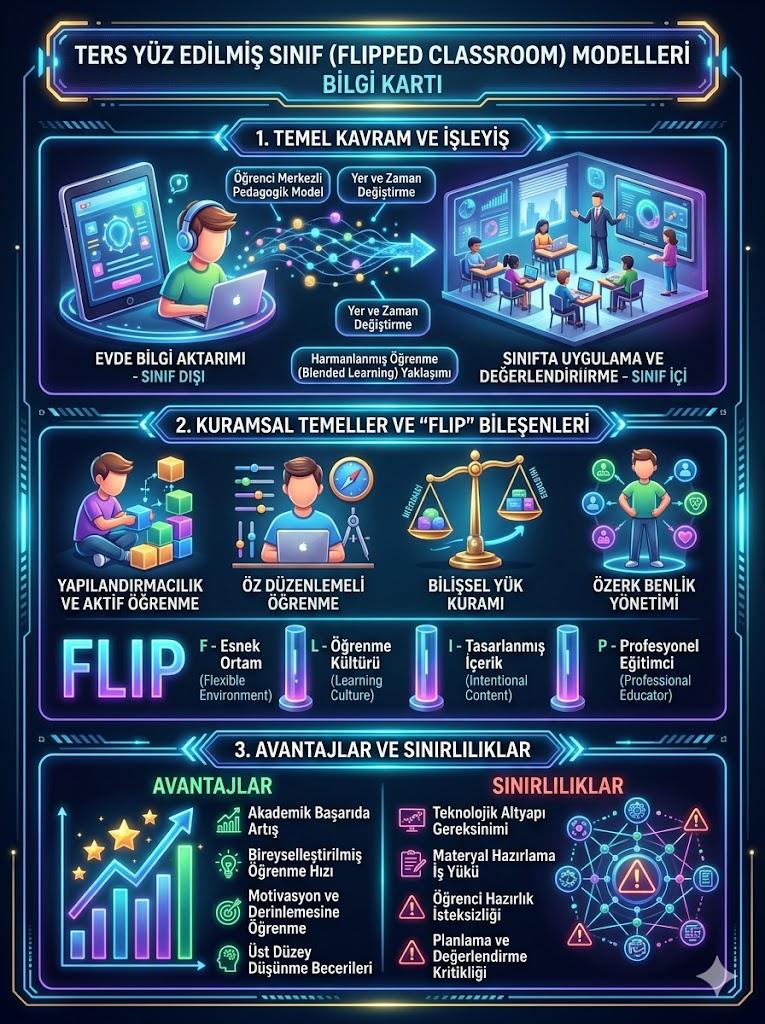
(Generated with Artificial Intelligence.)
Flipped Classroom Model
Conceptual Essence and Definition | Title: Blended Learning Approach Core Logic: Lectures at home, practice/application at school Out-of-Class Focus: Transfer of foundational knowledge through technological materials In-Class Focus: Discussion, problem-solving, higher-order cognitive activities Synonyms: Flipped classrooms, inverted learning | ||||||||
|---|---|---|---|---|---|---|---|---|---|
Model Type | Blended learning approach. | ||||||||
Model Type | Blended learning | ||||||||
Basic Logic | Transfer of theoretical knowledge out of class, active application and discussion in class. | ||||||||
Basic Logic | Theory out of class, practice in class | ||||||||
Other Names | Flipped classrooms, inverted learning, lectures at home, homework at school. | ||||||||
Other Names | Flipped learning | ||||||||
Theoretical Origin (1990s) | Eric Mazur - Peer instruction method. | ||||||||
Theoretical Origin | Eric Mazur (Peer instruction) | ||||||||
Term Founders (2000) | J. Wesley Baker 'classroom flip' and Miami University economics professors 'inverted classroom'. | ||||||||
Term Founders | J. Wesley Baker and professors at Miami University | ||||||||
Modern Practitioners (2007) | Jonathan Bergmann and Aaron Sams (pioneers who moved lectures outside the classroom). | ||||||||
Modern Practitioners | Jonathan Bergmann and Aaron Sams | ||||||||
FLIP Columns | Flexible Environment (Flexible Environment), Learning Culture (Learning Culture), Intentional Content (Intentional Content), Professional Educator (Professional Educator). | ||||||||
FLIP Columns | Flexible Environment, Learning Culture, Intentional Content, Professional Educator | ||||||||
Theoretical Foundations | Constructivism, active learning, self-regulated learning, cognitive load theory, autonomous self-management theory. | ||||||||
Theoretical Foundations | Constructivism, active/self-regulated learning, cognitive load, autonomous self | ||||||||
Difference from Traditional Model | Memorization and understanding out of class; application and analysis under teacher guidance in class. | ||||||||
Difference from Traditional Model | Understanding out of class, application in class | ||||||||
Contribution to the Student | Individual learning pace, high motivation, academic achievement, advanced higher-order thinking skills | ||||||||
Contribution to the Student | Individual pace, high motivation, 21st century skills | ||||||||
Application Limitations | Technological infrastructure dependency, high material preparation burden on teachers, student reluctance to prepare before class | ||||||||
Application Limitations | Infrastructure dependency, teacher workload, student unpreparedness | ||||||||
The flipped classroom model is a student-centered pedagogical approach in which the traditional sequence of in-class instruction and out-of-class homework and practice is reversed in terms of time and place.【1】In this model, basic knowledge transmission is conducted outside the classroom through various technological materials and digital tools, while in-class time is dedicated to developing higher-order cognitive skills such as discussion, problem solving, analysis, and application. In the literature, this approach is also referred to as transformed classrooms, inverted learning, lessons at home homework at school, and reversed learning, and is regarded as a type of blended learning model. The primary aim of the model is to enhance the quality of face-to-face instruction in the classroom by moving the knowledge delivery component outside of it and reinforcing the student’s active role in the learning process.
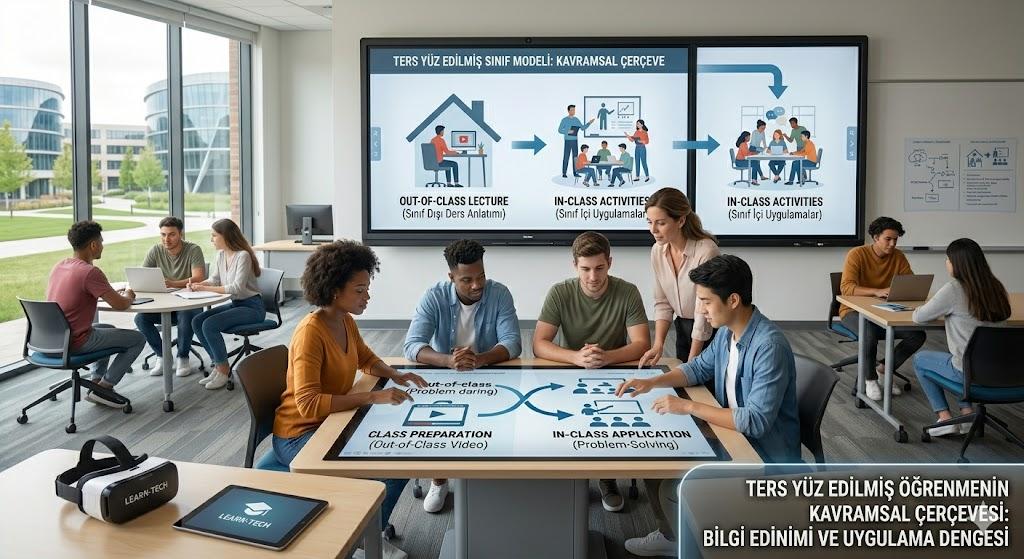
Tanım ve Kavramsal Çerçeveye Ait Görsel (Yapay Zekâ ile Oluşturulmuştur.)
The theoretical and practical foundations of the model extend back to early 1990s research.【2】The peer instruction method developed by Eric Mazur is considered one of the earliest examples, as it required students to read course material at home and use class time to reinforce this knowledge. In 2000, J. Wesley Baker used the term “classroom flip,” while economics professors at Miami University described a similar approach as the “inverted classroom.”【3】The modern popularity and widespread adoption of the model gained momentum in 2007 when chemistry teachers Jonathan Bergmann and Aaron Sams from Woodland Park High School created and shared video lessons with their students.【4】Over time, the focus shifted from the logistical concept of the classroom to the pedagogical concept of learning.
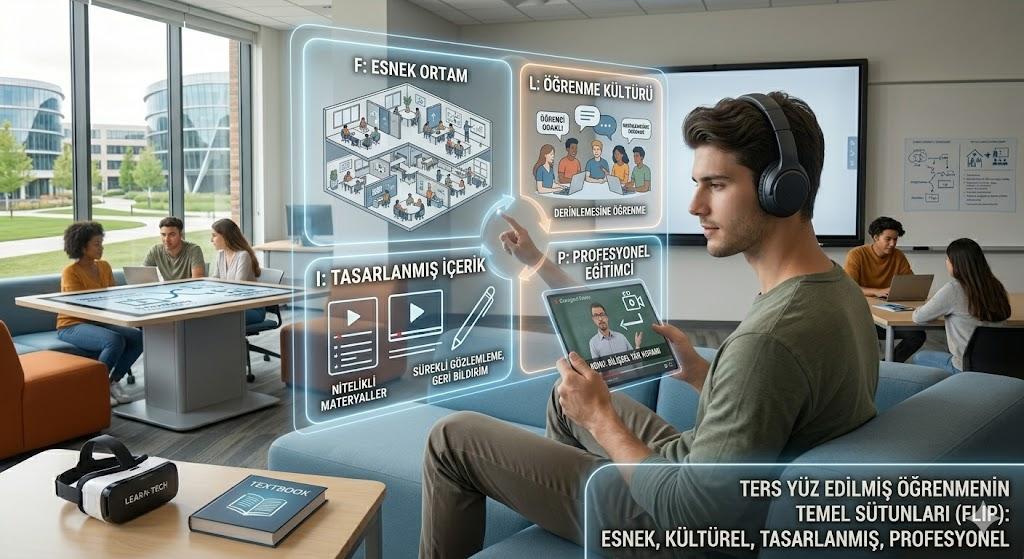
Modelin Temel Bileşenlerine Ait Görsel (Yapay Zekâ ile Oluşturulmuştur.)
Effective implementation of the flipped learning model depends on four key characteristics represented by the acronym FLIP:
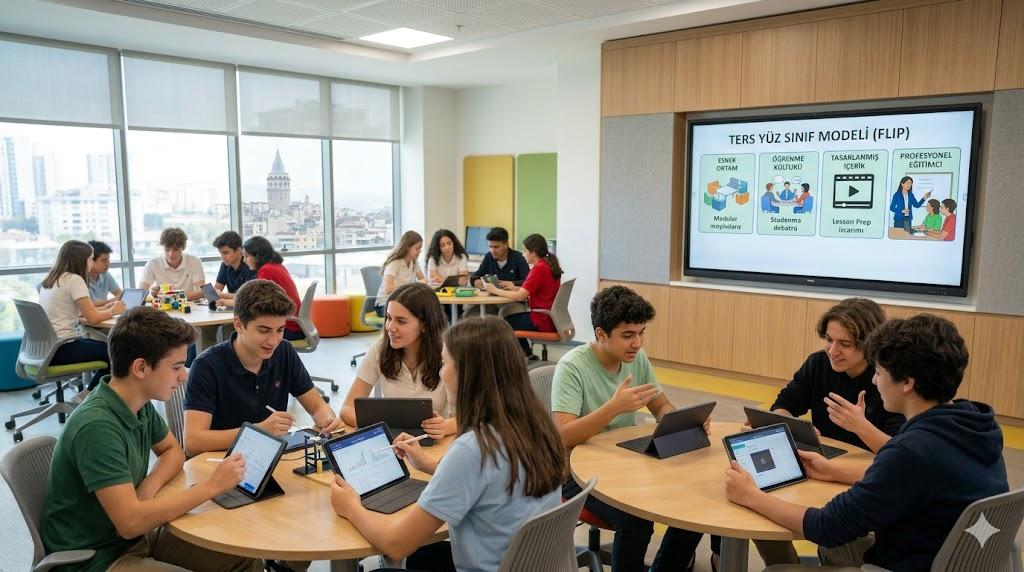
Ters Yüz Edilmiş Sınıf Modeline Ait Görsel (Yapay Zekâ ile Oluşturulmuştur.)
Flipped classroom models are built upon strong theoretical foundations in educational and cognitive psychology. Constructivist learning and active learning aim to have students actively construct knowledge in their minds and engage cognitively in the learning process; these are grounded in Piaget’s cognitive constructivism for individual learning and in Vygotsky’s and Bandura’s social constructivism for group interactions.【5】Cognitive load theory suggests that students can reduce the burden on working memory and enhance the transfer of knowledge to long-term memory by being able to pause and replay video lectures at their own pace. Self-determination theory seeks to increase intrinsic motivation by fulfilling students’ needs for autonomy, competence, and social connection. Additionally, self-regulated learning skills, in which students take responsibility for their own learning process, form the foundation of individual work in this model.
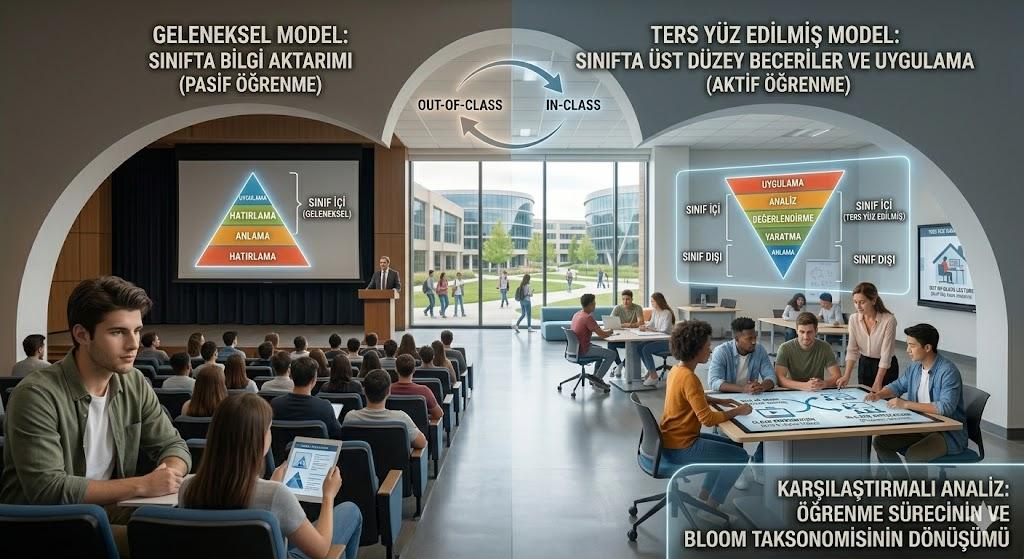
Geleneksel Model ile Karşılaştırmalı Analize Ait Görsel (Yapay Zekâ ile Oluşturulmuştur.)
In the traditional education model, lower-order cognitive processes such as remembering and understanding occur in the classroom, while higher-order processes like application, analysis, and evaluation are typically assigned as homework outside the classroom, often without teacher guidance. In the flipped classroom model, this sequence is reversed: lower-order cognitive processes are completed individually outside the classroom, while higher-order cognitive processes are carried out in the classroom with teacher guidance and group interaction. This structure increases the time teachers can spend individually with students, enabling greater personalization of instruction.
The model is applied across a wide range of fields, from financial education to medical education, and from engineering to the social sciences. Research has shown that the flipped classroom model improves academic achievement, positively influences student motivation and attitudes toward learning, and enhances 21st-century skills such as problem solving and critical thinking.【6】The ability of students to follow materials at their own pace also positively affects their time management skills. However, several limitations exist in implementing the model: lack of technological infrastructure and internet access, student reluctance to complete preparatory work before class, and the heavy workload for teachers in creating instructional materials are identified as key disadvantages. The success of the model is directly linked to meticulous planning aligned with its theoretical framework, the production of high-quality digital content, and the use of process-oriented assessment methods.
Ağırman, Ensar, and Christopher Trinh. "The Flipped Learning Approach in Undergraduate Finance Education: A Literature Review." Atatürk Üniversitesi İktisadi ve İdari Bilimler Dergisi 33, no. 4 (2019): 1367-1381. Accessed June 15, 2026.
Güçlü Bilgiç, Yeşim. "Kitap İnceleme: Ters Yüz Edilmiş Sınıf ve Öğrenme." International Journal of Computers in Education 5, no. 1 (2022): 71-73, Accessed June 15, 2026.
Hayırsever, Fahriye, and Ali Orhan. "Ters Yüz Edilmiş Öğrenme Modelinin Kuramsal Analizi." Mersin Üniversitesi Eğitim Fakültesi Dergisi 14, no. 2 (2018): 572-596. Accessed June 15, 2026.
Sarıgöz, Okan. "An Analytical Study Related Learning with Flipped Classroom Model." Mustafa Kemal Üniversitesi Sosyal Bilimler Enstitüsü Dergisi 13, no. 36 (2016): 1-11, Accessed June 15, 2026.https://dergipark.org.tr/tr/pub/mkusbed/article/305616?issue_id=30676
[1]
Fahriye Hayırsever ve Ali Orhan, "Ters Yüz Edilmiş Öğrenme Modelinin Kuramsal Analizi," Mersin Üniversitesi Eğitim Fakültesi Dergisi 14, no. 2 (2018): 572, https://dergipark.org.tr/en/pub/mersinefd/article/431745
[2]
Hayırsever ve Orhan, "Ters Yüz Edilmiş Öğrenme," 577.
[3]
Okan Sarıgöz, "An Analytical Study Related Learning with Flipped Classroom Model," Mustafa Kemal Üniversitesi Sosyal Bilimler Enstitüsü Dergisi 13, no. 36 (2016): 2, https://dergipark.org.tr/tr/pub/mkusbed/article/305616?issue_id=30676
[4]
Sarıgöz, "An Analytical Study," 2.
[5]
Hayırsever ve Orhan, "Ters Yüz Edilmiş Öğrenme," 583.
[6]
Hayırsever ve Orhan, "Ters Yüz Edilmiş Öğrenme," 572.

(Generated with Artificial Intelligence.)
Flipped Classroom Model
Conceptual Essence and Definition | Title: Blended Learning Approach Core Logic: Lectures at home, practice/application at school Out-of-Class Focus: Transfer of foundational knowledge through technological materials In-Class Focus: Discussion, problem-solving, higher-order cognitive activities Synonyms: Flipped classrooms, inverted learning | ||||||||
|---|---|---|---|---|---|---|---|---|---|
Model Type | Blended learning approach. | ||||||||
Model Type | Blended learning | ||||||||
Basic Logic | Transfer of theoretical knowledge out of class, active application and discussion in class. | ||||||||
Basic Logic | Theory out of class, practice in class | ||||||||
Other Names | Flipped classrooms, inverted learning, lectures at home, homework at school. | ||||||||
Other Names | Flipped learning | ||||||||
Theoretical Origin (1990s) | Eric Mazur - Peer instruction method. | ||||||||
Theoretical Origin | Eric Mazur (Peer instruction) | ||||||||
Term Founders (2000) | J. Wesley Baker 'classroom flip' and Miami University economics professors 'inverted classroom'. | ||||||||
Term Founders | J. Wesley Baker and professors at Miami University | ||||||||
Modern Practitioners (2007) | Jonathan Bergmann and Aaron Sams (pioneers who moved lectures outside the classroom). | ||||||||
Modern Practitioners | Jonathan Bergmann and Aaron Sams | ||||||||
FLIP Columns | Flexible Environment (Flexible Environment), Learning Culture (Learning Culture), Intentional Content (Intentional Content), Professional Educator (Professional Educator). | ||||||||
FLIP Columns | Flexible Environment, Learning Culture, Intentional Content, Professional Educator | ||||||||
Theoretical Foundations | Constructivism, active learning, self-regulated learning, cognitive load theory, autonomous self-management theory. | ||||||||
Theoretical Foundations | Constructivism, active/self-regulated learning, cognitive load, autonomous self | ||||||||
Difference from Traditional Model | Memorization and understanding out of class; application and analysis under teacher guidance in class. | ||||||||
Difference from Traditional Model | Understanding out of class, application in class | ||||||||
Contribution to the Student | Individual learning pace, high motivation, academic achievement, advanced higher-order thinking skills | ||||||||
Contribution to the Student | Individual pace, high motivation, 21st century skills | ||||||||
Application Limitations | Technological infrastructure dependency, high material preparation burden on teachers, student reluctance to prepare before class | ||||||||
Application Limitations | Infrastructure dependency, teacher workload, student unpreparedness | ||||||||
No Discussion Added Yet
Start discussion for "Flipped Classroom Model" article
Historical Development
Core Components of the Model (FLIP Columns)
Theoretical Foundations and Learning Approaches
Comparative Analysis with the Traditional Model
Application Areas, Advantages, and Limitations