


This article was automatically translated from the original Turkish version.

In the historiography of science, Eurocentric narratives for a long historical period have evaluated scientific development as a linear and progressive trajectory extending from Ancient Greece to the European Renaissance. This approach confined the production of scientific knowledge to specific geographic and cultural centers, often positioning the Islamic scientific tradition as merely an intermediate stage responsible for transmitting ancient knowledge.【1】
Within this historical framework, the medieval Islamic world has been interpreted not as a site of original scientific production but as a transitional phase that preserved and transmitted earlier knowledge to Europe. Such an interpretation reflects a narrow methodological perspective that views the history of science solely through a Eurocentric continuum.
Yet historical evidence reveals that the medieval Islamic world functioned not only as a preserver of the ancient intellectual heritage but also as a dynamic intellectual center where original theories were developed and new scientific approaches were generated.【2】
This transformation demonstrates that the history of science is not merely a chronological progression but also a cultural and epistemological process of construction. In this context, the phrase “lost link” refers not to a historical deficiency but to scientific contributions rendered invisible by specific historiographical traditions.
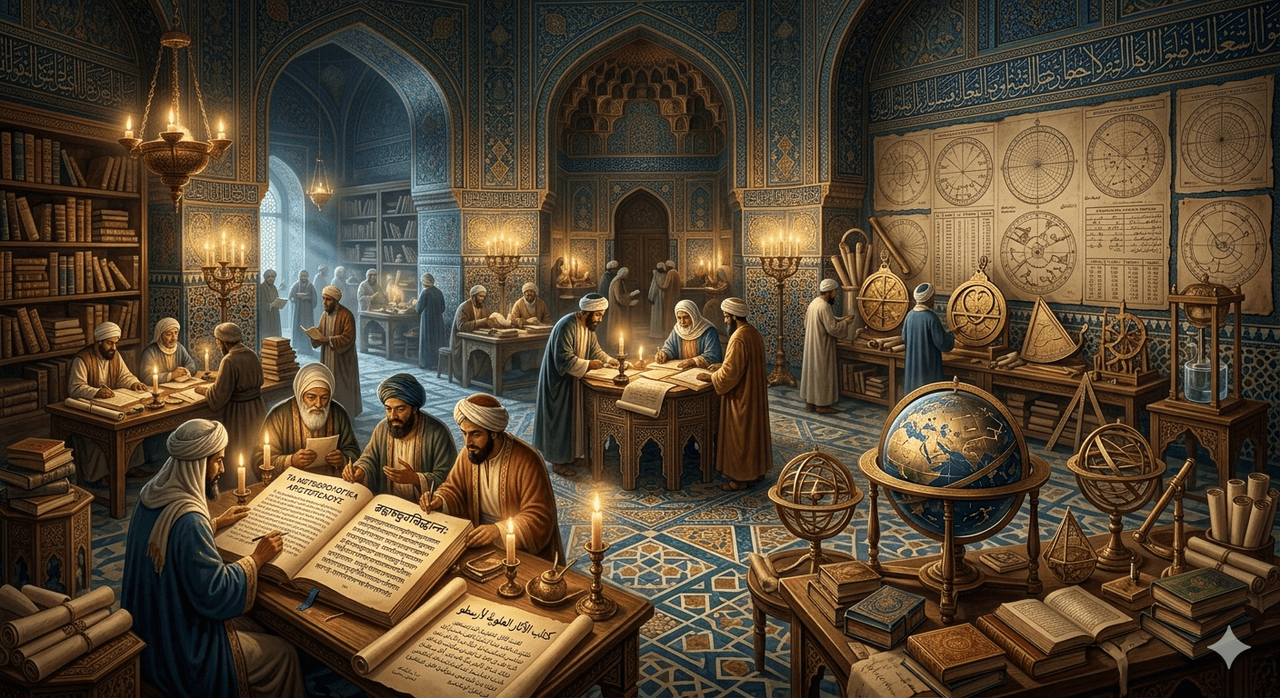
Depiction of Bayt al-Hikma (Generated by AI)
The institutional foundations of the Islamic scientific tradition gained strength through translation and research activities, especially during the Abbasid period in Baghdad. Thanks to scholarly work centered on Bayt al-Hikma, the scientific legacies of Ancient Greece, India, and Iran were translated into Arabic. Simultaneously, new research was conducted in mathematics, astronomy, medicine, and geography. With the contributions of figures such as Hunayn ibn Ishaq, Thabit ibn Qurra, and Qusta ibn Luqa, translation activities evolved into a research environment synthesizing diverse scientific traditions. Thus, Bayt al-Hikma became not merely a translation center but an institution where new theories were generated and scientific knowledge was systematically developed. This process laid the foundation for the original scientific achievements that the Islamic world would later produce in astronomy, mathematics, medicine, and optics.【3】

Translation Movements (Generated by AI)
Within this framework, the dominant literary portrayal of the “transmission phase” proves inadequate in capturing the nature of scientific activities at Bayt al-Hikma; available evidence demonstrates that this institution was not merely a center for copying texts but a dynamic intellectual environment where knowledge was re-produced and transformed.
One area where this debate has become concrete is Islamic astronomy. Structural similarities between planetary models developed by the 14th-century Syrian astronomer Ibn al-Shatir (1304–1375) and Copernicus’s heliocentric system of 1543 have generated significant debate in the history of science literature. These similarities indicate that the evolution of astronomical models cannot be confined to an exclusively European process but must be understood within a broader network of scientific interaction.
Otto Neugebauer (1903–1990), while studying Copernican astronomy, encountered Ibn al-Shatir’s mathematical models, which prompted new questions regarding the technical structure of Islamic astronomy. Subsequently, Edward S. Kennedy (1912–2009) conducted detailed analyses of Islamic astronomers’ planetary models and numerous astronomical tables (zīj). These studies more clearly revealed the structural parallels between Ibn al-Shatir’s models and the Copernican system. Research has shown that transformations in astronomical models cannot be explained solely by developments within Europe and must also account for the circulation of knowledge across different geographical regions.【4】 This has contributed to a renewed reading of the history of science based on intercultural interaction.
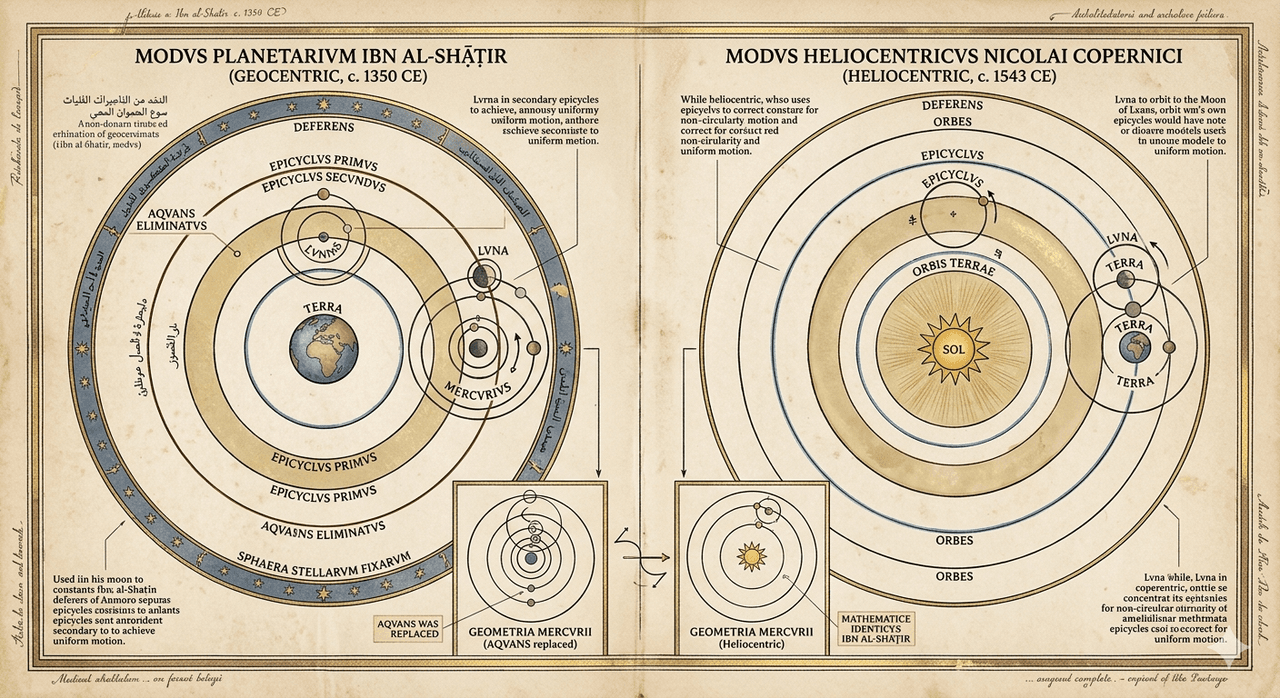
Ibn al-Shatir (1304–1375) (Generated by AI)
The similarities between Ibn al-Shatir and Copernicus demonstrate that the influence of the Islamic scientific tradition on Europe was not limited to isolated examples. As Fuat Sezgin has noted, the transmission of scientific knowledge to Europe was not confined to Andalusia and Latin translation movements; multifaceted networks of contact through Byzantium, Iran, and the Eastern Mediterranean also played a crucial role. In particular, theories and techniques developed in astronomy, trigonometry, and scientific instruments circulated across regions and influenced European scientific developments. Nasir al-Din al-Tusi’s trigonometric work, astronomical models developed around the Maragha Observatory, and Ibn al-Shatir’s planetary theories demonstrate that scientific knowledge produced in the Islamic world moved within a broad network of interaction and contributed to the formation of pre-Renaissance European scientific heritage.【5】
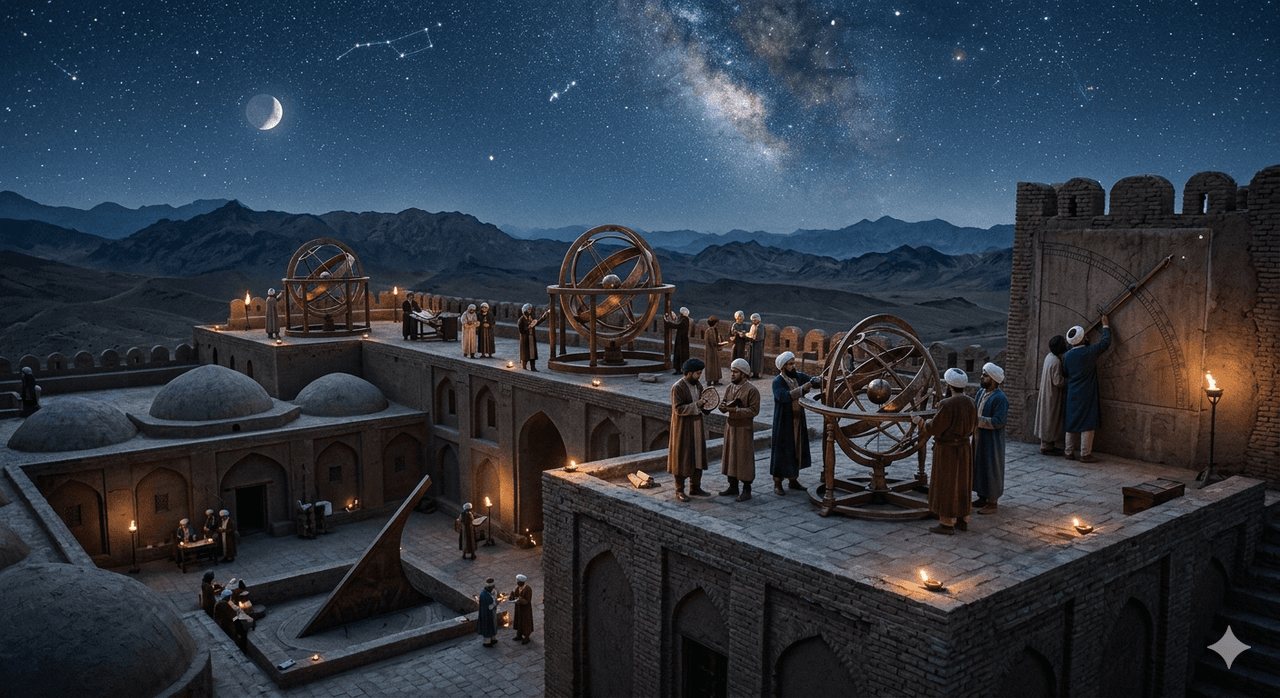
Maragha Observatory (Generated by AI)
This line of scholarly debate has been integrated into a broader theoretical framework alongside the foundational approach of George Sarton and Fuat Sezgin’s source-based methodology. George Sarton, in his three-volume work Introduction to the History of Science, presented scientific development as a continuous flow of knowledge and ideas linking antiquity, the Islamic world, and modern Europe, interpreting the history of science as a global synthesis. Sarton’s approach offered a holistic framework that viewed the history of science not as separate, independent civilizations but as a single continuous stream of knowledge. Within this framework, the Islamic scientific tradition was recognized not merely as a transmitter of ancient knowledge but as a foundational stage contributing to the emergence of modern scientific thought. In particular, in his evaluations titled “The Time of Biruni,” Sarton highlighted Abu Rayhan al-Biruni as central, meticulously demonstrating the high level of detail achieved by the Islamic scientific tradition in empirical observation, mathematical calculation, and natural inquiry. This approach reveals that Sarton did not limit the history of science to a notion of chronological progress but interpreted it as a multi-layered system of knowledge circulation shaped by contemporaneous contributions from diverse civilizations.【6】
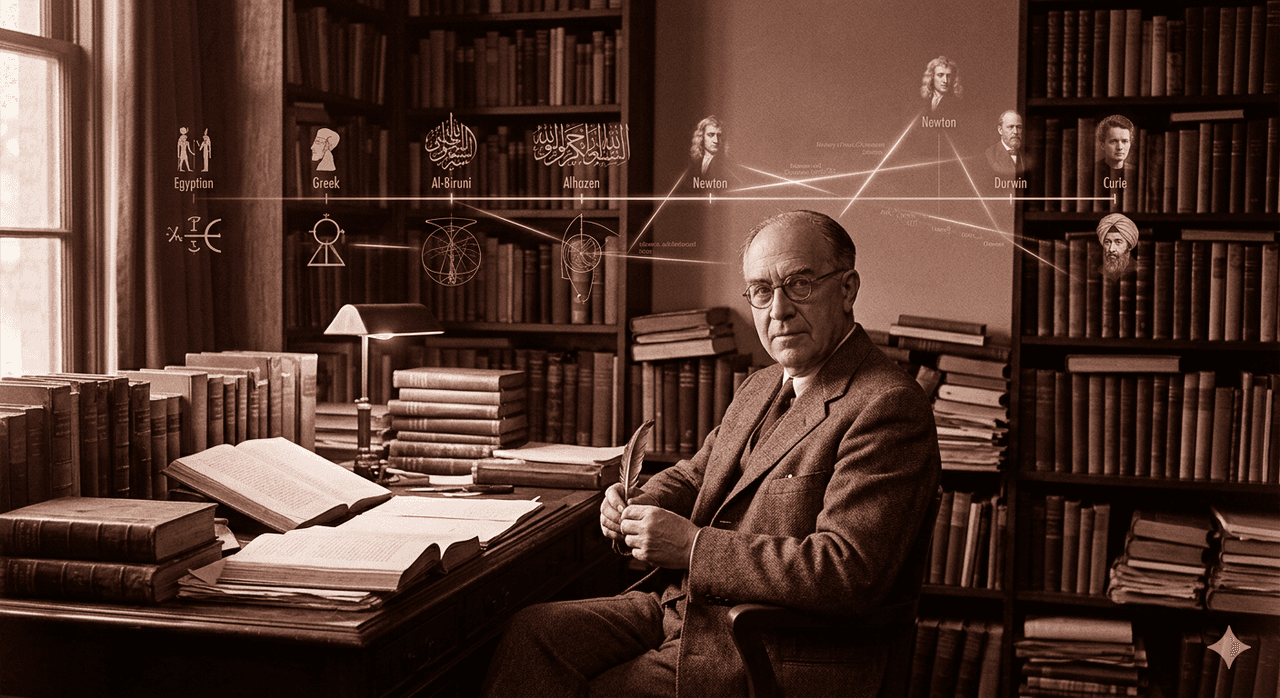
George Sarton (Generated by AI)
Al-Khwarizmi’s work on algebra, al-Biruni’s measurement and observation techniques, Ibn Sina’s medical system, and Ibn al-Haytham’s optical theories are regarded as decisive contributions to the development of the history of science. Sarton’s broad historical synthesis strengthened the idea that scientific knowledge evolved through uninterrupted circulation among different civilizations.【7】
Fuat Sezgin regarded Sarton’s contribution as a pivotal turning point in the historiography of science. According to Sezgin, Sarton was among the most important historians of science who, by comprehensively processing data uncovered by Orientalist research, integrated the Islamic scientific tradition as an inseparable part of world scientific history. In particular, in his three-volume work Introduction to the History of Science, which covers approximately three thousand years of scientific accumulation, Sarton systematically examined scientific developments from antiquity to the late Middle Ages and detailed the role of Islamic scholars in shaping the scientific heritage.
However, Sezgin noted that the conclusions reached by Sarton have not been sufficiently acknowledged in subsequent historiographical works, especially in educational narratives. This indicates that despite scholarly efforts to establish the place of the Islamic scientific tradition in the history of science, it remains inadequately represented in general historical writing and textbooks.【8】
Fuat Sezgin reconstructed Sarton’s theoretical framework on a more concrete and source-based level. Sezgin’s work treated manuscript texts, scientific instruments, and material cultural artifacts as fundamental data sources for the history of science. This approach transformed the history of science from a field interpreted solely through texts into a research discipline supported by empirical and material evidence.
Sezgin’s evaluations of Introduction to the History of Science revealed the methodological strength of Sarton’s historical synthesis while demonstrating that this framework could be expanded through more detailed source analysis. Moreover, Sezgin’s Geschichte des Arabischen Schrifttums (History of Arabic Literature) is regarded as one of the most comprehensive studies systematically establishing the bibliographic and philological foundations of the Islamic scientific tradition.【9】
The Museum of the History of Islamic Science and its research collections established in Frankfurt demonstrate that Sezgin’s approach to the history of science was not confined to theoretical frameworks but created a tangible research domain grounded in material culture. The reconstructed astronomical instruments and scientific devices in these collections have enabled historical knowledge to acquire a visual and experiential dimension. The transfer of a significant portion of this collection to the Museum of the History of Islamic Science and Technology in Istanbul in 2019 has strengthened the international academic circulation of this scientific heritage and contributed to the institutionalization of the history of science.
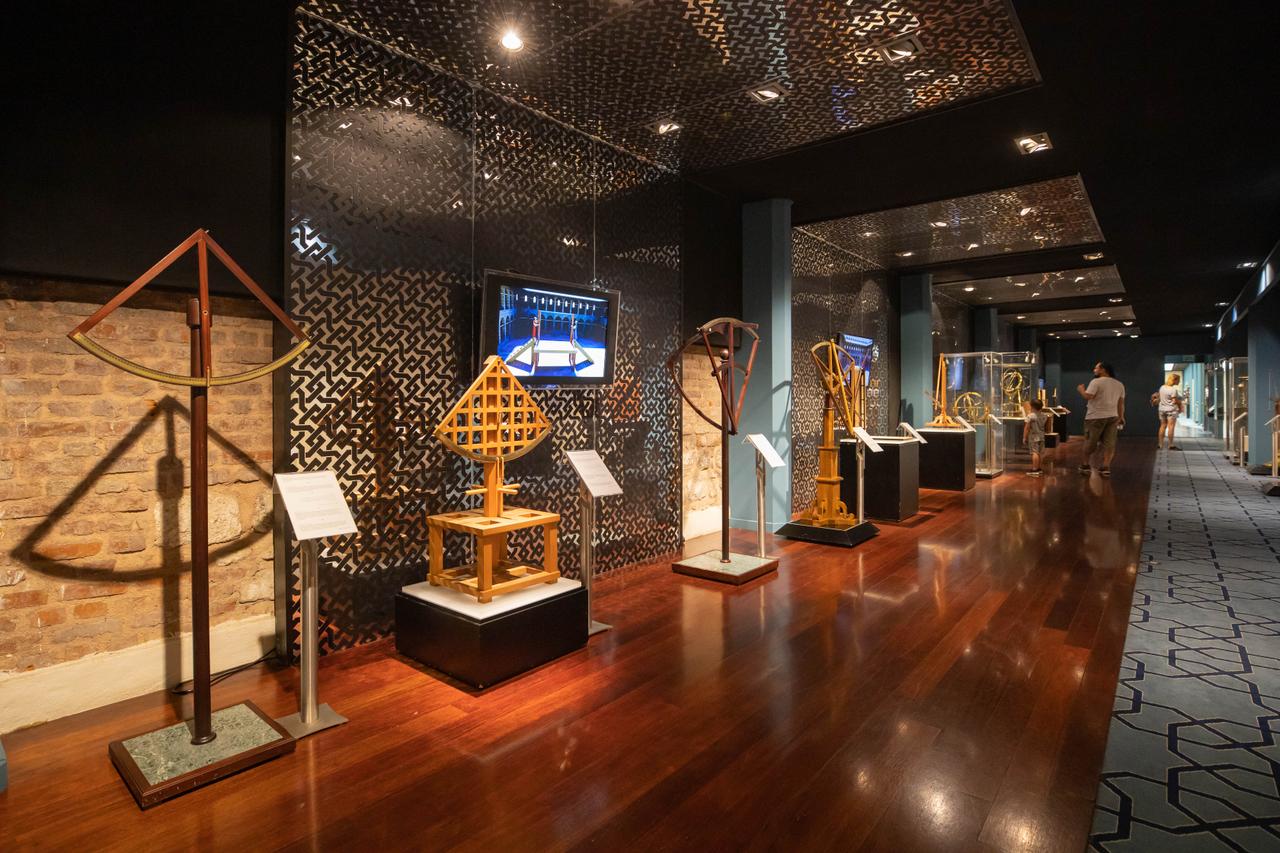
Museum of the History of Islamic Science and Technology (Government of Istanbul)
The relationship between Sarton and Sezgin represents a structure characterized by both continuity and methodological distinction. While Sarton developed a broad historical synthesis, Sezgin elaborated this synthesis through manuscript texts and material evidence. When considered together, these two approaches make it possible to interpret the history of science not as a single-centered model of progress but as a multi-centered and interactive process of knowledge circulation.
Jacques Sédillot (1777–1832) and his son Louis-Amélie Sédillot (1808–1875) produced significant research on the history of Islamic astronomy and mathematics. When evaluated alongside the contributions of Joseph-Toussaint Reinaud (1795–1867) in geography, Islamic archaeology, and military technology, these works reveal the emergence of an important intellectual current in 19th-century historiography of science that brought the Islamic scientific heritage back into visibility.
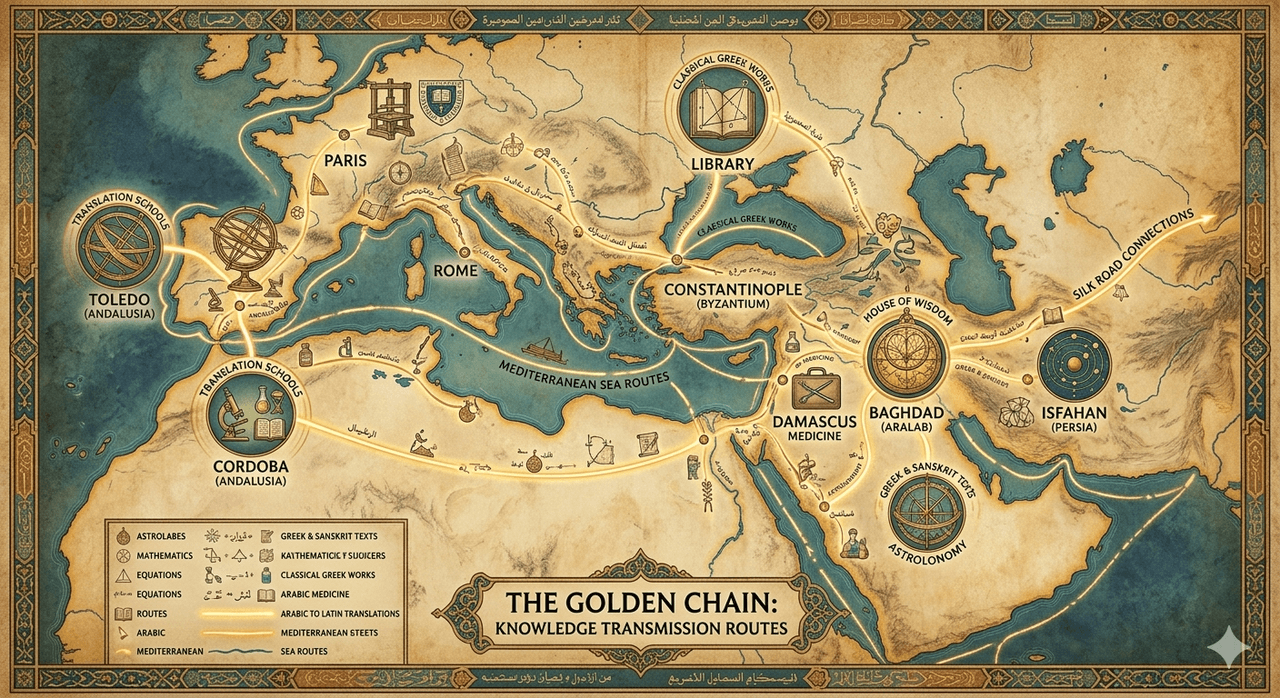
Visual Representing the Circulation of Knowledge (Generated by AI)
According to Fuat Sezgin, Reinaud did not view the history of sciences as a discontinuous progression but as a continuous process, evaluating human discoveries not as sudden leaps but as steps within an unbroken chain of knowledge. Within this framework, the history of science was conceived not as a collection of isolated events but as a chain whose links may have become invisible over time yet retained structural integrity.【10】
This perspective acquired a theoretical foundation with George Sarton’s holistic framework. Sarton interpreted scientific development as a continuous flow of knowledge shaped by contributions from diverse civilizations, assigning the Islamic scientific tradition a central place within this chain. Fuat Sezgin extended this notion of continuity beyond textual narratives by concretizing it through manuscripts, scientific instruments, and material culture, thereby enabling the recovery of previously invisible historical contributions.
In this context, the problem of the “lost link” should be understood not as inherent to the nature of science itself but as a problem of invisibility generated by historiographical traditions. When Sarton’s model of continuity and Sezgin’s source-based approach are considered together, it becomes evident that the history of science is not the product of a single civilization but a multi-centered and uninterrupted process of knowledge circulation shaped by contributions from diverse cultures and societies.
Demirci, Mustafa. Beytü’l-Hikme. İstanbul: İnsan Yayınları, 1996.
Saliba, George. İslam Bilim Geleneği Avrupa’yı Nasıl Aydınlattı? Çev. M. Murtaza Özeren. İstanbul: Ketebe Yayınları, 2025.
Sarton, George. Introduction to the History of Science. 3 vols. Washington, DC: Carnegie Institution of Washington, 1927–1948.
Sezgin, Fuat. Geschichte des arabischen Schrifttums. 17 vols. Leiden: Brill, 1967–2015.
Sezgin, Fuat. İslam’da Bilim ve Teknik. 3rd ed. 5 vols. Ankara: Türkiye Bilimler Akademisi Yayınları, 2015.
T.C. İstanbul Valiliği. "İstanbul’un Müzeleri: İslam Bilim ve Teknoloji Tarihi Müzesi." *istanbul.gov.tr*. Accessed June 21, 2026. https://istanbul.gov.tr/istanbulun-muzeleri-islam-bilim-ve-teknoloji-tarihi-muzesi
Tekeli, Sevim, Esin Kâhya, Melek Dosay Gökdoğan, Remzi Demir, Hüseyin Gazi Topdemir, and Yavuz Unat. Bilim Tarihi. Ankara: Doruk Yayıncılık, 1997.
[1]
George Saliba, How Did the Islamic Scientific Tradition Illuminate Europe?, trans. M. Murtaza Özeren (Istanbul: Ketebe Publications, 2025), 259–308.
[2]
Sevim Tekeli et al., History of Science (Ankara: Doruk Publishing, 1997), 49, 87.
[3]
Mustafa Demirci, Bayt al-Hikma (Istanbul: Insan Publications, 1996), 52, 129.
[4]
Saliba, How Did the Islamic Scientific Tradition Illuminate Europe? 263–264.
[5]
Fuat Sezgin, Science and Technology in Islam (Ankara: Turkish Academy of Sciences Publications, 2015), 159–160.
[6]
George Sarton, Introduction to the History of Science (Washington, DC: Carnegie Institution of Washington, 1927–1948), 1–3.
[7]
Sarton, Introduction to the History of Science, 1–3.
[8]
Sezgin, Science and Technology in Islam, 1–2.
[9]
Fuat Sezgin, Geschichte des arabischen Schrifttums (Leiden: Brill, 1967–2015), 1–17.
[10]
Joseph-Toussaint Reinaud, as cited by Fuat Sezgin, Geschichte des arabischen Schrifttums (Leiden: Brill, 1967–2015), 1–11.