This article was automatically translated from the original Turkish version.
Basic Methodologies | Waterfall (Şelale), Agile (Çevik), Hybrid. | ||||||||
|---|---|---|---|---|---|---|---|---|---|
Key Institution | Project Management Institute (PMI) | ||||||||
Primary Objective | on time to complete within budget and specified quality | ||||||||
Project Triple Constraint | Cost Time Scope | ||||||||
Process Groups | Monitoring and Control Initiating Planning Executing Closing | ||||||||
Knowledge Areas | Stakeholder Management Integration Management Scope Management Schedule Management Cost Management Quality Management Resource Management Communication Management Risk Management Procurement Management | ||||||||
Tools and Techniques | Matrices Interpersonal and Team Skills Meetings Expert Judgment Data Collection Techniques Analyses | ||||||||
International Standards | PMBOK® Guide (Project Management Body of Knowledge) – PMI PRINCE2® Manual – AXELOS PRiSM (Projects integrating Sustainable Methods) – GPM IPMA ICB (Individual Competence Baseline) – IPMA ISO 21500 and ISO 21502 APM Body of Knowledge – APM | ||||||||
Software | Asana OpenProject Tom’s Planner Microsoft Project Oracle Primavera P6 Trello Jira ClickUp monday.com Wrike Smartsheet Notion Adobe Workfront Basecamp Zoho Projects Scoro Paymo ProjectLibre Taiga Redmine | ||||||||
Project Management, is the discipline of applying the processes, methods, skills, and tools necessary to achieve a project’s objectives. More formally, according to the Project Management Institute (PMI), project management is the application of knowledge, skills, tools, and techniques to project activities to meet the project’s requirements. This application encompasses planning, organizing, executing, controlling, and closing processes from the project’s inception to its completion. Project management is viewed as a strategic competency for organizations because it enhances corporate competitiveness by linking project outcomes to business objectives. From a neutral perspective, project management enables each project to be focused within the framework of its unique goals, resources, and time schedule. Thus, project management has emerged as a body of knowledge and set of best practices applicable universally across different industries and fields.
Project Management (generated with artificial intelligence)
In its simplest definition, a project is a temporary and unique endeavor initiated to achieve a specific objective. According to thePMIdefinition, a project is “a temporary effort undertaken to create a unique product, service, or result.” The term temporary in this definition means that every project has a definite start and end date, that is, it does not last indefinitely. The phrase unique product, service, or result emphasizes that the output of a project is something distinct from routine, repetitive tasks. Indeed, projects are distinct from daily operations; for example, continuously producing the same product in a factory is an operational activity, whereas setting up a new production line in that factory is considered a project. Projects can be small-scale and short-term activities or large-scale initiatives requiring multi-year efforts and substantial budgets. However, regardless of scale, all projects share certain common characteristics:
These characteristics distinguish projects from operational activities and make them the subject of project management discipline. To successfully complete a project, the project manager must clearly define the scope of this temporary and unique effort, plan time and financial resources effectively, manage risks, and ensure that the project’s output meets the targeted quality criteria. In conclusion, a project is defined as a temporary effort undertaken to produce a specific product, service, or result, with a defined start and end date, executed with defined resources, and yielding a unique output.
The concept of a project is shaped by temporariness and uniqueness, while project management literature further defines detailed criteria and life cycles for projects. Projects are generally undertaken to achieve specific objectives; these objectives are articulated through the scope and success criteria defined at the project’s outset. The scope of a project refers to the work and deliverables the project will produce—it defines what the project aims to accomplish. Project objectives are often specified as measurable criteria related to scope, time, and cost: for example, a project’s objective might be stated as “produce the product with specified features within six months using a $1 million budget.”
To better understand the concept of a project, one can examine the elements that distinguish projects from operational activities. Operations are continuous and repetitive tasks, while projects are one-time endeavors. For instance, daily customer service in a company is an operational process; however, the initiative to upgrade the customer service system is a project. Projects are typically undertaken within organizations to create change or solve a problem; therefore, every project is based on an business case or feasibility study at its inception. This business case explains why the project is being undertaken and outlines the expected benefits. Project success is measured not only by the fulfillment of technical requirements but also by the delivery of the value anticipated for stakeholders. Today, it is emphasized that evaluating project success solely based on the so-called “triple constraint” of time-cost-scope is insufficient; factors such as quality, stakeholder satisfaction, and executive support must also be considered.
In summary, the concept of a project can be described as a temporary and unique endeavor executed within a defined scope, duration, and financial resource framework to achieve specific objectives. In this sense, projects are vital tools for organizations to achieve strategic goals, and each must be planned and managed according to its own specific constraints and conditions.
While the concept of a project refers to a single endeavor, the concepts of program and portfolio describe the grouping of projects within broader management structures. These three concepts can be evaluated in a hierarchical relationship:
In brief, the difference among these concepts is as follows: project management focuses on delivering a single project within time, cost, and scope targets; program management aims to maximize the benefits arising from managing interrelated projects together; and portfolio management operates at the highest level, focusing on selecting, prioritizing, and allocating resources to the right projects and programs in alignment with the organization’s strategy. For example, portfolio management determines which projects a company should invest in and their priority order; program management ensures coordination among projects grouped around a specific goal; and project management strives to successfully deliver a specific project. The ultimate goal at all these levels is to add value to the organization and achieve strategic objectives. Therefore, the concepts of portfolio, program, and project are complementary structures requiring management at different scales.
The classical “triple constraint” concept in project management refers to three fundamental factors that define a project’s success and scope: Time, Cost, and Scope. These three elements are also known as the project management triangle or “iron triangle” and are treated as critical constraints in project planning. According to the triple constraint concept, managing a project involves balancing when the project will be completed (schedule), how much it will cost (budget), and what it will deliver (scope). Each constraint is defined below:
These three constraints are closely interrelated and must be managed in balance within project management. The classicPMBOK® Guideexplains this relationship as follows: any change in one constraint has the potential to affect at least one other. For example, if the project’s duration needs to be shortened, additional cost increases such as more manpower or overtime may be required; if the budget cannot be increased, then the project’s scope may need to be reduced or quality expectations lowered to complete the project sooner. Similarly, if scope is expanded, it will inevitably impact either cost or schedule. Project stakeholders may have differing views on which of these three factors is most critical; for some, time is the most critical constraint, while for others, budget or scope may be more important. The project manager’s role is to maintain balance among these three elements during change requests and planning to achieve project goals.
In modern project management practices, in addition to the triple constraint, other factors such as quality, resources, and risk are also considered critical constraints, leading to a more comprehensive six-constraint model. Accordingly, quality expectations, the project’sriskprofile, and available human resource capacity are significant factors that limit the project plan. Nevertheless, the time-cost-scope triple remains the foundational planning parameter for project management. A successful project is one completed within the defined timeframe, within approved budget limits, and in accordance with the required scope and quality requirements. Project managers proactively manage the triple constraint: they monitor the schedule, control the budget, tie scope changes to approval mechanisms, and review priorities with stakeholders when necessary. Ultimately, the triple constraint concept is a principle that symbolizes the art of balance in project management and guides decision-making throughout the project.
In the field of project management, various project management approaches have been developed to suit different types and sizes of projects. Each approach has unique characteristics regarding how the project is planned and executed, how it adapts to changes, and how the team works. No single approach is universally the best solution for every situation; factors such as the project’s scope, industry, level of uncertainty, and stakeholder expectations determine which method is more appropriate.
Three main approaches in project management are:
Organizations such as PMI (Project Management Institute) view project life cycles as a spectrum between predictive (plan-driven) and adaptive (agile) extremes; the combination of approaches at either end of this spectrum is defined as the hybrid approach. Below, these three approaches are examined in detail with technical specifics, meeting practices, and information based on official standards.
Traditional project management approach encompasses classic methods based on plan-driven, sequential steps. In this approach, the project is managed through detailed planning from start to finish, and the project life cycle is divided into distinct phases. For example, according to PMI standards, a traditional project typically progresses through the following sequential phases: Project Initiation, Project Planning (and Design), Project Execution (and Construction), Project Monitoring and Control, and Project Closure (Completion). Each phase must be completed before moving to the next, so project steps follow one another like a waterfall. Hence, the traditional method is often called the “Waterfall Model” (Waterfall). It is critical that all requirements are fully defined and clarified with the customer at the very beginning of the project; otherwise, change requests arising in later stages can cause problems that force the process back to the beginning.
One of the key features of the traditional approach is its low flexibility to changes. Project scope, schedule, and costs are determined as early as possible, and scope changes are addressed only through a strict change control process. This approach is typically preferred for work where the scope is well-defined at the outset and major changes are not expected during the project duration. For example, in fields such as construction and manufacturing, the predictability of this method provides advantages when requirements are established at the beginning. During the planning phase, aWork Breakdown Structure (WBS)is created, and schedules are visualized using Gantt charts; critical phases are analyzed using the Critical Path Method (CPM). The project manager monitors the project throughout its duration, tracking performance against the initial plan. For example, tools such asMicrosoft Projectare widely used in waterfall projects to track task durations, dependencies, and the critical path.
Meetings and communication in traditional projects are less frequent but more comprehensive. For example, a kick-off (initiation) meeting is held at the project’s start with all stakeholders to define scope, objectives, and roles. Planning meetings are held at the beginning of each major phase, and phase review meetings (stage gate reviews) are conducted at the end to assess whether the project is progressing according to plan. The project team typically reports progress to managers and stakeholders through weekly or monthly status meetings. Formal change requests may be reviewed in Change Control Board (CCB) meetings. At the project’s end, a closure meeting and lessons learned session are held to evaluate the project’s overall performance and document lessons learned (this is, in a sense, aretrospective evaluation, but since it occurs at the project’s end, it does not support the continuous improvement cycle of agile approaches). The traditional approach stands out for its strong documentation and clear time/budget discipline; however, it is risky because adapting to changes that emerge later is difficult.
Agile project management approach is a general term for iterative and incremental methods used in projects requiring high adaptability and flexibility, where requirements evolve over time. The Agile Manifesto, published in 2001 by software industry experts, defined the core values and principles of this approach. In agile methods, the goal is to respond quickly to changing needs by frequently interacting with the customer and delivering value early and continuously. The project is divided into short cycles (iterations or sprints) lasting from a few weeks to a few months, and at the end of each cycle, a working product increment (output) is delivered. Thus, continuous feedback is received throughout the project, allowing adjustments to be made as needed.
Scrum is one of the most common implementations of the agile approach. Looking at the team roles in Scrum, instead of the traditional project manager role, we find the Product Owner, Scrum Master, and Development Team. The Product Owner is responsible for prioritizing the product backlog, a list of business requirements. The Development Team consists of cross-functional members who self-organize to deliver the work. The Scrum Master is a leadership role focused on facilitating the team’s adherence to Scrum principles and removing obstacles.
In Scrum and other agile methods, meetings (events) are frequent and conducted within time-boxed limits. In Scrum, each sprint cycle includes the following ceremonies:
The agile approach provides significant advantages in environments with a high rate of change. Even if requirements are not clear initially, they can be clarified as the project progresses because the team delivers a portion of the product in each iteration and receives real feedback. The customer or end user becomes part of the project process, and if priorities change, they are reflected in the next iteration. This increases customer satisfaction and product quality because errors are identified and corrected early in the development process. Technically, agile projects follow the principle of sufficient documentation rather than detailed documentation; requirements are typically documented concisely in the form of user stories. Progress is tracked based on delivered value and completed work: for example, Scrum teams evaluate their progress rate using tools such as the burn-down chart (remaining work graph) or velocity measurement. Other agile methods such as Kanban use boards (Kanban boards) to visualize workflow and aim to balance flow using a pull system that limits work in progress across columns. All these technical practices support the agile approach’s core philosophy of adaptation and continuous improvement.
The greatest advantages of agile project management include flexibility, fast feedback, and high customer involvement. It is ideal for small, cross-functional teams and has been successfully applied in fields such as software development, R&D, and innovation, where uncertainty is high and requirements evolve during the project. On the other hand, agile methods can create challenges in managing upper management’s fixed budget/time expectations; there is a risk of scope creep due to continuously changing scope, and they require active participation from the customer or project owner. Therefore, it is important that the organizational culture and stakeholders are aligned with agile principles.
Hybrid project management approach combines elements of predictive (traditional) and agile methodologies to blend the best practices suitable for different parts of the project. The hybrid approach is not a single methodology but rather a spectrum that can correspond to any point on this spectrum. In ahybrid project managementapplication, some parts of the project are managed according to classical planning discipline, while other parts are executed using agile techniques. For example, PMI defines a scale in project management with fully predictive (traditional) approaches at one end and fully agile approaches at the other; the hybrid approach refers to various combinations at intermediate points on this scale. Due to this variability, there is no universally accepted single framework for the “hybrid” approach; each team can adapt methods according to its own needs.
Implementation of the hybrid method is typically shaped according to the nature of the project. A common pattern is to plan the project’s scope, budget, and time frame in detail using traditional methods at the beginning, but then transition to agile iterations during the development or construction phase. For example, in a large software + hardware project, hardware development and legal compliance components may be executed using a planned approach like Waterfall, while software development teams work using Scrum with two-week sprints. This hybrid model aims to combine the advantages of the traditional approach—predictability and scope control—with the agility and adaptability of the agile approach. PMI’s recent research also shows that hybrid approaches are increasingly being adopted and are viewed by organizations as a flexible solution tailored to different project needs.
The management tools and meetings used in hybrid approaches vary depending on which methodology dominates in each part of the project. For example, a traditional-style master plan andGantt schedulecan be created for the overall project roadmap, with keymilestonestracked through this plan. Within the same project, a separate agile board (such as Kanban/Jira) can be maintained for software sprints, and daily Scrum meetings, sprint planning, demos, andretrospectivesare conducted by the relevant teams. Periodic status report meetings are held for upper management and all stakeholders (e.g., after each major phase), while operational-level development teams continue their agile rituals. This multi-layered structure can complicate communication in hybrid projects, making strongproject governanceand clearly defined roles critical. The project manager in a hybrid model must understand both classical planning and agile delivery and act like an interface connecting the two worlds.
The advantages and disadvantages of the hybrid approach depend on balancing the strengths and weaknesses of its constituent elements. When correctly applied, the hybrid model provides the organization with a wider set of tools, enabling tailor-made solutions on a project-by-project basis. For example, a plan-driven approach can be used for parts subject to legal regulations and unlikely to change, while agile cycles can be preferred for uncertain or innovative components—thus achieving both control and flexibility across the project. However, for thehybrid methodologyto succeed, the organizational culture must be open to both the documentation and discipline required by the traditional approach and the agility required by the agile approach. Otherwise, team members may struggle between two different methods. Additionally, coordinating bidirectional processes in a hybrid structure demands a higher level of management skill and experience from the project manager.
Project management approachesare tools that require tailoring according to project needs, as there is no single correct approach. International standards (such as PMI’s PMBOK guide) also emphasize that each project is unique and that successful outcomes require conscious selection and adaptation of traditional, agile, or hybrid approaches. The table below compares some key dimensions of traditional, agile, and hybrid approaches:
Table Source: Prepared by the author.
These three approaches can also be viewed as a spectrum: one end features a rigid predictive model fully driven by planning, while the other end features a highly adaptive agile model; hybrid lies in between as a balanced position adapted to project needs. Today, project managers use these approaches by tailoring them according to project type and environmental conditions. Even within a single project, different approaches can be used at different stages (e.g., predictive planning at the beginning followed by agile development). The important thing is to select the most suitable management style for the project and adapt methods as needed in a tailor-made manner.
Project life cycle is the total of sequential phases a project goes through from its initiation to completion. Every project consists of a series of stages, starting with a concept or feasibility study and extending to project closure. According to PMI, the project life cycle is composed of a series of phases from the project’s beginning to its end. These phases can be named according to the nature of the project (e.g., initiation, design, development, testing, implementation, and closure). The number and type of phases can vary from project to project; the structure of the project life cycle largely depends on the project’s industry, product, and applied methodology. For example, a typical life cycle in the construction industry consists of sequential phases (design, bidding, construction, delivery), while software projects may involve iterative development sprints within anagile life cycle. In predictive approaches, the project life cycle typically consists of sequential phases, with each phase taking the output of the previous one as input. In adaptive approaches, the life cycle continues through repeated short cycles throughout the project; each iteration produces a new product increment, and the product evolves and matures until the project’s end. In all these approaches, the common point is that the life cycle ensures value creation and controlled progress throughout the project.
Project Process Groups are the five fundamental categories defined by the Project Management Institute (PMI) to group project management processes according to their objectives. As a universal project management principle, the sequential order of Initiating → Planning → Executing → Monitoring and Controlling → Closing defines the managerial framework of a project. Process groups logically bring together various processes within the project management knowledge areas (scope, time, cost, etc.) and are applied repeatedly throughout each project or project phase. This grouping allows operations during project management to be divided into specific stages and helps ensure that all processes are conducted in a more orderly and controllable manner throughout the project life cycle. It should be emphasized that process groups should not be confused with project phases; process groups collect processes with similar characteristics, while project phases are sequential periods on the timeline. A project phase generally includes all five process groups from initiation to closure, and processes can be executed in a repetitive manner as needed according to project requirements. Below, the definitions and purposes of the five traditional process groups are explained in detail.
Project management processes are grouped into five traditional process groups:
The five fundamental process groups defined in the PMBOK® Guide categorize project management processes at a high level. Each process group brings together processes with similar objectives and comes into play at appropriate stages throughout the project. Below are the definitions and purposes of the Initiating, Planning, Executing, Monitoring and Controlling, and Closing process groups:
Initiating Process Group includes the processes required to formally start a new project or a new phase of an existing project. The processes in this group ensure the high-level definition and organizational approval of the project. The primary purpose of the initiating process is to obtain the necessary authority and approval for the project, define the project’s initial scope and objectives, and identify key stakeholders. The most important output of this process group is usually the Project Charter, which outlines the project definition, prerequisites, initial high-level time and cost estimates, and alignment of the project with the organization’s strategic goals. The Project Charter represents the official approval from senior management or the project sponsor to initiate the project and grants the project manager the authority to execute the project. Additionally, during initiation, stakeholder identification (Identify Stakeholders) is performed to identify individuals and organizations affected by or having influence on the project. This ensures that all critical stakeholders are identified at the project’s outset, laying the groundwork for understanding their needs and expectations. In conclusion, the Initiating Process Group is critical for obtaining the initial approval necessary to implement the project and establishing a solid foundation for it.
Planning Process Group encompasses the processes involved in detailed planning of the work required to achieve the project’s objectives. The purpose of the processes in this group is to clarify the project scope, define requirements, elaborate on goals, and identify the methods and action steps needed to achieve these goals. The planning process group produces detailed plans across nearly every knowledge area of the project; for example, planning activities in scope management, schedule development, cost estimation and budgeting, quality requirement definition, resource planning, communication plan, risk management plan, procurement strategy, and stakeholder management plan are all performed in this group. All these sub-plans are integrated to create a comprehensive document called the Project Management Plan. In conclusion, the Planning Process Group draws the roadmap for “how” the project will be executed and establishes a solid planning foundation for successful project execution. A significant portion of the 49 processes defined in PMBOK® 6th Edition are in the Planning group, demonstrating how comprehensive and critical planning is in project management. A well-executed planning process directly affects the effectiveness of project execution and control steps; therefore, the effort and detail invested in this process group increase the likelihood of project success.
Executing Process Group is the group of processes where the work defined in the project plan is actually performed and the project’s outputs are produced. The purpose of this process group is to carry out the work specified in the project management plan and produce the project’s intended deliverables. During the execution phase, the project team is assembled and managed, tasks are assigned, resources are utilized, and project activities are carried out. Processes in this group include a wide range of activities such as Direct and Manage Project Work, Perform Quality Assurance, Acquire Resources and Develop Team, and Manage Communications. During execution, the documents and plans prepared during planning are put into practice; the project team performs the work according to the project management plan, and project deliverables begin to be produced. This process group typically consumes the largest portion of the project’s time and budget because tangible work is performed here. During execution, activities such as resolving emerging issues, ensuring team coordination, and addressing potential change requests are also carried out. The success of the Executing Process Group is critical for ensuring that the project progresses as planned and achieves its intended outputs. Key outputs produced within this group include project deliverables (e.g., a product, service, or result), records of completed work, and performance information. Additionally, performance data collected during execution is used as input for monitoring and control.
Monitoring and Controlling Process Group consists of the processes required to continuously observe the project’s progress against plans, evaluate performance, and take corrective actions to keep the project under control. The purpose of this process group is to track project performance, identify deviations, and maintain control over the project by making necessary changes to align with the project plan. Monitoring and controlling processes continue throughout the project’s life, particularly in parallel with the execution phase. Processes in this group include Monitoring Progress, Change Control, Scope/Quality/Time/Cost Control, and Monitoring Risks. The project’s actual performance data (actual costs, completed work, quality measurements, etc.) are compared with the planned values. If significant differences (variances) exist between planned and actual performance, corrective and preventive actions are defined and implemented within this group. For example, if the project is delayed, corrective measures to recover the schedule, or if the budget is exceeded, cost-reduction measures may be implemented. Additionally, change management is a critical component of this process group: change requests received from stakeholders or arising from changing conditions are evaluated, approved or rejected, and approved changes are integrated into the plan in a controlled manner. TheMonitoring and Controlling Process Groupensures the achievement of project objectives by continuously monitoring the project’s “health status” and making necessary corrections, thereby updating theproject management planto reflect actual conditions. Outputs of this group include performance reports, change requests, revised project plan, and updated project documents.
Closing Process Group includes the processes required to formally complete or close a project or project phase. The primary purpose of this process group is to verify that all project work has been completed, formally deliver the project outputs, obtain necessary approvals, and close project records to officially conclude the project. During the closing process, the project’s product, service, or result is first delivered to the customer or sponsor, and the required acceptance (approval) is obtained. Then, administrative closure activities are performed: all documents and records are reviewed and archived, contracts are closed if applicable (including procurement/contractor contracts), unused resources are released, and the project team is disbanded. The Lessons Learned document is typically compiled at this stage; experiences and lessons learned during the project are captured for institutional memory. The most important process in the Closing Process Group is the Close Project or Phase process and is typically the final step of the project. This step involves evaluating the project against its initially defined success criteria and officially declaring the project complete. In conclusion, the Closing Group ensures that all aspects of the project are fully completed and that no loose ends remain. A successful closure includes the complete delivery of project outputs, evaluation of stakeholder satisfaction, and acquisition of valuable information for future projects.
Project process groupsare repeating steps that can be applied in every phase of the project life cycle. If a project has multiple phases, each phase includes its own Initiating, Planning, Executing, Monitoring and Controlling, and Closing processes. In this context, although process groups follow a similar sequence to project phases, they are different from the concept of phases. For example, suppose a project has three phases: conceptual design, detailed design, and implementation; each phase is separately initiated, planned, executed, controlled, and closed. That is, when the project manager enters a new phase, they reapply the initiating group processes, then create phase-specific planning, and proceed to execution. At the end of the phase, they close that phase and move to the next phase’s initiation. PMI’s standard expresses this situation as “process groups interactively occur in every project phase.” It is also possible for all process groups to occur within a single project phase; in small-scale or single-phase projects, the entire project passes through all five process groups in one go. The interactive and repetitive nature of process groups provides flexibility and adaptability in project management. For example, since monitoring and control activities are continuously performed during execution, the project team can regularly evaluate performance and, if necessary, return to planning for revisions (feedback to the planning group). Similarly, when a change is approved, planning and execution processes re-enter the cycle. This cyclical interaction facilitates the project’s adaptation to dynamic conditions.
Another important point is the relationship between process groups and their position in the project life cycle with adaptive approaches. For example, in Agile methodologies, instead of a long planning phase, small-scale initiating, planning, executing, controlling, and closing steps occur in each iteration/sprint. Thus, even in Agile projects, the five process groups exist but operate as numerous mini-cycles throughout the project. In predictive (plan-driven) project life cycles, process groups are applied in more distinct sequential phases: comprehensive planning is done for the entire project, followed by a long execution phase and continuous control, with closure performed only once at the end. The PMBOK® Guide states that process groups can be applied in every project regardless of the life cycle or development approach used and that these groups are independent of industry, application area, or methodology. Thanks to this flexibility, whether using a traditional waterfall approach or agile approaches, process groups serve as a universal framework for project management.
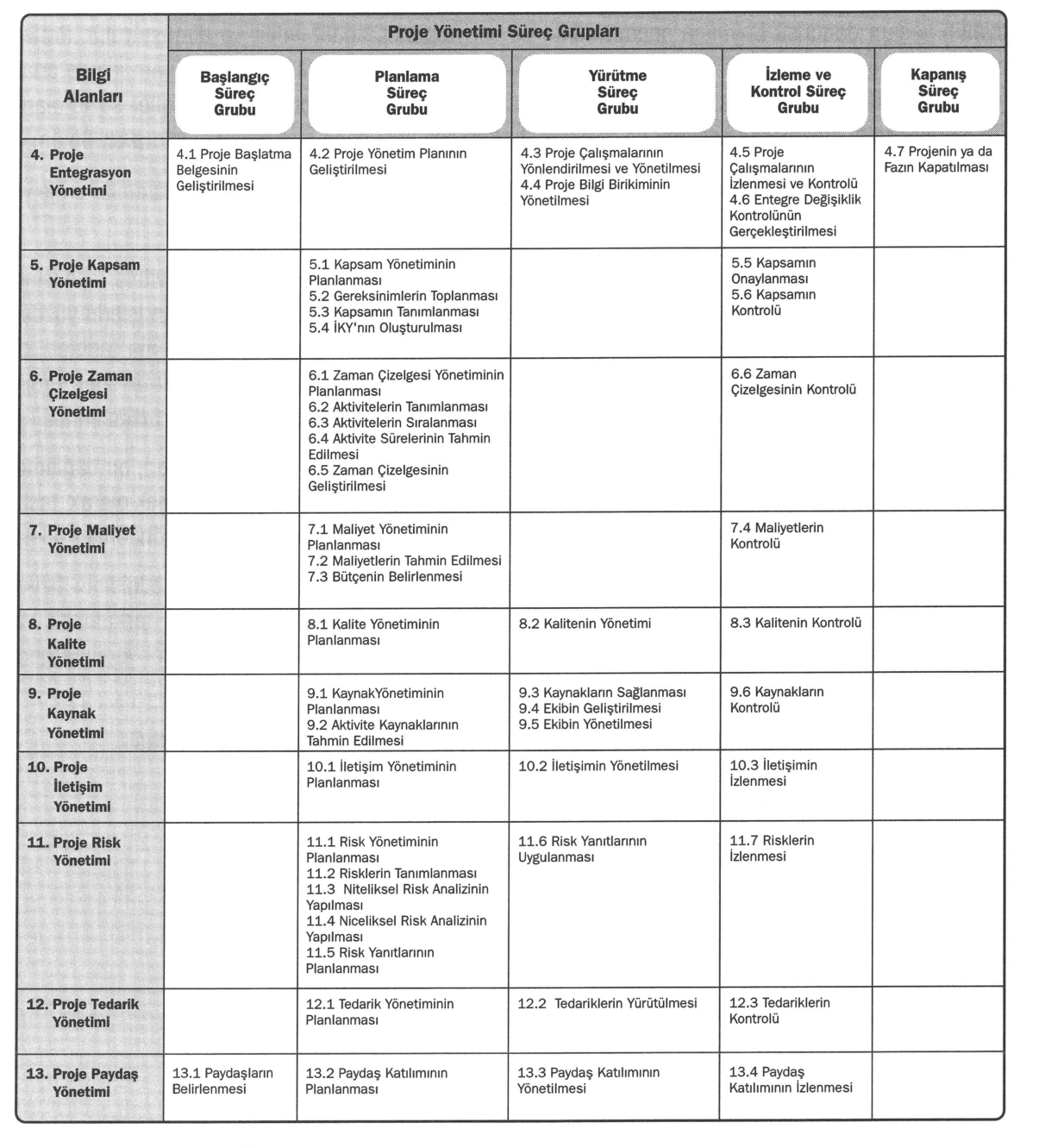
PMBOK 7th Edition Guide: Project Management Process Groups and Knowledge Areas Table(Project Management Institute, PMBOK® Guide, 7th ed., Table 1.4)
Visual: A matrix showing the relationship between project management process groups (horizontal axis) and knowledge areas (vertical axis). Each cell represents a project management process located at the intersection of a knowledge area and a process group. For example, the process “Develop Project Charter” intersects with the Initiating process group and Integration Management knowledge area.
As shown in the table above, PMI classifies project management processes not only by process groups but also by knowledge areas. A total of 10 Project Management Knowledge Areas cover integration, scope, time (schedule), cost, quality, resource, communication, risk, procurement, and stakeholder management. These knowledge areas represent the subject areas of project management and each contains processes related to its domain. For example, the Scope Management knowledge area includes processes related to planning, defining, approving, and controlling the project scope; theTime Managementknowledge area includes processes related to developing and monitoring the project schedule. A project manager applies processes from all these knowledge areas at appropriate times throughout the project.
Throughout the project life cycle, process groups are generally operated in a cyclical and interactive manner. Especially in large and complex projects, initiating and closing processes can be repeated at the beginning and end of each phase, and planning and execution activities can be revisited at every stage. This flexible use of process groups facilitates the project’s adaptation to changing conditions. For example, lessons learned after the first phase of a project can be reflected in the planning of the next phase to achieve continuous improvement. In this way, the repetition and improvement of processes within the project life cycle is a factor that enhances project success.
Project Management Knowledge Areas are the fundamental topics that project managers must address to effectively plan, execute, and control projects. According to PMI’s Project Management Body of Knowledge (PMBOK®) guide, ten knowledge areas are defined in project management: Integration Management, Scope Management, Time (Schedule) Management, Cost Management, Quality Management, Resource Management, Communication Management, Risk Management, Procurement Management, and Stakeholder Management.
These knowledge areas provide the information and processes necessary for a project to achieve success and help evaluate whether project objectives have been met. Each knowledge area includes the processes, tools, and techniques required to be applied throughout all process groups (initiating, planning, executing, monitoring and controlling, closing) of the project life cycle. Below is a detailed examination of each knowledge area, including its definition, scope, and key tools/techniques:
Project Integration Management encompasses the processes and activities that define, combine, unify, and coordinate the various elements of project management. This knowledge area aims to ensure that all other knowledge areas work in harmony; therefore, it emphasizes the project manager’s role as an integrator.Integration managementincludes critical processes such as developing theproject management plan, creating the project charter, directing and managing project work, monitoring progress, controlling changes holistically, and closing the project. For example, the project manager initiates the project officially by preparing the Project Charter and documenting the authority granted to use organizational resources to guide the project. Subsequently, a comprehensive Project Management Plan is created, integrating all plans for scope, time, cost, etc.; this plan details how the project will be executed, monitored, and closed.
Integration Management also includes evaluating change requests and applying integrated change control processes to ensure project success criteria are met. One of the project manager’s most important responsibilities is ensuring that processes across all knowledge areas operate consistently. To this end, tools such as Change Control Boards, integrated configuration management systems, and project management information systems (PMIS) are used to manage information from different areas in a unified manner. Successful implementation of integration management processes maintains the project’s overall coherence and plays a central role in achieving project goals.
Project Scope Management defines the processes that ensure all necessary work—and only the necessary work—is identified and included in the project to achieve successful completion. In other words, the primary purpose of scope management is to do the right job and clearly define what work should be excluded from the project. Scope includes all characteristics of the product, service, or result to be delivered and the work required to produce this output. PMBOK distinguishes between product scope (the features of the output to be delivered) and project scope (the work required to produce this output). Project Scope Management consists of sub-processes such as Planning Scope Management, Collecting Requirements, Defining Scope, Creating the Work Breakdown Structure (WBS), Validating Scope, and Controlling Scope. Through these processes, the project scope is determined, documented, and protected against changes.
One of the most important outputs of scope management is the Scope Management Plan document; this plan outlines how the project scope will be defined, validated, controlled, and how the WBS will be created. The Work Breakdown Structure (WBS) is a hierarchical structure that breaks down project deliverables and work into smaller, manageable components and is a critical tool in scope management. The WBS organizes and defines the total scope of the project to ensure that no important work item is overlooked. During scope definition, all stakeholders’ expectations and needs must be considered; therefore, stakeholder identification and requirement gathering are vital for successful scope management. If a stakeholder’s need is overlooked, the project scope may be inadequately defined. On the other hand, the unauthorized inclusion of out-of-scope work, known as scope creep, is a problem that complicates project control. Therefore, when any change request arises in scope, the impact on time, cost, and other factors must be evaluated, and approval mechanisms must be implemented.
Common techniques used in scope management include requirement gathering techniques (interviews, surveys, workshops, prototypes), expert judgment and templates for scope definition, the decomposition method for creating the WBS, and review/inspection methods for scope validation. All these tools and techniques are used to ensure that the project includes only necessary work and to clarify the work definition for the project team and stakeholders.
Project Schedule Management encompasses the processes and steps required to complete the project on time. This knowledge area includes identifying project activities, sequencing them, estimating durations, and developing and controlling aproject schedule. Comprehensive schedule management requires the project team to plan when all activities will be performed and continuously monitor actual progress against the plan. The main processes of schedule management include Schedule Management Planning, Defining Activities, Sequencing Activities, Estimating Activity Resources and Durations, Developing the Schedule, and Controlling the Schedule. As a result of these steps, a detailed project schedule (calendar) and the schedule baseline are created.
Defining and sequencing activities involves breaking down work packages in the project scope into specific activities and determining the precedence relationships (dependencies) among these activities. Then, the duration and required resource quantities for each activity are estimated. Using this information, the project schedule is developed; during schedule development, network diagrams are drawn, critical path method (CPM) is applied, and optimization techniques such as schedule compression techniques (e.g., crashing and fast tracking) are used to shorten the project duration. After the draft schedule is developed,network analysisandcritical path calculationsare performed, and optimizations are completed; the resulting final schedule is “frozen” as the baseline. This schedule baseline serves as a reference for monitoring the project’s time performance. As the project progresses, actual activity completion times are compared against this baseline; if deviations are detected, necessary updates or corrective actions are taken to the schedule.
A variety of tools and techniques are used in project schedule management. Gantt charts are a common tool for visually planning and tracking the distribution of activities over time. Network diagrams and Precedence Diagramming Methods (PDM) are used to model relationships between activities. The critical path method identifies the longest path in the project and the buffers (float) that provide flexibility to the project duration. The Program Evaluation and Review Technique (PERT) calculates average durations using three-point estimates (optimistic, most likely, pessimistic durations) under uncertainty. These techniques enable the project manager to plan the necessary scheduling to get the job done on time and proactively manage potential delays.
Project Cost Management encompasses the processes involved in planning, estimating, budgeting, and controlling costs to ensure the project is completed within the approved budget. In other words, the project manager must watch the budget by forecasting all expenditures required for the project and ensuring that spending remains within budget limits throughout the project. The main processes of cost management include Planning Cost Management, Estimating Costs, Determining Budget, and Controlling Costs. In these processes, a cost plan is created for the project, cost estimates are made for individual activities and components, the total project budget is determined, and actual expenditures are monitored and compared against the budget to manage variances.
Estimating costs involves attempting to accurately forecast all types of expenses required for the work in the project scope, such as human resources, materials, equipment, and facilities. Various estimation techniques are used for this purpose: for example, analogous estimation using data from past projects, parametric estimation calculating unit costs based on parameters, Delphi technique based on expert opinions, or the three-point estimation technique. In three-point estimation, optimistic, most likely, and pessimistic cost estimates are obtained for each task, and a probabilistic average is calculated; this method increases estimation accuracy by reducing uncertainty. Additionally, contingency reserves are determined for uncertainties and risks; for example, setting a tolerance range of ±10% on planned costs is a common practice.
Determining the budget involves combining all cost estimates to create the project’stotal budget. This budget includes expenditures for contracts and procurements within the project scope. After the budget is approved, during the Controlling Costs phase, expenditures during the project’s subsequent stages are regularly monitored and compared. The goal here is to see how much of the budget has been consumed by a specific date and to evaluate whether this consumption aligns with the planned budget. This evaluation is typically performed using techniques such as Earned Value Management (EVM); the project’s completion percentage is compared with the amount spent to measure the project’s cost performance. If expenditures are ahead of or behind the plan (budget overruns or savings), the project manager analyzes the reasons and takes corrective/preventive measures. For example, to prevent budget overruns, scope changes can be reviewed, factors reducing resource efficiency can be eliminated, or contingency reserves can be utilized.
In cost management, tools such as various software and electronic spreadsheet programs (e.g., MS Excel, project management software) stand out; these tools facilitate complex financial calculations and cash flow tracking. Additionally, expert judgment and historical data play a critical role in the planning phase; past project cost performances can serve as guides for new projects. Group budgetevaluation meetingsand decision-making techniques are also recommended to create a realistic budget through team consensus. In conclusion, effective cost management ensures the project’s financial sustainability and adherence to budget targets.
Project Quality Management encompasses the processes applied to ensure that the project produces outputs that meet the intended objectives, established quality standards, and customer expectations. Quality management, in a sense, means “doing the job right”: it aims for both the efficient and error-free operation of the project process and the output product/service to possess the desired quality characteristics. According to PMBOK, project quality management includes the processes of Planning Quality Management, Performing Quality Assurance (management activities related to quality) and Controlling Quality (monitoring product and process quality). Throughout the project, quality management requires adapting the organization’s overall quality management system to the project and implementing project-specific quality policies.
Planning Quality Management involves defining the quality standards applicable to the project and product and determining the activities required to achieve these standards. For example, international standards such as ISO 9001 or industry-specific quality criteria are considered during the planning phase. During planning, cost and time analyses are performed to achieve quality goals, and documentation requirements are determined. Additionally, various analytical tools are used to support decision-making and problem-solving in quality planning. Commonly used tools in the industry include cause-and-effect diagrams (fishbone diagrams), flowcharts, Pareto diagrams, histograms, control charts, and scatter diagrams. These tools help identify potential sources of errors, visualize process flows, and prioritize actions. Through these tools, critical factors for quality are identified, and proactive measures are planned.
Performing Quality Assurance includes activities aimed at ensuring that the project is being executed according to the defined quality processes. In this context, process audits are conducted to ensure that the quality management plan is being effectively implemented, and necessary training and guidance are provided to the project team. Quality assurance aims to proactively identify and prevent errors in the process and improve processes; this way, quality-related defects can be detected and corrected early in the project. Various tools can also be used in quality assurance: for example, affinity diagrams, process decision program charts (PDPC), relationship diagrams, tree diagrams, priority matrices, and matrix diagrams are more advanced analysis tools that contribute to process improvement and decision-making. These tools help evaluate complex cause-effect relationships and multi-dimensional data in quality management.
Controlling Quality is the activity of monitoring and testing whether the project deliverables and executed processes meet the planned quality requirements. Inspections, tests, and measurements performed on the product, along with tracking process performance indicators, are part of this process. The results obtained in the quality control step are evaluated against the criteria in the quality plan; if deviations or problems are identified, corrective actions are recommended and implemented. For example, if defective products are identified in a manufacturing project, improvements are made to the production process based on quality control reports. The quality control process also includes documenting all quality-related data and test results; this ensures that quality performance is recorded and data is provided for continuous improvement.
Project quality management generally includes continuous improvement philosophies (such asKaizen) and modern quality management approaches. Many organizations view project-based quality management as part of their corporate quality systems and ensure compliance with international standards. Well-implemented quality management leads to higher productivity, lower costs, increased customer/stakeholder satisfaction, and significant contributions to project success.
Project Resource Management encompasses planning, acquiring, developing, and managing all resources (human, materials, equipment, facilities, etc.) required for the successful execution of the project. Especially in terms of human resources, the focus of this knowledge area is on bringing the team together, establishing an effective team structure, and maintaining team performance. Note that, starting from PMBOK 6, the term Human Resource Management has been expanded to Resource Management; thus, the management of physical resources beyond the project team is also emphasized. However, team management remains the central element.
Project Resource Management processes include Planning Resource Management, Acquiring the Project Team (resource acquisition), Developing the Project Team, and Managing the Project Team (including the management of physical resources). In the resource management planning phase, the human competencies and physical resources needed for the project are identified, organizational charts and responsibility assignments are defined. For example, a Responsibility Assignment Matrix (RAM) or RACI chart (Responsible, Accountable, Consulted, Informed) can be used to map project activities with team members’ roles and responsibilities. This planning also reveals when and how the right number and quality of personnel will be included in the project. When necessary, expert judgment is obtained, and the organizational structures of similar projects are reviewed. Additionally, organizational constraints (
AXELOS. *PRINCE2® 7 Project Management Certification*. AXELOS. Accessed July 21, 2025.https://www.axelos.com/certifications/propath/prince2-project-management.
GPM (Green Project Management). "What Is GPM?" Accessed July 21, 2025.https://gpm.org/about/what-is-gpm.
Greene, Jennifer, and Andrew Stellman. Head First PMP. İstanbul: Yakın Plan, 2022.
Greene, Jennifer, and Andrew Stellman. Head First PMP: A Brain-Friendly Guide. 4th ed. Sebastopol, CA: O'Reilly Media, 2013.
Greene, Jennifer, and Andrew Stellman. Head First PMP: A Brain-Friendly Guide. 5th ed. Sebastopol, CA: O'Reilly Media, 2018.
IPMA (International Project Management Association). *Individual Competence Baseline – ICB4*. Accessed July 21, 2025.https://ipma.world/ipma-standards-development-programme/icb4/.
International Organization for Standardization (ISO). *ISO 21500:2021 – Project, Programme and Portfolio Management — Context and Concepts*. Geneva: ISO, 2021. Accessed August 4, 2025.https://www.iso.org/obp/ui/en/#iso:std:iso:21500:ed-2:v1:en
Pixabay. "Masanın Yanında Oturan Üç Kişi." Pexels. Accessed February 13, 2026.https://www.pexels.com/tr-tr/fotograf/masanin-yaninda-oturan-uc-kisi-416405/
Project Management Institute (PMI). "Amacı." PMI. Accessed August 4, 2025.https://www.pmi.org/about/purpose.
Project Management Institute. A Guide to the Project Management Body of Knowledge (PMBOK® Guide). 7th ed. Newtown Square, PA: Project Management Institute, 2021.
Project Management Institute. Project Manager Competency Development Framework. 3rd ed. Newtown Square, PA: Project Management Institute, 2017.
The Association for Project Management (APM). APM Body of Knowledge – 8th Edition.
İstanbul Teknik Üniversitesi Sürekli Eğitim Merkezi (İTÜSEM). "Proje Yönetimi Uzmanlığı Sertifika Programı." Accessed July 21, 2025.https://itusem.itu.edu.tr/egitim-ve-programlar/isletme-fakultesi-sertifika-programlari/proje-yonetimi-egitimi-sertifika-programi.

Basic Methodologies | Waterfall (Şelale), Agile (Çevik), Hybrid. | ||||||||
|---|---|---|---|---|---|---|---|---|---|
Key Institution | Project Management Institute (PMI) | ||||||||
Primary Objective | on time to complete within budget and specified quality | ||||||||
Project Triple Constraint | Cost Time Scope | ||||||||
Process Groups | Monitoring and Control Initiating Planning Executing Closing | ||||||||
Knowledge Areas | Stakeholder Management Integration Management Scope Management Schedule Management Cost Management Quality Management Resource Management Communication Management Risk Management Procurement Management | ||||||||
Tools and Techniques | Matrices Interpersonal and Team Skills Meetings Expert Judgment Data Collection Techniques Analyses | ||||||||
International Standards | PMBOK® Guide (Project Management Body of Knowledge) – PMI PRINCE2® Manual – AXELOS PRiSM (Projects integrating Sustainable Methods) – GPM IPMA ICB (Individual Competence Baseline) – IPMA ISO 21500 and ISO 21502 APM Body of Knowledge – APM | ||||||||
Software | Asana OpenProject Tom’s Planner Microsoft Project Oracle Primavera P6 Trello Jira ClickUp monday.com Wrike Smartsheet Notion Adobe Workfront Basecamp Zoho Projects Scoro Paymo ProjectLibre Taiga Redmine | ||||||||
Project
Project Concept and Scope
Portfolio, Program, and Project Concepts
Triple Constraint in Project Management: Time, Cost, and Scope
Project Management Approaches/Methodologies: Traditional, Agile, and Hybrid
Traditional (Waterfall - Predictive) Methodology
Traditional (Predictive) Meetings
Agile (Adaptive) Methodology
Agile Approach (Agile) Meetings
Hybrid Methodology
Project Life Cycle and Process Structure
Project Process Groups
Initiating Process Group
Planning Process Group
Executing Process Group
Monitoring and Controlling Process Group
Closing Process Group
Position of Process Groups in the Project Life Cycle
Project Management Knowledge Areas
Integration Management: Get the Job Done
Scope Management: Do the Right Job
Time (Schedule) Management: Get the Job Done on Time
Cost Management: Watch the Budget
Quality Management: Do the Job Right
Resource Management: Bring the Team Together