


This article was automatically translated from the original Turkish version.
Definition | Flexible, customer-focused, and iterative project management approach | ||||||||
|---|---|---|---|---|---|---|---|---|---|
Basic Principles | Flexibility Continuous Improvement Customer satisfaction Collaboration | ||||||||
Common Methods | Lean Scrum Kanban Extreme Programming (XP) | ||||||||
Application Area(s) | Healthcare services Software development Education Marketing Product management | ||||||||
Advantage | Team motivation Rapid delivery Customer satisfaction Flexibility | ||||||||
Difficulty | Application challenges Cultural change Management support | ||||||||
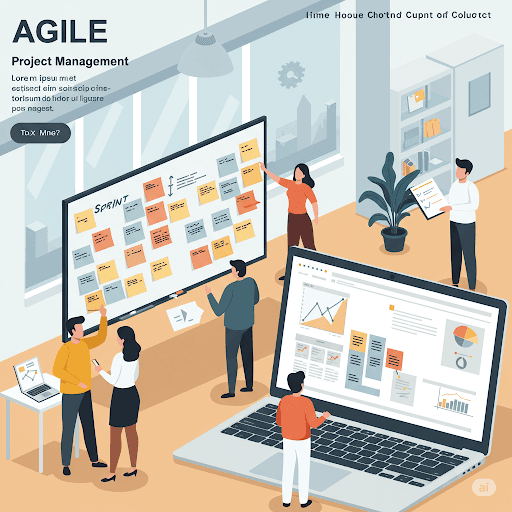
Agile Project Management is a flexible and iterative approach to project management that emphasizes the ability to quickly adapt to changing requirements. Although it originated in the field of software development, today it is applied across numerous domains including healthcare, public administration, education, and manufacturing. This approach aims to manage projects more efficiently and effectively by prioritizing customer focus, continuous feedback, and team collaboration.
Agile project management is an approach that breaks projects into small, manageable units and advances them through short iterative cycles. During this process, customer feedback is regularly collected and the project direction is adjusted as needed. This method provides flexibility and adaptability, particularly in projects characterized by high uncertainty.
Scrum aims to work in fixed time periods called sprints and deliver a functional product increment at the end of each sprint. Scrum teams typically consist of a Scrum Master, a Product Owner, and a Development Team. Kanban is a method used to visualize workflow and identify bottlenecks. Kanban boards enhance team efficiency by showing the current stage of each task.
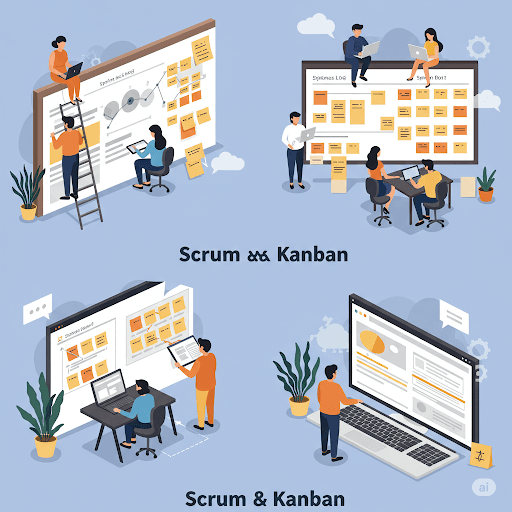
Çevik Yaklaşımlar : Scrum ve Kanban (Yapay Zeka Tarafından Oluşturulmuştur)
Published in 2001, the Agile Manifesto emphasizes four core values: individuals and interactions, working software, customer collaboration, and responding to change. These values form the foundation of agile methodologies and enable projects to be managed in a more customer-focused and flexible manner.
Agile methods are applied in many areas beyond software development. For example, patient care processes in healthcare, curriculum development in education, and policy implementation in the public sector are all managed using agile approaches.
The success of Agile Project Management depends on factors such as internal team communication, customer feedback, continuous improvement, and flexible planning. Additionally, organizational culture alignment with agile principles and strong leadership support are critical elements influencing success.
Challenges in implementing agile methods include organizational resistance, inadequate training, and misinterpretation of principles. To overcome these challenges, organizations must implement agile training programs, secure leadership commitment, and integrate an agile culture throughout the organization.
Artificial intelligence (AI) and automation technologies enhance Agile Project Management by improving data analysis, forecasting, and decision-making processes. AI-powered tools provide project managers with faster and more accurate decision-making capabilities.
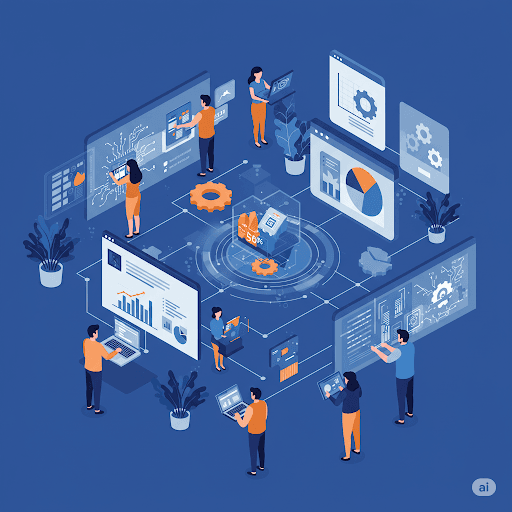
Çevik Proje Yönetiminde Yapay Zeka Entegrasyonu (Yapay Zeka Tarafından Oluşturulmuştur)
Frameworks such as SAFe (Scaled Agile Framework), LeSS (Large Scale Scrum), and the Spotify model have been developed to apply agile methods in large organizations. These approaches enable the effective implementation of agile principles across large teams and complex projects.
Agile Project Management aligns with goals of sustainability and social responsibility. By considering the environmental and social impacts of projects, it contributes to achieving more ethical and sustainable outcomes.
Abrahamsson, Pekka, Outi Salo, Jussi Ronkainen, and Juhani Warsta. "Agile Software Development Methods: Review and Analysis." *arXiv preprint arXiv:1709.08439* (2017).https://arxiv.org/abs/1709.08439
Dam, Hoa Khanh, Truyen Tran, John Grundy, Aditya Ghose, and Yasutaka Kamei. "Towards effective AI-powered agile project management." *arXiv preprint arXiv:1812.10578* (2018).https://arxiv.org/abs/1812.10578
Koi-Akrofi, Godfred Yaw, Joyce Koi-Akrofi, and Henry Akwetey Matey. "Understanding The Characteristics, Benefits And Challenges Of Agile IT Project Management: A Literature Based Perspective." *arXiv preprint arXiv:1910.06218* (2019).https://arxiv.org/abs/1910.06218
Turk, Dan, Robert France, and Bernhard Rumpe. "Limitations of Agile Software Processes." *arXiv preprint arXiv:1409.6600* (2014).https://arxiv.org/abs/1409.6600

Definition | Flexible, customer-focused, and iterative project management approach | ||||||||
|---|---|---|---|---|---|---|---|---|---|
Basic Principles | Flexibility Continuous Improvement Customer satisfaction Collaboration | ||||||||
Common Methods | Lean Scrum Kanban Extreme Programming (XP) | ||||||||
Application Area(s) | Healthcare services Software development Education Marketing Product management | ||||||||
Advantage | Team motivation Rapid delivery Customer satisfaction Flexibility | ||||||||
Difficulty | Application challenges Cultural change Management support | ||||||||
No Discussion Added Yet
Start discussion for "Agile Project Management" article
Core Principles and Implementation Approaches of Agile Project Management
Definition and Core Principles
Scrum and Kanban Approaches
The Agile Manifesto and Its Principles
Application Areas and Success Factors of Agile Project Management
Applications Beyond Software Development
Success Factors
Challenges and Solutions
The Future of Agile Project Management and Emerging Trends
Artificial Intelligence and Automation
Scaled Agile Approaches
Sustainability and Social Responsibility