


This article was automatically translated from the original Turkish version.
+1 More
Project management defines various work models followed by projects. These models are called life cycle project management process groups.
According to the PMBOK® GUIDE Seventh Edition, a project is defined as “a temporary endeavor undertaken to create a unique product, service, or result.” According to this definition, projects are a set of activities serving a specific objective. Each project has specific constraints. Project constraints are time, scope, and cost management. These constraints interact with each other, and a interaction must be maintained among these elements to achieve project objectives. Project constraints are represented by a triangle; “Time,” “Cost,” and “Scope” occupy the corners, while “Quality” is emphasized at the center.
Projects, like a recipe, consist of processes requiring adherence to specific steps. All projects, regardless of size, are divided into process groups. These process groups are organized similarly to the steps in applying a recipe.
The initiating process is the group of processes that formally define and authorize a project or a project phase. This phase ensures alignment of the project with the organization’s strategic objectives while also clarifying resource allocation and managerial responsibilities.
The most important output of this process group is the Project Charter. This document authorizes the project manager and outlines the project’s objectives and high-level scope.
Tools and Techniques Used:
The planning process encompasses the development of detailed plans that define how the project’s scope, objectives, deliverables, schedule, cost structure, quality, communication, risks, and stakeholder interactions will be managed. This group has a recurring and evolving nature because requirements and constraints may change.
The planning process involves creating the Project Management Plan and supporting plans, which form the foundation for execution and control activities. These documents provide the basis for execution and control activities.
Tools and Techniques Used:
The executing process is the group of processes that carry out the work as defined in the project plan, coordinate resources, and produce project deliverables. The objective of this process group is to deliver project outputs on time and within budget, meeting the planned quality and content standards.
During execution, team management, communication management, and stakeholder engagement processes take center stage. Supplier management and implementation of changes are also included in this process group.
Tools and Techniques Used:
This process group encompasses the systematic observation of project progress, comparison with plans, and implementation of corrective actions when necessary. Identification of deviations from project objectives and their effective correction occur within this process.
Tools and Techniques Used:
The closing process includes the procedures that formally document the completion of a project or phase and confirm that all planned work has been executed. In this stage, project resources are released, outcomes are evaluated, and lessons learned are recorded.
This process is not only an administrative closure but also holds significant learning value for organizational development. Acquired experiences are transformed into knowledge for use in future projects.
Tools and Techniques Used:
Project management process groups provide a structured roadmap for successfully managing and completing projects. Although these process groups offer a universal framework, different project delivery approaches (e.g., agile or waterfall) create significant variations in how these processes are applied. The PMBOK Guide addresses these differences within a flexible structure, providing guidance open to diverse approaches and practices.
In plan-driven, phased approaches such as the Waterfall model, project closure is achieved through the formal completion and verification of specific deliverables and project outputs. Since processes in this model proceed sequentially, project closure typically occurs at a single point after project objectives have been met. Key activities performed at this stage include:
This structure is preferred when clarity, predictability, and control are prioritized in project management.
In agile approaches, project closure is viewed not as a single event but as part of a continuous, iterative learning process. Projects are not oriented toward a fixed endpoint but focus on meeting evolving customer needs. Therefore, closure typically occurs at a micro level after each iteration or product increment. Key elements in agile closure processes include:
Agile approaches prioritize flexibility and customer feedback in managing projects with high uncertainty and variability. Therefore, project closure is seen not as an “end” but as an evolution of an ongoing process.

class=\
According to the PMBOK Guide Seventh Edition, process groups enable projects to be managed not only in a phased structure but also within a holistic and value-oriented system. Each process group has its own set of tools and techniques, which can be flexibly applied depending on the project’s nature, complexity, and organizational structure. In project management, these process groups form the foundation for both operational efficiency and achievement of strategic objectives.
class=\
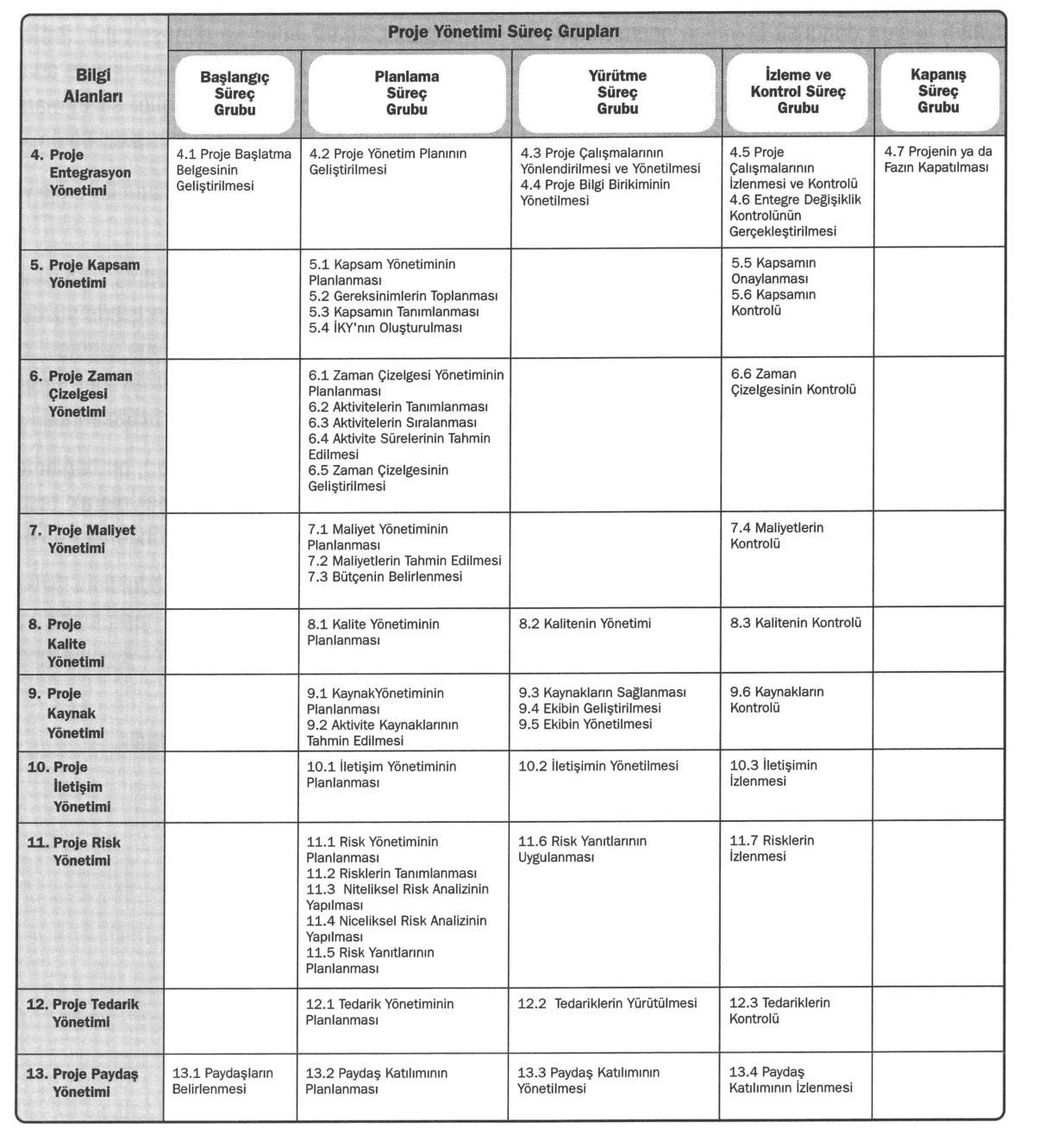
According to the PMBOK Guide, project management is carried out through a total of 49 Management Processes based on 10 Knowledge Areas and 5 Core Process Groups. The 10 Knowledge Areas encompass the essential elements that must be managed at every stage of the project and include project time, cost, quality, scope, resources, risk, communication, procurement, stakeholder, and integration management. Each knowledge area guides managers by addressing different aspects of the project, ensuring balanced management of all project dimensions and successful completion.
Success in project management is achieved through proper planning and effective communication. Setting clear objectives throughout the project lifecycle, using resources efficiently, and anticipating potential risks are essential. Ultimately, applying project management process groups requires careful planning, continuous monitoring, and a proactive, solution-oriented approach.
Greene, Jennifer, and Andrew Stellman. Head First PMP. İstanbul: Yakın Plan, 2022.
Project Management Institute. A Guide to the Project Management Body of Knowledge (PMBOK® Guide). 7th ed. Newtown Square, PA: Project Management Institute, 2021.
Project Management Institute. Project Manager Competency Development Framework – Third Edition. Newtown Square, PA: Project Management Institute, 2017.
İstanbul Teknik Üniversitesi Sürekli Eğitim Merkezi (İTÜSEM). "Proje Yönetimi Uzmanlığı Sertifika Programı." Accessed April 5, 2025.https://itusem.itu.edu.tr/egitim-ve-programlar/isletme-fakultesi-sertifika-programlari/proje-yonetimi-egitimi-sertifika-programi.

No Discussion Added Yet
Start discussion for "Process Groups in Project Management" article
Process Groups
1. Initiating Process Group
2. Planning Process Group
3. Executing Process Group
4. Monitoring and Controlling Process Group
5. Closing Process Group
Project Closure in Traditional (Waterfall - Predictive) Approaches
Project Closure in Agile Approaches
General Evaluation