


This article was automatically translated from the original Turkish version.
+2 More
Project Management Approach Types
Door | Hybrid Approach (Hybrid) Adaptive Approach (Adaptive – Agile) Predictive Approach (Predictive – Waterfall Model) | ||||||||
|---|---|---|---|---|---|---|---|---|---|
In project management, there are three distinct approaches: Predictive, Adaptive, and Hybrid. These approaches are applied and subdivided based on the nature and requirements of the project.
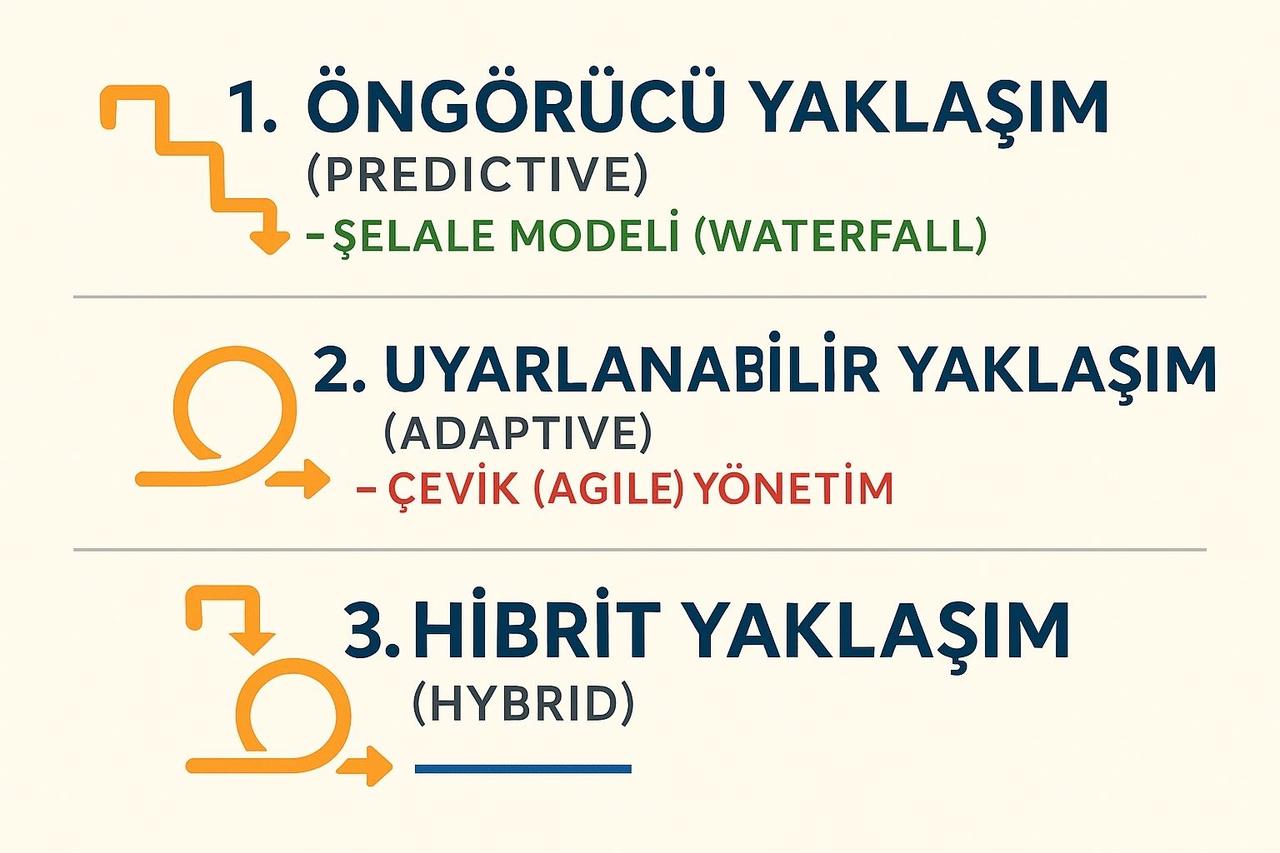
Project Management Approach Types (Generated by artificial intelligence.)
Predictive project management is an approach based on detailed and comprehensive planning. Software such as Microsoft Project (MS Project) is widely used in this model. At the outset of the project, scope, time, cost, resource requirements, and risks are planned in detail. Uncertainty is low, and project success depends on the clear definition of scope from the beginning. In predictive life cycles, the project schedule, scope, and costs are defined in advance. The initial phases of the project determine how the remainder will be executed, and the project team does its best to implement the plan and minimize the impact of changes.
• In this approach, the scope is clearly defined at the start, and detailed schedules and cost plans are developed.
• The project process operates in sequential phases; first analysis, then design, followed by development, and so on.
• Changes are expected to be minimal, as scope changes affect the entire plan.
• Documentation is intensive and controlled; PMI’s knowledge areas and process groups are applied within this structure.
• Suitable Areas: Sectors requiring high levels of order, such as construction, manufacturing, and defense industry.
For example, construction projects align well with this model. Once the floors of a building are completed, major changes to the scope are not feasible. Therefore, in the predictive approach, changes are minimized to ensure the project proceeds in a stable manner.
• Gantt chart
• Critical Path Method (CPM)
• PERT (Program Evaluation Review Technique)
• WBS (Work Breakdown Structure)
• Scheduling
• Resource Leveling
• Cost Estimation
• RACI Matrix
• Risk Registers
• Quality Control Checklists
• Microsoft Project – scheduling, Gantt charts.
• Primavera P6 – enterprise project planning.
• Smartsheet – table-based planning.
• Excel – manual planning and tracking.
• ProjectLibre – open-source project scheduling tool.
• Lucidchart / Draw.io – creating WBS and process flows.
Adaptive project management is an approach developed for projects with variable requirements. In this method, continuous feedback is obtained through a flexible and iterative process. Agile methodologies are widely used, especially in software development projects. Adaptive life cycles are entirely focused on change. Teams that adopt an adaptive approach repeatedly execute all project activities not to plan and execute a fixed plan, but to deliver valuable small portions of the project to stakeholders.
• The scope is not clearly defined at the outset; it evolves over time. Customer needs become clearer throughout the process.
• The project is built on iterative and incremental deliveries.
• Tools such as user stories, feedback loops, and product backlogs are used.
• Team autonomy, continuous communication with the customer, frequent deliveries, and evaluation meetings are fundamental.
• It aligns with the values of the Agile Manifesto (individuals, software, customer collaboration, responding to change).
• Suitable Areas: Software development, R&D, product design, and other dynamic and variable environments.
In this model, a Product Backlog is created. The timing of which tasks will be delivered is not predetermined. Development proceeds in iterations (sprints) and is shaped according to customer feedback. Tasks are added to the backlog and selected for inclusion in the sprint plan during meetings based on priority.
In addition to these two primary models, the hybrid approach combines predictive and agile methodologies and is used to provide flexibility across various sectors.
• Scrum
• Kanban
• Product Backlog
• Sprint Planning / Daily Stand-up
• Burndown Chart
• User Story Mapping
• Velocity Tracking
• MVP (Minimum Viable Product)
• Test-Driven Development (TDD)
• Jira – Scrum and Kanban boards, backlog management.
• Trello – visual Kanban boards.
• Asana – task and sprint management.
• ClickUp – task tracking, agile boards.
• Monday.com – agile project boards.
• Azure DevOps – agile tools for software development.
• Miro – digital whiteboard for agile planning.
• VersionOne – agile management platform.
The Hybrid Approach is a project management method that combines Predictive and Agile techniques. Most projects are produced in environments that integrate both predictive and agile approaches. The hybrid approach, which simultaneously applies traditional and agile management philosophies, is widely preferred in sectors such as defense industry. While predictive approaches dominate in process and project departments, agile management is favored for processes such as web software development. Overall, the Hybrid Approach presents a practical example of integrating these two methods.
• It combines waterfall and agile structures to balance flexibility and control.
• System development is typically managed predictively, while interface design is managed agilely.
• It is used in scenarios where adaptive and pre-planned work components coexist.
• Projects may include both phased stage gates and sprint deliveries.
• Integration, coordination, and clear role definition are critical for success.
• Suitable Areas: Corporate transformation projects, technology integrations, comprehensive digitalization processes.
For projects divided into phases, numerous approaches exist between sequential and overlapping methods. When iterative relationships exist between phases, while initiation and planning processes are carried out for a single work component, the team continues executing the Execution process of the previous phase. Thus, once the Execution and Closure processes are completed, the team can directly move to the Execution process of the next phase. In projects managed by flexible methods such as agile software development, overlapping phases are common.
• Agile-Waterfall Integration
• Phase-based planning + Sprint-based deliveries
• Risk and Change Management
• Phase-gated Deliveries + Scope Management
• Integrated tracking using both sprint boards and Gantt charts
• Stakeholder Analysis and Engagement Management
• Microsoft Project + Jira Integration – schedule and agile process integration.
• Smartsheet + Trello / Jira – hybrid workspaces.
• Wrike – project management supporting both traditional and agile methods.
• ClickUp – creating projects with multiple methodologies.
• Zoho Projects – mixed planning options.
• Planview AgilePlace – integration of classical planning with agile teams.
Project Management Institute (PMI) Official Website. Accessed April 13, 2025.https://www.pmi.org.tr/
The Standard for Project Management and A Guide to the Project Management Body of Knowledge (PMBOK® Guide). 7th ed. Newtown Square, PA: Project Management Institute, 2021.

Project Management Approach Types
Door | Hybrid Approach (Hybrid) Adaptive Approach (Adaptive – Agile) Predictive Approach (Predictive – Waterfall Model) | ||||||||
|---|---|---|---|---|---|---|---|---|---|
No Discussion Added Yet
Start discussion for "Approach Types in Project Management" article
Predictive Approach (Predictive) – Waterfall Model – Traditional Channel
Advantages:
Disadvantages:
Tools and Techniques:
Application Programs:
Adaptive Approach (Adaptive) – Agile Management
Advantages:
Disadvantages:
Tools and Techniques:
Application Programs:
Hybrid Approach
Tools and Techniques:
Application Programs: