


This article was automatically translated from the original Turkish version.
+1 More
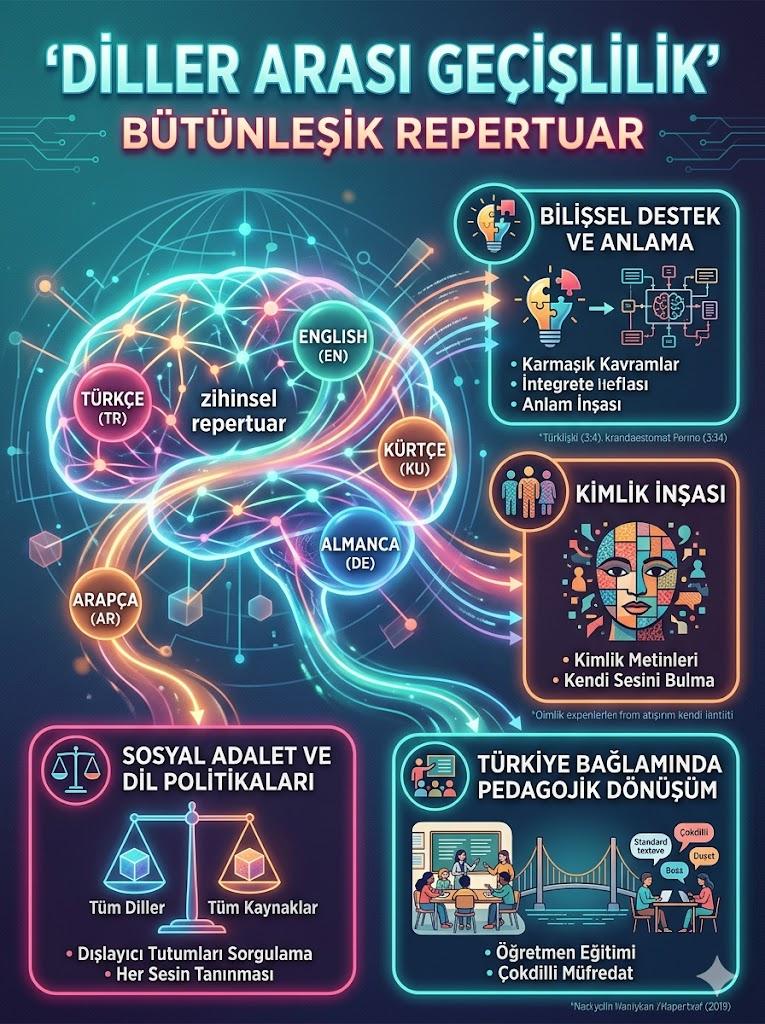
(Generated with Artificial Intelligence.)
Interlinguistic Transition
Application Format | Face-to-face/online classrooms, EMI English instruction, note-taking, consultation, and facilitator perception | ||||||||
|---|---|---|---|---|---|---|---|---|---|
Justice Dimension | Rejection of standard language hierarchies; recognition of linguistic resources of marginalized students | ||||||||
Türkiye Context | Transnational migration, critique of rigid immersion exposure, and resistance strategies in academia | ||||||||
Developing Academics | Garcia, Blackledge, Creese, Canagarajah | ||||||||
First Name | Trawsieithu | ||||||||
Writing Strategy | Mixing of dialects and local expressions (code-meshing) | ||||||||
First Appearance | 1980s, Wales | ||||||||
Founding Name | Cen Williams | ||||||||
First Usage Area | Bilingual education environments | ||||||||
First Usage Area | Bilingual education environments | ||||||||
Founding Name | Cen Williams | ||||||||
Developing Academics | Garcia, Blackledge, Creese, Canagarajah | ||||||||
First Appearance | 1980s, Wales | ||||||||
Writing Strategy | Mixing of dialects and local expressions (code-meshing) | ||||||||
Translanguaging is the process by which multilingual individuals draw upon their full range of linguistic and semiotic resources not as separate systems but as an integrated repertoire for meaning-making. This approach challenges the traditional monolingual paradigm that views languages as closed systems rigidly divided by social, cultural, and political boundaries.
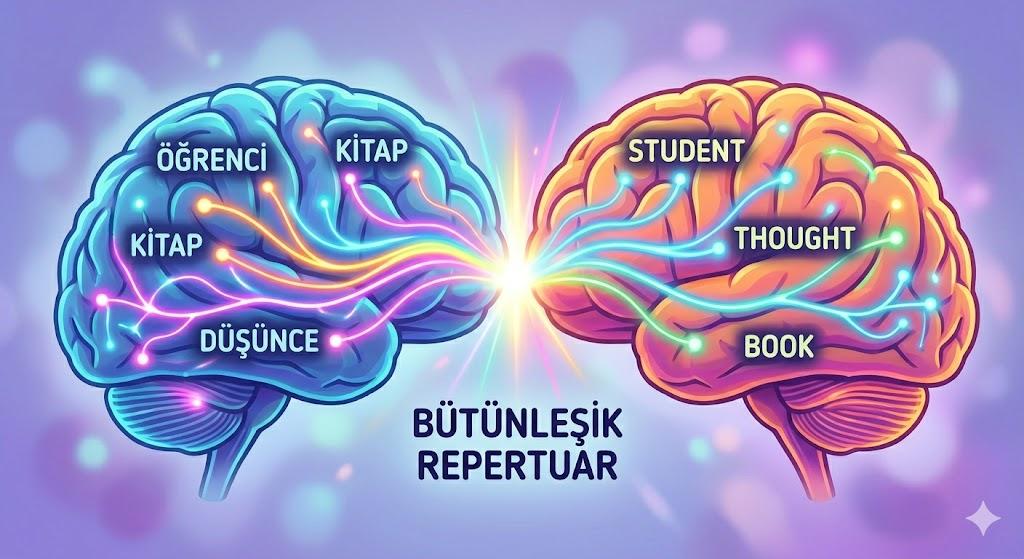
Visual Representation of the Integrated Repertoire (Generated by Artificial Intelligence)
The concept was first introduced in the 1980s in bilingual educational settings in Wales by Cen Williams using the Welsh term "trawsieithu"; it was later translated into English as "translanguaging". 【1】 Initially defined as the planned and systematic use of two languages within the same lesson, the concept has since been expanded by scholars such as García, Blackledge, Creese, and Canagarajah into a broad theoretical framework encompassing both spoken interaction and multilingual practices in written texts.【2】 Theoretically, language is viewed not as a static object (noun) but as a continuous process of becoming (verb/languaging).
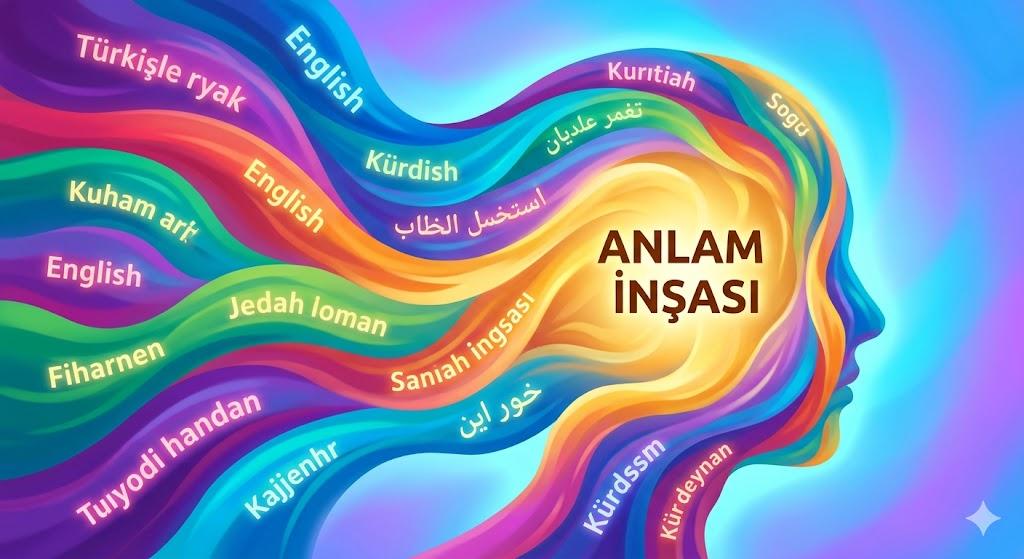
Visual Representation of Meaning Construction (Generated by Artificial Intelligence)
Translanguaging pedagogy positions students’ home languages and other linguistic resources not as obstacles to learning but as cognitive and social tools. The core functions of this pedagogical approach are categorized as follows:
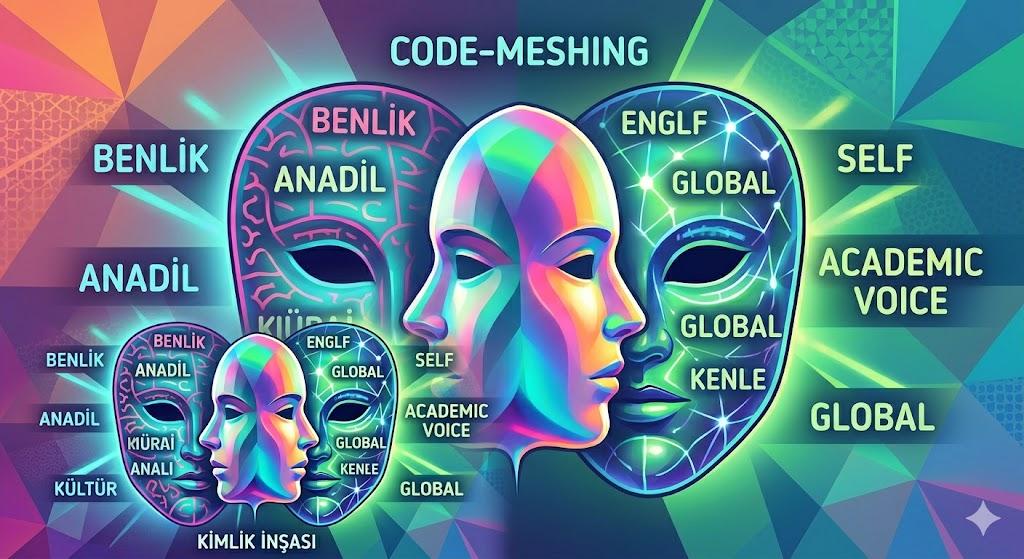
Visual Representation of Code-meshing (Generated by Artificial Intelligence)
Translanguaging practices are observed not only in face-to-face classrooms but also in online foreign language classrooms, in content and language integrated learning (CLIL) settings where English is the medium of instruction (EMI), and in writing courses.
Translanguaging is also linked to the dimension of social justice in language education. This approach questions the hierarchies imposed by notions of "standard" or "target" languages and advocates for the recognition of multilingual resources of marginalized students within educational settings.【4】 Rejecting the nation-state ideology of the "two monolinguals in one body," it argues that languages function as complementary competencies rather than isolated systems.【5】
Türkiye has become a geographic space where multilingualism is intensively experienced, due to increasing international student mobility and migration waves.
Altun, Hatice. "Diller Arası Geçişlilik (Translanguaging): Çıkarımlar ve Türkiye Bağlamında Artan İhtiyaç." *AVRASYA Uluslararası Araştırmalar Dergisi* 9, no. 29 (2021): 61–83. Accessed April 4, 2026. https://dergipark.org.tr/tr/download/article-file/2128249
Canlı, Bekir, and Zeynep Canlı. "Translanguaging in Online Foreign Language Classrooms: Students’ Perceptions." *Erciyes Akademi* 37, no. 3 (2023): 1162-1181. Accessed April 4, 2026. https://dergipark.org.tr/tr/download/article-file/3251559
Conteh, Jean. "Translanguaging." *ELT Journal* 72, no. 4 (2018): 445–447. Accessed April 4, 2026. https://academic.oup.com/eltj/article/72/4/445/5098484?guestAccessKey=
[1]
Bekir Canlı and Zeynep Canlı, "Translanguaging in Online Foreign Language Classrooms: Students’ Perceptions," Erciyes Akademi 37, no. 3 (2023): 1163, https://dergipark.org.tr/tr/download/article-file/3251559
[2]
Jean Conteh, "Translanguaging," ELT Journal 72, no. 4 (2018): 445, https://academic.oup.com/eltj/article/72/4/445/5098484?guestAccessKey=
[3]
Canlı and Zeynep Canlı, "Translanguaging in Online Foreign Language Classrooms: Students’ Perceptions," 1162.
[4]
Conteh, "Translanguaging," ELT Journal 72, no. 4 (2018): 446.
[5]
Hatice Altun, "Translanguaging: Implications and Growing Need in the Turkish Context," AVRASYA International Research Journal 9, no. 29 (2021): 62, https://dergipark.org.tr/tr/download/article-file/2128249

(Generated with Artificial Intelligence.)
Interlinguistic Transition
Application Format | Face-to-face/online classrooms, EMI English instruction, note-taking, consultation, and facilitator perception | ||||||||
|---|---|---|---|---|---|---|---|---|---|
Justice Dimension | Rejection of standard language hierarchies; recognition of linguistic resources of marginalized students | ||||||||
Türkiye Context | Transnational migration, critique of rigid immersion exposure, and resistance strategies in academia | ||||||||
Developing Academics | Garcia, Blackledge, Creese, Canagarajah | ||||||||
First Name | Trawsieithu | ||||||||
Writing Strategy | Mixing of dialects and local expressions (code-meshing) | ||||||||
First Appearance | 1980s, Wales | ||||||||
Founding Name | Cen Williams | ||||||||
First Usage Area | Bilingual education environments | ||||||||
First Usage Area | Bilingual education environments | ||||||||
Founding Name | Cen Williams | ||||||||
Developing Academics | Garcia, Blackledge, Creese, Canagarajah | ||||||||
First Appearance | 1980s, Wales | ||||||||
Writing Strategy | Mixing of dialects and local expressions (code-meshing) | ||||||||
No Discussion Added Yet
Start discussion for "Interlinguistic Transition" article
Conceptual Origins and Theoretical Development
Pedagogical Functions and Strategies
Application Areas and Student Perceptions
Social Justice and Language Policies
Significance and Needs in the Turkish Context