


This article was automatically translated from the original Turkish version.
+2 More
Epic of Battal Gazi
Written Century | On Third Century | ||||||||
|---|---|---|---|---|---|---|---|---|---|
Initial Form | Flat Script (Mensur) | ||||||||
Historical Origin | Umayyad-Byzantine Wars | ||||||||
Central Geography | Malatya | ||||||||
Birth Name | Cafer | ||||||||
Horse | Aşkar | ||||||||
First Spouse | Zeynep | ||||||||
Close Friend | Abdülvehhap Gazi | ||||||||
Father | Hüseyin Gazi | ||||||||
Basic Characteristic | Ideal Gazi Type | ||||||||
Battal Gazi Epic is an epic folk tale that recounts the military and religious campaigns of the historical hero Battal Gazi, who gained fame in the 8th century for his achievements during the Umayyad-Byzantine wars, in his efforts to spread and defend Islam. This work is also known by various titles such as Menakıb-ı Gaazavâtı -ı Seyyid Battal Gazi, Hikayet-i Seyyid Battal Gazi, Seyyid Battal Gazi Menkıbeleri, and Kitab-ı Battal Gazi. Its longest and most complete title is recorded as "Hazret-i ‘Ali Kerremâ’llahu Vechehu Hazretlerinin Sülâle-i Tâhirelerinden Seyyid Battal Gâzî Hazretlerinin Gaazavâtıdır". The earliest version of the epic, known to have been composed in prose (mensur), was written down and preserved in the 13th century.【1】Menakıb-ı Gaazavâtı -ı Seyyid Battal Gazi, Hikayet-i Seyyid Battal Gazi, Seyyid Battal Gazi Menkıbeleri ve Kitab-ı Battal Gazi gibi muhtelif isimlerle de zikredilen bu eserin en uzun ve tam adı "Hazret-i ‘Ali Kerremâ’llahu Vechehu Hazretlerinin Sülâle-i Tâhirelerinden Seyyid Battal Gâzî Hazretlerinin Gaazavâtıdır" şeklinde kayıtlıdır. İlk biçiminin düz yazı (mensur) türünde olduğu bilinen destan, XIII. yüzyılda yazıya geçirilerek kaydedilmiştir.【2】
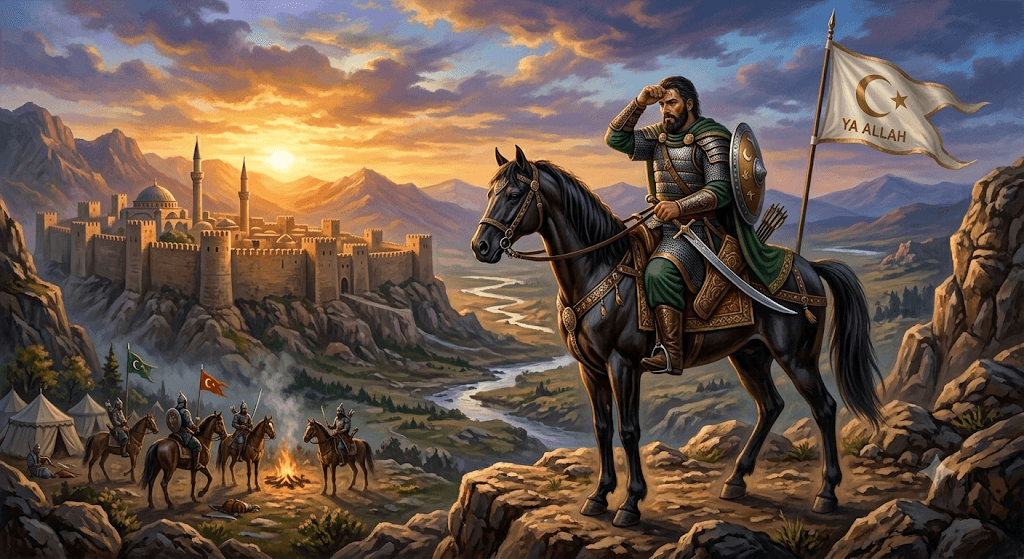
Temsili Battal Gazi Görseli (Yapay Zeka İle Oluşturulmuştur)
Although it emerged after the invention of writing, this work retains the characteristics of a natural epic. Its narrative centers on Battal Gazi’s military struggles against Christian and Byzantine communities in Anatolia and his sacrifices for the Turkification and Islamization of the region. The geographical area where these military activities and historical services took place extends from the center of Malatya to the walls of Istanbul, which formed the Byzantine frontier at the time.【3】
As of the 8th century, when the pivotal events occurred, Battal Gazi is confirmed by historical sources as a real historical figure.【4】 However, over time he became a shared cultural element among Muslim communities from Al-Andalus to Central Asia, and his historical identity gradually merged with his legendary persona in collective memory.
Numerous historical sources, including Ya'qubi, Tabari, Masudi, Ibn Asakir, Ibn al-Athir, Sibt ibn al-Jawzi, Ibn Shakir al-Kutubi, Ibn Fazlullah al-Umari, Zahabi, Ibn Kathir, and Gelibolulu Mustafa Ali, up to Evliya Çelebi, present a fusion of history and legend.【5】 Consequently, when existing narratives are subjected to scholarly and historical criticism and legendary elements are separated, the concrete historical identity of Battal Gazi remains inadequately documented.
In historical records, Battal Gazi appears as a commander who gained renown during the 8th century Umayyad military campaigns against the Byzantine Empire in Anatolia. There are differing views regarding his historical identity, lineage, birthplace, and real name.
Historical and folkloric sources present two prevailing tendencies regarding Battal Gazi’s lineage and origin. The generally accepted view, supported by researchers such as Boratav, Hasan Köksal, and Saim Sakaoğlu, identifies Battal Gazi as an Arab commander and Arab hero who served in the Umayyad army.【6】 This perspective aligns with local accounts gathered in field studies conducted in Malatya and the Battal Gazi district, where the populace and informants describe him as an Arab figure originating from Arabia. Additionally, due to beliefs in his miraculous powers, he is widely regarded in society as a descendant of the Prophet and referred to as "evlad-ı Resul" or "Seyyid."
In contrast, a second view, based on historical documents cited by Islamic historians Ibn al-Athir and Ibn Asakir, holds that Battal Gazi was not originally Arab but belonged to a family of freed slaves who had pledged allegiance to the Umayyad dynasty. There are conflicting reports regarding his birthplace, as Ibn al-Athir and Ibn Kathir claim he was from Antioch, Sibt ibn al-Jawzi asserts he was from Damascus (Shami), while the written epic text Battalnâme records his birthplace as Malatya.【7】
Battal Gazi’s real identity and the pseudonyms he adopted during his military operations clarify the distinction between official historical records and oral folk narratives. Upon examining the naming conventions associated with his persona, a clear differentiation emerges between his historical and epic names: official historical sources record his true name as Abdullah, whereas the literary and epic text Battalnâme states that his original name before acquiring fame and titles was Cafer.
Field studies conducted in Malatya and the Battal Gazi district reveal that local informants are unfamiliar with the name "Abdullah" from historical records but consistently refer to him as "Cafer." This data indicates that the local population has fully embraced the epic name, demonstrating their recognition and internalization of Battal Gazi’s legendary and hagiographic persona rather than his concrete historical identity.【8】
In addition, during his military campaigns, Battal Gazi employed numerous pseudonyms for strategic purposes, including Abdülmesih, Akanuş, Akkuş, Cayil, Kanatus Nerker, Mihruz, Sercail, Şamil, Şemsuran, Yehuda, and Zengbar. The Arabic-origin word "Battal," which eventually became his primary name, means "hero" in dictionaries and functions in the texts as a title symbolizing his exceptional qualities and warrior attributes.【9】
The Battalnâme gained widespread social acceptance and prestige among both civilian populations and military circles across Anatolia and other Turkish regions. Due to high public demand, the text was repeatedly copied by hand (istinsah) or printed over centuries; thus, the total number of surviving manuscripts cannot be precisely determined. The original manuscript from the time of its composition has not survived. However, numerous copies in verse, prose, and printed forms are preserved in libraries and private collections both within and outside Türkiye. Since the 1800s, numerous editions have been published based on high-quality manuscripts dating to the second half of the 13th century or the first half of the 14th century.【10】
Battal Gazi’s ancestor Ali, while serving as imam in Medina, fled the city one night after the Kharijites seized power and migrated to Malatya. With the approval of Malatya’s ruler Ziyad, Ali settled in the city and was appointed as a preacher, thereby securing the legal foundation for his livelihood. Subsequently, his lineage continued: Ali had a son named Rebi in Malatya, and Rebi fathered two sons, Hasan and Hüseyin. It was through the messenger Tevabil, who brought the news to Hüseyin Gazi during a hunt, that the birth of Cafer, who would later become known as Battal Gazi, occurred. Thus, this chain of births demonstrates the epic’s emphasis on the uninterrupted continuation of lineage and the secure biological survival of the hero within a defined geographical space.【11】
Upon the death of Malatya’s ruler Ziyad, his son Numan succeeded him, assigning Hasan to the role of preacher and Hüseyin Gazi to the position of military commander. Hüseyin Gazi secured the city’s safety by defeating the enemy ruler Kayser. However, after Hüseyin Gazi was martyred by Mihras, Malatya was left without a commander.【12】 At that time, Cafer was only three years old and too young to assume command. Therefore, Emir Ömer and the city’s leading figures convened and decided to appoint Abdüsselam as commander until Cafer reached maturity. This administrative measure effectively addressed the security vacuum.
During a hunt, Hüseyin Gazi pursued a deer into a cave and encountered a horse (Aşkar) and a bundle. As he attempted to tame the horse, an invisible voice called out to it: "Ya Aşkar! Allah has given you to Cafer; mount him and liberate the earth from the darkness of disbelief; serve this hero." Hearing this voice, the horse calmed down. Hüseyin Gazi then took possession of a lance inscribed with "It belongs to Cafer", along with garments, hair of Adam, and weapons of David and Hamza.【13】
At the age of thirteen, Cafer underwent an educational process that legally and socially secured his spiritual and material readiness. Spiritually, he memorized the four holy books and attained mastery in Hadith and Tafsir, reaching a level sufficient to deliver sermons from the Friday pulpit. Materially, he trained under the renowned warrior Gazban, excelling in horsemanship and the use of mace, lance, sword, and wrestling. Having completed this dual education, Cafer first invited Mihras, his father’s killer, and his followers to embrace Islam. When they refused, he beheaded Mihras, eliminating the major security threat to Malatya.【14】
After Mihras’s death, Cafer returned to Malatya and was joyfully welcomed by his mother, his foster mother Tevabil, his companions, and the Malatya beys, earning the affection of his community. When Kayser sent a large army to avenge Mihras, panic spread in Malatya. Accusing himself of responsibility for the crisis, Abdüsselam prompted Cafer to leave the city alone to confront the enemy. In response to this sacrifice, Tevabil and his companions immediately followed him. Upon Abdülvehhap’s reproachful address to Emir Ömer and the beys, all the Malatya warriors rushed to Cafer’s aid. This unified mobilization of the Islamic army and the beys confirmed Cafer’s legitimacy as a civil and military leader.【15】
Following the decisive victory over Kayser’s army, a period of respect, admiration, and recognition began for Cafer among military and religious authorities. First, the warriors swore allegiance to him, openly declaring: "Our master is Cafer; we are his bound servants." Abdülvehhab Gazi then presented a sacred letter, explaining that the Prophet Muhammad, through the angel Gabriel, had foretold Cafer’s qualities and that he would come two centuries later to conquer the land of the Romans.【16】
Finally, his institutional status was completed through the caliph’s official appointment. After receiving a letter of conquest and a share of the spoils, the Islamic caliph dispatched messengers to announce the great victory throughout the Roman and Syrian provinces and formally conferred upon Cafer the title of governor of Malatya as an official token of recognition. Thus, these legitimacy steps completed the hero’s social status and honor.【17】
According to oral traditions, Battal Gazi’s martyrdom is recounted in two versions. The first, known as the Roma Castle Narrative, states that while on a campaign toward Eskişehir, he rested beneath the walls of a Roman castle. There, he was struck on the head by a stone thrown by the castle king’s daughter, whom he had fallen in love with. His death is believed to have resulted from this accidental injury combined with previous physical wounds sustained in battle.
According to the second narrative, the Flood and Grave Narrative, immediately after Battal Gazi was martyred near Eskişehir-Bilecik, a supernatural flood occurred, sweeping away his physical body and causing it to vanish. Consequently, among the people, the belief became widespread that Battal Gazi has no tangible grave.【18】
Epic texts mention Zeynep as Battal Gazi’s first wife and Ali as one of his three sons. In the Battal Gazi district of Malatya, tombs dedicated to these two family members exist. Accordingly, Ali’s tomb is known locally as the "Ali Baba Türbesi."【19】 According to preserved accounts, while Battal Gazi was engaged in military campaigns against Kayser-i Rum outside Malatya, a local judge who outwardly appeared Muslim but inwardly remained an unbeliever took advantage of his absence and murdered his wife Zeynep. Upon his return, Battal Gazi had the judge executed and, to amplify the deterrent effect of the punishment, had his skin stretched and stuffed with straw.【20】
The Umayyad Arab commander Battal Gazi was transformed into a religious hero in the written epic text Battalnâme, becoming the subject of historical reinterpretation. The adaptation of this folkloric work into cinema introduced a transition process described by Richard Bauman as "intergeneric textualism" and by Ute Heidmann as "generic reconfiguration."【21】 The film Battal Gazi Destanı underwent significant modifications within the framework of intertextuality: large portions of the source text were removed, narratives were shortened, the number of stories and historical details was reduced, and a condensed text was produced.【22】
Battalnâme consists of nineteen extensive chapters covering the Prophet Muhammad’s prophecy of Battal Gazi’s arrival, the hero’s birth and childhood, and his supernatural battles across various regions. In the cinematic adaptation, these multiple geographical settings and fantastical elements were entirely omitted, and the focus was narrowed exclusively to his struggles against the Byzantines. Consequently, religious opening scenes from the epic—such as Hüseyin Gazi receiving the sacred horse Aşkar and prophetic relics from a cave for his unborn son Cafer (Battal Gazi), or Cafer’s vision of the prophetic message—were excluded from the film.
The film begins in a fictional political atmosphere in which the Byzantines pay tribute to the Malatya Beylik. Hüseyin Gazi is assassinated in a trap set by the collaborator Abdüsselam and the Byzantine commander Polemon at the Süleyman Gazi Türbesi. While the theme of avenging the father’s death forms a common backbone in both versions, the treatment differs. In the epic, Cafer, after completing his religious and military training at age thirteen, kills enemy beys and brings their heads to Malatya. In the film, Cafer receives only sword training from his mentor Tevabil, with no religious education scenes, and ten years later travels to Amoryon Castle to bring back the heads of the governor Polemon and Testor. Abdüsselam’s initial disbelief in these victories and his eventual acceptance upon seeing the heads remain a shared narrative structure in both the epic and the film.【23】
In the film, Battal Gazi’s religious motifs are diminished, and he is reimagined as a Turkish/Turkmen gazi-alp archetype, as evidenced by the Byzantines’ derogatory references to him as a "poor Turkmen" or "hairless Turkmen." The serious and solemn demeanor of the epic is replaced in the film with a satirical and parodic tone suited to popular cinema’s entertainment goals. Examples of this parody include Hüseyin Gazi calling his enemy the "Byzantine Crow," Cafer addressing the knight Alyon as "Ox-Head Alyon," the use of comedic elements when he secretly enters the palace, and clichéd expressions such as "The Whore Byzantium."【24】
In terms of spatial and character transformation, the scene in the epic where the defeated enemy wrestler Ahmer praises Cafer in a kiosk and converts to Islam, taking the name Ahmed Tarran after wrestling, is parodically relocated in the film to a brothel called the Temple of the Forty Virgins. There, the enemy warrior Hammer, after drinking and wrestling with Cafer, converts to Islam and adopts the name Ahmet Turani, and in return, grants Cafer the title "Battal."
Regarding marriage and monogamy, the epic depicts Battal Gazi marrying numerous women, many of whom converted from Christianity. In contrast, the film adheres to modern family norms by portraying monogamy: the hero marries only the Byzantine princess Elenora, whom he renames Ayşe Sultan. The cast was simplified: Abdülvehhab Gazi, one of the epic’s main figures, was removed from the film. Characters such as Elenora, Leon, Polemon, İren, Alyon, Testor, Hilaryon, and Faustina—none of whom appear in the original Battalnâme—were synthesized from various folk narratives and novels to streamline the plot into cinematic figures.【25】
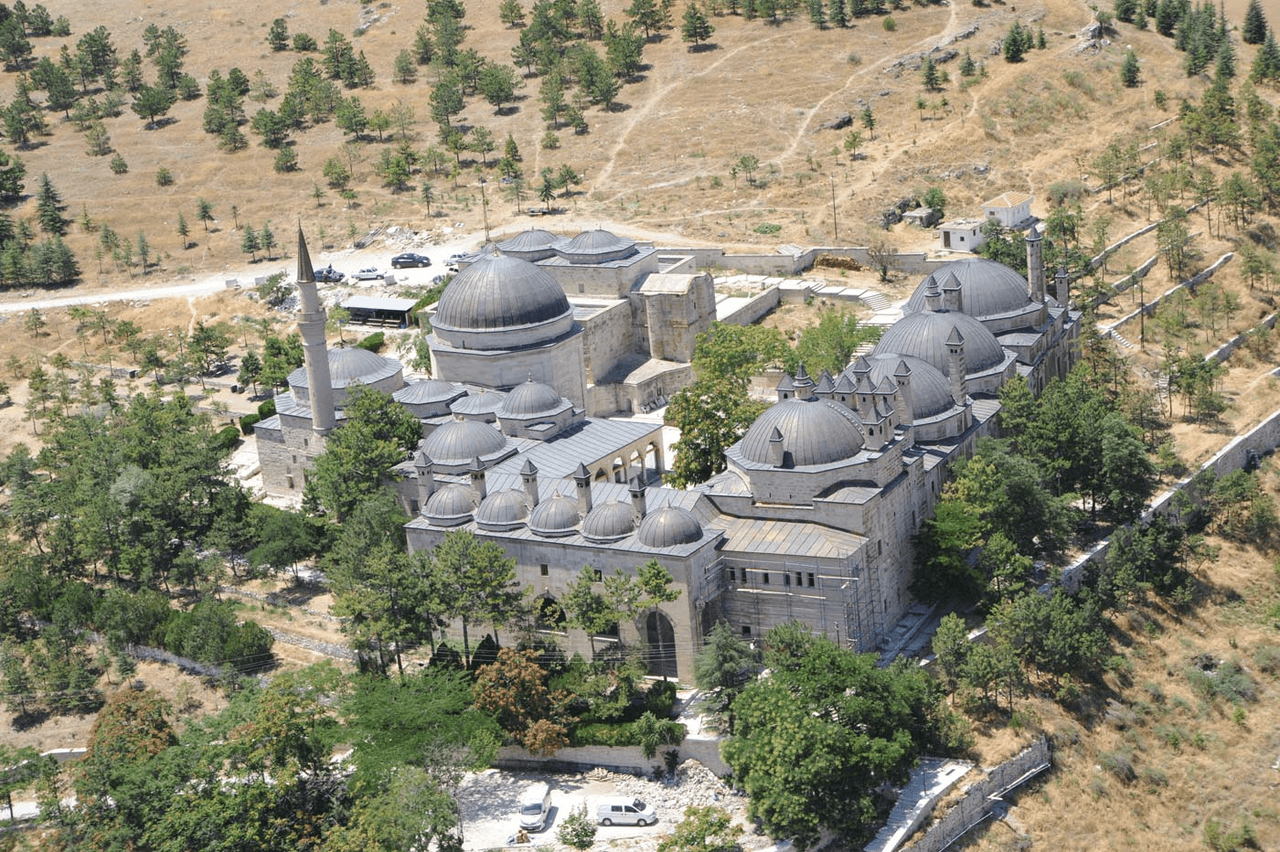
Battal Gazi Külliyesi (Türkiye Kültür Portalı )
The Seyyid Battal Gazi Külliyesi is a historical religious and social complex centered around the tomb of Seyyid Battal Gazi, a figure revered as a saint, warrior, and seyid across various sects and Sufi orders in Eskişehir’s Seyitgazi district.
According to legend, after the location of Seyyid Battal Gazi’s tomb was revealed in a dream, his tomb and later a mosque were built by Ümmühan Hatun, mother of the Anatolian Seljuk Sultan I. Alaeddin Keykubat.【26】 Due to its location along the Istanbul-Baghdad-Hijaz pilgrimage route, the külliye served as a lodging center for pilgrims. During the Ottoman period, it was expanded with the addition of a madrasa, imaret, tekke, and dergah.
The complex was repaired and enriched with new additions during the reigns of Fatih Sultan Mehmet, II. Bayezid, and Yavuz Sultan Selim. During Sultan Süleyman’s Iranian campaigns, further additions were made, and during Sultan Murad IV’s Revan campaign, a caravanserai was added to the complex. The külliye, through its madrasa, functioned as a center for Islamic sciences and, chronologically, became first a major center for Kalenderi dervishes and later an important hub and pilgrimage site for the Bektaşi order.【27】
Dal, Sevgi. "Malatya’da Yaşayan Bir Anlatı Olarak Battal Gazi Destanı." Uluslararası Folklor Akademi Dergisi, Volume 2, no. 2 (2019): 311-322. Accessed July 7, 2026.
Gümüş, İnan. "Battalname’nin Sinemadaki Yansıması: Battal Gazi Destani (1971) Filminde Göstergelerarası Dönüşümler." *Yeni Türk Edebiyatı Araştırmaları* 17, no. 34 (2025): 493-514. Accessed July 7, 2026.
Metin, Mustafa. "Maslow’un İhtiyaçlar Hiyerarşisi Bağlamında Battal Gazi." *AVRASYA Uluslararası Araştırmalar Dergisi*, Volume 10, no. 30 (2022): 412-425. Accessed July 7, 2026.
T.C. Ministry of Culture and Tourism. "Seyyid Battal Gazi Külliyesi - Eskişehir." Türkiye Kültür Portalı. Accessed July 10, 2026.
[1]
Sevgi Dal, “Malatya’da Yaşayan Bir Anlatı Olarak Battal Gazi Destanı,” Uluslararası Folklor Akademi Dergisi 2, no. 2 (2019): 313. Erişim tarihi: 7 Temmuz 2026.https://dergipark.org.tr/tr/download/article-file/791973.
[2]
Dal, “Malatya’da Yaşayan Bir Anlatı Olarak Battal Gazi Destanı,”314.
[3]
Dal, “Malatya’da Yaşayan Bir Anlatı Olarak Battal Gazi Destanı,” 314.
[4]
Dal, “Malatya’da Yaşayan Bir Anlatı Olarak Battal Gazi Destanı,”314.
[5]
Dal, “Malatya’da Yaşayan Bir Anlatı Olarak Battal Gazi Destanı,” 314.
[6]
Dal, “Malatya’da Yaşayan Bir Anlatı Olarak Battal Gazi Destanı,” 315.
[7]
Dal, “Malatya’da Yaşayan Bir Anlatı Olarak Battal Gazi Destanı,” 315.
[8]
Dal, “Malatya’da Yaşayan Bir Anlatı Olarak Battal Gazi Destanı,” 316.
[9]
Dal, “Malatya’da Yaşayan Bir Anlatı Olarak Battal Gazi Destanı,” 316.
[10]
Dal, “Malatya’da Yaşayan Bir Anlatı Olarak Battal Gazi Destanı,” 314.
[11]
Mustafa Metin, “Maslow’un İhtiyaçlar Hiyerarşisi Bağlamında Battal Gazi,” AVRASYA Uluslararası Araştırmalar Dergisi 10, no. 30 (2022): 416. Erişim tarihi: 7 Temmuz 2026.https://dergipark.org.tr/tr/download/article-file/2302591.
[12]
Metin, “Maslow’un İhtiyaçlar Hiyerarşisi Bağlamında Battal Gazi,” 416.
[13]
Metin, “Maslow’un İhtiyaçlar Hiyerarşisi Bağlamında Battal Gazi,” 416-417.
[14]
Metin, “Maslow’un İhtiyaçlar Hiyerarşisi Bağlamında Battal Gazi,” 417.
[15]
Metin, “Maslow’un İhtiyaçlar Hiyerarşisi Bağlamında Battal Gazi,” 419.
[16]
Metin, “Maslow’un İhtiyaçlar Hiyerarşisi Bağlamında Battal Gazi,” 419.
[17]
Metin, “Maslow’un İhtiyaçlar Hiyerarşisi Bağlamında Battal Gazi,”420.
[18]
Dal, “Malatya’da Yaşayan Bir Anlatı Olarak Battal Gazi Destanı,” 321.
[19]
Dal, “Malatya’da Yaşayan Bir Anlatı Olarak Battal Gazi Destanı,”321.
[20]
Dal, “Malatya’da Yaşayan Bir Anlatı Olarak Battal Gazi Destanı,” 321.
[21]
İnan Gümüş, “Battalname’nin Sinemadaki Yansıması: Battal Gazi Destanı (1971) Filminde Göstergelerarası Dönüşümler,” Yeni Türk Edebiyatı Araştırmaları 17, no. 34 (2019): 500. Erişim tarihi: 7 Temmuz 2026.https://dergipark.org.tr/tr/download/article-file/5465967.
[22]
Gümüş, “Battalname’nin Sinemadaki Yansıması: Battal Gazi Destanı (1971) Filminde Göstergelerarası Dönüşümler,” 500.
[23]
Gümüş, “Battalname’nin Sinemadaki Yansıması: Battal Gazi Destanı (1971) Filminde Göstergelerarası Dönüşümler,” 503.
[24]
Gümüş, “Battalname’nin Sinemadaki Yansıması: Battal Gazi Destanı (1971) Filminde Göstergelerarası Dönüşümler,” 508-509.
[25]
Gümüş, “Battalname’nin Sinemadaki Yansıması: Battal Gazi Destanı (1971) Filminde Göstergelerarası Dönüşümler,” 510.
[26]
T.C. Kültür ve Turizm Bakanlığı, “Seyyid Battal Gazi Külliyesi - Eskişehir,” Türkiye Kültür Portalı. Erişim tarihi: 10 Temmuz 2026.https://www.kulturportali.gov.tr/turkiye/eskisehir/gezilecekyer/seyyid-battal-gazi-kulliyesi-ve-turbesi.
[27]
T.C. Kültür ve Turizm Bakanlığı, “Seyyid Battal Gazi Külliyesi - Eskişehir,” Türkiye Kültür Portalı. Erişim tarihi: 10 Temmuz 2026. https://www.kulturportali.gov.tr/turkiye/eskisehir/gezilecekyer/seyyid-battal-gazi-kulliyesi-ve-turbesi.


Epic of Battal Gazi
Written Century | On Third Century | ||||||||
|---|---|---|---|---|---|---|---|---|---|
Initial Form | Flat Script (Mensur) | ||||||||
Historical Origin | Umayyad-Byzantine Wars | ||||||||
Central Geography | Malatya | ||||||||
Birth Name | Cafer | ||||||||
Horse | Aşkar | ||||||||
First Spouse | Zeynep | ||||||||
Close Friend | Abdülvehhap Gazi | ||||||||
Father | Hüseyin Gazi | ||||||||
Basic Characteristic | Ideal Gazi Type | ||||||||
No Discussion Added Yet
Start discussion for "Epic of Battal Gazi" article
Historical and Geographical Context of the Epic
Historical and Epic Identity
Ethnic Origins and Birthplace Debates
Views on His Name
Manuscript Status and Prevalence
Narrative Structure of the Epic
The Birth of Cafer
Administrative and Military Measures
Cafer’s Inheritance of Sacred Relics
His Education and Military Training
Civil and Military Mobilization Against the Kayser Threat: Cafer’s Legitimization as Leader
Post-Victory Period: Oath of Allegiance by the Warriors and Appointment as Governor of Malatya
His Death and Accounts of His Family
From Epic to Cinematic Figure: Battal Gazi
Battalnâme’s Adaptation to Cinema: Textual and Narrative Transformations
Characterization and Thematic Changes
Seyyid Battal Gazi Külliyesi