


This article was automatically translated from the original Turkish version.

Mathematics is one of the oldest and most important branches of science in human history. Today, mathematics is used in technology, engineering, astronomy, economics, and many areas of daily life; it emerged as the result of thousands of years of accumulated knowledge. From the earliest times, humans have used mathematics to measure time, conduct trade, calculate taxes, define agricultural land, and study the heavens.
The word “mathematics” derives from the Greek word mathema, meaning “learning.” 【1】 The earliest known information about mathematics has reached us through clay tablets and papyri found in Mesopotamia and Egypt. Research conducted especially in the 20th century revealed that ancient civilizations had achieved a far more advanced level in mathematics than previously assumed.
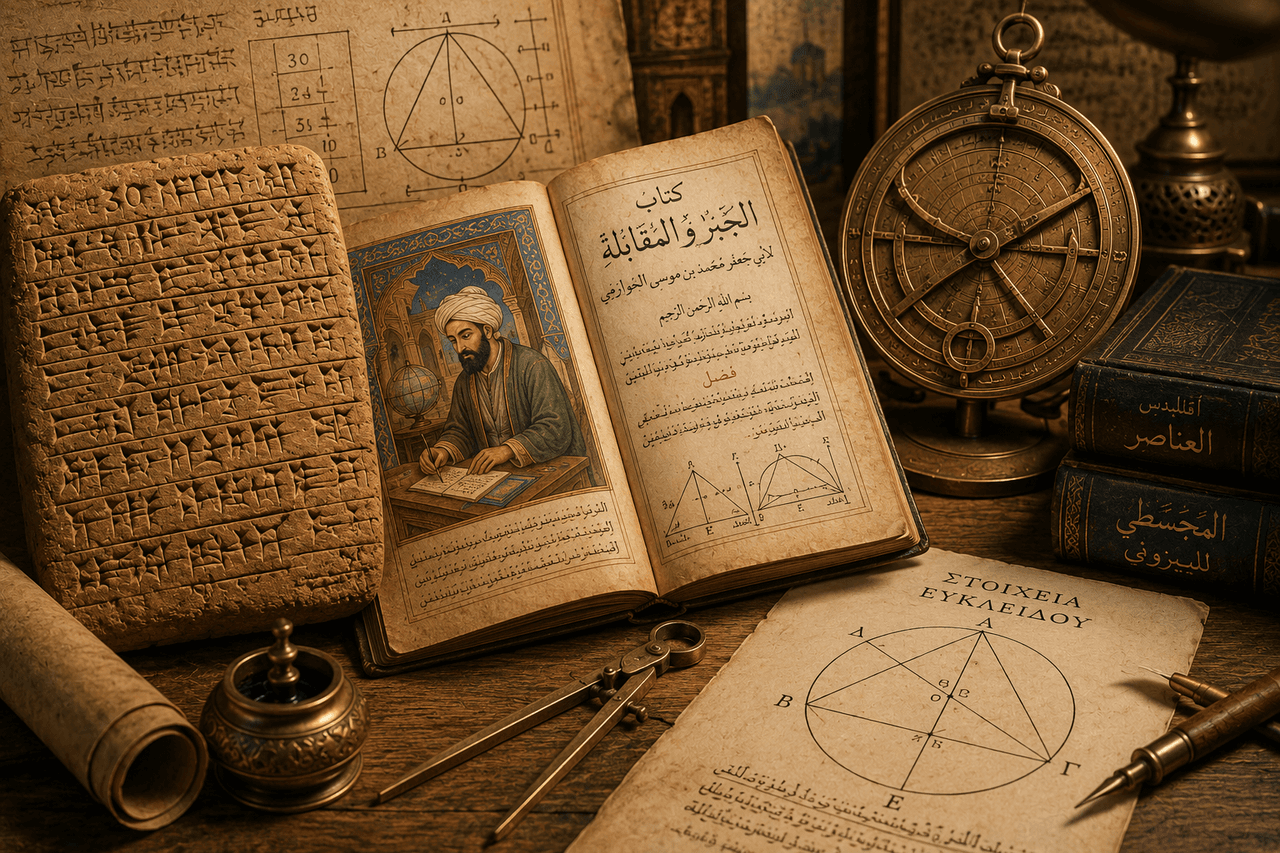
Representative Image (Generated by Artificial Intelligence.)
One of the earliest important centers of mathematical history is Mesopotamia. The Sumerians, Akkadians, and Babylonians used mathematics for trade, astronomy, calendar creation, and taxation. Hundreds of clay tablets uncovered through archaeological excavations demonstrate that these civilizations conducted serious mathematical studies.
The Babylonians are particularly noted for their use of a base-60 number system. The modern division of the hour into 60 minutes and the minute into 60 seconds is one of the most significant legacies of this system. Babylonian mathematics also included multiplication tables, fraction operations, quadratic equations, and geometric calculations.
Clay tablets contain geometric problems, division operations, and various mathematical computations. This shows that mathematics developed not only as a theoretical discipline but also in response to practical daily needs.
In ancient Egypt, mathematics developed primarily in response to practical needs. The measurement of agricultural land, the redefinition of boundaries after the Nile’s annual floods, and the construction of pyramids all contributed to the advancement of mathematics.
One of the most important sources on Egyptian mathematics is the Rhind Papyrus. Named after its discoverer, Henry Rhind, this work contains information on the four basic operations, fractions, prime numbers, and various mathematical problems. In addition, the Moscow and Berlin papyri are also significant works that reflect the mathematical understanding of the time.
Some problems in the Berlin Papyrus are believed to indicate that the Egyptians were aware of the fundamental principle behind the Pythagorean theorem. This demonstrates that mathematical knowledge was transmitted and developed across civilizations over time.
The transformation of mathematics into a systematic and theoretical science occurred largely through the achievements of ancient Greek civilization. Greek mathematicians built upon knowledge from Egypt and Mesopotamia and placed emphasis on the method of proof in mathematics.
One of the most important figures of this era is Thales. He is widely regarded as one of the first to apply mathematical proof and to conduct significant work in geometry.【2】 He is thought to have established that a line dividing a circle into two equal parts is its diameter and to have formulated several fundamental geometric principles.
Another key figure in ancient Greek mathematics is Pythagoras. Pythagoras viewed mathematics as the fundamental order of the universe and founded his own school to teach mathematics to his students. The Pythagoreans, guided by the belief that “all is number,” held that numbers could explain the order of the cosmos.【3】
The Pythagorean theorem, still in use today, bears his name. His studies on special triangles, square numbers, and mathematical order made significant contributions to the history of mathematics.
Hippocrates of Chios, who was educated on the island of Chios, gained recognition for his work in geometry. It is believed that his studies laid the groundwork for the Elements, later written by Euclid. He was also one of the first mathematicians to use the method of reducing complex geometric problems to simpler ones.
Another key figure in the development of mathematics in ancient Greece was Plato. The academy he founded became one of the most important scientific centers of the era. According to tradition, the entrance to the academy bore the inscription: “Let no one ignorant of geometry enter here.”【4】 This highlights the high value placed on mathematics.
One of Plato’s students, Eudoxus, conducted research on the method of exhaustion, which laid the foundation for modern integral calculus. His geometric methods provided guidance for later mathematicians.
In the 3rd century BCE, Alexandria became a major center of science. One of the most important mathematicians of this period, Euclid, wrote Elements, one of the most influential works in the history of mathematics.
This work is highly systematic, organized around definitions, axioms, theorems, and geometric proofs. Many fundamental concepts still used in geometry education today are based on Euclid’s work. The book contains important information on prime numbers, irrational numbers, and geometric shapes.
According to a famous anecdote, a student who was learning geometry asked Euclid, “What will I gain from learning this?” In response, Euclid turned to his slave and said, “Give him a few coins, since he must profit from what he learns.”【5】 This story illustrates that mathematics is important not merely for material gain but for intellectual and cognitive development.
Considered one of the greatest mathematicians of antiquity, Archimedes made significant contributions to both mathematics and physics. His methods for calculating areas and volumes are regarded as foundational to modern integral calculus.
Archimedes also used geometric methods to approximate the value of pi. Thanks to his method of exhaustion, he succeeded in calculating the areas of complex geometric shapes.
Apollonius of Perga, a contemporary of this period, is known for his work on conic sections and is regarded as one of the first mathematicians to use the concept of the parabola. Hipparchus is counted among the founders of trigonometry, while Heron contributed to the history of mathematics through his development of Heron’s formula.
From the 8th and 9th centuries onward, mathematical studies experienced great advancement in the Islamic world. Especially during the Abbasid era, the House of Wisdom established in Baghdad became one of the most important scientific centers of the time.
During this period, ancient Greek texts were translated into Arabic and then further developed, leading to new mathematical discoveries. The demand for mathematics in fields such as astronomy, optics, engineering, and trade encouraged scholars to develop new methods.
Many scholars, including Muhammad ibn Musa al-Khwarizmi, Al-Kindi, Thabit ibn Qurra, Nasir al-Din al-Tusi, and Ibn al-Haytham, made significant contributions to mathematics.
The renowned historian of mathematics Dirk Jan Struik expressed the role of the Islamic world in the history of science as follows in his work A Short History of Mathematics:
“We owe our gratitude to the Arabs for passing on the torch of Greek science without extinguishing it.”【6】
However, scholars in the Islamic world were not merely passive transmitters of knowledge; they also made original contributions to mathematics.
One of the most important figures in the Islamic mathematical tradition is Muhammad ibn Musa al-Khwarizmi. The Western term “algorithm” is derived from his name.
Al-Khwarizmi is particularly renowned for his work in algebra. His book Al-Kitab al-Mukhtasar fi Hisab al-Jabr wal-Muqabala is considered one of the first systematic works on algebra. For this reason, he is often called the “father of algebra.”
Thanks to Al-Khwarizmi’s work, the Indian numeral system became widespread in the Islamic world and was later transmitted to Europe. His studies on linear and quadratic equations played a crucial role in the development of mathematics. Many European scholars, beginning with Fibonacci, were influenced by his writings.
The history of mathematics is directly linked to the development of human civilization. Numerous civilizations, from Mesopotamia to Egypt, from ancient Greece to the Islamic world, contributed to mathematical knowledge. Many of the mathematical methods and concepts we use today are the result of this long accumulation of knowledge.
In my view, one of the most striking aspects of the history of mathematics is the transmission and development of knowledge across different civilizations. In particular, the transfer of scientific achievements from the Islamic world to Europe played a vital role in the formation of modern mathematics. This demonstrates that scientific progress is not the heritage of a single civilization but the common legacy of humanity.
Barker, Stephen F. Matematik Felsefesi. Translated by Yücel Dursun. Ankara: İmge Kitabevi Yayınları, 1964.
Boyer, Carl B. Matematiğin Tarihi. Translated by Saadet Bağçacı. İstanbul: Doruk Yayıncılık, 2015.
Ronan, Colin A. Bilim Tarihi. Translated by Ekmeleddin İhsanoğlu and Feza Günergun. Ankara: TÜBİTAK Popüler Bilim Kitapları, 2005.
Struik, Dirk J. Kısa Matematik Tarihi. Translated by Yıldız Silier. İstanbul: Doruk Yayıncılık, 2011.
[1]
Carl B. Boyer, Matematiğin Tarihi, çev. Saadet Bağçacı (İstanbul: Doruk Yayıncılık, 2015), 43.
[2]
Carl B. Boyer, Matematiğin Tarihi, çev. Saadet Bağçacı (İstanbul: Doruk Yayıncılık, 2015), 43-46.
[3]
Colin A. Ronan, Bilim Tarihi, çev. Ekmeleddin İhsanoğlu ve Feza Günergun (Ankara: TÜBİTAK Popüler Bilim Kitapları, 2005), 90-92.
[4]
Colin A. Ronan, Bilim Tarihi, çev. Ekmeleddin İhsanoğlu ve Feza Günergun (Ankara: TÜBİTAK Popüler Bilim Kitapları, 2005), 97.
[5]
Dirk J. Struik, Kısa Matematik Tarihi, çev. Yıldız Silier (İstanbul: Doruk Yayıncılık, 2011), 88.
[6]
Dirk J. Struik, Kısa Matematik Tarihi, çev. Yıldız Silier (İstanbul: Doruk Yayıncılık, 2011), 12.
The Origins of Mathematics in Mesopotamia
Egyptian Mathematics and the Papyri
Ancient Greek Mathematics
Hippocrates, Plato, and Mathematical Education
Euclid and the Systematization of Geometry
Archimedes and Mathematical Methods
The Rise of Mathematics in the Islamic World
Al-Khwarizmi and the Birth of Algebra
Conclusion