This article was automatically translated from the original Turkish version.
+2 More
Place of Establishment | Shanghai China | ||||||||
|---|---|---|---|---|---|---|---|---|---|
Founding Members | Russia Kyrgyzstan Tajikistan Uzbekistan China Kazakhstan | ||||||||
Primary Focus Areas | Regional cooperation Economy Security Politics | ||||||||
2026 Full Members | Kyrgyzstan Belarus Uzbekistan Tajikistan Russia Pakistan China Kazakhstan Iran India | ||||||||
Secretariat Center | Beijing China | ||||||||
Previous Structure | Shanghai Five | ||||||||
Türkiye's Status | Dialogue partner | ||||||||
Decision-Making Method | Consensus | ||||||||
Permanent Administrative Body | SCO Secretariat | ||||||||
Security Body | Regional Anti-Terrorism Structure | ||||||||
Abbreviation | SCO | ||||||||
Official Language | Russian Chinese | ||||||||
Establishment | 2001 | ||||||||
The Shanghai Cooperation Organization (SCO) is an intergovernmental regional organization established in 2001 with the participation of the People's Republic of China, Russian Federation, Kazakhstan, Kyrgyzstan, Tajikistan, and Uzbekistan to institutionalize multilateral cooperation in the areas of security, economy, and politics across the Eurasian region. The foundations of this organization rest on the Shanghai Five mechanism, established in 1996 to ensure border security and develop confidence-building measures in the geopolitical vacuum following the dissolution of the Soviet Union.【1】 Initially focused solely on resolving border disputes and establishing military security, the organization gradually expanded its institutional capacity by adopting the fight against international terrorism, separatism, and extremism as its core security doctrine. In addition to security-oriented activities, promoting free trade among member states, enhancing regional economic integration, developing transportation infrastructure, and ensuring the security of major energy transit pipelines have been incorporated into the organization’s macroeconomic objectives. With the subsequent full membership of India, Pakistan, Iran, and Belarus, the organization has extended its demographic, economic, and geopolitical boundaries to encompass Asia, the Middle East, and Eastern Europe, functioning as a global political and economic bloc offering a multipolar, multi-actor, and inclusive integration model in opposition to the unipolar world order dominated by the United States.

Flag of the Shanghai Cooperation Organization (SCO)
As of 2026, the Shanghai Cooperation Organization (SCO) functions as a regional cooperation platform with a multi-layered membership structure. The organization’s full members include Belarus, India, Iran, Kazakhstan, China, Kyrgyzstan, Pakistan, Russia, Tajikistan, and Uzbekistan. In addition, Afghanistan and Mongolia hold observer state status, while Azerbaijan, Armenia, Egypt, Cambodia, Qatar, Kuwait, Laos, Maldives, Myanmar, Nepal, the United Arab Emirates, Saudi Arabia, Türkiye, and Sri Lanka maintain relations with the organization through the status of dialogue partner. The official languages used in the SCO’s institutional operations are Russian and Chinese.【2】
The dissolution of the Union of Soviet Socialist Republics (USSR) in 1991 ended the bipolar structure of the Cold War era in the international system, compelling a new search for global and regional geopolitical equilibrium. This process resulted in the emergence of new independent states across Central Asia, the Caucasus, and Eastern Europe, creating a profound geopolitical vacuum particularly in Central Asia. These newly independent states, still lacking full institutionalization in political, economic, and social domains, faced serious potential crises in safeguarding their national security and territorial integrity.【3】 The emergence of a unipolar world order centered on the United States of America (USA) created the conditions for fundamental revisions in the foreign policy strategies of Russia and China, the traditional power centers of Asia. The authority vacuum and border uncertainties in Central Asia made regional stability a pressing diplomatic and military necessity in the post-independence era.
Emblem of the Shanghai Cooperation Organization (SCO)
The consolidation of a unipolar world order and the North Atlantic Treaty Organization’s (NATO) expansion strategy toward Eastern Europe brought Russia and China together around common minimum interests. The People’s Republic of China, concerned about the United States’ military presence in the Asia-Pacific region and its Taiwan policies, emphasized strategic balancing policies. Similarly, the Russian Federation perceived NATO’s expansion as a direct threat to its national security and entered a quest for a multipolar international system to preserve its influence in Eurasia. These strategic imperatives pushed Moscow and Beijing, which had experienced occasional border clashes during the Cold War, to construct a regional alliance against American hegemony.【4】 By suspending their historical disagreements and adopting a cooperation-oriented foreign policy, both powers facilitated the integration of the new Central Asian states into this equilibrium-seeking framework.
The border disputes between the Russian Federation and the People’s Republic of China, stretching over 4,300 kilometers since the 19th century, constituted the most fundamental concrete justification for establishing a regional security mechanism. With the dissolution of the Soviet Union, a portion of this long border became part of the territories of the newly established Kazakhstan, Kyrgyzstan, and Tajikistan, transforming the border security issue into a multilateral diplomatic concern. The absence of clearly demarcated borders and the highly militarized nature of these regions carried the risk of potential hot conflict. Bilateral and multilateral negotiations initiated in the early 1990s to resolve border disputes revealed the necessity of a formal diplomatic dialogue platform for establishing a lasting peace zone in Central Asia. China's strategy to minimize external conflict risks that could disrupt its economic and political development accelerated the adoption of confidence-building military measures along its borders.【5】
The first concrete diplomatic outcome of the pursuit of border security and military stability was achieved at a summit of heads of state held in Shanghai, China, on April 26, 1996.【6】 At this summit, attended by the leaders of the People’s Republic of China, the Russian Federation, Kazakhstan, Kyrgyzstan, and Tajikistan, the “Agreement on Confidence-Building Measures in the Military Field in Border Areas” was formally signed.【7】 Under this agreement, the five states established a new international forum known as the “Shanghai Five,” centered on resolving border disputes. The signed document obligated the participating states to notify each other in advance of military movements along their borders and to conduct exercises on a transparent basis. The establishment of the Shanghai Five reduced member states’ security concerns and laid the first institutional step toward regional integration.
Shanghai Cooperation Organization Anthem (Asketen)
The second phase of institutionalization of the Shanghai Five occurred at a summit of heads of state held in Moscow, the capital of Russia, on April 24, 1997.【8】 At this summit, the “Agreement on Mutual Reduction of Armed Forces in Border Areas” transformed the previous confidence-building measures into more concrete military commitments. The agreement mandated the reciprocal reduction of armed forces and conventional weapons capacities within a 100-kilometer zone along the former China-Soviet border.【9】 It was decided that these diplomatic instruments would remain in force until December 31, 2020, thereby establishing a long-term military stability environment along the borders. At the Moscow Summit, a declaration emphasizing a multipolar world vision was also issued, announcing that the formation was beginning to develop a strategic stance not only on border security but also on the general architecture of the international system.
The successful implementation of military confidence-building measures and the substantial resolution of border disputes enabled the Shanghai Five to expand its scope of activities. The third summit of heads of state, held in Almaty, Kazakhstan, on July 3, 1998, marked a critical turning point as the organization evolved from a purely border security mechanism into a multidimensional cooperation platform. At this summit, enhancing economic cooperation and trade volume among member states became the primary agenda item, moving beyond the concept of border security. The same meeting also adopted firm decisions on non-interference in each other’s internal affairs, peaceful resolution of disputes through diplomacy, and joint efforts against terrorism, separatism, and extremism.【10】 The Almaty Summit also incorporated transnational crimes such as illicit drug trafficking and arms smuggling into the organization’s official areas of combat.
The fourth summit of heads of state of the Shanghai Five convened in Bishkek, the capital of Kyrgyzstan, on August 25, 1999, and affirmed the organization’s capacity to respond collectively to global security issues. The Bishkek Declaration, issued at this summit, emphasized the fight against international terrorism, ethnic separatism, and religious extremism, while also containing strong criticism of NATO’s military intervention in Yugoslavia.【11】 NATO’s intervention under the doctrine of humanitarian intervention was condemned, and the need to uphold the international legal system was emphasized. Regionally, the Bishkek Summit assessed the bombing attacks in Russia, an attempted assassination against the President of Uzbekistan, and armed clashes along the Kyrgyz border, leading to the decision to establish an anti-terrorism center in Bishkek.【12】 This development marked the first concrete manifestation of the Shanghai Five’s resolve to build permanent institutions to counter regional security threats.
The fifth summit, which accelerated the organizational transformation, was held on July 5, 2000, in Dushanbe, the capital of Tajikistan, and the organization’s name was revised to the “Shanghai Forum.”【13】 At the Dushanbe Summit, cooperation in political, economic, and military fields was further deepened; a joint commitment document was issued opposing any interference in the national independence and sovereignty of states under the guise of human rights or humanitarian intervention. Member states pledged full support for each other’s internal political matters, affirming the legitimacy of China’s policies in the Xinjiang Uyghur Autonomous Region (East Turkestan) and Russia’s policies in Chechnya within the framework of the principle of territorial integrity under international law.【14】 The most significant expansion step of the summit was Uzbekistan’s participation as an observer, opening the path for the organization to transform into a structure encompassing all of Central Asia.
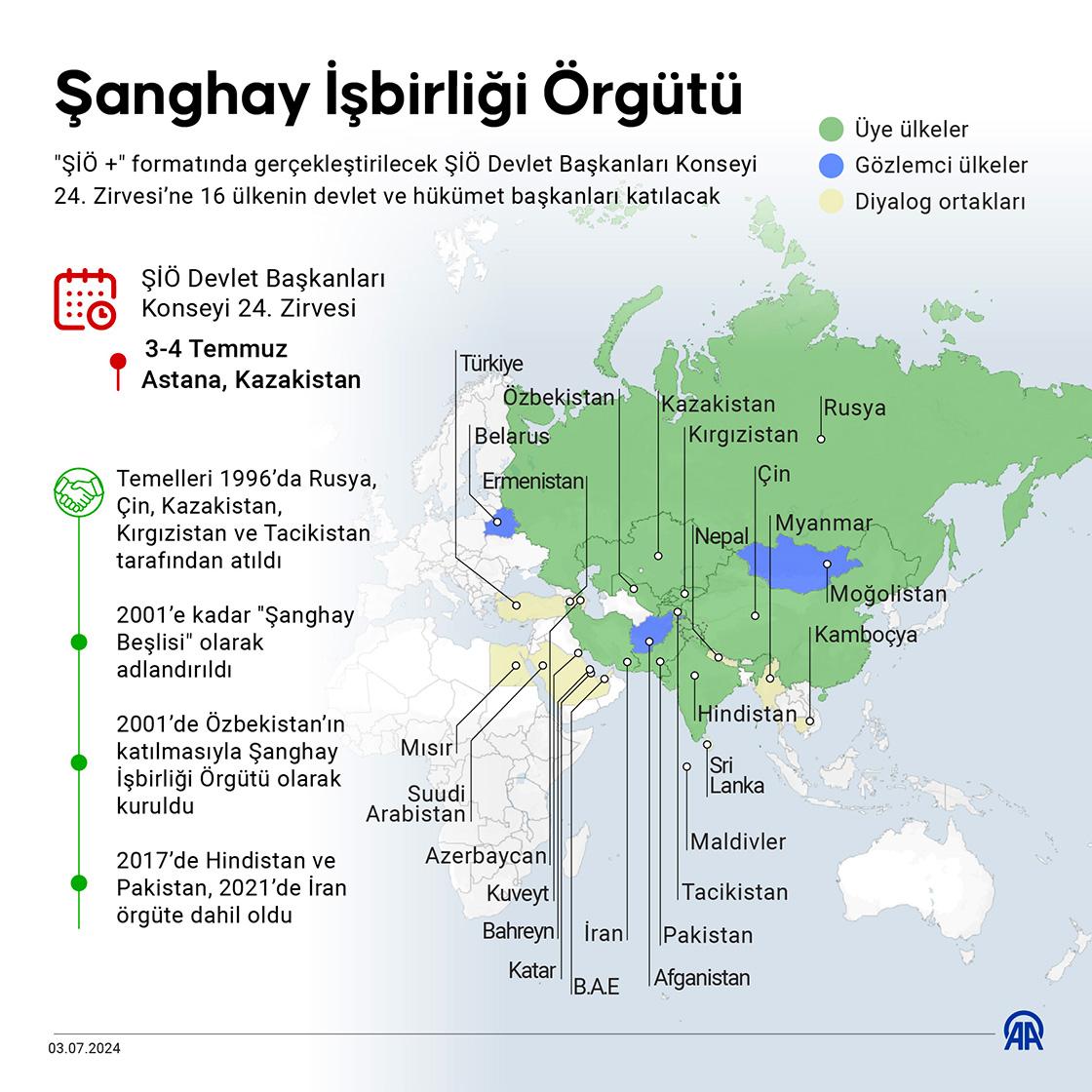
Shanghai Cooperation Organization Infographic (Anadolu Ajansı)
The process of transforming the Shanghai Forum into a comprehensive international organization was completed at the sixth summit of heads of state held in Shanghai, China, on June 14–15, 2001. At this summit, Uzbekistan’s formal admission as a full member was approved, increasing the number of founding member states to six.【15】 With the joint signature of the six heads of state, the “Declaration on the Establishment of the Shanghai Cooperation Organization” formally renamed the Shanghai Five mechanism as the Shanghai Cooperation Organization (SCO) and granted it permanent regional organizational status with international legal personality. The founding declaration recorded the goals of jointly preserving regional peace, security, and stability; establishing a democratic and just international political-economic order; and strengthening multidirectional strategic cooperation among member states.【16】
On the same day the founding of the Shanghai Cooperation Organization was announced, the member states signed the “Shanghai Convention on the Prevention of Terrorism, Separatism, and Extremism,” which legally grounded the organization’s integration in the security field.【17】 This convention clearly demonstrated that combating international terrorism, ethnic separatism, and religious radicalism—the “three evil forces” as defined in the organization’s political rhetoric—constitutes the very reason for the organization’s existence and its primary focus. Under the convention, binding legal procedures were established for uninterrupted information sharing, joint operational planning, and extradition of criminals between member states’ law enforcement and intelligence agencies. This move proved that the loose consultative forum established to resolve border disputes after the dissolution of the Soviet Union had evolved into a security architecture based on deep institutional commitments.
The “Charter of the Shanghai Cooperation Organization” (Statute), which serves as the organization’s constitutional document, was adopted and signed at a summit of heads of state held in St. Petersburg, Russia, on June 7, 2002. This founding treaty, consisting of 26 articles, clearly defined the SCO’s objectives, fundamental principles, internal hierarchical structure, decision-making mechanisms, and relations with other states and international organizations. The Statute mandated absolute respect for the sovereignty and territorial integrity of member states, non-interference in internal affairs, and a united stance against hegemonic ambitions in foreign policy. The SCO Charter introduced a consensus-based decision-making mechanism and officially entered into force on September 19, 2003, after completion of ratification procedures by member states’ national parliaments, granting the organization full legitimacy under international law.【18】
Parallel to the entry into force of the SCO Charter, permanent bureaucratic organs were established to enhance the organization’s administrative capacity and operational power. As a result of decisions taken at the Moscow Summit on May 28–29, 2003, the SCO Secretariat, responsible for central administrative affairs, was established in Beijing, China’s capital, and began operations on January 1, 2004, with its own personnel and budget.【19】 Simultaneously, the Executive Committee of the Regional Anti-Terrorism Structure (RATS), established in 2001 under the convention to coordinate security cooperation, was permanently configured in Tashkent, the capital of Uzbekistan, and began operations in June 2004. The establishment of the Secretariat and RATS ensured continuous and institutionalized bureaucratic support for processes carried out by periodic decision-making bodies such as the Council of Heads of State, the Council of Heads of Government, and the Council of Foreign Ministers.
The year 2001, when the SCO was established, also marked the period when the global security paradigm underwent a fundamental change with the 9/11 attacks. The U.S.-led international coalition’s military intervention in Afghanistan under its counter-terrorism doctrine and the establishment of military bases in Central Asian countries such as Uzbekistan and Kyrgyzstan reshaped the region’s geopolitical map. Initially supportive of the international counter-terrorism concept, SCO member states began to express discomfort as the American military presence in Central Asia showed signs of becoming permanent, and they adopted a strategy of using the organization as a shield against external hegemony. In this context, at the 2005 Astana Summit, a timetable was requested for the U.S. and its allies to vacate their military bases in Central Asia, and the organization’s position in regional security was clearly communicated to the international public.【20】
The Shanghai Cooperation Organization, initially focused on narrow security issues such as resolving border conflicts and combating terrorism upon its founding, has evolved into a multidimensional structure encompassing economic, commercial, and energy integration as its institutionalization process was completed. The “Multilateral Program for Trade and Economic Cooperation,” approved in September 2003, set as its vision the liberalization of capital, goods, services, and technology flows within the SCO region and, in the long term, the establishment of a free trade area..【21】 Energy supply security has become the central axis of strategic cooperation between member states with vast fossil fuel reserves and China, with high consumption capacity, laying the foundation for an “Energy Club” project within the SCO. This infrastructural deepening has demonstrated that the organization is not merely a military-political shield against external threats but also possesses the resolve to build an independent integration model that ensures socio-economic development in the Eurasian hinterland.【22】
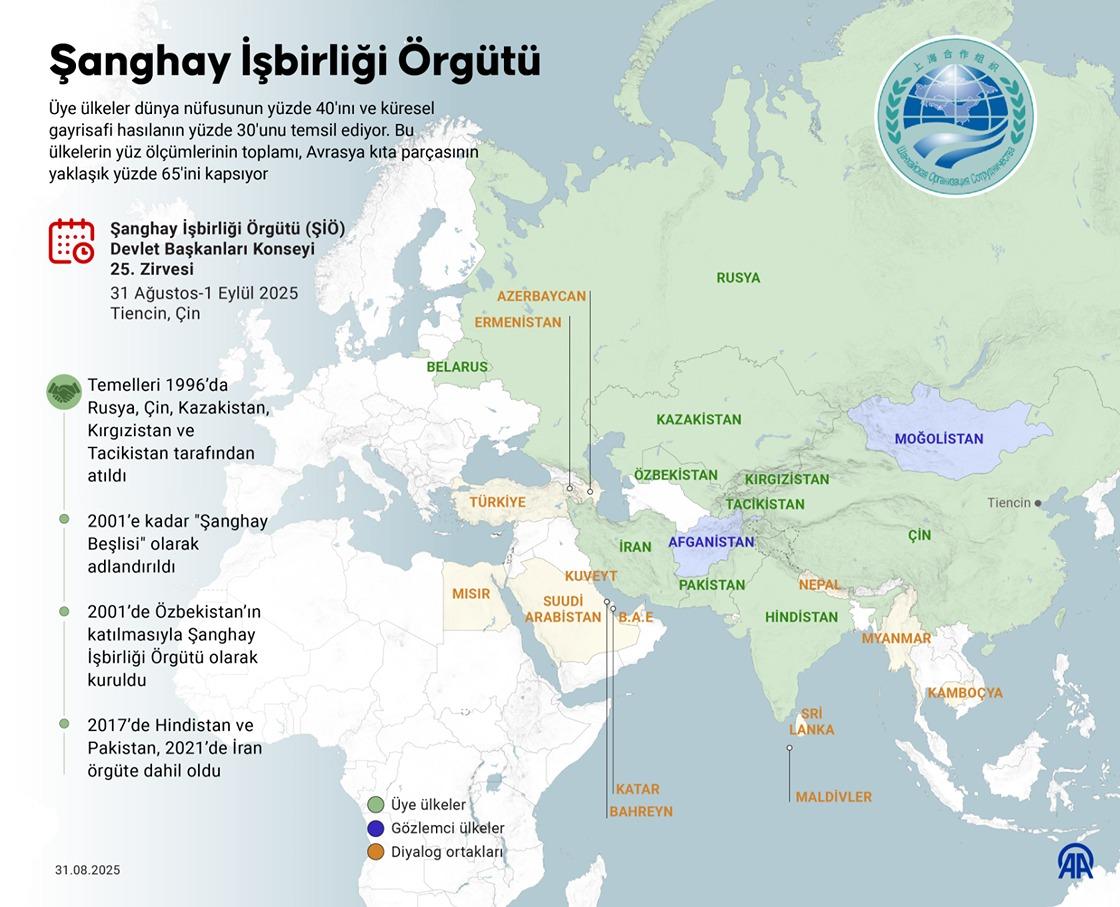
Shanghai Cooperation Organization Infographic (Anadolu Ajansı)
Ultimately, the Shanghai Five mechanism, initiated in 1996 as a narrow initiative aimed at demilitarizing border regions and enhancing military security, underwent a systematic evolution within a short time span, ascending to the status of Eurasia’s most effective multilateral institution under the identity of the Shanghai Cooperation Organization. This process, representing a successful synthesis of the rational power balance strategies of the Russian Federation and the People’s Republic of China and the stability and development needs of the Central Asian republics, has presented a new regionalization paradigm in international relations theory—one that is non-exclusionary and based on equal rights. The organization, having solidified its institutional architecture through founding agreements, adopted statutes, and implemented permanent organs, has fully and comprehensively completed its establishment and institutionalization phase by 2004, creating a diplomatic, economic, and geopolitical alternative center in opposition to the unipolar international system of the post-Cold War era.
The highest binding documents that define the legal infrastructure, institutional hierarchy, fundamental principles, and ultimate objectives of the Shanghai Cooperation Organization are the “Declaration on the Establishment of the Shanghai Cooperation Organization” of June 15, 2001, and the “Charter of the Shanghai Cooperation Organization,” adopted at the summit of heads of state held in St. Petersburg on June 7, 2002.【23】 This statute, consisting of 26 articles and officially entering into force on September 19, 2003, transformed the limited consultative mechanism established solely to ensure border security after the dissolution of the Soviet Union into a permanent, intergovernmental organization with international legal personality and multidimensional characteristics. These founding agreements have established a legitimate foundation for the organization’s operational capacity in Eurasia by clearly defining the boundaries of military, political, and economic integration, the functioning of decision-making mechanisms, and the mutual obligations of member states.【24】 As detailed in the first article of the Charter, the organization’s vision is designed not merely as a border security pact but as a strategy to create a multilateral, multi-axis, and comprehensive regional cooperation regime. The Charter moves beyond a static framework, prioritizing the establishment of a dynamic institutional architecture capable of adapting to changing geopolitical and geo-economic dynamics of the international system.
The first article of the Charter of the Shanghai Cooperation Organization clearly lists the organization’s founding objectives and fundamental goals in a hierarchical order. At the absolute center of these goals lies the reinforcement of mutual trust, friendship, and good-neighborly relations among member states, and the joint preservation of lasting peace, security, and stability across the vast Eurasian region.【25】 In addition to the security concept, the Charter mandates the development of multilateral, effective, and results-oriented cooperation across a broad spectrum including politics, trade, economy, science, technology, culture, education, energy, transportation, finance, credit, tourism, and environmental protection, by combining the geopolitical and economic potentials of member states. At the macro level, a structural transformation of the existing unipolar structure of the international system has been targeted; contributing to the establishment of a new global political and economic order based on democracy, justice, rationality, and the supremacy of international law has been included among the organization’s primary missions. This multi-dimensional sequence of objectives clearly demonstrates that the organization is not merely a regional integration project but also possesses the resolve to become a central actor in reshaping global governance architecture.【26】
The fundamental principles that determine the organization’s institutional functioning, decision-making mechanisms, and stance in international relations are enshrined as non-negotiable provisions in the second article of the founding statute. The most important of these principles is the absolute and unconditional respect for the sovereignty, political independence, territorial integrity, and inviolability of state borders of member states. Within the organization’s internal law, the principles of non-aggression, peaceful resolution of disputes through diplomacy, and non-intervention in the internal affairs of states by military or political means are strictly adopted. In accordance with the principle of equality, all decisions within the SCO are taken by consensus (agreement/unanimity), and no member state is granted veto rights or privileged status enabling it to unilaterally block decision-making processes, thereby institutionally preventing the hegemonic tendencies of major powers from infiltrating the organization. In external policies, the principles of non-alignment, non-targeting of third countries or international organizations, and openness to cooperation with other states and international institutions are adopted, legally and completely preventing the organization from transforming into a closed military bloc or aggressive alliance system.【27】
The conceptual counterpart of the Shanghai Cooperation Organization’s fundamental principles, philosophical foundation, and diplomatic vision is defined in international relations literature and the organization’s official rhetoric as the “Shanghai Spirit.”【28】 Formulated by the People’s Republic of China and accepted by all founding states, this integrated concept comprises mutual trust, mutual benefit (win-win approach), equality among member states, joint consultation, respect for different civilizations and cultural diversity, and the pursuit of common socio-economic development. The Shanghai Spirit explicitly rejects the zero-sum game logic of the Cold War era, the culture of bloc confrontation, and the pursuit of ideological superiority, presenting a new paradigm of international relations in which sovereign states with different socio-economic systems and cultural backgrounds can coexist harmoniously. This doctrine, placing at its core the idea that regional security and development are tightly interlinked and that one state’s national security cannot be achieved at the expense of others’ security (indivisible security), forms the intellectual and political foundation of an inclusive integration model that is non-exclusionary and promotes mutual dependence.【29】
Multilateral and coordinated cooperation in the field of security is the primary motivation and fundamental reason for the existence of the Shanghai Cooperation Organization. The collective struggle against international terrorism, ethnic separatism, and religious extremism, conceptualized in the organization’s political and legal documents as the “three evil forces” or “three scourges,” has been designated as the organization’s most urgent, concrete, and primary security objective.【30】 To eliminate these vital threats, the “Shanghai Convention on the Prevention of Terrorism, Separatism, and Extremism,” signed simultaneously with the founding declaration in Shanghai on June 15, 2001, established the international legal foundation for operational security cooperation among member states. To ensure the continuous institutional implementation of security objectives, the Regional Anti-Terrorism Structure (RATS) Executive Committee, established in Tashkent, Uzbekistan, coordinates intelligence sharing among member states’ intelligence services and law enforcement agencies, maintains a joint database of terrorist suspects, facilitates the extradition of wanted individuals, and executes the planning of joint anti-terrorism military exercises known as “Peace Mission.”【31】
The organization’s security architecture and strategic objectives have been systematically expanded beyond the traditional border security and the fight against the “three evil forces” to encompass the new generation of non-traditional and asymmetric threats of the 21st century. In this context, illicit arms trafficking, drug trafficking, dismantling transnational organized crime networks, and controlling illicit cross-border migration have been incorporated into the SCO’s core security operations and legal combat areas.【32】 Simultaneously, considering the destructive effects of information warfare and cyberattacks on national security, the SCO aims to develop a state-centered and information-control-based collective defense mechanism in the field of cybersecurity, in contrast to the Western-style multi-stakeholder model. The establishment of joint emergency response systems to address infectious disease outbreaks, ecological imbalances, environmental disasters, and natural or human-caused emergencies has also been included among the organization’s comprehensive security objectives, aiming to create a continuous security belt across the vast Eurasian region.【33】
The reality that the permanent establishment of regional security and geopolitical stability cannot be conceived independently of the economic development and integration of member states is one of the fundamental principles of the Shanghai Cooperation Organization. The “Multilateral Program for Trade and Economic Cooperation,” adopted by the heads of state in 2003, sets as its primary goal the removal of barriers to the free flow of goods, capital, services, and technology within the SCO region and, in the long term, the establishment of a fully-fledged free trade area.【34】 To promote the integration of member states’ national economies and enhance their commercial capacity, joint financing through the Interbank Consortium and the Council on Economic Cooperation is planned for energy transit pipelines, transportation corridors, telecommunications infrastructure, and large-scale investment projects. The SCO, bringing together the world’s largest energy producers and the largest energy consumers under the same organizational umbrella, has established an “Energy Club” mechanism to guarantee energy supply and demand security, clearly setting as its objective the enhancement of socio-economic welfare, reduction of poverty, and comprehensive improvement of living standards in the member countries of the Eurasian hinterland.【35】
The SCO’s wide-ranging integration strategy across Eurasia is not limited to military, political, and economic cooperation but is also supported by human and cultural dimensions aimed at extending these ties to the grassroots level and strengthening inter-societal solidarity. The organization’s documents define the Eurasian region as a historical intersection point of different civilizations, ancient religions, and rich cultures, and condition the preservation of cultural diversity and the promotion of inter-civilizational dialogue as a fundamental principle. To this end, institutional cooperation networks have been established in the fields of education, science, culture, health, sports, and tourism; student and academic exchange programs among member states have been implemented; and joint cultural festivals, sports competitions, and art exhibitions have been decided upon. Increasing social, academic, and cultural interactions among the peoples of member states is viewed as a strategic “public diplomacy” tool that ensures the sustainability of diplomatic relations, aiming for the philosophical foundations of the Shanghai Spirit to find their social-level counterpart and become deeply rooted.
In the context of its strategic vision for the general architecture of the global system, the Shanghai Cooperation Organization has adopted as a fundamental objective the construction of a United Nations-centered, multipolar, democratic, and just international relations system in opposition to the United States-centered unipolar world order and any form of hegemonic ambition. The SCO Charter, official declarations, and summit communiqués define any external interference in the internal affairs of sovereign states or regime change imposition under the pretext of human rights violations or the “humanitarian intervention” doctrine as a clear violation of international law and the sovereignty rights of states, and explicitly reject them.【36】 The SCO condemns attempts to resolve international conflicts and crises through the use of military force or threats of force, specifying that all problems must be resolved exclusively through diplomatic negotiations, equitable dialogue, and within the framework of United Nations norms. In this institutional dimension, the organization has fully reflected in its founding philosophy and political objectives the aim of creating an independent, non-exclusionary, and effective global balance center that shields the geopolitical security of the Eurasian continent from external interventions through its own internal dynamics.【37】
The institutional architecture and decision-making mechanisms of the Shanghai Cooperation Organization (SCO) are built on a flexible model that completely rejects the transfer of supranational authority and is based entirely on the intergovernmental principle of equality. The organizational framework and administrative hierarchy have been legally grounded in the relevant articles of the SCO Charter (Statute), signed in St. Petersburg on June 7, 2002, which serves as the organization’s constitution.【38】 The institutional organization is divided into two main categories: decision-making and consultative councils that meet at specific intervals, and permanent organs that ensure uninterrupted administrative, technical, and intelligence operations. The hierarchical backbone of the decision-making mechanisms consists of the Council of Heads of State, the Council of Heads of Government, the Council of Foreign Ministers, the Council of Ministers and Heads of Institutions, and the Council of National Coordinators. The permanent organs responsible for implementing decisions, bureaucratic coordination, and managing specific areas of combat are the Secretariat based in Beijing and the Regional Anti-Terrorism Structure (RATS) based in Tashkent. This institutional design ensures the absolute protection of member states’ sovereignty and national independence while simultaneously providing systematic coordination of regional integration focused on security and economy across the vast Eurasian region.【39】
The Council of Heads of State holds the highest, most authoritative, and ultimate decision-making status within the organization’s institutional hierarchy. The authority to determine the organization’s fundamental operational roadmap, set long-term strategic priorities, outline the general framework of relations with other states and organizations in the international system, and resolve the most critical issues regarding institutional functioning is exclusively vested in this council. Under normal conditions, the Council of Heads of State convenes once annually, and the head of state of the country hosting the summit assumes the rotating presidency of the organization for that year. The location of the summits and the rotation of the presidency are systematically determined by a rotation procedure based on the alphabetical order of member states’ names in the Russian alphabet. Fundamental issues of regional or global scale that are discussed in lower councils, working groups, or permanent organs but cannot be resolved at lower levels are referred to the Council of Heads of State for final judgment and approval, where decisions are made by the highest political wills of the states.
The Council of Heads of Government (Prime Ministers’ Council) is the second most important primary decision-making body in the organization’s hierarchical structure, immediately following the Council of Heads of
Aksu, Zehra. “Yeni Bir Bölgeselcilik Yaklaşımı Olarak Enerji Bölgeselciliği: Şanghay İşbirliği Örgütü ve Avrasya Ekonomik Birliği.” PhD thesis, Karadeniz Teknik Üniversitesi Sosyal Bilimler Enstitüsü, 2022. Accessed June 8, 2026. https://avesis.ktu.edu.tr/yonetilen-tez/d62b2baa-7bfd-4ecd-b27e-b4f77567c995/yeni-bir-bolgeselcilik-yaklasimi-olarak-enerji-bolgeselciligi-sanghay-isbirligi-orgutu-ve-avrasya-ekonomik-birligi
Akın, Gökhan. “Bir Bölgesel Örgütlenme Modeli Olarak Şanghay İşbirliği Örgütü ve Türkiye.” Master's thesis, Yüzüncü Yıl Üniversitesi Sosyal Bilimler Enstitüsü, 2024. Accessed June 8, 2026. https://tezara.org/theses/877130
Altundağ, Zehra. 2016. “Geçmişten Günümüze Şanghay İşbirliği Örgütü”. Avrasya Etüdleri 49, no. 1: 99–124. Accessed June 8, 2026. https://dergipark.org.tr/tr/pub/avrasya/article/392466
Anadolu Ajansı. "Cumhurbaskanı Erdoğan'dan Şanghay İşbirliği Teşkilatı zirvesinde yoğun diplomasi trafiği." Accessed June 8, 2026. https://www.aa.com.tr/tr/gundem/cumhurbaskani-erdogandan-sanghay-isbirligi-teskilati-zirvesinde-yogun-diplomasi-trafigi/3675395
Anadolu Ajansı. "Cumhurbaşkanı Erdoğan'dan Şanghay İşbirliği Örgütü 24'üncü Devlet Başkanları Zirvesi'nde yoğun diplomasi mesaisi." Accessed June 8, 2026. https://www.aa.com.tr/tr/pg/foto-galeri/cumhurbaskani-erdogandan-sanghay-isbirligi-orgutu-24uncu-devlet-baskanlari-zirvesinde-yogun-diplomasi-mesaisi-/0
Anadolu Ajansı. "Putin: Rusya, Şanghay İşbirliği Örgütü ülkeleriyle ortaklığı geliştirme niyetinde." Accessed June 8, 2026. https://www.aa.com.tr/tr/dunya/putin-rusya-sanghay-isbirligi-orgutu-ulkeleriyle-ortakligi-gelistirme-niyetinde/3747175
Anadolu Ajansı. "Türkiye, Şanghay İşbirliği Örgütü ülkelerine ihracatını 5 yılda yüzde 85 artırdı." Accessed June 8, 2026. https://www.aa.com.tr/tr/ekonomi/turkiye-sanghay-isbirligi-orgutu-ulkelerine-ihracatini-5-yilda-yuzde-85-artirdi/3263587
Anadolu Ajansı. "Şanghay İşbirliği Örgütü Zirvesi, Çin'in Tiencin şehrinde düzenlenecek." Accessed June 8, 2026. https://www.aa.com.tr/tr/dunya/sanghay-isbirligi-orgutu-zirvesi-cinin-tiencin-sehrinde-duzenlenecek/3673402
Anadolu Ajansı. "Şanghay İşbirliği Örgütü yeni küresel saflaşmalarda kritik ağırlık kazanıyor." Accessed June 8, 2026. https://www.aa.com.tr/tr/dunya/sanghay-isbirligi-orgutu-yeni-kuresel-saflasmalarda-kritik-agirlik-kazaniyor/3669262
Anadolu Ajansı. “Çin Devlet Başkanı Şi: ŞİÖ, hegemonyacılığa ve güç siyasetine karşı etkin bir güç haline geldi.” Accessed June 8, 2026. https://www.aa.com.tr/tr/dunya/cin-devlet-baskani-si-sio-hegemonyaciliga-ve-guc-siyasetine-karsi-etkin-bir-guc-haline-geldi/3674708
Anadolu Ajansı. “Şanghay İşbirliği Örgütü 15 trilyon dolarlık ekonomiye ulaştı.” Accessed June 8, 2026. https://www.aa.com.tr/tr/ekonomi/sanghay-isbirligi-orgutu-15-trilyon-dolarlik-ekonomiye-ulasti/840369
Anadolu Ajansı. “Şanghay İşbirliği Örgütü Zirvesi'nde 'Tiencin Deklarasyonu' kabul edildi.” Accessed June 8, 2026. https://www.aa.com.tr/tr/dunya/sanghay-isbirligi-orgutu-zirvesinde-tiencin-deklarasyonu-kabul-edildi-/3675781
Anadolu Ajansı. “Şanghay İşbirliği Örgütü yeni küreselsaflaşmalarda kritik ağırlık kazanıyor.” Accessed June 8, 2026. https://www.aa.com.tr/tr/dunya/sanghay-isbirligi-orgutu-yeni-kuresel-saflasmalarda-kritik-agirlik-kazaniyor/3669262
Anadolu Ajansı. “ŞİÖ Genel Sekreteri Yermekbayev, Türkiye'nin yapıcı bir diyalog ortağı olduğunu vurguladı.” Accessed June 8, 2026. https://www.aa.com.tr/tr/gundem/sio-genel-sekreteri-yermekbayev-turkiyenin-yapici-bir-diyalog-ortagi-oldugunu-vurguladi/3536400
Anadolu Ajansı. “ŞİÖ Zirvesi: Türkiye ve yeni küresel dönüşüm dinamikleri.” Accessed June 8, 2026. https://www.aa.com.tr/tr/analiz/sio-zirvesi-turkiye-ve-yeni-kuresel-donusum-dinamikleri/3674922
Askeroglu, Sabir. “Şanghay İşbirliği Örgütü İran’ın Güvenlik Garantisi Olabilir mi?” İran Araştırmaları Merkezi (İRAM), April 2018. Accessed June 8, 2026. https://iramcenter.org/uploads/files/Yanghay_YYbirliYi_Orgutu_YranYYn_Guvenlik_Garantisi_Olabilir_Mi.pdf
Asketen. “"上合组织会歌" - Anthem of the Shanghai Cooperation Organization.” YouTube. Accessed June 8, 2026. https://www.youtube.com/watch?v=Nphs0cd3LYE
Avrasya İncelemeleri Merkezi. “Şanghay İşbirliği Örgütü (Şanghay Beşlısı) Nedir?” Accessed June 8, 2026. https://avim.org.tr/tr/Bulten/SANGHAY-ISBIRLIGI-ORGUTU-SANGHAY-BESLISI-NEDIR
Aydın Düzgit, Senem. “Şanghay İşbirliği Örgütü.” Tübitak Bilim ve Toplum Başkanlığı. Popüler Bilim Yayınları. Accessed June 8, 2026. https://ansiklopedi.tubitak.gov.tr/ansiklopedi/sanghay_isbirligi_orgutu
Azimzadeh, Chingiz. “Şanghay İşbirliği Örgütü ve Türkiye’nin Örgüte Üyeliği.” ORSAM (Ortadoğu Araştırmaları Merkezi). Accessed June 8, 2026. https://orsam.org.tr/yayinlar/sanghay-isbirligi-orgutu-ve-tukiyenin-orgute-uyeligi/
Bilek, Serhat. “Türkiye Açısından Avrupa Birliği’ne Bir Alternatif Olarak Şanghay İşbirliği Örgütü.” Master's thesis,Sakarya Üniversitesi Institute of Social Sciences, 2022. Accessed June 8, 2026. https://acikerisim.sakarya.edu.tr/yayin/2013247
Deveci, Şule. “Orta Asya’da Sovyetler Birliği Sonrası Kurulan Düzende Bölgesel Örgütlerin Rolü: Şanghay İşbirliği Örgütü Örneği.” Master's thesis, Nevşehir Hacı Bektaş Veli Üniversitesi Sosyal Bilimler Enstitüsü, 2021. Accessed June 8, 2026. https://acikerisim.nevsehir.edu.tr/handle/20.500.11787/6363
Eren, Erdem. 2017. “Şangay İşbirliği Örgütü ve Türk Dış Politikasında Gelecek Perspektifi”. Strategic Public Management Journal 3, no. 5: 77–94. Accessed June 8, 2026. https://dergipark.org.tr/tr/pub/spmj/article/305263
Gözütok, Osman Turan. "Siyasi ve Ekonomik Yapılarıyla Avrupa Birliği ile Şanghay İşbirliği Örgütü’nün Karşılaştırılması." Master's thesis, Van Yüzüncü Yıl Üniversitesi Sosyal Bilimler Enstitüsü, 2025.
Hamzaoğlu, Halit. 2024. “Bir Bölgeselleşme Örneği Olarak Şanghay İşbirliği Örgütü”. Bölgesel Araştırmalar Dergisi 8, no. 2: 210–229. Accessed June 8, 2026. https://dergipark.org.tr/tr/pub/bader/article/1472814
Khaleqi, Zahir Ahmad, and Jamaluddin Sadruddin Oghli. “Şangay İşbirliği Örgütü ve Türkiye’nin Olası İlişkileri.” *Pearson Journal of Social Sciences & Humanities* 6, no. 12 (2021): 107–116. Accessed June 8, 2026. https://pearsonjournal.com/index.php/pub/article/view/187
Manaflı, Tural. “Uluslararası İlişkiler Teorilerinde Neoliberalizm’in Yeri ve Önemi: Şanghay İşbirliği Örgütü ve BRICS Karşılaştırması.” Master's thesis, Bursa Uludağ University Institute of Social Sciences, 2021. Accessed June 8, 2026. https://acikerisim.uludag.edu.tr/server/api/core/bitstreams/7ceb6565-4a5a-47e5-ad38-3ae72b8468a1/content
Marişova, Ümüt. “Orta Asya Ülkelerinin Güvenlik Alanındaki Çok Taraflı İşbirliği Faaliyetlerinin Etkinliği.” Master's thesis, Kyrgyzstan-Turkey Manas University Graduate School of Education, 2025. Accessed June 8, 2026. https://tezara.org/theses/968245
Ministry of Foreign Affairs of the Republic of Türkiye. "Shanghai Cooperation Organization (SCO)." Accessed June 8, 2026. https://www.mfa.gov.tr/sanghay-isbirligi-orgutu.tr.mfa
Shanghai Cooperation Organization Secretariat. "Symbols of the SCO." Accessed June 8, 2026. https://eng.sectsco.org/20260304/2182173.html
Shanghai Cooperation Organization Secretariat. “About the Shanghai Cooperation Organization.” Accessed June 8, 2026. https://rus.sectsco.org/20151208/16789.html
T.C. Presidency of Communication. "President Erdoğan Spoke at the 24th Summit of Heads of State of the Shanghai Cooperation Organization." Accessed June 8, 2026. https://www.iletisim.gov.tr/turkce/haberler/detay/cumhurbaskani-erdogan-sanghay-isbirligi-orgutu-24uncu-devlet-baskanlari-zirvesinde-konustu
T.C. Presidency of Communication. "President Erdoğan: The Target Is Shanghai Cooperation Organization Membership." Accessed June 8, 2026. https://www.iletisim.gov.tr/turkce/haberler/detay/cumhurbaskani-erdogan-hedef-sanghay-isbirligi-orgutu-uyeligi
TRT Haber. “Şanghay İşbirliği Teşkilatı toplanıyor.” Accessed June 8, 2026. https://www.trthaber.com/haber/dunya/sanghay-isbirligi-teskilati-toplaniyor-918377.html
Yardımcıoğlu, Mahmut, and Hüseyin Koçarslan. 2012. “Çok Kutuplu Dünyaya Doğru: Şanghay İşbirliği Örgütü”. Kahramanmaraş Sütçü İmam Üniversitesi İktisadi ve İdari Bilimler Fakültesi Dergisi 2, no. 2: 163–74. Accessed June 8, 2026. https://dergipark.org.tr/tr/pub/ksuiibf/article/125909
Yeni, Gülistan. “Şanghay İşbirliği Örgütü’nün Genişleme Politikasının Entegrasyona Etkisi.” Master's thesis,Selçuk Üniversitesi Institute of Social Sciences, 2021. Accessed June 8, 2026. https://tezara.org/theses/673486
Yılmaz, Yavuz. “Şanhay İşbirliği Örgütü Adalet Bakanları Toplantısı ve Türkiye.” *Uluslararası Hukuk Bülteni*, T.C. Adalet Bakanlığı, 5-6. Accessed June 8, 2026. https://diabgm.adalet.gov.tr/Resimler/Dokuman/2622020084531y_yilmaz.pdf
Zeynalov, Arzu. “Ar-Ge Harcamalarının Ekonomik Büyümeye Etkisi: Şanghay İş Birliği Örgütü Üyeleri Üzerine Ampirik Analiz.” Master's thesis, İstanbul Üniversitesi Sosyal Bilimler Enstitüsü, 2023. Accessed June 8, 2026. https://tezara.org/theses/811960
Çayıroğlu, Halil İbrahim. “Türkiye Şanghay Ülkeleri Arasındaki Dış Ticaret İlişkilerinin Ekonomik Analizi.” Master's thesis, Nevşehir Hacı Bektaş Veli Üniversitesi Sosyal Bilimler Enstitüsü, 2022. Accessed June 8, 2026. https://acikerisim.nevsehir.edu.tr/handle/20.500.11787/6431
Örmeci, Ozan, and Sina Kısacık. “Şanghay İşbirliği Örgütü’nün Enerji Güvenliği Politikaları Çerçevesinde Çin-Rusya İlişkilerini Anlamak.” *İstanbul Kent Üniversitesi İnsan ve Toplum Bilimleri Dergisi* 2, no. 1 (2021): 1–24. Accessed June 8, 2026. https://dergipark.org.tr/tr/pub/itbfkent/article/829366
Özacar, Abdurrahman. "Kolektif Güvenlik Anlaşması Teşkilatı ve Kriz Anı Karar Alma Süreçleri: 2010 Kırgızistan Olayları Örneği." Master's thesis, İstanbul Üniversitesi Sosyal Bilimler Enstitüsü, 2025.
İstikbal, Deniz. “YÜKSENEN BİR GÜÇ ŞANGAY İŞBİRLİĞİ ÖRGÜTÜ VE TÜRKİYE A RISING POWER SHANGAI COOPERATION ORGANISATION and TURKEY.” Avrasya Stratejileri: İlişkiler, Örgütler, Politikalar (Astana Yayınları), 2019, pp. 176–190. Accessed June 8, 2026. https://www.academia.edu/39444125/Y%C3%9CKSELEN_B%C4%B0R_G%C3%9C%C3%87_%C5%9EANGAY_%C4%B0%C5%9EB%C4%B0RL%C4%B0%C4%9E%C4%B0_%C3%96RG%C3%9CT%C3%9C_VE_T%C3%9CRK%C4%B0YE_A_RISING_POWER_SHANGAI_COOPERATION_ORGANISATION_and_TURKEY
[1]
Zahir Ahmad Khaleqi ve Jamaluddin Sadruddin Oghli, “Şangay İşbirliği Örgütü ve Türkiye’nin Olası İlişkileri,” Pearson Journal of Social Sciences & Humanities 6, no. 12 (2021): 107. Erişim 8 Haziran 2026. https://pearsonjournal.com/index.php/pub/article/view/187
[2]
Секретариат Шанхайской организации сотрудничества. “О Шанхайской организации сотрудничества.” Erişim 8 Haziran 2026. https://rus.sectsco.org/20151208/16789.html
[3]
Şule Deveci, “Orta Asya’da Sovyetler Birliği Sonrası Kurulan Düzende Bölgesel Örgütlerin Rolü: Şanghay İşbirliği Örgütü Örneği” (yüksek lisans tezi, Nevşehir Hacı Bektaş Veli Üniversitesi Sosyal Bilimler Enstitüsü, 2021), V, erişim: 8 Haziran 2026, https://acikerisim.nevsehir.edu.tr/handle/20.500.11787/6363
[4]
Gülistan Yeni, “Şanghay İşbirliği Örgütü’nün Genişleme Politikasının Entegrasyona Etkisi” (yüksek lisans tezi, Selçuk Üniversitesi Sosyal Bilimler Enstitüsü, 2021), 51, erişim: 8 Haziran 2026. https://tezara.org/theses/673486
[5]
Erdem Eren, “Şangay İşbirliği Örgütü ve Türk Dış Politikasında Gelecek Perspektifi,” Strategic Public Management Journal 3, no. 5 (2017): 79, erişim: 8 Haziran 2026, https://dergipark.org.tr/tr/pub/spmj/article/305263.
[6]
Gülistan Yeni, “Şanghay İşbirliği Örgütü’nün Genişleme Politikasının Entegrasyona Etkisi” (yüksek lisans tezi, Selçuk Üniversitesi Sosyal Bilimler Enstitüsü, 2021), 51, erişim: 8 Haziran 2026. https://tezara.org/theses/673486
[7]
Tural Manaflı, “Uluslararası İlişkiler Teorilerinde Neoliberalizm’in Yeri ve Önemi: Şanghay İşbirliği Örgütü ve BRICS Karşılaştırması” (yüksek lisans tezi, Bursa Uludağ Üniversitesi Sosyal Bilimler Enstitüsü, 2021), 41, erişim: 8 Haziran 2026, https://acikerisim.uludag.edu.tr/server/api/core/bitstreams/7ceb6565-4a5a-47e5-ad38-3ae72b8468a1/content
[8]
Erdem Eren, “Şangay İşbirliği Örgütü ve Türk Dış Politikasında Gelecek Perspektifi,” Strategic Public Management Journal 3, no. 5 (2017): 80, erişim: 8 Haziran 2026, https://dergipark.org.tr/tr/pub/spmj/article/305263.
[9]
Tural Manaflı, “Uluslararası İlişkiler Teorilerinde Neoliberalizm’in Yeri ve Önemi: Şanghay İşbirliği Örgütü ve BRICS Karşılaştırması” (yüksek lisans tezi, Bursa Uludağ Üniversitesi Sosyal Bilimler Enstitüsü, 2021), 41, erişim: 8 Haziran 2026, https://acikerisim.uludag.edu.tr/server/api/core/bitstreams/7ceb6565-4a5a-47e5-ad38-3ae72b8468a1/content
[10]
Gülistan Yeni, “Şanghay İşbirliği Örgütü’nün Genişleme Politikasının Entegrasyona Etkisi” (yüksek lisans tezi, Selçuk Üniversitesi Sosyal Bilimler Enstitüsü, 2021), 14, erişim: 8 Haziran 2026. https://tezara.org/theses/673486
[11]
Gökhan Akın, “Bir Bölgesel Örgütlenme Modeli Olarak Şanghay İşbirliği Örgütü ve Türkiye” (yüksek lisans tezi, Yüzüncü Yıl Üniversitesi Sosyal Bilimler Enstitüsü, 2024), 25, erişim: 8 Haziran 2026. https://tezara.org/theses/877130
[12]
Erdem Eren, “Şangay İşbirliği Örgütü ve Türk Dış Politikasında Gelecek Perspektifi,” Strategic Public Management Journal 3, no. 5 (2017): 80, erişim: 8 Haziran 2026, https://dergipark.org.tr/tr/pub/spmj/article/305263.
[13]
Erdem Eren, “Şangay İşbirliği Örgütü ve Türk Dış Politikasında Gelecek Perspektifi,” Strategic Public Management Journal 3, no. 5 (2017): 80, erişim: 8 Haziran 2026, https://dergipark.org.tr/tr/pub/spmj/article/305263.
[14]
Anadolu Ajansı. “Şanghay İşbirliği Örgütü yeni küresel saflaşmalarda kritik ağırlık kazanıyor.” Erişim 8 Haziran 2026. https://www.aa.com.tr/tr/dunya/sanghay-isbirligi-orgutu-yeni-kuresel-saflasmalarda-kritik-agirlik-kazaniyor/3669262
[15]
Gülistan Yeni, “Şanghay İşbirliği Örgütü’nün Genişleme Politikasının Entegrasyona Etkisi” (yüksek lisans tezi, Selçuk Üniversitesi Sosyal Bilimler Enstitüsü, 2021), 1, erişim: 8 Haziran 2026. https://tezara.org/theses/673486
[16]
Ozan Örmeci ve Sina Kısacık, “Şanghay İşbirliği Örgütü’nün Enerji Güvenliği Politikaları Çerçevesinde Çin-Rusya İlişkilerini Anlamak,” İstanbul Kent Üniversitesi İnsan ve Toplum Bilimleri Dergisi 2, no. 1 (2021): 5, erişim: 8 Haziran 2026, https://dergipark.org.tr/tr/pub/itbfkent/article/829366
[17]
Örmeci ve Kısacık, “Şanghay İşbirliği Örgütü’nün Enerji Güvenliği Politikaları,” 5.
[18]
Eren, “Şangay İşbirliği Örgütü ve Türk Dış Politikasında Gelecek Perspektifi,” 81.
[19]
Manaflı, “Uluslararası İlişkiler Teorilerinde Neoliberalizm’in Yeri ve Önemi: Şanghay İşbirliği Örgütü ve BRICS Karşılaştırması,” 45.
[20]
Eren, “Şangay İşbirliği Örgütü ve Türk Dış Politikasında Gelecek Perspektifi,” 81.
[21]
Halil İbrahim Çayıroğlu, “Türkiye Şanghay Ülkeleri Arasındaki Dış Ticaret İlişkilerinin Ekonomik Analizi” (yüksek lisans tezi, Nevşehir Hacı Bektaş Veli Üniversitesi Sosyal Bilimler Enstitüsü, 2022), 18, erişim: 8 Haziran 2026, https://acikerisim.nevsehir.edu.tr/handle/20.500.11787/6431
[22]
Ozan Örmeci ve Sina Kısacık, “Şanghay İşbirliği Örgütü’nün Enerji Güvenliği Politikaları Çerçevesinde Çin-Rusya İlişkilerini Anlamak,” İstanbul Kent Üniversitesi İnsan ve Toplum Bilimleri Dergisi 2, no. 1 (2021): 8, son erişim: 8 Haziran 2026, https://dergipark.org.tr/tr/pub/itbfkent/article/829366
[23]
Tural Manaflı, “Uluslararası İlişkiler Teorilerinde Neoliberalizm’in Yeri ve Önemi: Şanghay İşbirliği Örgütü ve BRICS Karşılaştırması” (yüksek lisans tezi, Bursa Uludağ Üniversitesi Sosyal Bilimler Enstitüsü, 2021), 43, erişim: 8 Haziran 2026, https://acikerisim.uludag.edu.tr/server/api/core/bitstreams/7ceb6565-4a5a-47e5-ad38-3ae72b8468a1/content
[24]
Ozan Örmeci ve Sina Kısacık, “Şanghay İşbirliği Örgütü’nün Enerji Güvenliği Politikaları Çerçevesinde Çin-Rusya İlişkilerini Anlamak,” İstanbul Kent Üniversitesi İnsan ve Toplum Bilimleri Dergisi 2, no. 1 (2021): 5, son erişim: 8 Haziran 2026, https://dergipark.org.tr/tr/pub/itbfkent/article/829366
[25]
Örmeci ve Kısacık, “Şanghay İşbirliği Örgütü’nün Enerji Güvenliği Politikaları Çerçevesinde Çin-Rusya İlişkilerini Anlamak,” 5.
[26]
Erdem Eren, “Şangay İşbirliği Örgütü ve Türk Dış Politikasında Gelecek Perspektifi,” Strategic Public Management Journal 3, no. 5 (2017): 81, erişim: 8 Haziran 2026. https://dergipark.org.tr/en/pub/spmj/article/305263
[27]
Örmeci ve Kısacık, “Şanghay İşbirliği Örgütü’nün Enerji Güvenliği Politikaları Çerçevesinde Çin-Rusya İlişkilerini Anlamak,” 6-7.
[28]
Tural Manaflı, “Uluslararası İlişkiler Teorilerinde Neoliberalizm’in Yeri ve Önemi: Şanghay İşbirliği Örgütü ve BRICS Karşılaştırması” (yüksek lisans tezi, Bursa Uludağ Üniversitesi Sosyal Bilimler Enstitüsü, 2021), 42, erişim: 8 Haziran 2026, https://acikerisim.uludag.edu.tr/server/api/core/bitstreams/7ceb6565-4a5a-47e5-ad38-3ae72b8468a1/content
[29]
Gülistan Yeni, “Şanghay İşbirliği Örgütü’nün Genişleme Politikasının Entegrasyona Etkisi” (yüksek lisans tezi, Selçuk Üniversitesi Sosyal Bilimler Enstitüsü, 2021), 2, erişim: 8 Haziran 2026. https://tezara.org/theses/673486
[30]
Yeni, “Şanghay İşbirliği Örgütü’nün Genişleme Politikasının Entegrasyona Etkisi," 2.
[31]
Yeni, “Şanghay İşbirliği Örgütü’nün Genişleme Politikasının Entegrasyona Etkisi," 30.
[32]
Ozan Örmeci ve Sina Kısacık, “Şanghay İşbirliği Örgütü’nün Enerji Güvenliği Politikaları Çerçevesinde Çin-Rusya İlişkilerini Anlamak,” İstanbul Kent Üniversitesi İnsan ve Toplum Bilimleri Dergisi 2, no. 1 (2021): 6, son erişim: 8 Haziran 2026, https://dergipark.org.tr/tr/pub/itbfkent/article/829366
[33]
Tural Manaflı, “Uluslararası İlişkiler Teorilerinde Neoliberalizm’in Yeri ve Önemi: Şanghay İşbirliği Örgütü ve BRICS Karşılaştırması” (yüksek lisans tezi, Bursa Uludağ Üniversitesi Sosyal Bilimler Enstitüsü, 2021), 94, erişim: 8 Haziran 2026, https://acikerisim.uludag.edu.tr/server/api/core/bitstreams/7ceb6565-4a5a-47e5-ad38-3ae72b8468a1/content
[34]
Halit Hamzaoğlu, “Bir Bölgeselleşme Örneği Olarak Şanghay İşbirliği Örgütü,” Bölgesel Araştırmalar Dergisi 8, no. 2 (2024): 213, son erişim: 8 Haziran 2026, https://dergipark.org.tr/tr/pub/bader/article/1472814
[35]
Örmeci ve Kısacık, “Şanghay İşbirliği Örgütü’nün Enerji Güvenliği Politikaları Çerçevesinde Çin-Rusya İlişkilerini Anlamak,” 8-9.
[36]
Erdem Eren, “Şangay İşbirliği Örgütü ve Türk Dış Politikasında Gelecek Perspektifi,” Strategic Public Management Journal 3, no. 5 (2017): 81-82, son erişim: 8 Haziran 2026. https://dergipark.org.tr/tr/pub/spmj/article/305263
[37]
Örmeci ve Kısacık, “Şanghay İşbirliği Örgütü’nün Enerji Güvenliği Politikaları Çerçevesinde Çin-Rusya İlişkilerini Anlamak,” 6.
[38]
Eren, “Şangay İşbirliği Örgütü ve Türk Dış Politikasında Gelecek Perspektifi,” 81.
[39]
Gülistan Yeni, “Şanghay İşbirliği Örgütü’nün Genişleme Politikasının Entegrasyona Etkisi” (yüksek lisans tezi, Selçuk Üniversitesi Sosyal Bilimler Enstitüsü, 2021), 29, son erişim: 8 Haziran 2026. https://tezara.org/theses/673486

Place of Establishment | Shanghai China | ||||||||
|---|---|---|---|---|---|---|---|---|---|
Founding Members | Russia Kyrgyzstan Tajikistan Uzbekistan China Kazakhstan | ||||||||
Primary Focus Areas | Regional cooperation Economy Security Politics | ||||||||
2026 Full Members | Kyrgyzstan Belarus Uzbekistan Tajikistan Russia Pakistan China Kazakhstan Iran India | ||||||||
Secretariat Center | Beijing China | ||||||||
Previous Structure | Shanghai Five | ||||||||
Türkiye's Status | Dialogue partner | ||||||||
Decision-Making Method | Consensus | ||||||||
Permanent Administrative Body | SCO Secretariat | ||||||||
Security Body | Regional Anti-Terrorism Structure | ||||||||
Abbreviation | SCO | ||||||||
Official Language | Russian Chinese | ||||||||
Establishment | 2001 | ||||||||
No Discussion Added Yet
Start discussion for "Shanghai Cooperation Organization (SCO)" article
Historical Development and Establishment Process
Fundamental Principles and Objectives
Institutional Structure and Decision-Making Mechanisms