


This article was automatically translated from the original Turkish version.

Space research continues to expand our understanding of the universe each day. Most recently, astronomers announced the discovery of a new planet, relatively close to Earth, that may have potential for habitability. This planet, named HD 137010 b, has attracted scientific interest due to its characteristics.
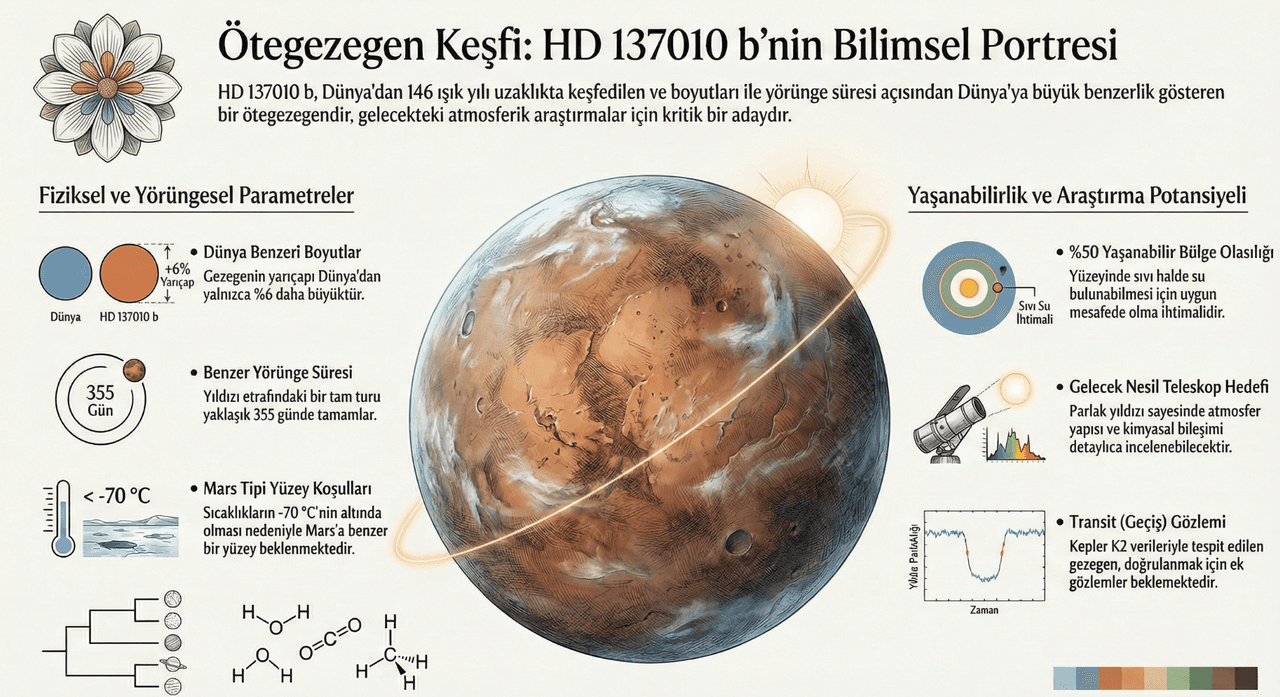
HD 137010 b is located approximately 146 light years from Earth. Its radius is only 6 percent larger than Earth’s, placing it very close to the category of “Earth-like planets.”
The planet’s orbital period around its star is about 355 days, closely resembling Earth’s orbital period around the Sun.
class=\
Scientists estimate a 50 percent probability that HD 137010 b lies within the habitable zone. The habitable zone refers to the distance from a star where liquid water could exist on a planet’s surface.
While this does not confirm that the planet is definitively habitable, it makes HD 137010 b one of the most compelling candidates for detailed study.
The star to which HD 137010 b is bound is cooler and less luminous than the Sun. This directly influences the planet’s surface conditions.
According to researchers, surface temperatures on the planet may be below -70 °C. As a result, surface conditions are expected to resemble those of Mars more than those of Earth.
The planet was detected using data collected during the K2 mission of the Kepler Space Telescope. The discovery was confirmed by an international team of scientists.
However, so far the planet has been observed during only a single transit. This indicates that additional observations are needed to confirm the precise characteristics of HD 137010 b.
Because its star is relatively close and bright, HD 137010 b is an ideal target for next-generation telescopes. This enables future studies to examine:
Although HD 137010 b has not yet been definitively confirmed, it is a notable exoplanet candidate due to its Earth-like size and potential presence in the habitable zone. Future observations will clarify whether this planet truly possesses conditions suitable for life.
Borucki, William J. 2016. “Kepler Mission: Development and Overview.” *Reports on Progress in Physics* 79 (3): 036901. Accessed January 29, 2026.https://doi.org/10.1088/0034-4885/79/3/036901
Kopparapu, Ravi Kumar, Ramses M. Ramirez, James F. Kasting, Vincent Eymet, Tyler D. Robinson, Suvrath Mahadevan, Ryan C. Terrien, Shawn Domagal-Goldman, Victoria Meadows, and Ravi Deshpande. 2013. “Habitable Zones around Main-Sequence Stars: New Estimates.” *The Astrophysical Journal* 765 (2): 131. Accessed January 29, 2026.https://doi.org/10.1088/0004-637X/765/2/131
Luhman, K. L., T. L. Esplin, and N. P. Loutrel. "A Census of Young Stars and Brown Dwarfs in IC 348 and NGC 1333." The Astrophysical Journal 827, no. 1 (2016): 52. Accessed January 29, 2026.
How Close Is It to Earth?
Potential for the Habitable Zone
Its Star and Likely Surface Conditions
How Was the Discovery Made?
Why Is It Important?