


This article was automatically translated from the original Turkish version.
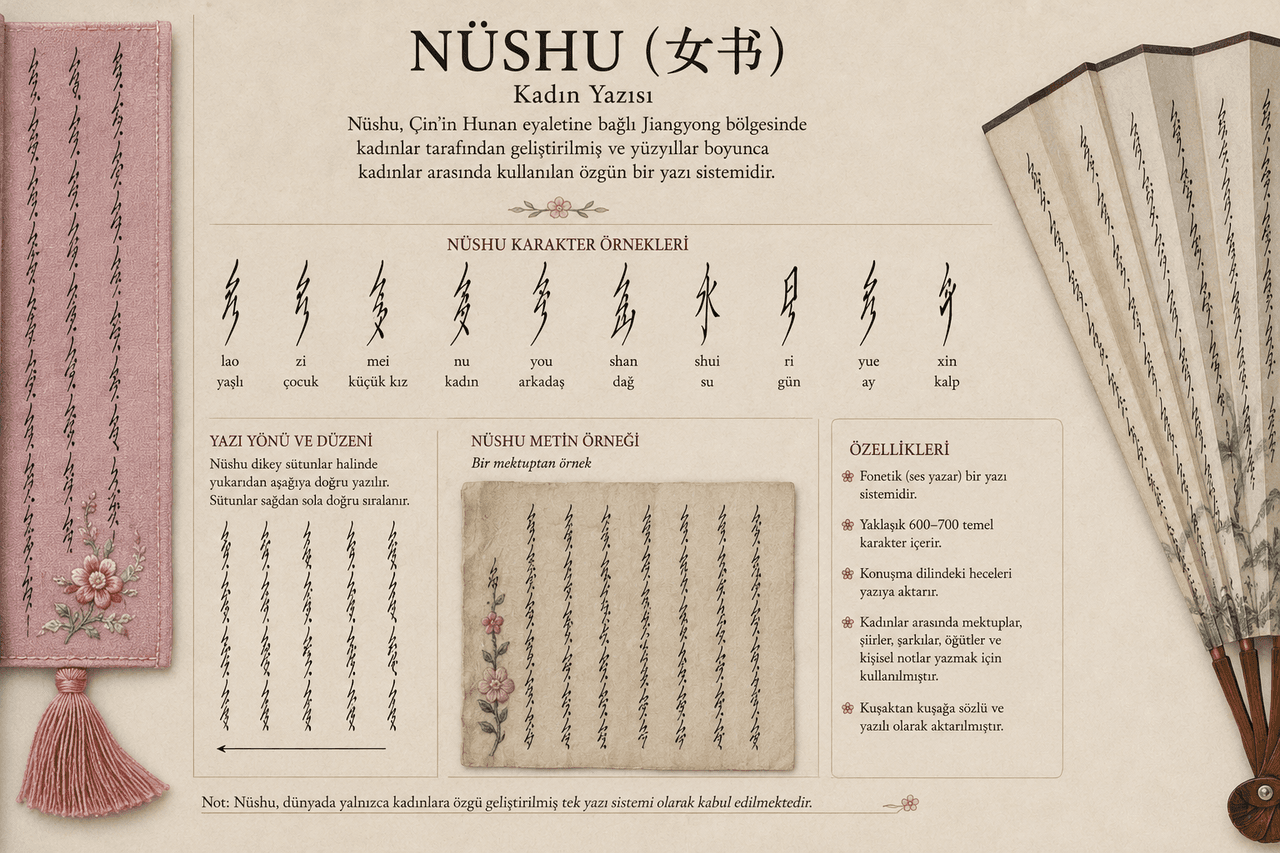
Nüshu (Generated with Artificial Intelligence)
Word Meaning | Women's Writing | ||||||||
|---|---|---|---|---|---|---|---|---|---|
Region of Origin | Jiangyong Region, Hunan Province | ||||||||
User Base | Only women | ||||||||
Historical Context | Feudal China Confucian patriarchal system Doctrine of the Three Obediences | ||||||||
Primary Function | Cultural resistance area Collective memory Construction of the spiritual homeland | ||||||||
Carrier Media | Fans Mendiller Dowry fabrics | ||||||||
Literary Genres | Sanjiaoshu (Third Day Books) Letters Wedding messages | ||||||||
International Registration | Unicode Standard | ||||||||
Nüshu (Chinese: 女书) is the only unique writing system in the world that has remained exclusively female. It was developed and used for centuries by women in the rural areas of Jiangyong County in Hunan Province, China. The term literally means "women's script." This system was first introduced to the academic world in 1982 by scholar Gong Zhebing during his research on the Yao ethnic group.【1】
In scholarly literature, Nüshu is described by its uniqueness, mystery, locality, and richness. It developed entirely independently from the official Chinese writing system, Hanzi—which carries the connotation of "men's script"—and was created by women deprived of formal education to facilitate communication among themselves.【2】
Nüshu is a writing system developed and used by women in Jiangyong County, Hunan Province, China. Its emergence is examined within the historical context shaped by the social conditions and gender-based division of labor in the region.
During the Ming and Qing dynasties, the Confucian social order required women to adhere to the traditional principle of "three obediences" (san cong): before marriage, to their fathers; after marriage, to their husbands; and if widowed, to their sons. During the same period, women had limited access to formal education and significantly lower literacy rates compared to men. This social structure also restricted women’s participation in public life.
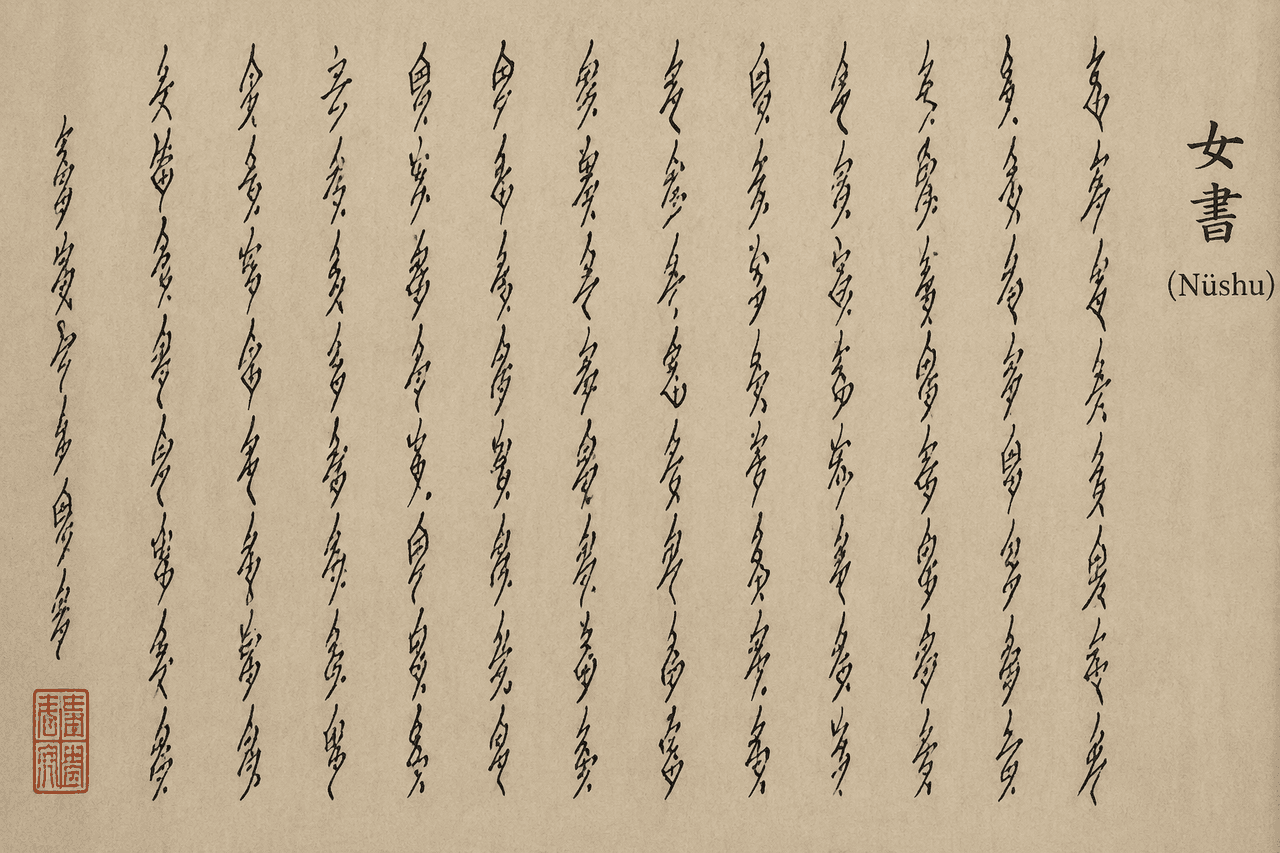
Nüshu Örneği (Yapay Zeka ile Oluşturulmuştur)
The practice of foot binding, known locally as lotus feet, was a custom that reduced women’s mobility and had physical consequences. This tradition affected women’s daily lives and social mobility. Under these historical and social conditions, women developed a phonetic writing system distinct from the standard Chinese script, Hanzi.
Nüshu characters, with their delicate and slanted strokes, were well suited for embroidery on fabric, fans, and other textile items. The writing system was designed to phonetically represent the local Tuhua dialect spoken in Jiangyong. Texts written in Nüshu include poems, songs, letters, autobiographical narratives, and accounts of everyday life experiences.
One of the primary uses of Nüshu was to sustain social networks among women. During the feudal era, it was common for women to leave their natal villages after marriage and move to their husband’s households. In this process, women maintained communication with family members and close female friends through letters, poems, and embroidered textiles. Nüshu became one of the writing systems used in these forms of communication.
Among the texts produced in this context were the Sanjiaoshu ("Books of the Third Day"), which were written and presented to brides on the third day after their wedding by their mothers, relatives, and close female friends. These works addressed themes of separation, married life, friendship, advice, and good wishes. Nüshu was also used during women’s gatherings, while doing needlework, and in social bonds known as "sworn sisterhood."【3】
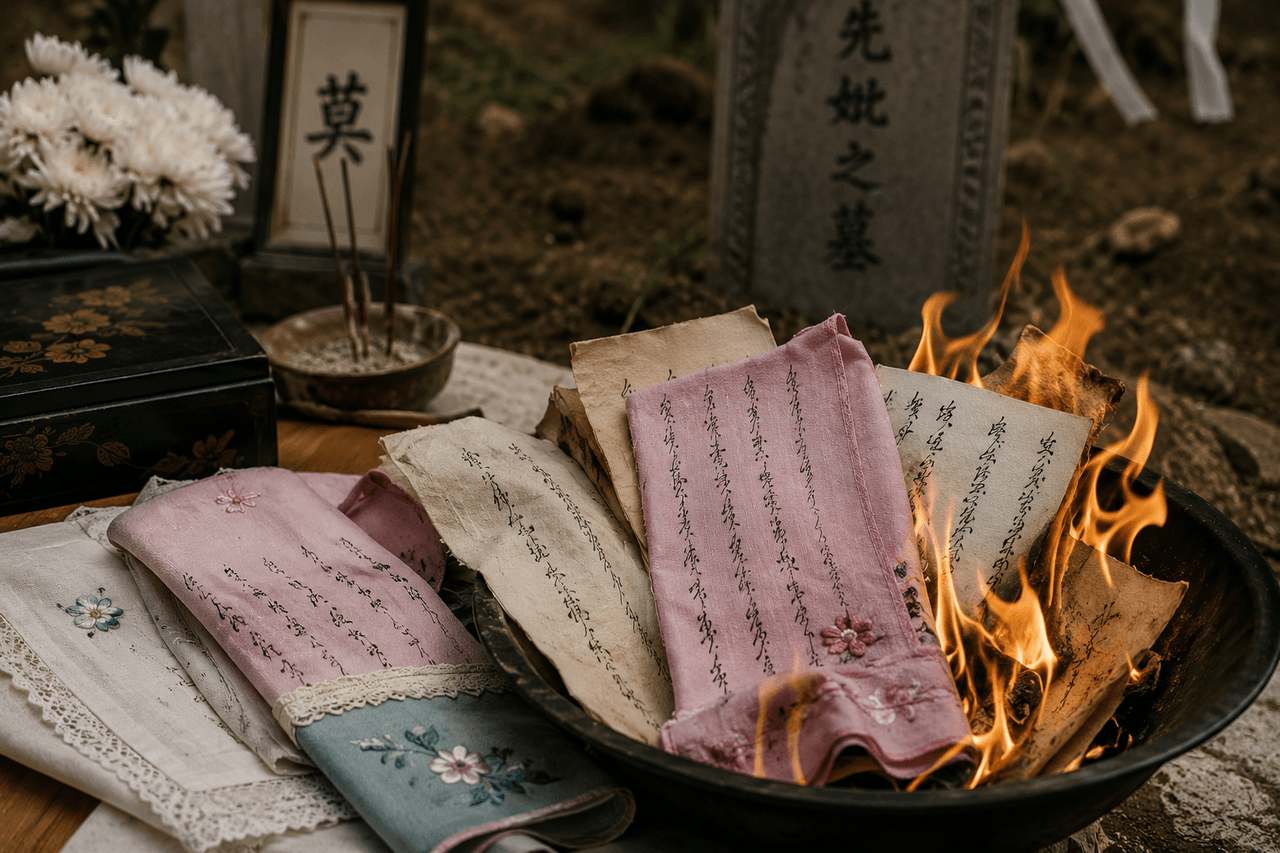
Nüshu ile Yazılmış Peçete ve Kumaşlar (Yapay Zeka ile Oluşturulmuştur)
According to some studies, letters, textiles, and other personal items written in Nüshu were burned during funeral rites or buried with their owners after their deaths.【4】
The number of surviving written examples of Nüshu has diminished over time due to various historical factors. One reason is the local custom of burning or burying Nüshu texts after the death of their owners. This tradition limited the preservation of written materials across generations.
Additionally, during the Taiping Rebellion in the 19th century, the Second Sino-Japanese War (1937–1945), and the Cultural Revolution (1966–1976), Nüshu texts, like many other local cultural artifacts, were damaged or destroyed.【5】
During the Cultural Revolution, Nüshu was regarded by some local authorities as a "feudal relic" and a "secret communication language."【6】 One of the last bearers of the Nüshu tradition, Yang Huanyi (1909–2004), collaborated with researchers to document the script and transmitted knowledge on how to read and teach it.【7】 Starting in the 1980s, researchers including Zhao Liming conducted fieldwork in Jiangyong, recording Nüshu texts, oral traditions, and character inventories, contributing significantly to the linguistic and cultural documentation of the script.【8】
Since the 2000s, institutional efforts to preserve, document, and promote Nüshu have increased. In this context, the Jiangyong Nüshu Ecological Museum, established on Puwei Island in Jiangyong County, is one of the institutions that preserve Nüshu manuscripts, audio recordings, textiles, and other cultural artifacts.【9】
During the same period, the Jinghua Women’s Script Academy, founded by prominent Nüshu practitioner He Jinghua, has carried out educational activities aimed at teaching the script and sustaining traditional practices. Alongside these preservation and promotion efforts, the Nüshu script has begun to be used in cultural heritage tourism through various events and outreach activities.
Standard Chinese writing (Hanzi) is a logographic system in which each character represents an idea, object, or concept. Its use requires learning thousands of characters. Nüshu, by contrast, is a phonetic writing system based on the local Tuhua dialect spoken in Jiangyong, transcribing syllables of the spoken language.
While Hanzi contains tens of thousands of characters, Nüshu uses approximately 600 to 700 basic characters. These characters were used to write words and texts in the local dialect. Due to the fact that different words with the same pronunciation are written using the same character, homophony is common in the system.
Therefore, meaning in Nüshu texts is interpreted not only by the characters themselves but also by context, sentence structure, and the overall coherence of the text. Nüshu’s phonetic structure and limited character repertoire facilitated oral transmission, allowing the script to be passed down through generations both orally and in writing. Although the script remained confined to the Jiangyong region for centuries, its character forms and usage patterns were preserved across generations.
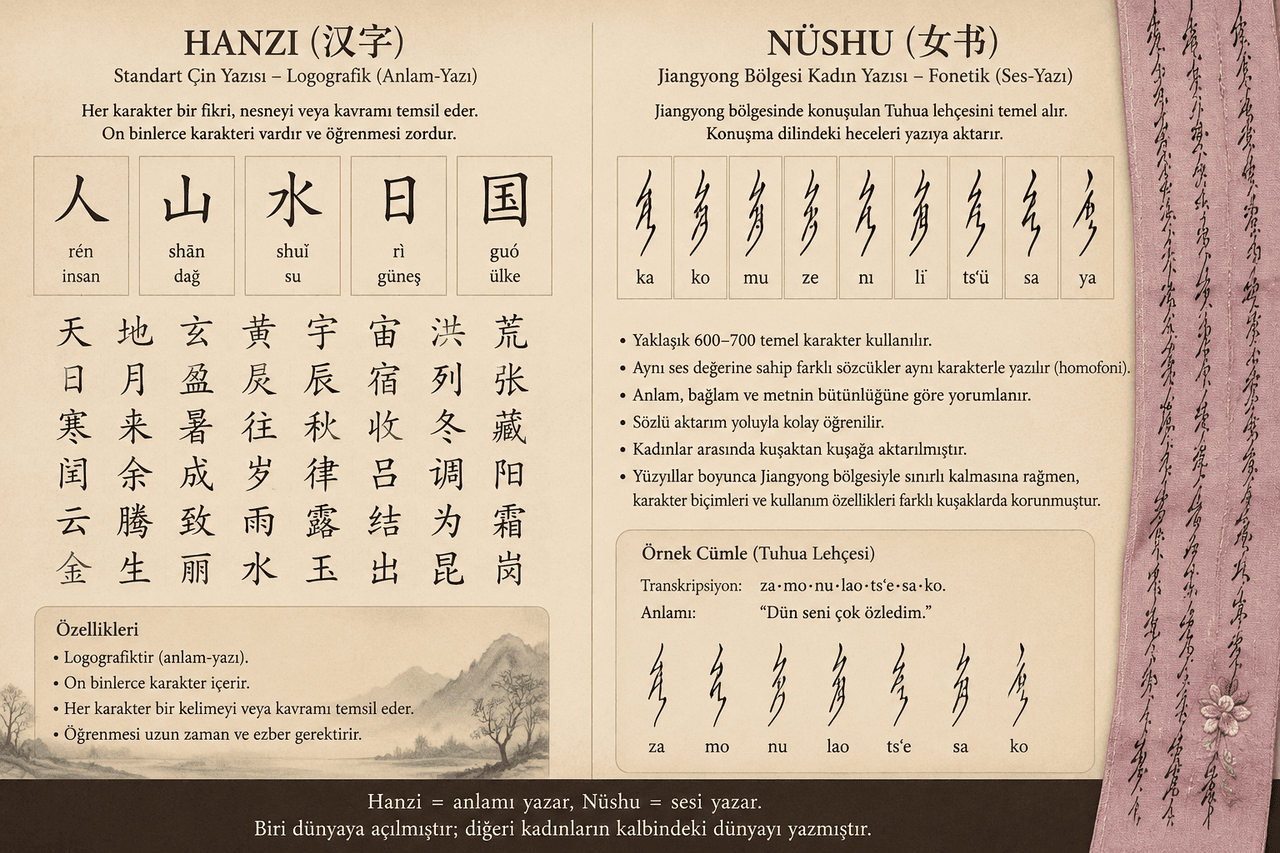
Nüshu ve Hanzi Farklılıkları (Yapay Zeka ile Oluşturulmuştur)
Visually, Nüshu differs formally from standard Chinese writing (Hanzi). Hanzi characters are generally square-shaped and composed of numerous brush strokes, whereas Nüshu characters have a long, slender, and slanted form.
Nüshu characters are also referred to by locals as "fly script" due to their visual appearance. The characters are primarily constructed from four basic stroke elements: dots, vertical lines, slanted lines, and curved lines. Each character generally follows a diagonal orientation from upper right to lower left.
Nüshu texts are written vertically, from top to bottom in columns, with columns arranged from right to left, as in traditional Chinese writing. The system lacks standardized punctuation marks as understood in modern usage. Therefore, pauses and emphasis in reading are determined based on context, oral tradition, and local reading conventions.
In the use of Nüshu, not only the structural features of the writing system but also the social and economic conditions of the time played a decisive role. The limited access of women in Jiangyong to education and public life affected their access to writing materials. As a result, writing tools were mostly made from locally available and household materials.
Women also produced ink by mixing soot from the bottom of cooking pots with water and used bamboo twigs or thin pieces of wood as writing instruments.【11】 Nüshu texts were written or embroidered not only on paper but also on fans, handkerchiefs, fabrics, dowry textiles, quilt covers, and garment linings. This practice enabled the script to be integrated into textiles and everyday objects. Although Nüshu survived for centuries as a local tradition, it was incorporated into the Unicode Standard in 2017, achieving standardization in digital formats.【12】
Due to the limited access of women to formal education in traditional China, the transmission of Nüshu occurred through familial and local learning processes. The script was taught orally and practically from mother to daughter and from older women to younger generations. Additionally, local teaching practices existed in which literate women instructed young girls. Homes, gatherings of women, and some local religious spaces served as educational and practical settings for learning Nüshu.
The teaching process relied on practical methods such as reading, copying, memorizing, and reciting aloud existing texts, rather than formal curricula or grammatical instruction. Due to its phonetic nature, poetry, songs, and oral narratives were also used in teaching, enabling the script to be transmitted across generations through these methods.
Nüshu literature encompasses various text types but is predominantly structured in traditional seven-syllable lines, with some examples in five-syllable lines. In Nüshu literature, letters, wedding messages, devotional texts, autobiographical and biographical narratives, laments, and folk songs hold significant importance. These texts address themes such as marriage, family life, daily experiences, religious practices, and various aspects of women’s lives.
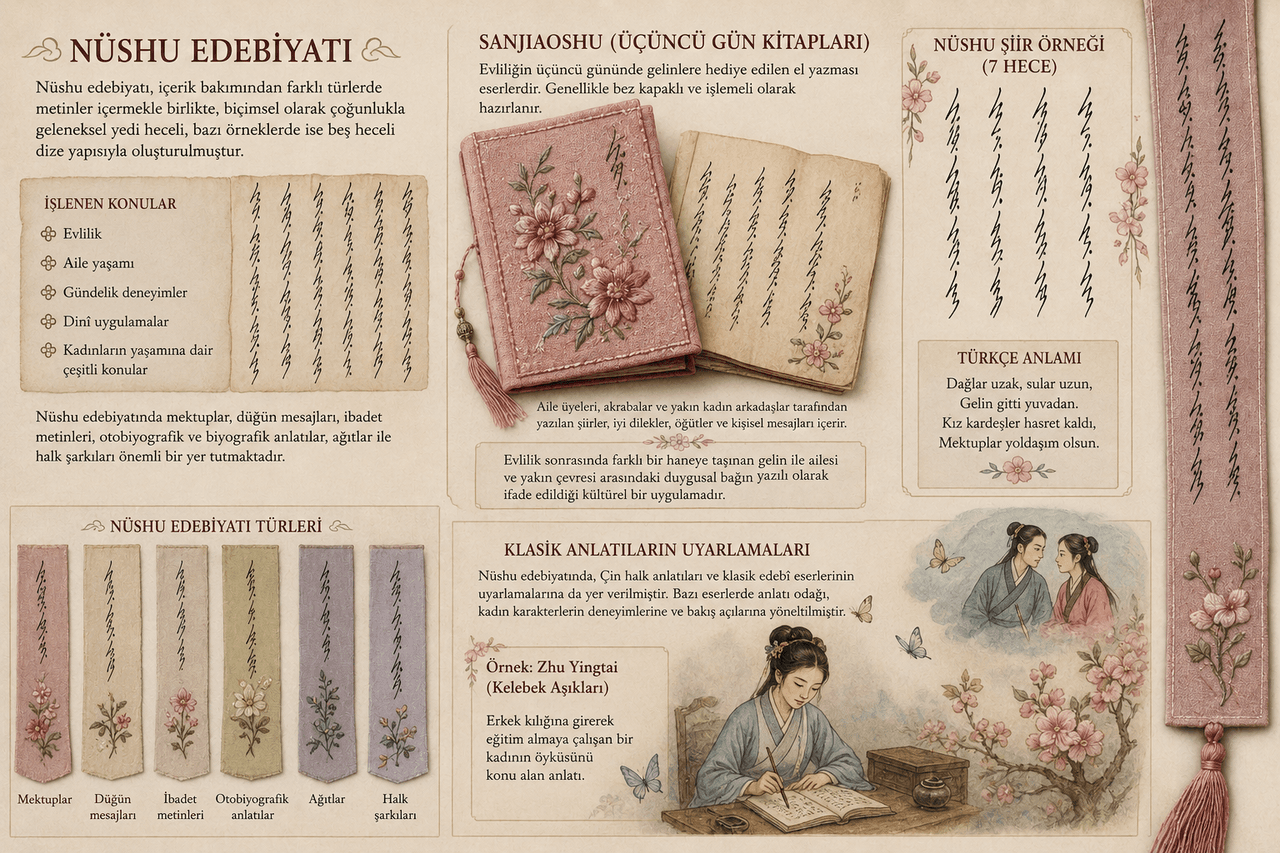
Nüshu Edebiyatı (Yapay Zeka ile Oluşturulmuştur.)
One genre of Nüshu literature is the Sanjiaoshu ("Books of the Third Day"), which are handwritten gifts presented to brides on the third day after their wedding. These works, typically bound in cloth and embroidered, contain poems, blessings, advice, and personal messages written by family members, relatives, and close female friends.【13】 The Sanjiaoshu represents a cultural practice in which the emotional bond between a bride, who has moved to a new household after marriage, and her family and close circle is expressed in writing.【14】
In addition to texts based on women’s personal experiences, Nüshu literature also includes adaptations of Chinese folk tales and classical literary works. In some of these adaptations, the narrative focus shifts to the experiences and perspectives of female characters. One such example is the story of Zhu Yingtai, who disguised herself as a man to pursue education.【15】
In Nüshu texts, themes include women’s lives, family relationships, marriage, education, social roles, and daily experiences. References are made to female figures in Chinese mythology and history, goddesses, and Wu Zetian, the only female emperor in Chinese history.【16】
Today, Nüshu is not only a historical and cultural heritage but also a subject of contemporary art and gender studies. Some contemporary artists incorporate Nüshu into their works within frameworks of cultural memory, authorship, identity, gender, and remembrance.
Akgür, Tuğba. “Kimlik İnşası Ve Özgürleşme Aracı Olarak Çinli Kadınların Yazısı 'Nüshu' (女书).” *Kadın ve Toplum Dergisi* 2(1): 32–43. Accessed July 17, 2026.https://izlik.org/JA57LT68EP
Englebert, Isabel. "Nüshu and the Quiet Transmission of Memory". tate.org. Accessed July 17, 2026.https://www.tate.org.uk/research/tate-papers/tate-papers-no37-mother-lines/nushu-and-the-quiet-transmission-of-memory.
Ergun, Pervin, Şahin Bütüner, and Cansu Körkem Akçay. “Çin’de Nüshu Kültürü Üzerine Halk Bilimsel Bir İnceleme”. *Milli Folklor* 18, no. 144 (2026): 89–98. Accessed July 17, 2026.https://doi.org/10.58242/millifolklor.1360468.
Lofthouse, Andrew. "Nüshu: China’s secret female-only language". BBC. Accessed July 17, 2026.https://www.bbc.com/travel/article/20200930-nshu-chinas-secret-female-only-language.
UNESCO. "Nüshu: from tears to sunshine". Accessed July 17, 2026.https://courier.unesco.org/en/articles/nushu-tears-sunshine.
[1]
Tuğba Akgür, “Kimlik İnşası Ve Özgürleşme Aracı Olarak Çinli Kadınların Yazısı 'Nüshu' (女书)”, *Kadın ve Toplum Dergisi* 2(1): 33, Accessed July 17, 2026.
[2]
Akgür, “Kimlik İnşası Ve Özgürleşme Aracı Olarak Çinli Kadınların Yazısı 'Nüshu' (女书)”, 33.
[3]
Akgür, “Kimlik İnşası Ve Özgürleşme Aracı Olarak Çinli Kadınların Yazısı 'Nüshu' (女书)”, 35.
[4]
Akgür, “Kimlik İnşası Ve Özgürleşme Aracı Olarak Çinli Kadınların Yazısı 'Nüshu' (女书)”, 34.
[5]
Isabel Englebert, "Nüshu and the Quiet Transmission of Memory", tate.org, erişim 17 Temmuz 2026, https://www.tate.org.uk/research/tate-papers/tate-papers-no37-mother-lines/nushu-and-the-quiet-transmission-of-memory.
[6]
Englebert, "Nüshu and the Quiet Transmission of Memory"
[7]
Andrew Lofthouse, "Nüshu: China’s secret female-only language", BBC, erişim 17 Temmuz 2026, https://www.bbc.com/travel/article/20200930-nshu-chinas-secret-female-only-language.
[8]
Pervin Ergun, Şahin Bütüner ve Cansu Körkem Akçay. “Çin’de Nüshu Kültürü Üzerine Halk Bilimsel Bir İnceleme”, Milli Folklor 18 (144): 92, erişim 17 Temmuz 2026, https://doi.org/10.58242/millifolklor.1360468.
[9]
Englebert, "Nüshu and the Quiet Transmission of Memory"
[11]
Akgür, “Kimlik İnşası ve Özgürleşme Aracı Olarak Çinli Kadınların Yazısı 'Nüshu' (女书)”, 36.
[12]
Akgür, “Kimlik İnşası Ve Özgürleşme Aracı Olarak Çinli Kadınların Yazısı 'Nüshu' (女书)”, 36.
[13]
Englebert, "Nüshu and the Quiet Transmission of Memory"
[14]
Englebert, "Nüshu and the Quiet Transmission of Memory"
[15]
Akgür, “Kimlik İnşası Ve Özgürleşme Aracı Olarak Çinli Kadınların Yazısı 'Nüshu' (女书)”, 40.
[16]
Akgür, “Kimlik İnşası Ve Özgürleşme Aracı Olarak Çinli Kadınların Yazısı 'Nüshu' (女书)”, 40.
[17]
Englebert, "Nüshu and the Quiet Transmission of Memory"
[18]
Englebert, "Nüshu and the Quiet Transmission of Memory"
[19]
Englebert, "Nüshu and the Quiet Transmission of Memory"

Nüshu (Generated with Artificial Intelligence)
Word Meaning | Women's Writing | ||||||||
|---|---|---|---|---|---|---|---|---|---|
Region of Origin | Jiangyong Region, Hunan Province | ||||||||
User Base | Only women | ||||||||
Historical Context | Feudal China Confucian patriarchal system Doctrine of the Three Obediences | ||||||||
Primary Function | Cultural resistance area Collective memory Construction of the spiritual homeland | ||||||||
Carrier Media | Fans Mendiller Dowry fabrics | ||||||||
Literary Genres | Sanjiaoshu (Third Day Books) Letters Wedding messages | ||||||||
International Registration | Unicode Standard | ||||||||
Social and Historical Context
Historical Destructions
Linguistic and Formal Features
Educational and Literary Functions
Contemporary Artistic Practices