


This article was automatically translated from the original Turkish version.
Human beings occupy in the universe a space equal to the volume of their own emptiness. But some spirits fill that emptiness with such a sharp, unyielding seepage that even the silence left behind becomes a roaring river.
Nilgün Marmara was one of those delicate and unyielding voices who treated this planet as a two-step lodging and watched its backyards early on, choosing departure as an act of will to preserve her own truth. Her poetry is a spiritual journey that wanders at the limits of enduring life, having clothed pain in the very essence of existence.
What made Nilgün Marmara so alien, so profoundly a “settled foreigner”? Why, in her verses, does death gently knock on the door as a “dear little death”? We must ask this beyond the coldness of academia, with the rhythm recalling Tanpınar’s inner time and Atay’s elusive clarity: What was the source of this ceaseless storm within Nilgün Marmara’s inner world?
For Nilgün Marmara, the world was not a homeland where one could move comfortably, reconciling with its rules and rituals. Instead of joining life, she chose to observe it from the outside, deepening the alienation she felt with every glance. Her gaze upon the world was the restlessness of a consciousness caught between sky and sea, struggling to make sense of its own tiny existence amid two infinitudes.
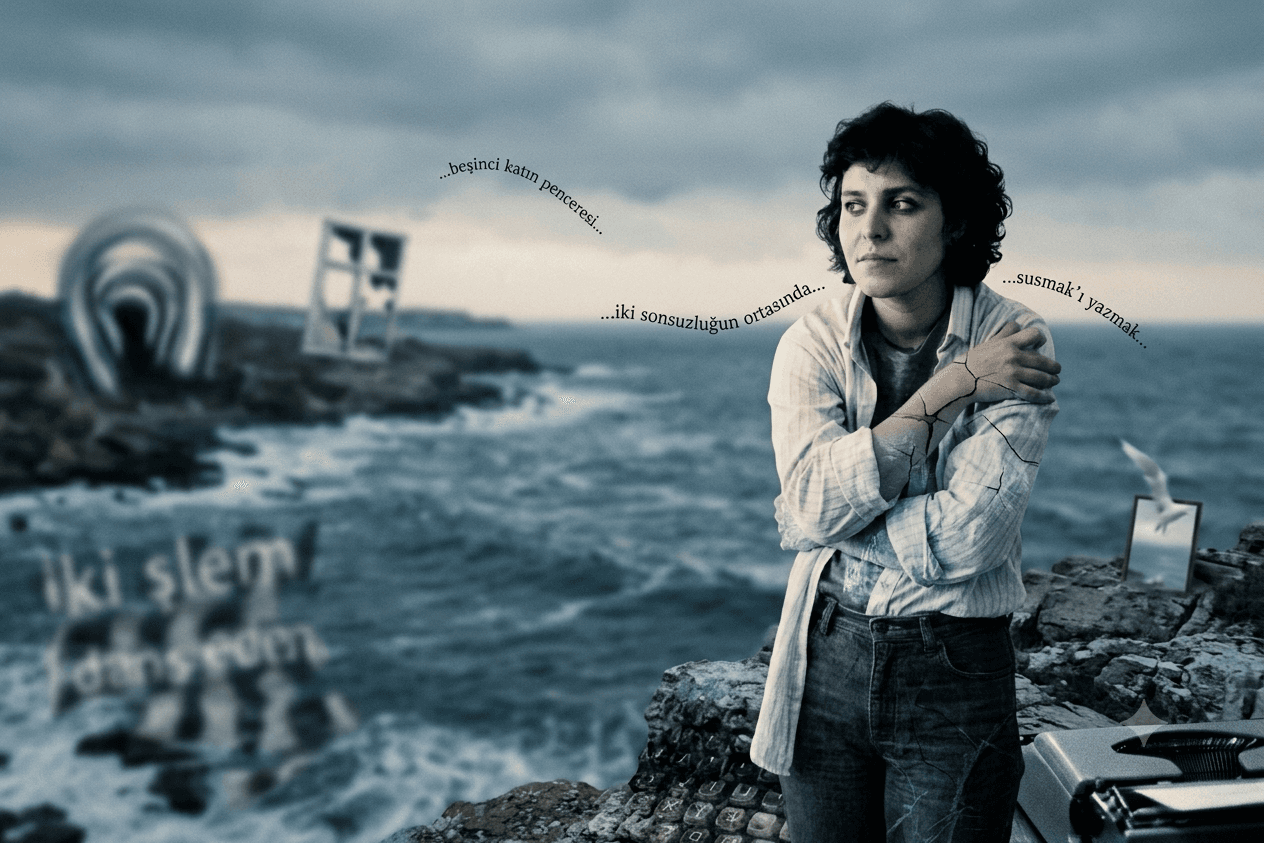
İki Adımlık Yerkürenin Arka Bahçesinde: Nilgün Marmara (Yapay Zeka ile Oluşturulmuştur)
The everyday joys, false reconciliations, and repetitive worldly scrambles of those around her appeared to her as portraits of a foreignness that “dances after two procedures” and expects reward in return.
She refused to yield her heart to these shallow modes of living. She understood life as an unshakable duality between life and death—neither fully rooted in this world nor ever relinquishing the idea of departure.
The yeast of Marmara’s spirit lay in that childlike purity which rejected maturation and integration into the dirty world of adults. While the adult world subtly implanted expectations in her, she wanted to vomit these “executioner judgments” from every cell of her being. When her youth and intellect fused with the intellectual depth stretching from Boğaziçi’s corridors to Sylvia Plath’s poetry of suicide, the sense of rootlessness within her became even more visible.【1】Neither Libya’s vast, scorching deserts nor the narrow garments society imposed on women as gender roles suited her spirit. The desert became for her a shocking metaphor representing the barrenness of her soul’s ties and the immense, insurmountable alienation she felt within marriage and relationships.【2】
Her loneliness is a layered alienation nourished by the fact that her pain, and the fragile self inseparable from it, remained “unseen,” “unheard,” and systematically “ignored.” As the world turned deaf to her cries and blind to her sensitivity, she dug deeper trenches within herself, dismantling one by one the bridges to the external world.
“And now only writing remains:
digging tunnels of screams along life’s paths
and silence.”
The poet transforms the act of writing into an aesthetic, noble, and melancholic form of silence. Her plaintive voice is a whisper rising from the loneliest corners, inward and hushed. Yet this whisper carries such intense spiritual weight, compressed between the words, that when it finally reaches its listener, it erupts into a deafening scream. Nilgün does not hurl her words like spears; she buries them within her own silence, and as the reader digs through that silence, they confront the deepest tremor within.
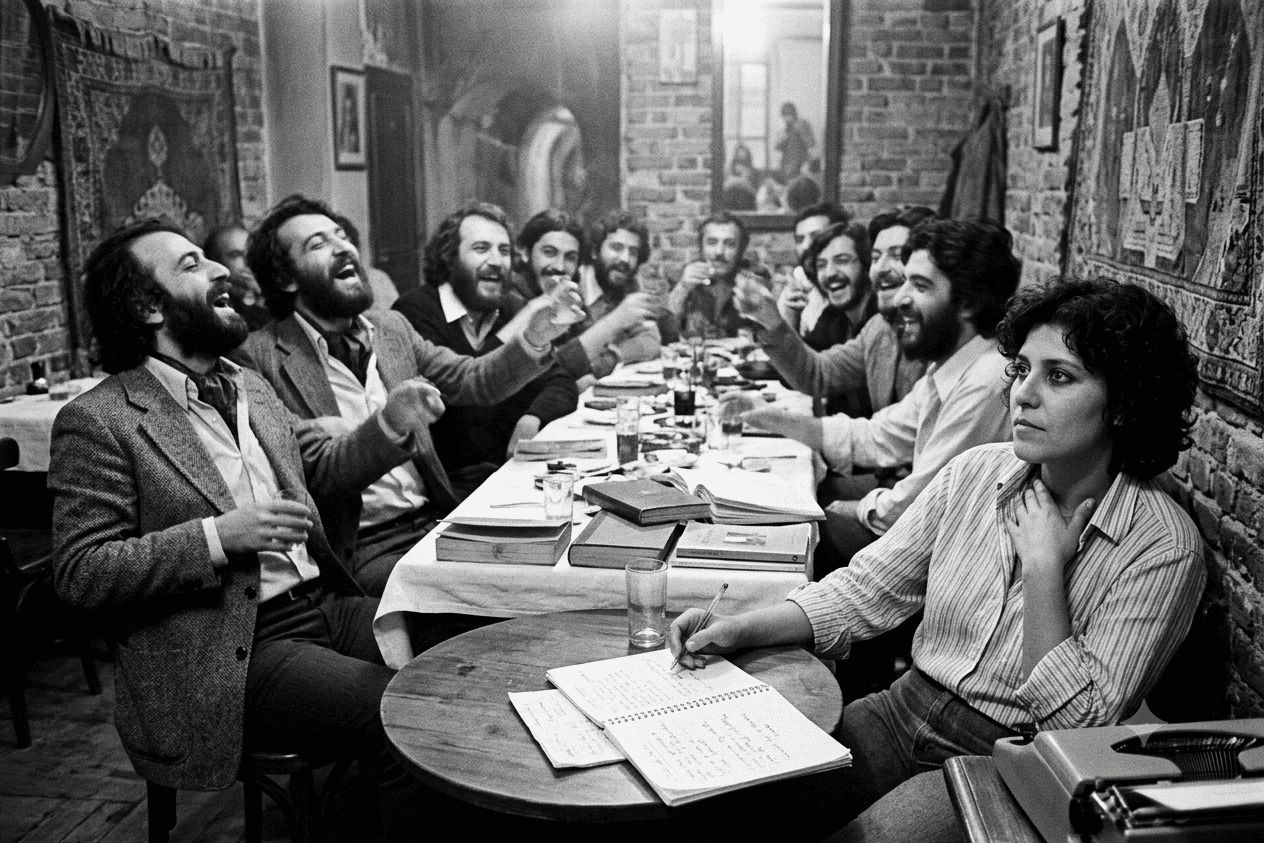
Kalabalıkların Ardında Bir Nilgün Marmara (Yapay Zeka ile Oluşturulmuştur)
In a materialist world that accepts only pain with a “justifiable cause,” pain that can be fitted into logical frameworks, concrete and normative, Nilgün’s causeless, existential, and spiritual anguish was often dismissed as “whining,” “marginality,” or a “bourgeois sensitivity.”
While the spiritual depth lost by people amid daily rush, petty interests, and artificial happiness appears to Nilgün as an open wound, those outside see only meaningless melancholy.
It is this insurmountable wall of incomprehension that made her loneliness absolute, completely closing her off from the external world and leaving her alone with her own “Star”—that singular, suffering companion and confidant, the imaginary image of her inner world.
To understand Nilgün Marmara’s poetics is to trace step by step the chronology of pain. Her poetic universe takes shape around three major stages where pain intensifies:
Her existential anguish is akin to Kierkegaard’s “deadly illness”: the desire to die yet being unable to do so, carrying death at every moment as a living seepage within...【6】 For Nilgün, suicide is seizing the will against the meaninglessness of life and choosing “to die as one is.”【7】
Marmara preserved nearly all her writings, hiding them in shelters she built with her own hands. Against a modern world that greedily consumes everything, sterilizing even the most intimate wounds and displaying them in its windows, her silence is the noblest and sharpest form of resistance woven from words. She chose to nourish her words within the protected silence of her spiritual chamber rather than offer them as food to the applause of a consumer society.
Her poems are secret letters never sent outward, entrusted only to the cold rhythm of typewriter keys, by a spirit that has embraced silence in rejection of reconciliation with the world. The thought of death is woven into her verses slowly, like delicate embroidery. Each line, each image, is a stone laid along the path toward this inevitable end; she mentally rehearsed her body’s final, tragic fall toward the earth countless times.
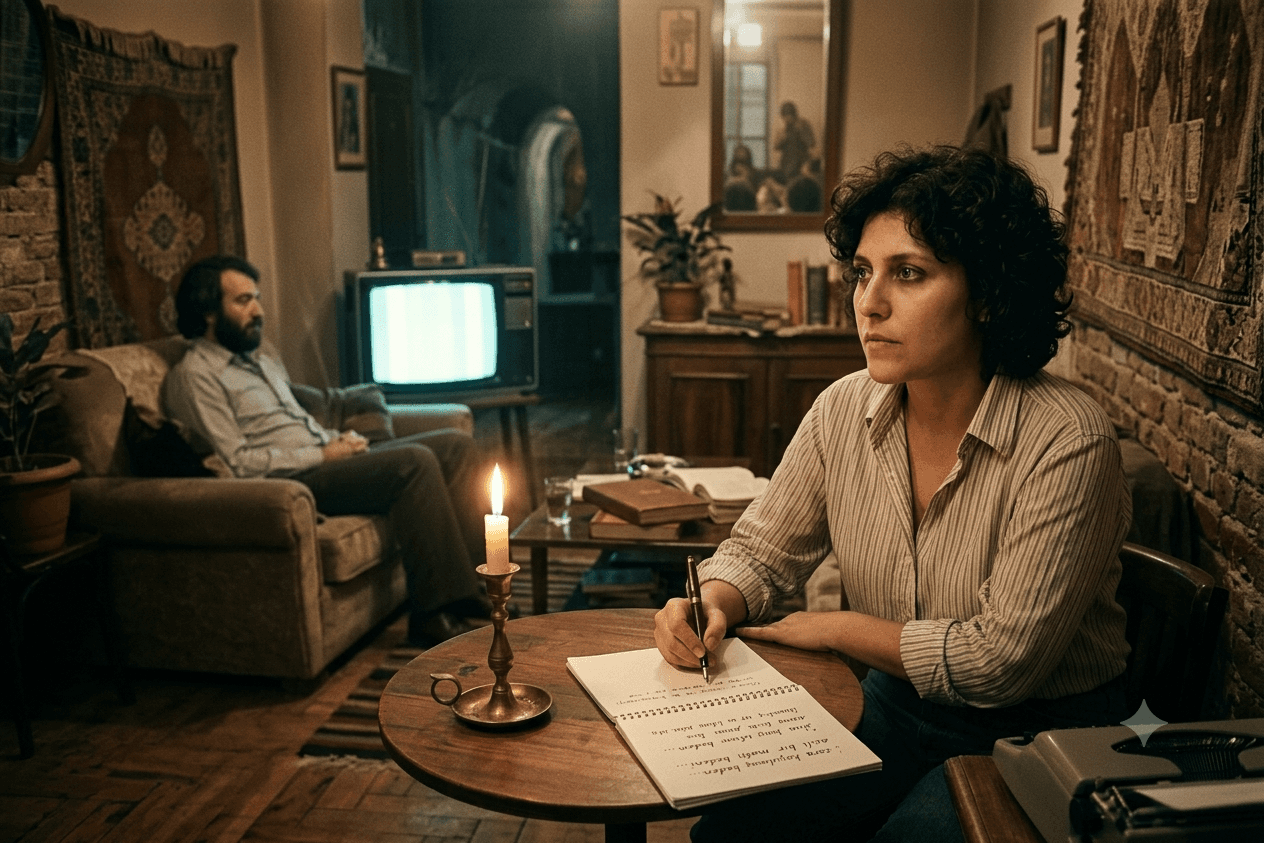
Nilgün Marmara's Profound Inner Loneliness and Spiritual Withdrawal (Generated by Artificial Intelligence)
The poet who saw herself as a “painful gull’s body” sensed long before that this fragile existence could no longer endure the brutal world. As she expressed in that shattering line: “The thin blood seeping from your lips becomes their ecstasy.” Thus, the ultimate silence she chose is the final and noblest spiritual victory, won through sacrifice against this dirty, noisy, and hypocritical world. At the very moment the world believes it has won, Marmara has long since taken refuge in her absolute freedom and noble nonconformity.
In Nilgün Marmara’s verses, we find something deeper than her tragic and untimely departure: an absolute honesty that resists modernity’s deceptive conformity, its promises of improvement, and its forced happiness.
Today’s world seeks to eliminate or mask every pain as a weakness, a mere “optimization error.” But Marmara utterly rejects concealing or fleeing from pain. In her verses, pain becomes a noble force that shapes our existence, purifies us, and defines who we are. Her sentiment—“I feel pain, therefore I am”—legitimizes the fragile existence we all feel inwardly but fear to show to the world.
When we feel disconnected from the world, when we embrace our true loneliness amid crowds and withdraw to the margins, we hear Marmara’s voice. She is the poet of the “settled foreigner”—one who has a place in the world but never truly belongs to it. In the midst of lovelessness, ambition, and norms, we take refuge in her noble nonconformity.
In a system that recognizes only visible, justified, and external causes of sorrow, our causeless, existential, and spiritual seepages are mostly excluded. Marmara is the voice of that invisible seepage, whispered but unheard. She shows us that silence, too, can be written, and that quietness can forge a language deeper than the greatest scream.
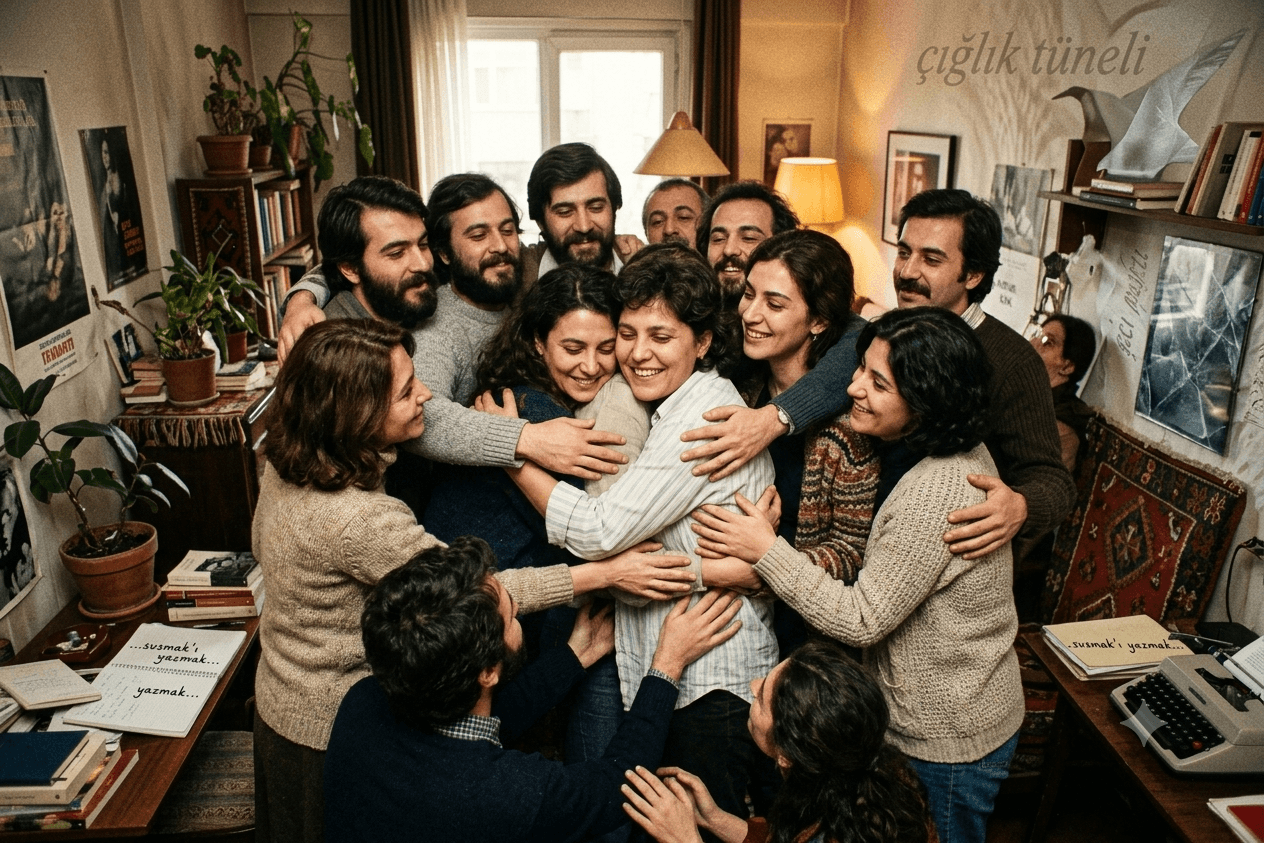
Hugging Nilgün Marmara’s Heart Full of Embrace (Generated by Artificial Intelligence)
When we strip away all roles, expectations, and masks imposed by life, we meet our most naked, most exhausted state—her “body of sorrow.” Marmara is the most lyrical testament to the human struggle to remain “as one is,” turned inward.
Each time we read her, we break free from the deceptive, noisy backyard of this two-step planet and confront our inner solitude with noble and honest clarity...
﹋﹋﹋﹋﹋﹋﹋﹋﹋﹋﹋﹋﹋﹋﹋﹋﹋﹋﹋﹋﹋﹋﹋﹋﹋﹋﹋﹋﹋﹋﹋﹋﹋﹋﹋﹋﹋﹋﹋﹋﹋﹋﹋﹋﹋﹋
Dear reader,
Thank you for staying with me this far, for stepping with me into Nilgün Marmara’s misty and honest world.
Sometimes we all feel like “winter guests” on this “two-step planet.” While everyone around us seems to harmonize effortlessly with the noisy rush of life, carrying our silent “settled foreignness” can be exhausting. It is precisely in those moments that the raw, naked honesty we find in Nilgün’s verses whispers to us: you are not alone. To make peace with your own “body of sorrow” is sometimes simply to write silence and refuse to mask your sorrow with artificial joy. That is our truest self.
I hope this analysis has opened a space for you to take a deep breath within your own spiritual world. Never forget that whenever you feel trapped by the noise of the world, you may find refuge in these verses and in the silent spirits who share this common seepage.
Thank you for being here,
With love and sincerity.
Şen Sönmez, Ürün. “Nilgün Marmara’nın Şiirinde Acının Kronolojisi”. *ViraVerita E-Dergi*, no. 17: 99–132. Accessed July 15, 2026.https://doi.org/10.47124/viraverita.1265686
[1]
Sönmez Şen Ürün, “Nilgün Marmara’nın Şiirinde Acının Kronolojisi”. ViraVerita E-Dergi, sy 17: 101. Erişim 15 Temmuz 2026. https://doi.org/10.47124/viraverita.1265686.
[2]
Sönmez Şen Ürün, “Nilgün Marmara’nın Şiirinde Acının Kronolojisi”. ViraVerita E-Dergi, sy 17: 120.
[3]
Sönmez Şen Ürün, “Nilgün Marmara’nın Şiirinde Acının Kronolojisi”. ViraVerita E-Dergi, sy 17: 107.
[4]
Sönmez Şen Ürün, “Nilgün Marmara’nın Şiirinde Acının Kronolojisi”. ViraVerita E-Dergi, sy 17: 111.
[5]
Sönmez Şen Ürün, “Nilgün Marmara’nın Şiirinde Acının Kronolojisi”. ViraVerita E-Dergi, sy 17: 114.
[6]
Sönmez Şen Ürün, “Nilgün Marmara’nın Şiirinde Acının Kronolojisi”. ViraVerita E-Dergi, sy 17: 107.
[7]
Sönmez Şen Ürün, “Nilgün Marmara’nın Şiirinde Acının Kronolojisi”. ViraVerita E-Dergi, sy 17: 122.
Seeing the World Nilgün’s Way
The Language of Loneliness in Her Poetry
The Ambivalent Dance Between Life and Death
Refuges of Paper
Why Do We Find Ourselves in Nilgün Marmara?
