


This article was automatically translated from the original Turkish version.
+1 More
Manaki Brothers, in the final period of the Ottoman Empire, were pioneering figures in photography and cinema history who operated in the Balkans. Of Ottoman subjects and ethnically Vlach (Aroman), the brothers documented the social, cultural, and political history of the Balkans through short documentary-style footage they began capturing from the early 20th century.
Documentary on the Manaki Brothers (TRT 2)
Yanaki was born in 1878 and Milton in 1880 in Avdella, a Vlach village near Grevena in the Ottoman province of Manastır.【1】
The Manakis belonged to a nomadic family of five children: three girls (Evantiya, Vasilika, and Steryana) and two boys. As part of this lifestyle, they spent the summer months in the village of Avdella at the summit of the Pindus Mountains and the winter months in seasonal dwellings in the town of Grevena. Their father, Dimitri Manaki, was a figure who actively worked from the 1860s onward to preserve the unique language, culture, and traditions of the Vlachs (Macedonian Romanians) and showed interest in Romanian national movements.
After completing middle school in Avdella, Yanaki Manaki graduated from the Romanian High School in Manastır. On 18 April 1898, Yanaki was appointed as a teacher in the village of Inan near Janina, and on 18 October 1899 he began teaching drawing and calligraphy at the Romanian Commercial High School in Janina. Seeking to turn his interest in visual arts into a commercial enterprise, Yanaki opened the first photography studio in Janina on 18 February 1898.
Milton Manaki, who completed his secondary education in Avdella during the same years, enrolled at the Romanian Commercial High School in Janina but left after completing the first grade. Sent by his father to assist his older brother, Milton was trained in photography under Yanaki’s guidance and quickly became a professional master of the craft. Between 1898 and 1905, the two brothers undertook more than forty journeys across villages and settlements in and around Janina—including Larissa, Selanik, and Manastır—laying the foundation for the region’s visual archive.【2】
Due to assimilation and pressure policies pursued by the Rum Patriarchate and Greek nationalists against the Vlach community, Yanaki Manaki was forced to resign from his teaching position at the high school in Janina in 1905.【3】 Having established broad social connections during his high school years, Yanaki moved to Manastır, where he and his brother Milton purchased a house with a garden on Shirok Street and established the “Art Photography Studio” (Atelje Za Umetničku Fotografiju).【4】
In 1906, the Manakis were invited to exhibit their photographs at the photographic exhibition in Bucharest (Macedonia Pavilion), where they won gold and silver medals for their anthropological and social imagery. Following this success, in 1907 Yanaki Manaki was awarded the title of “Official Photographer to the Royal Palace” by King Carol I of Romania. With financial support from the Romanian government, Yanaki embarked on a European tour encompassing Budapest, Vienna, Zurich, Paris, and London. During his visit to London, he purchased a 35 mm Bioscope model film camera with serial number 300 from the Charles Urban Trading Company and returned to Manastır. This camera enabled the brothers to transition from still photography to motion picture filming.【5】
Between 1905 and 1914, the brothers traveled to more than twenty-five cities and villages, primarily Istanbul, Selanik, and Bucharest, to sustain their commercial activities and conduct film shoots. During this period, they produced not only portrait and artistic photography but also advertising projects. It is known that they came to Istanbul in 1905 through their relative Apostol Bazda, the Istanbul Chief Commissioner, and established contact with official authorities there.【6】
In their personal lives, Yanaki Manaki married Anastasiya Hacı İliya on 29 July 1922, and they had a son named Dimitri. After his wife’s death in 1924, Yanaki raised his son alone. Milton Manaki married Vasiliki Dauka from Avdella, and they had a child named Leonid.【7】
The First World War (1914–1918) caused major disruptions in the brothers’ lives. During the German and Bulgarian occupation of Manastır in 1915, weapons and ammunition were found during a search of the Manakis’ photography studio. As a result, Yanaki Manaki was arrested and imprisoned in Manastır Prison on 3 February 1916, and later exiled to Filibe (Philippopolis) in Bulgaria. During his exile from 1916 to 1919, Yanaki opened a private photography studio in Filibe to support himself.
While Yanaki was in exile, Milton Manaki remained alone in Manastır and struggled greatly to operate the studio under wartime conditions. With studio operations suspended, he was forced to turn to horse trading, pig farming, and grain commerce to make a living. During the heavy bombardment of Manastır in 1917, the photography studios on Shirok Street suffered severe damage; the photographic equipment, glass plate negatives, and countless historical photographs were destroyed by fire.
After the end of the First World War, Yanaki Manaki returned to Manastır in 1919, and the two brothers restored their ruined studios. To overcome their economic hardship, they decided to enter the cinema exhibition business and opened an open-air cinema with 180 seats named “Manaki” on 16 August 1921. Beginning construction of a permanent cinema building in 1922, the brothers formed partnerships with Kosta Çomu and Mirko Stoykov due to financial constraints. After the partners separated, they officially opened the enclosed “Manaki Cinema” in December 1923, featuring a 395-seat main hall, a 200-seat balcony, and private boxes.【8】
During this period, Milton Manaki actively participated in the activities of numerous social organizations, including the Yugoslav-French Club, the Red Cross, and the Chamber of Crafts. However, due to ongoing economic difficulties, the brothers were forced to transfer the cinema to Risto Zerdevski between 1928 and 1931, and in 1935 they were forced to cease operations entirely after the State Mortgage Bank seized the property. The cinema building was re-rented to Risto Zerdevski for ten years in 1936, but was completely destroyed by a major fire in the spring of 1939.
After the cinema burned down, Yanaki Manaki permanently relocated to Selanik in the late 1930s to take up a teaching position at the Romanian School of Economics. Yanaki spent the years of the Second World War in Selanik. His 23-year-old son Dimitri died of tuberculosis on 14 January 1948. Following this tragedy, Yanaki Manaki died in Selanik on 19 May 1954 at the age of 76 after suffering a cerebral hemorrhage.【9】
Milton Manaki, who remained in Manastır (Bitola), continued his photographic work alone during the Second World War and the subsequent Yugoslav period. In the final years of his life, Milton transferred his historical film and photographic archive to state institutions to ensure its preservation. He died in Manastır on 6 March 1964 at the age of 84.【10】 The visual legacy left by the brothers today forms the foundational archive of Balkan cinema and photography history.
The Manaki Brothers documented the political, social, economic, cultural, and religious events of their time through their photography and cinematography. Although their early glass plate negatives, cameras, and countless photographs were destroyed in a fire during the bombing of Manastır in 1917, a surviving visual archive has reached the present day.【11】
The brothers’ film and photographic heritage was placed under protection through official agreements beginning in 1955. Their photographs are archived in the special section of the Macedonian Archive in Manastır, while their motion picture reels are cataloged by the North Macedonia Cinematheque. In collaboration with UNESCO and the Ministry of Culture of North Macedonia, the Macedonian Cinematheque has digitized the brothers’ original 2,480 meters of film material, including both negative and positive copies.【12】
Research on the film material produced by the Manaki Brothers reveals that Milton Manaki himself compiled a list of 67 titles. However, due to repeated documentation of the same events under different titles, the archive contains 42 confirmed independent film titles. These works are categorized as follows:
These recordings, which document the material and social culture, traditional clothing, and lifestyle of the Vlach community to which the brothers belonged, are considered the earliest examples of documentary cinema:
These films, recorded between 1908 and 1911, document the political celebrations and activities of the Committee of Union and Progress following the proclamation of the Second Constitutional Era in the Manastır province:
The political tour of Ottoman Sultan Reşad through the Balkan provinces in June 1911 was documented by the Manakis with the Sultan’s personal permission:
These recordings bear witness to the transition of power in the Macedonian region from Ottoman to Serbian and Greek administration:
In traditional Turkish cinema historiography, the documentary The Destruction of the Russian Monument in Ayastefanos, allegedly shot by Fuat Uzkınay on 14 November 1914 under the orders of Acting Commander-in-Chief Enver Pasha in Yeşilköy, has been officially recognized as the “first Turkish film” and the beginning of cinema in Turkey.【29】 However, the absence of any physical record of this film in military or civilian archives, and the lack of concrete evidence proving it was actually filmed, have raised serious doubts about this historical claim. In contrast, the tangible films produced by the Manaki Brothers, preserved intact since 1905, present an empirical challenge to this established narrative.
The basis for considering Fuat Uzkınay’s documentary as the first film lies in the unscientific, empirical, and ideological approach of early cinema historians (Râkım Çalapala, Nurullah Tilgen, Nijat Özön), who disregarded methodological rigor. These historians constructed a cinema history based solely on the criterion of “Turkish origin,” completely ignoring the Ottoman subject identity. The cultural and political functions assigned to cinema during the nation-state-building process, which emerged from the French Revolution and found ideological expression in the late Ottoman period, excluded the multi-ethnic and multicultural structure of the Ottoman millet system from this historical narrative.
According to historical and legal methodology, however, during the time the Manaki Brothers filmed, the provinces of Manastır and Selanik were fully within the sovereign boundaries of the Ottoman State, and the brothers were officially recognized as Ottoman subjects (non-Muslim subjects). Indeed, the Manaki Brothers explicitly declared their allegiance to the state by adding the inscription “Turcia” (Turkey) alongside their names on the cold-stamped identification logos affixed to their films and photographs. In this light, it is more historically appropriate to date the beginning of cinema history not to the abstract and contested notion of the “first indigenous film,” but to 1896, when cinematography first entered Ottoman territory. Adopting such a periodization, the tangible works produced by the Ottoman subjects, the Manaki Brothers, from 1905 onward must be recognized as the first documented, institutional, and physically existing examples of Turkish/Ottoman cinema history.
Launched in 1979 to honor the memory of Yanaki and Milton Manaki, the Manaki Brothers Film Festival has become one of the most established events in the art of cinema. In this context, the “44th Manaki Brothers International Cinematographers Film Festival,” organized by the Association of North Macedonia Film Workers under the patronage of President Stevo Pendarovski and with the support of the Ministry of Culture of North Macedonia and the Municipality of Manastır, was held in Manastır from 24 to 29 September 2023.
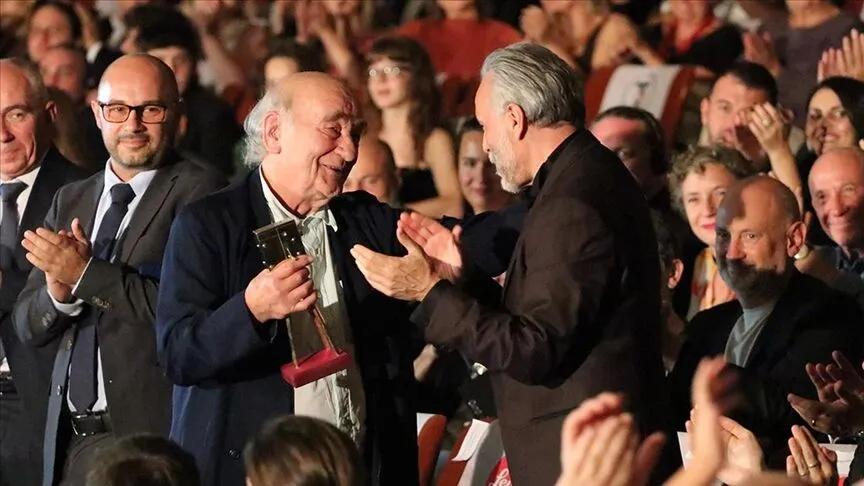
Film Festivalinden Bir Görsel (AA)
Under the slogan “The Beautiful Unknown,” the opening of the 44th festival took place at the Manastır Cultural Center. Events were held at three distinct locations within the city’s cultural memory: the Manastır Cultural Center, the Manaki Cinema, and the Officer’s House. According to the festival’s management and executive committee, over 350 international guests were hosted during the event, 80 films were screened at record levels, and nine separate workshops and numerous seminars were organized.
Anadolu Ajansı. "Kuzey Makedonya'da '44. Manaki Kardeşler Film Festivali' başladı." Accessed July 15, 2026.https://www.aa.com.tr/tr/kultur/kuzey-makedonyada-44-manaki-kardesler-film-festivali-basladi/2999633
Arayancan, Tanıl. "Manaki Kardeşlerin Türk Sinema Tarihindeki Yeri ve Önemi." Master's thesis, Osmaniye KorkutAta Üniversitesi Graduate School of Education, Department of History, April 2024. Accessed July 15, 2026.https://tez.yok.gov.tr/UlusalTezMerkezi/TezGoster?key=LY6e5xGA7WWUpEdrBmEPLrAKx20DdSI6723YLiwZEJPJrDVNOpTue8kbE-rW_X_T
TRT 2. "Tarihin Ruhu | Manaki Kardeşler." YouTube. Accessed July 15, 2026.https://www.youtube.com/watch?v=Tqjg67pVeOo
Çelikcan, Peyami. "Türkiye'de Belgesel Sinemanın Kısa Bir Tarihçesi." *Türkiye Araştırmaları Literatür Dergisi (TALİD)* 18, no. 36 (2020/2): 529-542. Accessed July 15, 2026.https://dergipark.org.tr/en/download/article-file/1452936
[1]
Tanıl Arayancan. "Manaki Kardeşlerin Türk Sinema Tarihindeki Yeri ve Önemi". Yüksek Lisans Tezi, Osmaniye Korkut Ata Üniversitesi Lisansüstü Eğitim Enstitüsü, Tarih Anabilim Dalı, 2024: 33. Son Erişim: 15 Temmuz 2026. https://tez.yok.gov.tr/UlusalTezMerkezi/TezGoster?key=LY6e5xGA7WWUpEdrBmEPLrAKx20DdSI6723YLiwZEJPJrDVNOpTue8kbE-rW_X_T
[2]
Arayancan, "Manaki Kardeşlerin Türk Sinema Tarihindeki Yeri ve Önemi", 33-34.
[3]
Arayancan, "Manaki Kardeşlerin Türk Sinema Tarihindeki Yeri ve Önemi", 68.
[4]
Arayancan, "Manaki Kardeşlerin Türk Sinema Tarihindeki Yeri ve Önemi", 34.
[5]
Arayancan, "Manaki Kardeşlerin Türk Sinema Tarihindeki Yeri ve Önemi", 35.
[6]
Arayancan, "Manaki Kardeşlerin Türk Sinema Tarihindeki Yeri ve Önemi", 35.
[7]
Arayancan, "Manaki Kardeşlerin Türk Sinema Tarihindeki Yeri ve Önemi", 33.
[8]
Arayancan, "Manaki Kardeşlerin Türk Sinema Tarihindeki Yeri ve Önemi", 36.
[9]
Arayancan, "Manaki Kardeşlerin Türk Sinema Tarihindeki Yeri ve Önemi", 36.
[10]
Arayancan, "Manaki Kardeşlerin Türk Sinema Tarihindeki Yeri ve Önemi", 101.
[11]
Arayancan, "Manaki Kardeşlerin Türk Sinema Tarihindeki Yeri ve Önemi", 35.
[12]
Arayancan, "Manaki Kardeşlerin Türk Sinema Tarihindeki Yeri ve Önemi", 38.
[13]
Peyami Çelikcan, "Türkiye'de Belgesel Sinemanın Kısa Bir Tarihçesi," *TALİD* 18, no. 36 (2020/2): 533.
[14]
Arayancan, "Manaki Kardeşlerin Türk Sinema Tarihindeki Yeri ve Önemi", 44-45.
[15]
Arayancan, "Manaki Kardeşlerin Türk Sinema Tarihindeki Yeri ve Önemi", 80.
[16]
Arayancan, "Manaki Kardeşlerin Türk Sinema Tarihindeki Yeri ve Önemi", 44.
[17]
Arayancan, "Manaki Kardeşlerin Türk Sinema Tarihindeki Yeri ve Önemi", 45.
[18]
Arayancan, "Manaki Kardeşlerin Türk Sinema Tarihindeki Yeri ve Önemi", 79-80-81.
[19]
Arayancan, "Manaki Kardeşlerin Türk Sinema Tarihindeki Yeri ve Önemi", 49.
[20]
Arayancan, "Manaki Kardeşlerin Türk Sinema Tarihindeki Yeri ve Önemi", 49.
[21]
Arayancan, "Manaki Kardeşlerin Türk Sinema Tarihindeki Yeri ve Önemi", 50.
[22]
Arayancan, "Manaki Kardeşlerin Türk Sinema Tarihindeki Yeri ve Önemi", 50-51.
[23]
Arayancan, "Manaki Kardeşlerin Türk Sinema Tarihindeki Yeri ve Önemi", 51.
[24]
Arayancan, "Manaki Kardeşlerin Türk Sinema Tarihindeki Yeri ve Önemi", 51.
[25]
Arayancan, "Manaki Kardeşlerin Türk Sinema Tarihindeki Yeri ve Önemi", 53-54.
[26]
Arayancan, "Manaki Kardeşlerin Türk Sinema Tarihindeki Yeri ve Önemi", 52.
[27]
Arayancan, "Manaki Kardeşlerin Türk Sinema Tarihindeki Yeri ve Önemi", 54.
[28]
Arayancan, "Manaki Kardeşlerin Türk Sinema Tarihindeki Yeri ve Önemi", 55.
[29]
Çelikcan, "Türkiye'de Belgesel Sinemanın Kısa Bir Tarihçesi", 6.

Lives
Childhood and Family Origins
Education and the Janina Studio (1898–1905)
Manastır Period and Transition to Cinema (1905–1914)
Marriages, War Years, and Exile (1914–1920)
Cinema Management and Final Years (1920–1964)
Works and Filmography
Ethnographic Films on the Vlachs (Aromans)
Second Constitutional Era and Liberty Films
Sultan V Mehmed Reşad’s Balkan Tour (1911)
Political Developments and Official Visit Films
The Place of the Manaki Brothers in Turkish Cinema History
The Legacy of the Manaki Brothers: The Film Festival