


This article was automatically translated from the original Turkish version.
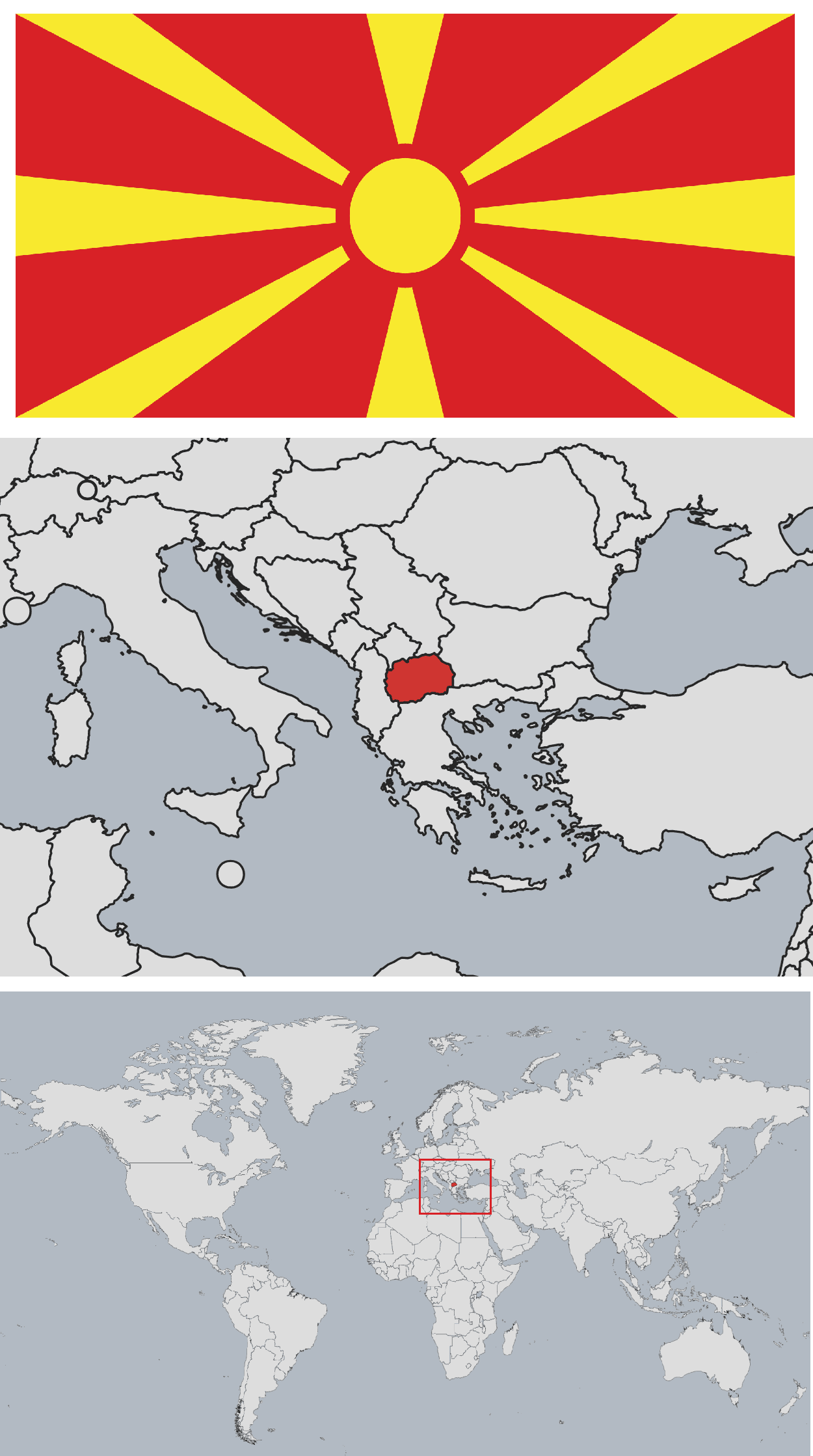
Republic of North Macedonia
Official Name | Republic of North Macedonia (Република Северна Македонија) | ||||||||
|---|---|---|---|---|---|---|---|---|---|
Capital | Skopje | ||||||||
Official Language | Macedonian | ||||||||
Recognized Languages | Albanian | ||||||||
Form of Government | Parliamentary Republic | ||||||||
Head of State | Stevo Pendarovski | ||||||||
Prime Minister | Dimitar Kovačevski | ||||||||
Independence | 8 September 1991 (from Yugoslavia) | ||||||||
Area | 25713 km² | ||||||||
Population | ~1.84 million (2021) | ||||||||
Currency | Macedonian Denar (MKD) | ||||||||
Time Zone | UTC+1 (Winter), UTC+2 (Summer) | ||||||||
Telephone Code | +389 | ||||||||
Internet Domain Code | .mk | ||||||||
Traffic Flow | Right | ||||||||
North Macedonia (officially the Republic of North Macedonia), located in the Balkan Peninsula, is a small landlocked country. It is bordered by Bulgaria to the east, Greece to the south, Albania to the west, and Serbia and Kosovo to the north. The country has an area of 25,713 km² and features a predominantly mountainous terrain. Its capital and largest city is Skopje, with a population of approximately 600,000. North Macedonia peacefully gained independence in 1991 following the dissolution of Yugoslavia and was known for many years simply as Macedonia. However, a naming dispute with Greece posed a significant issue in international politics, leading to the 2018 Prespa Agreement, which changed the country’s official name to the Republic of North Macedonia. This change officially took effect in February 2019. With a population of approximately 1.84 million, North Macedonia exhibits clear ethnic and linguistic diversity. In 2020 it became a full member of NATO and has taken important steps toward beginning accession negotiations with the European Union.
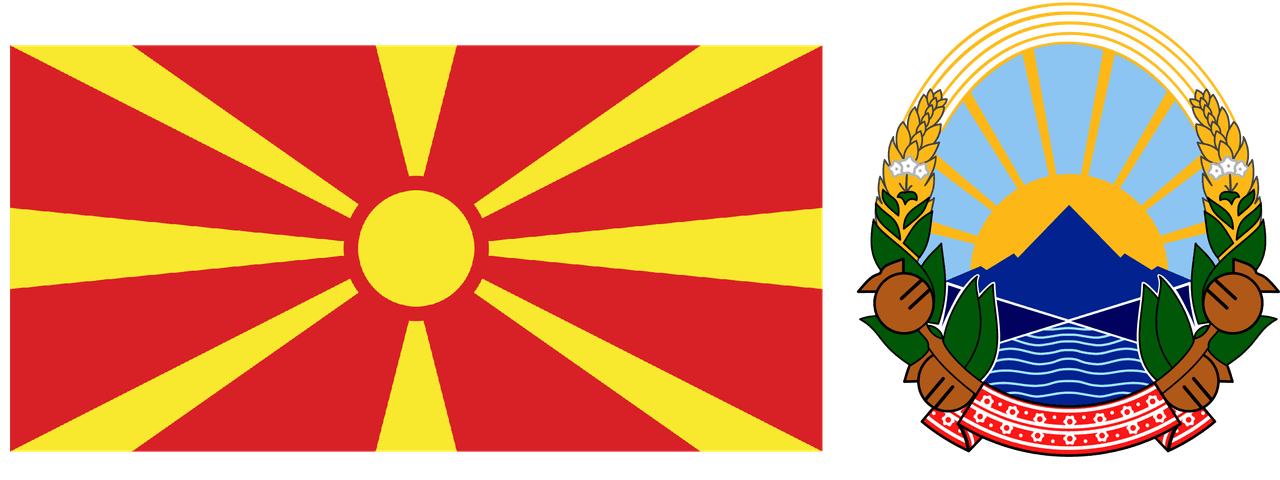
Flag and Coat of Arms of the Republic of North Macedonia
The national anthem of North Macedonia is Denes nad Makedonija (Today Over Macedonia), written during World War II as part of the Macedonian resistance movement and first performed publicly in 1942 in Struga. The lyrics were composed by the poet Vlado Maleski and the music by Todor Skalovski. During the Yugoslav period, this work served as the unofficial anthem of the Socialist Republic of Macedonia and was officially adopted as the national anthem of North Macedonia on 11 August 1992 after independence.
Denes nad Makedonija
The anthem’s lyrics emphasize the Macedonian people’s struggle for freedom and reference the 1903 Ilinden Uprising against the Ottoman Empire and the short-lived Kruševo Republic. It honors Macedonian national heroes such as Goce Delčev, Pitu Guli, Dame Gruev and Sandanski, reflecting the spirit of national unity and independence. Although the country’s name was changed to North Macedonia under the Prespa Agreement, the anthem’s lyrics have been preserved and continue to serve as a symbol of Macedonian identity.
The territory of North Macedonia has historically been a crossroads of various civilizations. In antiquity, the region was inhabited by peoples such as the Paeonians, Illyrians and Thracians; in the 4th century BCE, King Philip II of Macedon conquered the entire region and incorporated it into the Kingdom of Macedon. In 146 BCE, after the Roman conquest of Macedon, the region became part of the Roman province of Macedon. Following the division of the Roman Empire in 395 CE, it came under the rule of the Eastern Roman (Byzantine) Empire. Between the 6th and 7th centuries, Slavic communities settled in the region, transforming its ethnic and cultural structure; by the 9th century, it had become part of the First Bulgarian Empire.
The city of Ohrid served for a time as the capital of the Bulgarian Empire under Tsar Samuel in the 10th century and became a major religious and cultural center. Although the Byzantine Empire reasserted control over the region in the 11th century, in subsequent centuries Macedonian territories changed hands among the Byzantine, Bulgarian and Serbian states. In the mid-14th century, Skopje came under the rule of Serbian Emperor Stefan Dušan and briefly became the center of an empire. However, by the end of the same century, Ottoman Turks entered the Balkans and began their conquest of the region.
The territory of North Macedonia came under Ottoman rule at the end of the 14th century and remained part of the Ottoman Rumelia Eyalet for approximately five centuries. Under Ottoman administration, the region’s demographic and cultural structure was reshaped, with numerous architectural works such as mosques, hans, hamams and bridges constructed. With the weakening of Ottoman authority in the 19th century, nationalist uprisings began to emerge in the region.
As a result of the 1878 Treaty of San Stefano, which ended the Russo-Turkish War, much of Macedonia was temporarily ceded to Bulgaria. However, due to intervention by the Great Powers, the same year’s Treaty of Berlin returned the region to Ottoman control. Against Ottoman rule, Macedonian Slavs intensified their independence efforts, culminating in the Ilinden Uprising on 2 August 1903. The short-lived Kruševo Republic, proclaimed from Kruševo, was effectively suppressed by Ottoman forces.
The Balkan Wars, beginning in 1912, resulted in the withdrawal of Ottoman rule from the Balkans. During the First Balkan War, the Ottoman Empire lost its territories in the region, but the victorious Balkan states could not agree on how to divide Macedonia. As a result of the Second Balkan War, which began in 1913, most of Macedonia was divided between Serbia and Greece; Bulgaria acquired only a small portion.
During World War I (1914–1918), Bulgaria, hoping to regain its lost Macedonian territories, joined the Central Powers and briefly occupied the region. However, after its defeat in the war, Bulgaria was forced to relinquish Macedonia once again. After the war, in 1918, the newly established Kingdom of Serbs, Croats and Slovenes (later the Kingdom of Yugoslavia) incorporated the territory of present-day North Macedonia, known as Vardar Macedonia.
During World War II (1941–1945), Bulgaria, allied with the Axis Powers, reoccupied the region. However, after the war ended in 1945, the Yugoslav Federation assumed control. In 1944, under the initiative of Yugoslav leader Marshal Tito, steps were taken to establish a republic in Macedonia. Within the Yugoslav Federation, the Socialist Republic of Macedonia was created as a constituent republic with equal rights. In the same year, the foundations of the modern Macedonian literary language were codified based on the Resen-Bitola (Manastir) dialect, and the Macedonian language was officially recognized.
During this period, efforts were made to strengthen Macedonian national identity; however, neighboring Bulgaria refused to recognize the Macedonian language and identity as distinct, viewing them instead as part of its own national history. During the Yugoslav period after 1945, Macedonia adapted to the socialist federal structure and developed its own parliament, government and educational institutions. Industrialization and urbanization accelerated during the socialist era, but economically Macedonia remained relatively underdeveloped compared to other Yugoslav republics.
As the Eastern Bloc began to dissolve and ethnic nationalism rose within the Yugoslav Federation, a referendum on independence was held in Macedonia on 8 September 1991. Seventy-four percent of voters endorsed independence, approving the establishment of the Republic of Macedonia. Thus, the country became one of the last peaceful republics to secede from Yugoslavia. However, in the early years of independence, the country faced a serious international dispute with Greece over its name. Greece considered the name “Macedonia” unacceptable, as it was identical to its own northern region, and viewed it as a threat to its sovereignty and historical heritage, refusing to recognize the new state under that name.
Due to this dispute, Macedonia was admitted to the United Nations in 1993 under the provisional name “the Former Yugoslav Republic of Macedonia” (FYROM). In 1994, Greece, in addition to objecting to the name, protested the country’s newly adopted flag (featuring the Vergina Sun symbol) and imposed an economic embargo on the country. This situation harmed the young nation’s economy. Eventually, in 1995, a temporary agreement was reached through mediation: the flag’s symbol was changed and both countries agreed to begin negotiations on the name issue.
During the first decade of independence, North Macedonia largely preserved internal peace, despite its ethnically sensitive structure. The Albanian minority, comprising approximately one-quarter of the population, demanded expanded rights regarding language and local governance. In early 2001, an armed Albanian organization (the National Liberation Army) launched an insurgency in the northwestern part of the country. This low-intensity conflict, lasting approximately seven months, was ended through international mediation.
From the mid-2000s onward, North Macedonia’s strategic goal has been to complete its integration into European and Atlantic institutions. Finally, in July 2022, following an agreement with Bulgaria, the country began EU accession negotiations and continues to advance toward integration with European and Atlantic institutions.
North Macedonia is a landlocked country located in the center of the Balkan Peninsula in Southeast Europe. With an area of 25,713 km², most of its territory is covered by mountains and valleys. The country has a predominantly mountainous terrain and frequently experiences earthquakes. The geographical structure consists of wide valley and basin systems extending from northeast to southwest, surrounded by mountain ranges. The Vardar River Valley forms the country’s geographical spine and creates the main east-west corridor. The Šar Mountains, Bistra and Korab Mountains lie to the west and north, while the Osogovo and Belasica Mountains extend parallel to the Bulgarian border in the east. The highest point in the country is Mount Korab at 2,764 meters (Golem Korab). This peak lies on the border between North Macedonia and Albania and is the highest mountain in both countries. Other significant summits include Titov Vrv at 2,748 meters and other high peaks in the Šar region. The average elevation is around 700 meters, indicating that the country generally has a high-altitude geography.
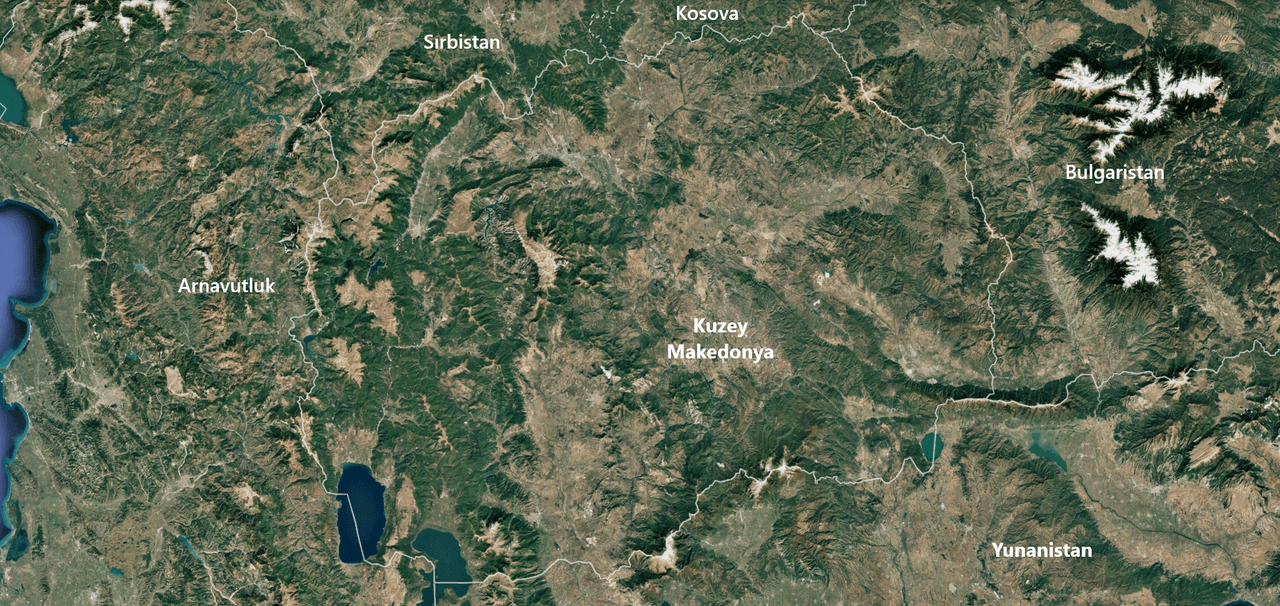
Geography of North Macedonia
Extensive lowlands are limited; the largest plain systems are the Vardar Plain in the central section of the Vardar River and the Ovče Pole Plateau in the east. The longest river in North Macedonia is the Vardar River, stretching 388 kilometers. It originates in the northwest, flows through Skopje, and continues southeastward to empty into the Aegean Sea near the Greek city of Thessaloniki. Another important river is the Crni Drim, which originates from Lake Ohrid and flows northward into Albanian territory before reaching the Adriatic Sea. Other significant rivers include the Bregalnica River.
North Macedonia is home to several large natural lakes, the most important of which are:
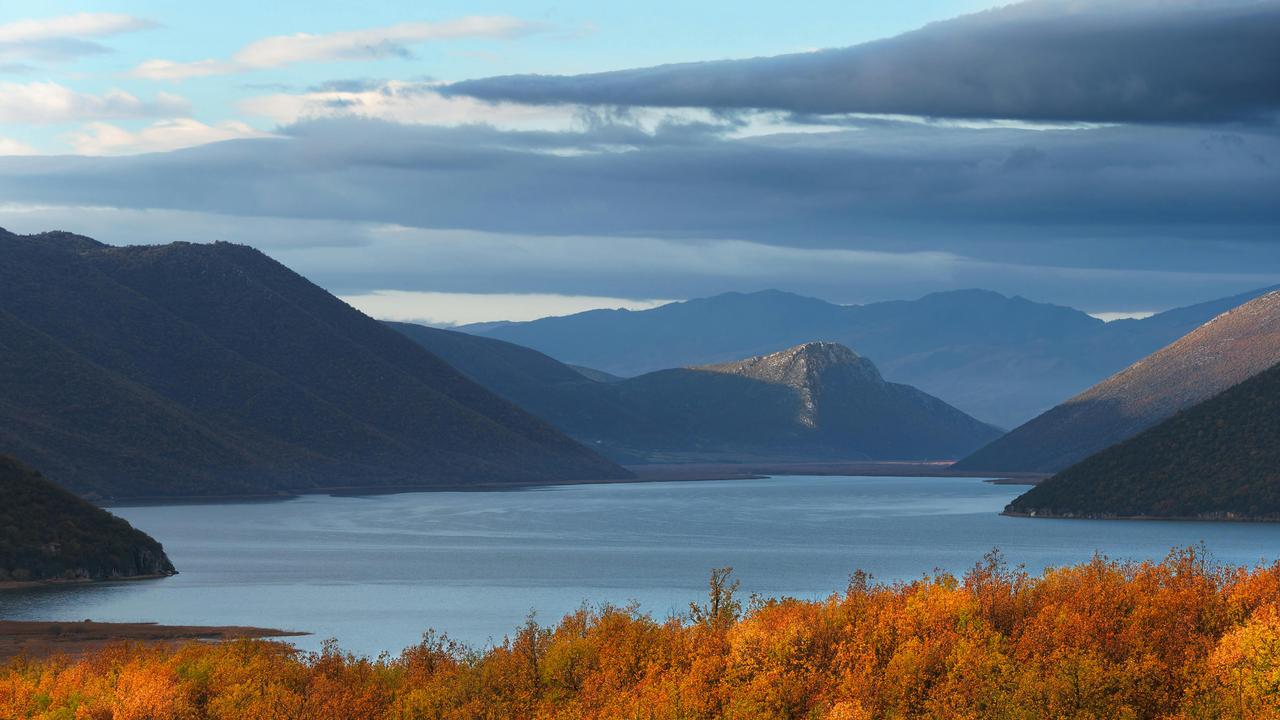
Lake Prespa (Thanos Metallinos)
North Macedonia’s ecology is protected by three major national parks and various natural conservation areas:
These natural areas help preserve North Macedonia’s rich biodiversity and serve as important destinations for ecotourism.
Despite its small size, North Macedonia exhibits climatic diversity due to its varied geographical features. Generally, a temperate continental climate prevails, with cold, snowy winters and hot, dry summers. Average annual temperatures range from approximately 8°C in the mountainous northwestern regions to 13–15°C in central and southern areas.
All four seasons are clearly experienced across the country, but three main climatic zones are observed depending on topography and elevation:
In the capital Skopje, the average January temperature is approximately 0°C, while in July it ranges between 20–25°C. The southeastern regions, including Gevgelija and Demir Kapija, are the hottest areas, where temperatures frequently exceed 40°C in July and August.
Located in the transition zone between the Adriatic and Black Sea climatic systems, North Macedonia’s precipitation patterns vary regionally. The general trend is lower rainfall in the eastern and southern areas and higher rainfall in the western mountainous regions.
Spring and autumn are the seasons with the highest rainfall, while summer months, especially along the Vardar Valley, are notably dry. Dry periods can negatively affect agriculture, while sudden and intense rainfall can occur in spring.
In recent years, climate change has led to an increase in extreme weather events. Particularly the heatwaves and droughts experienced in 2007 and 2012 have increased the risks of forest fires and water shortages in the country.
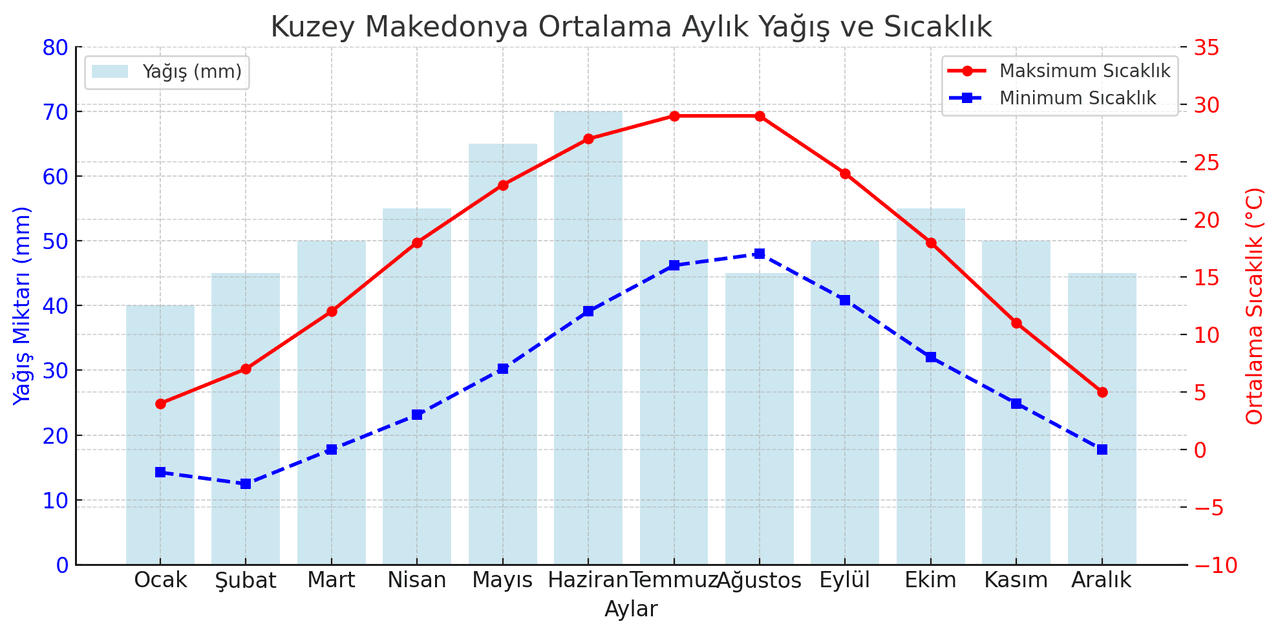
Average Monthly Precipitation and Temperature Graph for North Macedonia
North Macedonia’s population was last updated by the 2021 census. According to the census results, 1,836,713 people reside in the country. This figure represents a decrease of approximately 185,000 since the 2002 census. The population decline is attributed to low birth rates and youth emigration abroad.
Additionally, North Macedonian citizens who have lived abroad for more than 12 months were temporarily counted, bringing the total to 2,097,319. However, demographic analyses are based on the actual resident population of 1.84 million.
The population is 50.4% female and 49.6% male, with a slight majority of women.
North Macedonia has a highly diverse ethnic population. According to the 2021 census, the permanent resident population consists of:
Ethnic distribution varies geographically:
The official language of North Macedonia is Macedonian, belonging to the South Slavic language family. According to the 2021 census:
Following the 2001 Ohrid Agreement, the use of Albanian in public institutions expanded. The Law on the Use of Languages, enacted in 2019, further strengthened its official status nationwide. Turkish language education is also provided in some schools for the Turkish minority.
North Macedonia’s religious structure presents a mosaic largely aligned with ethnic identities. According to the 2021 census:
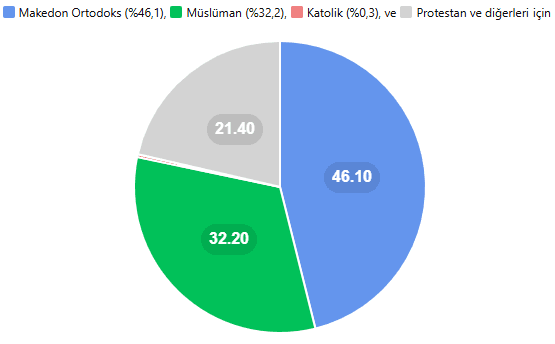
Pie chart showing the religious distribution of North Macedonia in 2021
Religious holidays (Christmas, Easter, Ramadan and Eid al-Adha) are recognized as official public holidays. The Macedonian Orthodox Church declared its independence from the Serbian Orthodox Patriarchate in 1967. However, for many years it was not recognized by other Orthodox churches; its recognition by the Serbian Orthodox Church in 2022 was a significant development.
North Macedonia has an aging population structure. According to the 2021 census:
The fertility rate has declined to 1.5 children per woman, below the replacement level. Economic difficulties and unemployment since the 1990s have led tens of thousands of North Macedonian citizens, particularly the young and educated, to emigrate abroad, primarily to Western Europe. As a result, population growth is very low (around 0.1%) and population decline is occurring in some regions.
Since independence, North Macedonia has prioritized integration into European and Atlantic institutions, good relations with neighbors and regional stability in its foreign policy. However, particularly due to the name issue, its international relations initially faced diplomatic challenges.
Greece argued that the name “Macedonia” was identical to its own northern region and posed a threat to its national identity. From 1991 to 1993, Greece refused to recognize the Republic of Macedonia under that name and secured its UN membership under the provisional name “the Former Yugoslav Republic of Macedonia” (FYROM). In 1994, Greece imposed an economic embargo, which was lifted in 1995 following the Interim Accord.
The Prespa Agreement was signed in 2018, changing the official name of the Republic of Macedonia to the Republic of North Macedonia. Through this agreement, Greece lifted its blockade on North Macedonia’s NATO and EU accession processes, and bilateral relations began to improve. Today, diplomatic and economic cooperation is increasing, although nationalist circles continue to criticize the agreement.
Bulgaria, one of the first countries to recognize North Macedonia’s independence in 1992, considers the Macedonian language a dialect of Bulgarian, while North Macedonia regards its identity as independent. In 2017, the Friendship Agreement established a joint historical commission, but Bulgaria vetoed North Macedonia’s EU accession negotiations in 2020 due to historical and linguistic disputes. In 2022, under French mediation, the veto was lifted, although political debates continue domestically.
Relations between North Macedonia and Albania have generally been friendly, with both countries aiming for EU and NATO integration. Albania mediated during the 2001 crisis and supported the Ohrid Agreement process. Their EU accession processes have been aligned, although Bulgaria’s veto has negatively affected Albania as well. Economic ties are growing, with trade volume increasing and transport and energy projects gaining prominence. Both countries cooperate in regional initiatives such as “Open Balkan.”
North Macedonia and Serbia established close relations in the 1990s due to their shared Yugoslav past, but North Macedonia’s recognition of Kosovo in 2008 caused discomfort in Serbia. Nevertheless, the two countries continue cooperation in trade, transport and energy.
Relations with Kosovo are friendly; North Macedonia signed an agreement in 2009 to define the border between the two countries and has contributed to the KFOR peacekeeping force.
North Macedonia applied for EU membership in 2004, but delays caused by disputes with Greece and Bulgaria slowed the process. Formal negotiations began in July 2022, and the country continues its efforts on rule of law and reforms. The NATO process accelerated after the Prespa Agreement, and on 27 March 2020, North Macedonia became NATO’s 30th member. The country contributes to NATO and UN peacekeeping missions, including in Kosovo.
Turkey was among the first countries to recognize North Macedonia’s independence and supported Skopje during the name crisis with Greece. Turkey supports North Macedonia’s NATO and EU integration processes. Economic relations accelerated after the Free Trade Agreement signed in 2000, and Turkey has become one of the largest investors in North Macedonia. Investments continue in construction, banking, energy and industry. Cultural ties are strong, with Ottoman heritage preserved through TİKA and the Yunus Emre Institute, and educational projects supported. The International Balkan University plays a significant role in academic cooperation between the two countries.
In terms of military cooperation, Turkey has provided training and logistical support to the North Macedonian army and has conducted joint exercises within the NATO framework. Approximately 80,000 Turks live in North Macedonia, and Turkish political parties and civil society organizations advocate for the rights of the Turkish community in the country.
North Macedonia is a member of the United Nations (UN), the Organization for Security and Co-operation in Europe (OSCE), the Council of Europe, and the World Trade Organization (WTO). It joined the UN in 1993 under its provisional name and transitioned to “North Macedonia” in UN records after its official name change in 2019. Regionally, it participates in initiatives such as the Southeast European Cooperation Process (SEECP) and the Central European Free Trade Agreement (CEFTA). It also holds observer status in the Organization of Islamic Cooperation (due to its Muslim population) and the Francophonie Organization (due to interest in the French language).
North Macedonia’s armed forces are known as the Army of North Macedonia (Armija na Severna Makedonija - ASM). The army operates to ensure national security, participate in international peace operations and strengthen integration with NATO. Compulsory military service was abolished in 2008, and a fully professional, volunteer-based military system has been adopted. Due to geographical reasons, there are no naval forces.
After becoming a full NATO member on 27 March 2020, North Macedonia implemented significant changes to its defense doctrine and accelerated its modernization process. The country has begun replacing its former Yugoslav-era military equipment with NATO-standard weapons and vehicles, particularly acquiring armored personnel carriers (JLTV) and other modern military equipment from the United States. Additionally, cyber security, communication infrastructure and command-and-control systems are being aligned with NATO standards. To develop qualified personnel, officers participate in military training programs in NATO countries such as Turkey, the United States and Germany.
The Army of North Macedonia actively participates in international peacekeeping missions, contributing to NATO and UN operations such as the NATO Force in Kosovo (KFOR), EUFOR Althea in Bosnia-Herzegovina and UNIFIL in Lebanon. It has also deployed troops to Afghanistan’s ISAF and Resolute Support missions. These contributions have strengthened the country’s integration into international security policies and established it as a reliable partner within NATO.
In terms of defense spending, North Macedonia committed to increasing its expenditure from 1.3% of GDP in 2020 to the NATO target of 2% by 2024. As of 2023, the defense budget was set at approximately 320 million euros, allocated for modernization, training and enhancing integrated military capacity with NATO. In addition, the army cooperates with civilian authorities during natural disasters and social crises, providing logistical support and participating in rescue operations in disaster areas. During the COVID-19 pandemic, the army supported the healthcare system and has played an active role in responding to floods, fires and earthquakes.
The Armed Forces of North Macedonia consist of a total of 72,500 personnel. However, the majority of this number comprises reserve forces. The army is structured as follows:
These figures indicate that North Macedonia’s defense strategy relies on a strong reserve system rather than large active units.
The Land Forces constitute the main defense capability of the country. Key components include:
The current inventory of North Macedonia’s land forces is as follows:
These figures indicate that North Macedonia has limited capacity in tanks and heavy artillery systems but possesses considerable capability in armored vehicles and artillery support systems.
North Macedonia’s Air Force has limited capacity and does not operate combat aircraft. The country’s air defense is provided by NATO members, particularly Greece and Italy.
Air Force inventory:
The primary missions of the Air Force are logistical support, personnel transport and aerial reconnaissance. With no offensive capability, the country’s airspace is protected by NATO member countries.
North Macedonia is a small market economy that transitioned after the dissolution of Yugoslavia. As of 2025, its nominal GDP is approximately $17 billion. Per capita income, calculated using Purchasing Power Parity (PPP), is about $23,000, placing the country in the upper-middle-income category. It has largely completed its transition to a free-market economy through privatization and structural reforms, but in recent years it has faced economic challenges due to global inflation and fluctuations in energy prices.
According to the CIA World Factbook, North Macedonia’s economy is recovering from the effects of energy price volatility and the COVID-19 pandemic. However, the energy crisis of 2022 caused inflation to rise rapidly, reaching double-digit levels. By 2023, stabilization measures had brought inflation down to 3–4%.
The sectoral composition of the economy is as follows:
North Macedonia’s agricultural sector is concentrated particularly in the southern regions and the Vardar Plain. Main agricultural products include tobacco, grapes, fruit (apples, apricots), vegetables (peppers, tomatoes), cereals and livestock. The Tikveš region is famous for its vineyards and wine production, and the country is one of the major wine exporters in the Balkans. Tobacco farming has long been the country’s most valuable agricultural product.
Traditionally, the industrial sector has been based on iron and steel, chemicals and textiles. However, in recent years, foreign investment has spurred growth in automotive components and electronics assembly. Several Free Economic Zones have been established in North Macedonia, with German companies being prominent investors. Electrical equipment, catalytic converters and automotive spare parts are among the most produced and exported industrial goods.
The “Zelezarnica” steel plant in Skopje, once one of the country’s largest industrial enterprises, continues production but at reduced capacity. The textile and leather industries remain important sources of employment in cities such as Štip and Prilep.
In North Macedonia, trade, transport, tourism and financial services are the most important areas of the service sector. The banking sector is relatively small, with the majority of the market controlled by foreign banks (particularly those based in Austria and Greece). The national currency, the Macedonian Denar (MKD), maintains a stable exchange rate against the euro. However, due to global inflationary pressures, inflation reached 14% in 2022 and was brought down to 3–4% in 2023.
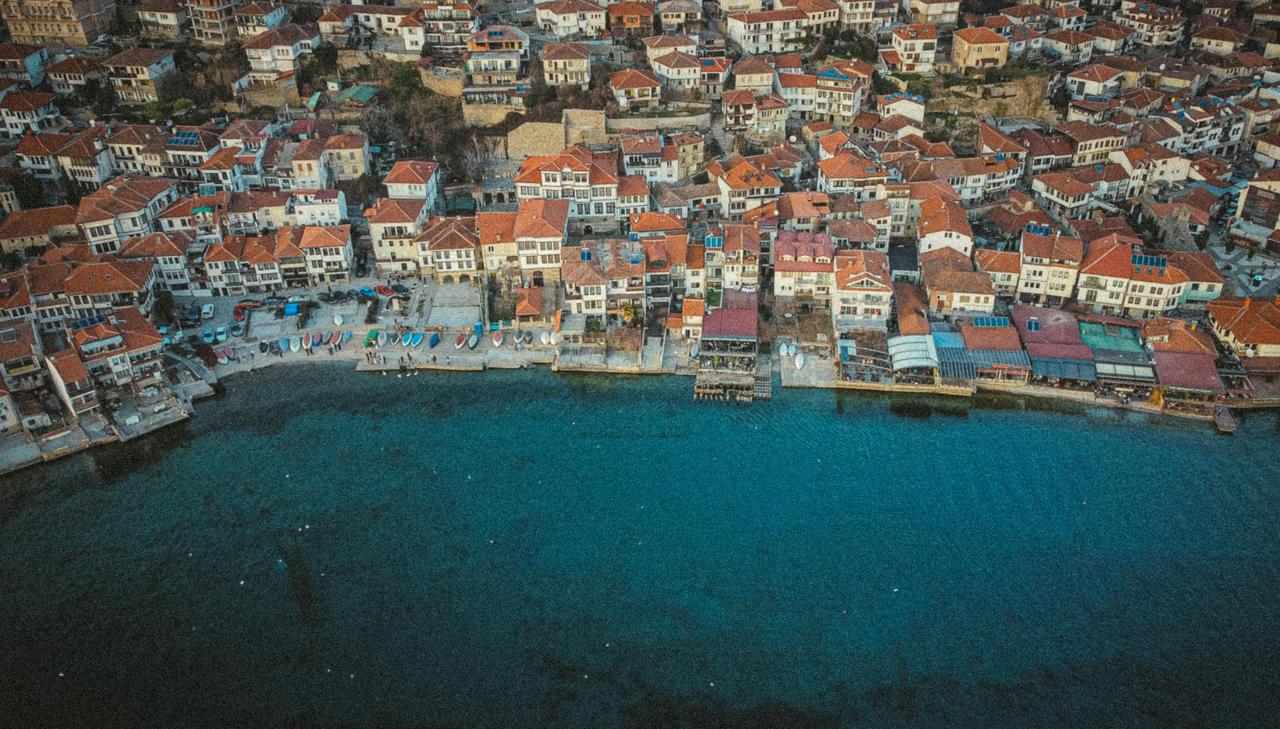
Ohrid (Jakov Jovanoski)
Unemployment in North Macedonia has remained high for many years. Unemployment, which exceeded 30% in the early 2000s, has gradually declined to 15.8% in 2021, 14.4% in 2022 and approximately 13% in 2023. Youth unemployment remains high, particularly among the 15–24 age group, where job-finding rates are low. This situation has led to emigration of skilled labor (brain drain), negatively affecting the country’s economic growth potential.
North Macedonia’s economy is export-oriented. As of 2022:
North Macedonia runs a trade deficit, which is offset by remittances from its citizens living abroad.
Main export partners are:
Main imported goods include:
Main import partners are:
North Macedonia’s economy achieved average annual growth of 3–4% during the 2000s. However:
The government has largely completed privatizations, but state involvement continues in energy, transport and public services. It aims to increase foreign direct investment (FDI) through investment incentives and a low corporate tax rate (10%).
North Macedonia is one of the Balkans’ important tourism destinations, thanks to its rich historical heritage, natural beauty and multicultural character. The country possesses significant potential for both cultural and nature tourism, with historical sites from antiquity to the Ottoman era, lakes and mountains. Historical and natural attractions can be found throughout the country, from the capital Skopje to Ohrid, Bitola (Manastir) to Mavrovo.
North Macedonia remained under Ottoman rule for approximately five centuries and is home to numerous Ottoman-era structures, including mosques, hans, hamams, bridges and tekkes. These buildings reflect important traces of Ottoman architecture and cultural heritage.
Skopje
The capital Skopje was one of the most important trade and cultural centers in the Balkans during the Ottoman period and retains an Ottoman-era bazaar. Key Ottoman heritage sites include:
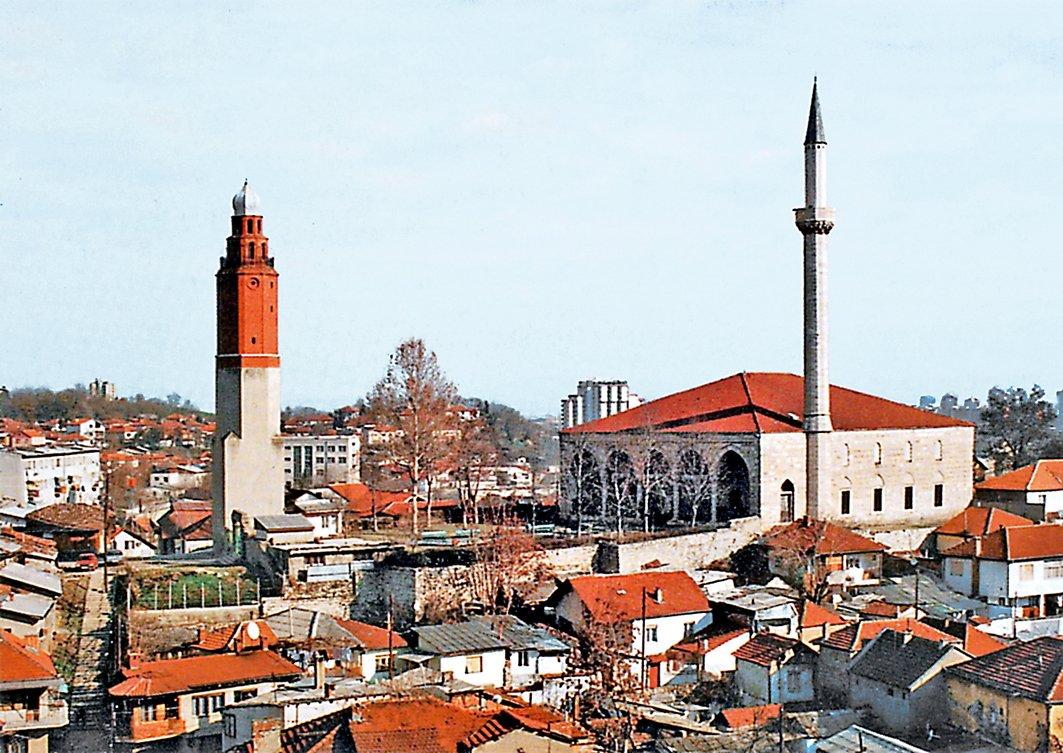
Sultan II. Murad Mosque
Manastir (Bitola)
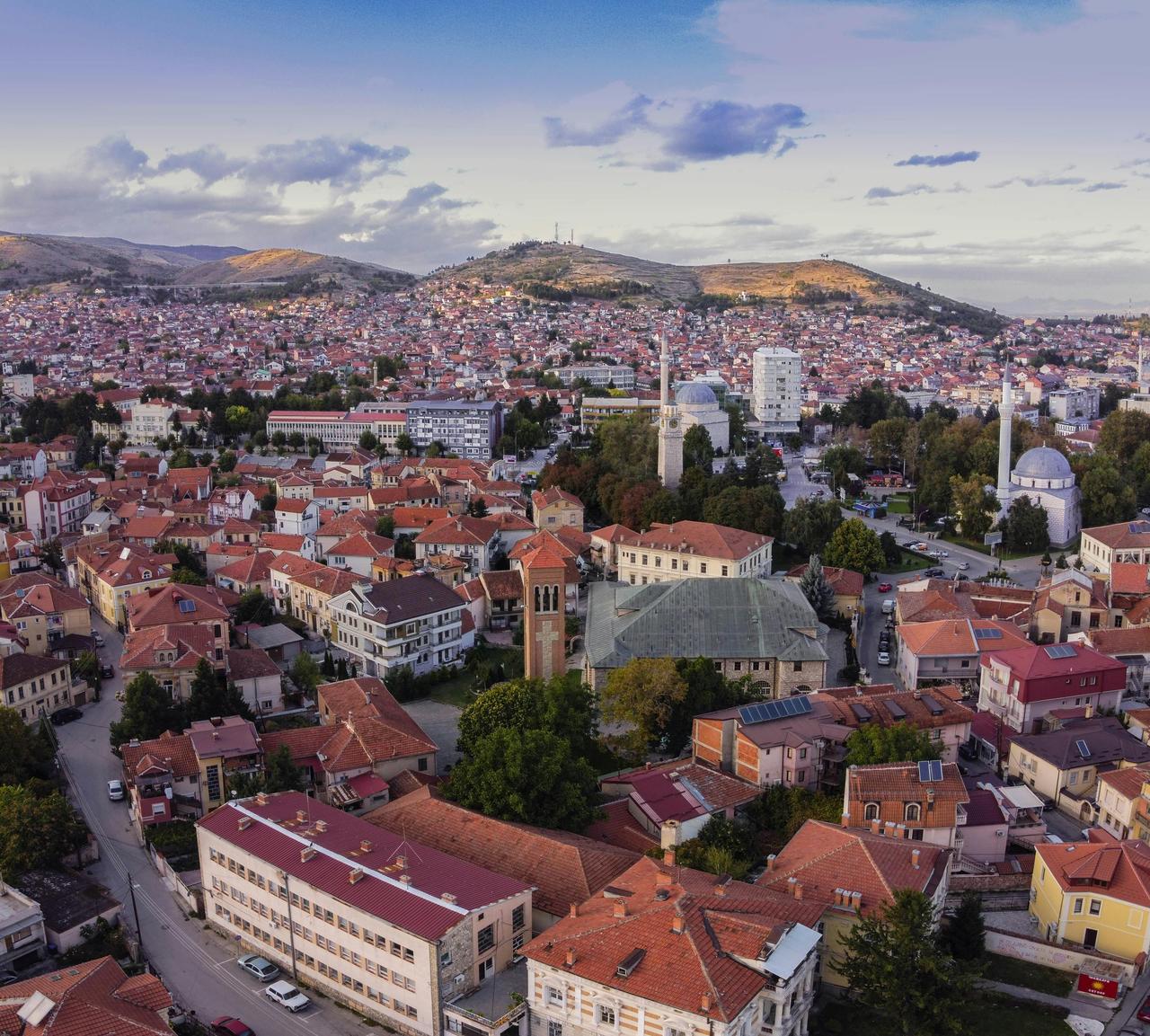
City of Manastir (Micko Damnjanovski)
Kalkandelen (Tetovo)
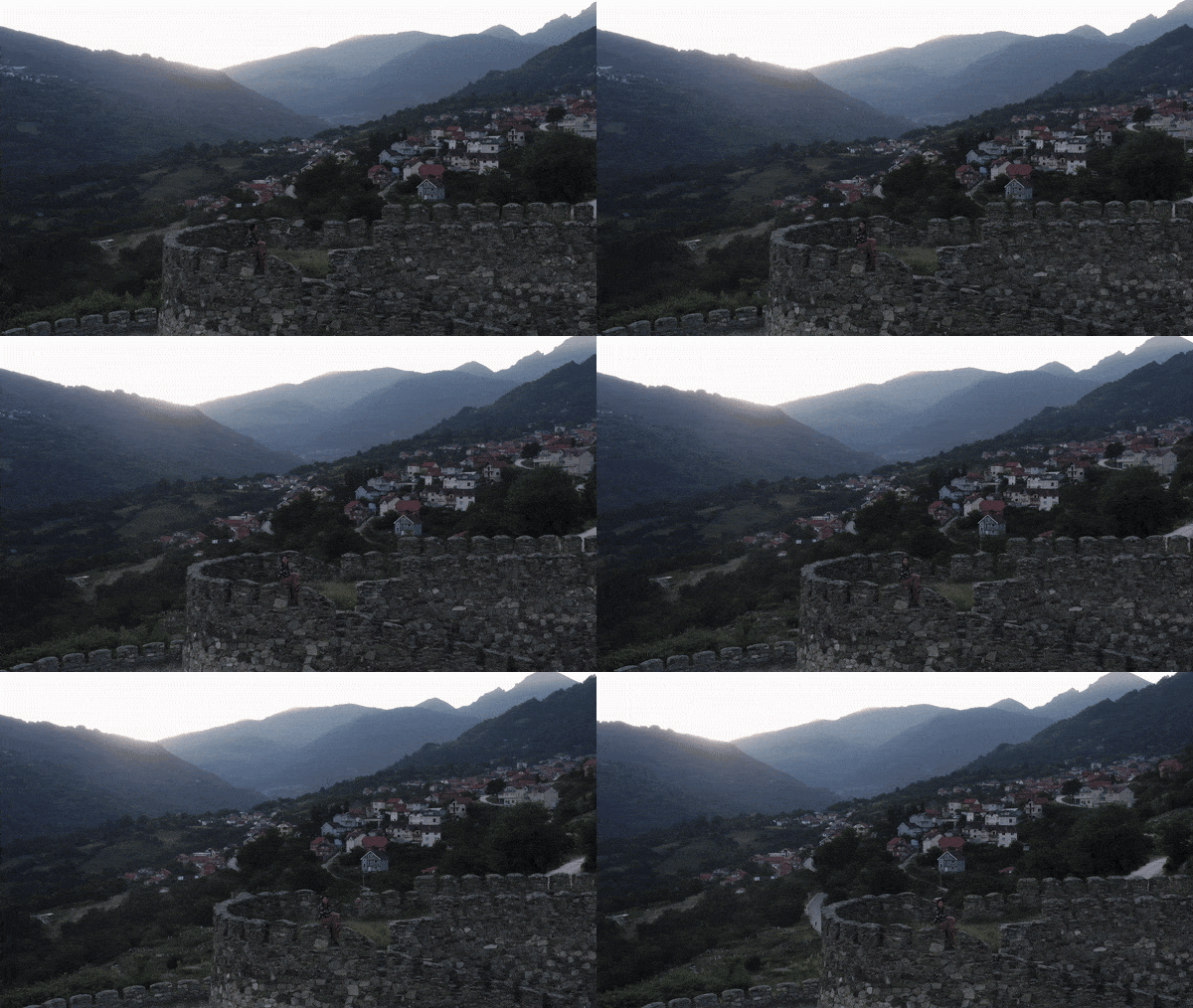
View of Kalkandelen
Other Regions
Ottoman heritage is an inseparable part of North Macedonia’s urban fabric. With support from TİKA, many sites such as Mustafa Pasha Mosque and Aladža Mosque have been restored and preserved.
Tourism in North Macedonia is shaped around historical sites, natural beauty and cultural festivals. Key tourist regions include Ohrid, a UNESCO World Heritage Site; the capital Skopje; Bitola and Tetovo (Kalkandelen), known for their Ottoman heritage; and Mavrovo and Galičica National Parks, renowned for their natural beauty.
The capital Skopje is a dynamic city blending historical and modern elements. After suffering major damage in the 1963 earthquake, the city was rebuilt with post-Soviet architecture and monument projects. However, Ottoman heritage remains preserved in historical districts.
One of the country’s most important tourist destinations is Ohrid and Lake Ohrid. Lake Ohrid, one of Europe’s oldest and deepest lakes, is listed as a UNESCO World Heritage Site for its unique ecosystem (1979). Ohrid was historically known as the “Jerusalem of the Balkans” and was a major religious center in the Middle Ages. The most notable historical structures in the region include:
Ohrid is also known for the Ohrid Summer Festival. Held each July, this international cultural event features classical music concerts, theater performances and artistic activities.
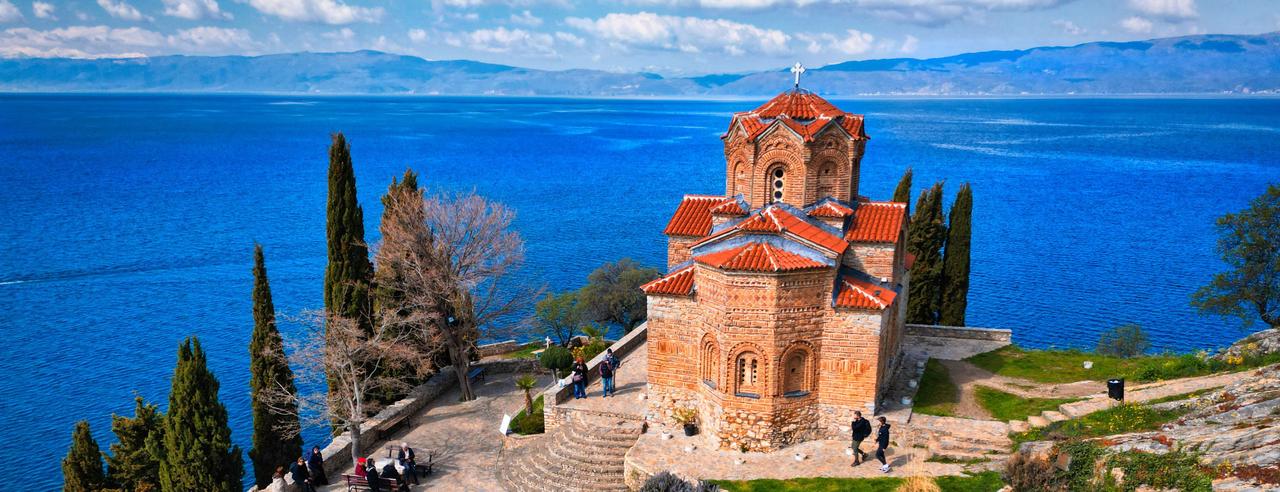
Lake Ohrid
Bitola, known as “Manastir” during the Ottoman period, was regarded as a diplomatic center of the Balkans. Ottoman heritage remains strongly visible in the city:
North Macedonia also has significant potential for nature tourism:
North Macedonia possesses a rich cultural heritage reflecting Slav-Macedonian traditions as well as Ottoman, Albanian and Roma influences. Traditional music, folk dances and literature are important components of this cultural mosaic.
North Macedonian cuisine is a synthesis of Balkan and Ottoman culinary traditions. Vegetables, meat and dairy products are the foundation of the cuisine.
Alakuş, Mahmut Serdar. 2021. "Kuzey Makedonya'nın Zarafet Sembolü: Alaca Cami." Anadolu Ajansı (AA), July 25, 2021. Accessed March 5, 2025.https://www.aa.com.tr/tr/dunya/kuzey-makedonyanin-zarafet-sembolu-alaca-cami/2313348
Arpalier, S. 2019. "Makedonya İsim Sorununun Bölge ve Dünya Politikasına Etkisi." Uludağ Journal of Economy & Society/Uludağ Üniversitesi İktisadi ve İdari Bilimler Fakültesi Dergisi 38 (1).
Central Intelligence Agency (CIA). 2025. "North Macedonia." The World Factbook. Accessed March 5, 2025.
Daily Sabah (with AA). 2024. "Ottoman Heritage Lives on in Skopje’s Turkish Bazaar." Daily Sabah, September 16, 2024. Accessed March 5, 2025.https://www.dailysabah.com/life/travel/ottoman-heritage-lives-on-in-skopjes-turkish-bazaar
Daskalovski, Zhidas. 2019. "Republic of Macedonia or North Macedonia?" *Insight Turkey* 21 (2): 63–74.https://www.jstor.org/stable/26776074
Durmaz, M. 2015. "Makedonya Sorunu ve Yunanistan’ın İsim Uzlaşmazlığı." ASSAM Uluslararası Hakemli Dergi 2 (3): 59-68.
Eurydice. 2025. "Republic of North Macedonia: Population, Demographic Situation, and Languages." Eurydice National Education Systems. Accessed March 5, 2025.https://eurydice.eacea.ec.europa.eu/national-education-systems/republic-north-macedonia/population-demographic-situation-languages-and.
Global Firepower. 2025. "North Macedonia Military Strength." Global Firepower. Accessed March 5, 2025.https://www.globalfirepower.com/country-military-strength-detail.php?country_id=north-macedonia.
IMF. 2025. "North Macedonia Economic Data." International Monetary Fund (IMF). Accessed March 5, 2025.https://www.imf.org/en/Publications/WEO/weo-database/2024/October.
Isakovic, Z. 1997. International Position of Macedonia and Balkan Security. Copenhagen: COPRI.
Kodal, T. 2014. "Makedonya’nın Bağımsızlığını Kazanması ve Türkiye." Çağdaş Türkiye Tarihi Araştırmaları Dergisi 14 (29): 377-396.
MEHMET HACISALİHOĞLU. 2025. "MAKEDONYA." *TDV İslâm Ansiklopedisi.* Accessed March 6, 2025.https://islamansiklopedisi.org.tr/makedonya
Maleski, Denko. 2003. "Law, Politics and History in International Relations: Macedonia and Greece." New Balkan Politics 6.
NATO. 2020. "North Macedonia Joins NATO as 30th Member, 27 Mart 2020." NATO Resmi Sitesi. Accessed March 5, 2025.https://www.nato.int/cps/en/natolive/news_174589.htm.
REYHAN GJUL. 2019. Avrupa Birliği Entegrasyon Sürecinde Kuzey Makedonya Cumhuriyeti. Master's thesis, Uludağ Üniversitesi.
Reuters. "North Macedonia Votes to End Dispute with Bulgaria, Clears Way for EU Talks." Reuters, July 16, 2022. Accessed March 5, 2025.https://www.reuters.com/world/europe/n-macedonia-votes-resolve-dispute-with-bulgaria-clears-way-eu-talks-2022-07-16
State Statistical Office, North Macedonia. 2022. *2021 Population, Households and Dwellings Census - First Data Set.* March 30, 2022. Accessed March 5, 2025.https://www.stat.gov.mk/pdf/2022/2.1.22.10Popis-mk-en.pdf
Türkiye Cumhuriyeti Dışişleri Bakanlığı. "Makedonya Siyasi Görünümü." Accessed March 5, 2025.https://www.mfa.gov.tr/makedonya-siyasi-gorunumu.tr.mfa
World Bank. 2025. "North Macedonia Overview." World Bank. Accessed March 5, 2025.https://www.worldbank.org/en/country/northmacedonia/overview#3
Ziberovski, B. 2024. "Makedonya’nın İsim Sorunu ve Prespa Anlaşması’nın Değerlendirilmesi." Anadolu Strateji Dergisi 6 (1): 107-114.

Republic of North Macedonia
Official Name | Republic of North Macedonia (Република Северна Македонија) | ||||||||
|---|---|---|---|---|---|---|---|---|---|
Capital | Skopje | ||||||||
Official Language | Macedonian | ||||||||
Recognized Languages | Albanian | ||||||||
Form of Government | Parliamentary Republic | ||||||||
Head of State | Stevo Pendarovski | ||||||||
Prime Minister | Dimitar Kovačevski | ||||||||
Independence | 8 September 1991 (from Yugoslavia) | ||||||||
Area | 25713 km² | ||||||||
Population | ~1.84 million (2021) | ||||||||
Currency | Macedonian Denar (MKD) | ||||||||
Time Zone | UTC+1 (Winter), UTC+2 (Summer) | ||||||||
Telephone Code | +389 | ||||||||
Internet Domain Code | .mk | ||||||||
Traffic Flow | Right | ||||||||
National Anthem of North Macedonia
History of North Macedonia
Ancient and Medieval Period
Ottoman Period (14th–20th centuries)
Pre- and During the Yugoslav Period
Independence and After
Geography
Rivers
National Parks and Natural Protected Areas
Climate
Precipitation Regime
Demographics
Ethnic Composition
Linguistic Structure
Religious Composition
Age Structure and Demographic Trends
Urbanization and Migration Trends
International Relations
Relations with Greece (Name Dispute)
Relations with Bulgaria
Relations with Albania
Relations with Serbia and Kosovo
European Union and NATO
Relations with Turkey
Other International Organizations
Armed Forces of North Macedonia
Land Forces
Air Force
Economy of North Macedonia
Agriculture, Industry and Services
Agricultural Sector
Industrial Sector
Service Sector
Labor Market and Employment Situation
Foreign Trade and Economic Growth
Economic Growth and Investment Climate
North Macedonia: Tourism, Culture and Cuisine
Summary of Ottoman Heritage
Tourism
Skopje
Ohrid and Lake Ohrid
Bitola (Manastir)
Nature Tourism and National Parks
Culture and Festivals
Cuisine of North Macedonia
Traditional Dishes
Desserts and Beverages