This article was automatically translated from the original Turkish version.
When we watch a video or listen to an audio recording on social media, we often assume these are real. This is because we have become accustomed to accepting as true what we have seen and heard for many years. However, rapid advances in artificial intelligence technologies are prompting us to question this habit.
What Is Deepfake (BBC Newsround)
Today, it is possible to generate content that is extremely difficult to distinguish from reality using only a few photographs, a short video, or a few seconds of audio. At first glance, these videos appear ordinary, yet they can make it seem as though an event never occurred actually happened, or that a person said words they never uttered. It is at this point that the deepfake technology emerges.
Initially introduced primarily for entertainment purposes, deepfake has gradually been adopted in many other fields. Today, this technology is widely debated in relation to misinformation, fraud, violations of personality rights, and manipulation of public opinion. It compels us to reconsider not only the digital world but also our trust in reality itself.
The term "deepfake" is a combination of the English words "deep learning" and "fake".【1】 In its simplest form, deepfake is a technology that uses artificial intelligence to alter a person’s image, voice, or facial expressions with remarkable realism. In other words, it can make it appear as though someone said words they never spoke or was present in a location they never visited. This causes the generated content to be perceived as real at first glance.
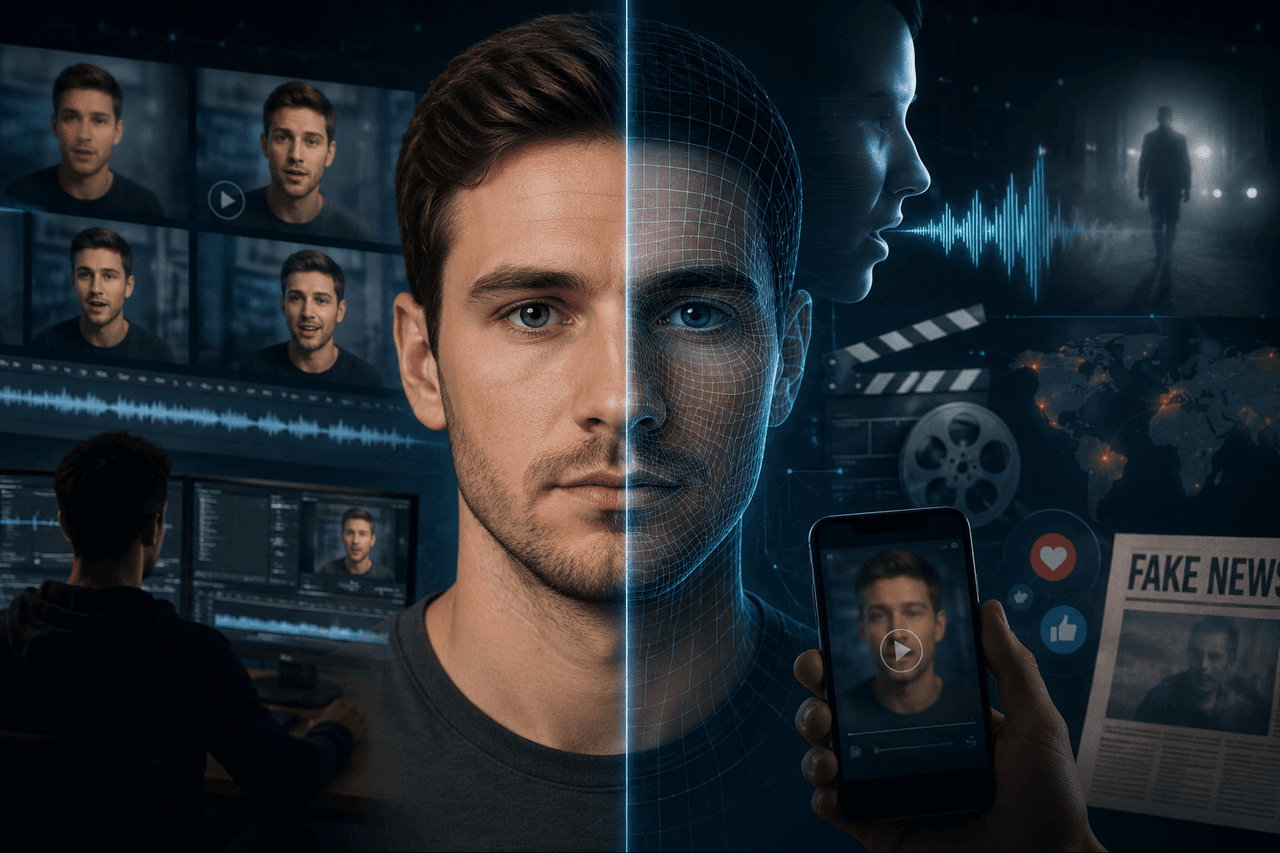
Deepfake Temsili Görsel (Yapay Zeka ile Oluşturulmuştur.)
Although deepfake technology has become widely discussed only in recent years, its origins are not new. The concept gained widespread attention in 2017 when manipulated videos were posted on the Reddit platform.【2】 At that time, the technology primarily involved placing the faces of celebrities into different videos, but with advances in AI tools, it has become far more accessible.
Today, deepfake is no longer limited to entertainment videos. This technology is used across many fields—from cinema and advertising to education and social media—and is also the subject of intense debate due to risks such as misinformation, fraud, and violations of personality rights. In other words, deepfake itself is neither entirely good nor entirely bad; what truly matters is the purpose for which the technology is used.
Many people who see a deepfake video for the first time wonder: "How can such a realistic image be created?" The answer lies in artificial intelligence’s learning capability. Deepfake systems analyze photos, videos, and audio recordings of a person to learn their facial features, expressions, speech patterns, and voice tone. They then use this data to generate entirely new images that never actually occurred.
Example of digital forgery (LipSynthesis)
In this process, artificial intelligence does not merely copy a face; it also attempts to imitate a person’s smile, eye movements, lip synchronization, and speech rhythm. As a result, the generated content often gives the impression of being real, especially in short videos.
Of course, these processes do not happen with a single click. Artificial intelligence learns to produce increasingly accurate results by analyzing large volumes of visual and audio data. The more data used and the higher its quality, the more realistic the output becomes. In recent years, advances in AI models have accelerated this process and made it far more accessible.
It is precisely this that makes deepfake so compelling—and so controversial. As technology improves, creating fake content becomes easier, while distinguishing it from reality at first glance becomes increasingly difficult. This situation makes the question, "Can we trust everything we see?" more important than ever.
When people hear the term "deepfake," they often think of fraud, fake videos, or manipulation. However, this technology is not used solely for malicious purposes. When used responsibly and within ethical boundaries, it can enable beneficial applications in many fields.
For example, in the film industry, deepfake technology can be used to digitally resurrect actors who have passed away or to complete scenes that were left unfinished during filming. Similarly, in education, digitally bringing historical figures to life can make learning materials more engaging. Content creators also use this technology to develop new storytelling methods in creative projects.
However, every coin has two sides. The same technology can become a dangerous tool in the hands of malicious individuals. Especially on social media, rapidly spreading fake content can affect not only individuals but also society’s trust in information.
Viewing deepfake technology merely as a tool for producing fake videos is a serious misconception. The real problem is that these contents can reach millions of people in a very short time and increasingly make it difficult to distinguish accurate information from misinformation. Especially on social media platforms, manipulated content has the potential to influence public opinion and shape people’s decisions.
Why Is Deepfake Dangerous (DW News)
In recent years, it has been frequently argued that deepfake can affect not only individuals but also election processes, political debates, and social trust. A video crafted to closely resemble reality can reach thousands or even millions of people before its authenticity is verified. Even if the content is later exposed as false, the initial impact often remains. This clearly demonstrates how quickly misinformation can spread in the digital environment.
However, the risks are not limited to public events. With advances in voice cloning technology, fraud methods have taken on a new dimension. A person’s voice can be imitated to deceive family members or close associates, fake phone calls can be made, or trust relationships can be exploited. Similarly, unauthorized use of individuals’ images can lead to serious problems such as reputational damage and privacy violations.
Perhaps the most striking point is that people are now beginning to doubt not only fake content but also real content. Even a genuine video can be easily dismissed with the claim, "This was also generated by artificial intelligence." Experts warn that this trend may gradually erode society’s trust in information and visual evidence.
As technology continues to advance, eliminating these risks entirely seems unlikely. However, this does not mean individuals are powerless. Becoming more conscious in the digital world and critically evaluating content is emerging as one of the most effective defenses against deepfake.
It appears impossible to stop the advancement of deepfake technology. However, this does not mean we are completely defenseless in the digital world. A few simple habits can help us act more consciously against the influence of fake content.
First, we must not accept every video or audio recording we encounter online as true. Especially with content that is shocking or quickly goes viral, verifying information through other reliable sources is crucial. This is because deepfake content often spreads rapidly by exploiting people’s initial emotional reactions.
Protecting personal data is equally important as verifying content. As more photos and videos are shared on social media, the amount of data available for AI systems to use increases. Regularly reviewing privacy settings and being more cautious when sharing personal content can help reduce potential risks.
Deepfake detection tools developed in recent years also play a significant role in this battle. Although they are not yet flawless, researchers and technology companies continue developing AI-based systems capable of identifying fake content more quickly. This is seen as a promising development for strengthening digital security in the future.
It is expected that deepfake technology will continue to advance in the coming years. As AI models become more powerful, distinguishing generated images and audio from reality will become even more difficult. This will force not only individuals but also media, legal systems, education, and public institutions to develop new solutions.
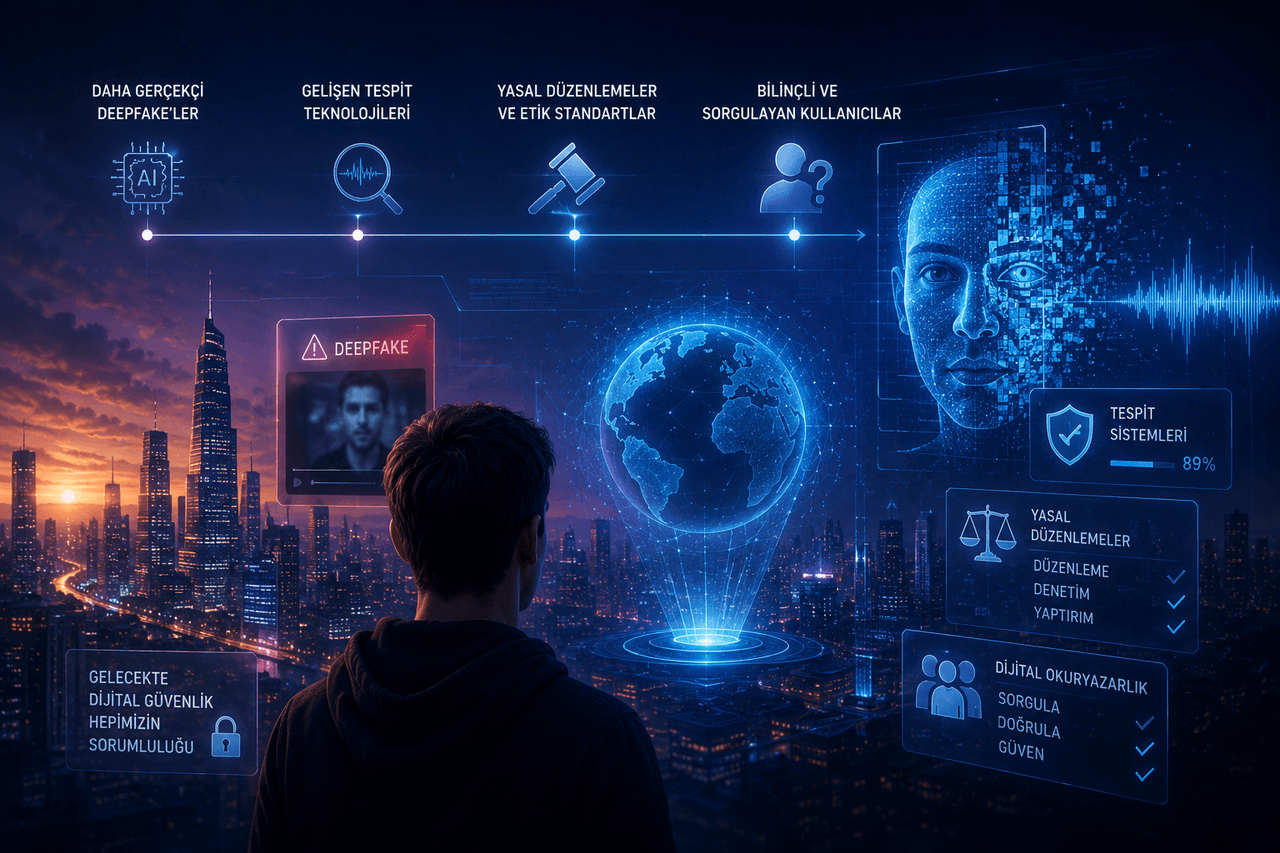
Gelecekte Deepfake Temsili Görsel (Yapay Zeka ile Oluşturulmuştur.)
On the other hand, systems designed to detect deepfake content are also advancing. Researchers and technology companies are working on AI-based tools that can identify fake content more rapidly. Meanwhile, many countries are drafting new regulations or updating existing laws to prevent the misuse of deepfake technology.
However, no matter how advanced technology becomes, the strongest defense will always be informed users. Critically evaluating digital content, verifying information through trusted sources, and sharing personal data responsibly will remain essential. Because although artificial intelligence will continue to evolve, the responsibility for accessing accurate information will still lie in human hands.
BBC Newsround. "What is a deepfake? | How does it work, and what can it be used for? | Newsround." YouTube, 4:26. May 16, 2024. Accessed July 9, 2026.
Berk, Mustafa Evren. "Dijital Çağın Yeni Tehlikesi 'Deepfake'." *OPUS Uluslararası Toplum Araştırmaları Dergisi* 16, no. 28 (August 2020): 1508-1523. Accessed July 9, 2026.https://dergipark.org.tr/tr/download/article-file/1235412
DW News. "Deepfakes flooding your feed: Why AI videos are dangerous — and how to spot them | DW News." YouTube, 4:47. Accessed July 9, 2026.
Demir, Mustafa. "Gerçek mi, Kurgu mu? Deepfake Teknolojisi ve Dezenformasyon Çağı." *Dicle Üniversitesi Sosyal Bilimler Enstitüsü Dergisi*, no. 40 (2025): 142–177. Accessed July 9, 2026.https://dergipark.org.tr/en/download/article-file/4446423
Elitaş, Türker. "Dijital Manipülasyon 'Deepfake' Teknolojisi ve Olmayanın İnandırıcılığı." *Hatay Mustafa Kemal Üniversitesi Sosyal Bilimler Enstitüsü Dergisi* 19, no. 49 (2022): 113–128. Accessed July 9, 2026.https://dergipark.org.tr/en/download/article-file/2249840
LipSynthesis. "Donald Trump, 4K Original/(Deep)Fake Example." YouTube, 0:27. October 26, 2023. Accessed July 9, 2026.
[1]
Mustafa Evren Berk, "Dijital Çağın Yeni Tehlikesi 'Deepfake'," *OPUS Uluslararası Toplum Araştırmaları Dergisi* 16, no. 28 (August 2020): 1510.
[2]
Berk, "Dijital Çağın Yeni Tehlikesi," 1512.
What Lies Behind the Curtain
How Is It So Realistic?
Is Every Deepfake Harmful?
Where Is the Real Danger?
How Can We Protect Ourselves?
What Lies Ahead?