

`artificial-intelligence` Related Article Results
The Future of Work Report (2025)
Future of Jobs Report 2025, World published by the World Economic Forum, January is a study released in 2025 aiming to shed light on the five-year future of global labor markets. analytic This report constitutes the fifth edition of the Future of Jobs series, which has been published biennially since 2016. Content and Publication Information This study is based on projections from over 1,000 employers representing more than 14 million workers across 55 economies and 22 industry clusters. The fin
EN
Onur Çolak

DolphinGemma
DolphinGemma is a artificial intelligence model developed by Google to analyze the vocalizations of marine mammals. The model is based on Google’s open-source large language model series named Gemma and is specifically configured to study the vocal communications of Atlantic spotted dolphins (Stenella frontalis). With approximately 400 million parameters, DolphinGemma is an “audio-in/audio-out” model capable of processing audio inputs and generating audio outputs, designed to decipher structural
EN
Ömer Said Aydın
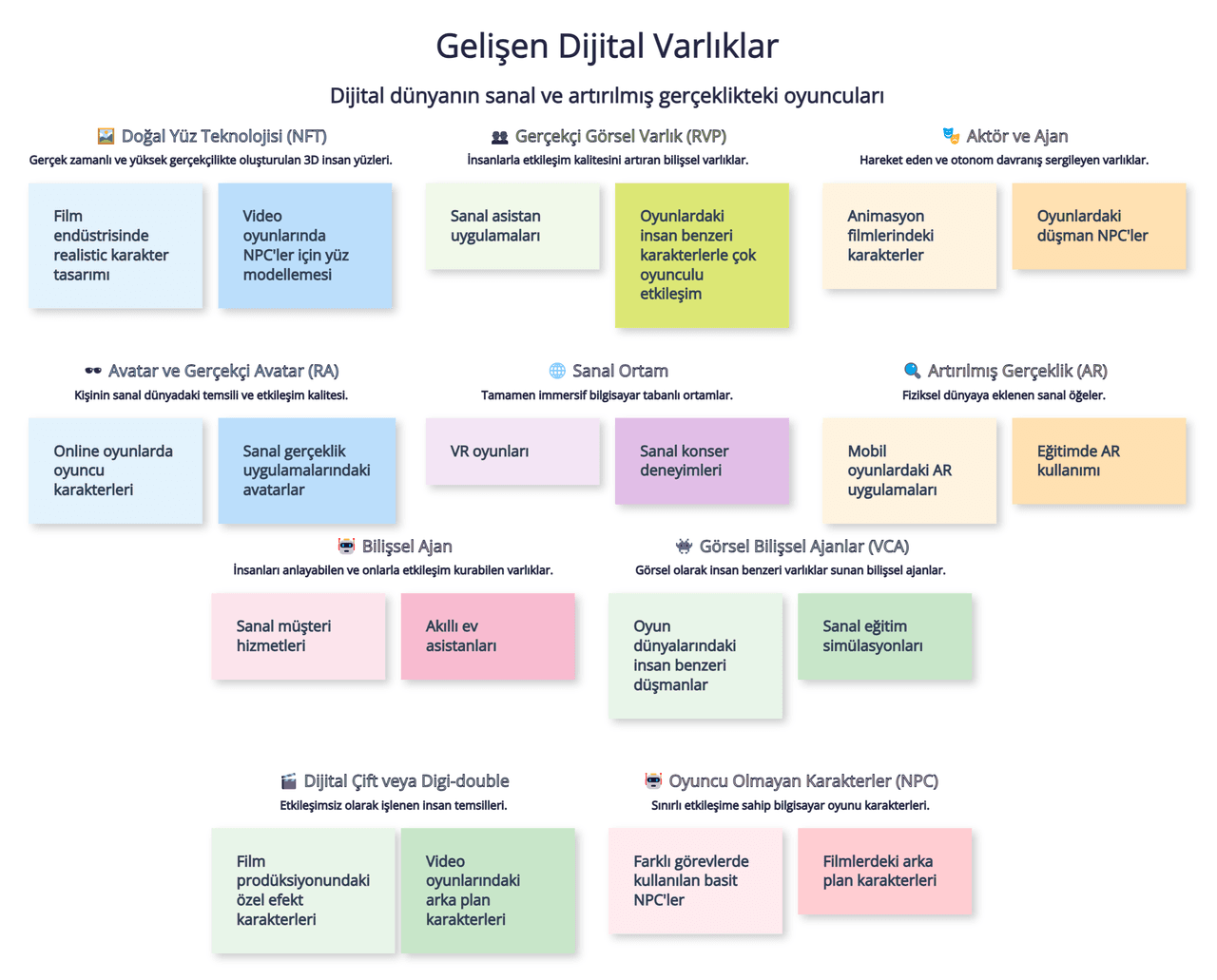
Virtual Humans
Virtual humansThese entities are equipped with technologies such as natural language processing, machine learning, and computer vision and are used in fields such as education, customer service, healthcare, entertainment, and content creation. Virtual humans aim to provide more personalized and realistic experiences to individuals they interact with, thanks to their human-like communication abilities and adaptability (Aykaç (2023). ">【1】 are entities supported by artificial intelligence and a
EN
Oksana Gülünay

Deepgram
Deepgram is an artificial intelligence company headquartered in the United States that develops speech recognition and speech intelligence technologies. Founded in 2015 by Scott Stephenson and Adam Sypniewski, Deepgram operates in areas such as extracting meaning from audio data, speech-to-text transcription, text-to-speech synthesis, and building voice AI agents. The company’s technology focuses on real-time and low-latency applications optimized particularly for enterprise use. Founding Deepgr
EN
Ömer Said Aydın

Dataiku
Dataiku is a software company that enables organizations to manage their data science, machine learning, and production-grade artificial intelligence (AI) applications through a single platform. Guided by the concept of “Everyday AI,” the company aims to encourage both technical and non-technical users to work with data in the same environment. Founded in 2013, Dataiku now serves more than 700 enterprise customers across various industries worldwide. The company is headquartered in New York and
ENÖmer Said Aydın
 Ar
ArArtificial Insemination Systems
Artificial labor systems refer to production and service systems in which artificial intelligence, robotics, and automation technologies are integrated to replace or support human labor. These systems encompass not only the performance of physical tasks but also the delegation of cognitive processes such as decision-making, analysis, and response to machines. In this regard, artificial labor distinguishes itself from traditional automation by exhibiting adaptability and learning capabilities aki
EN
Ahmet Burak Taner

Assembly AI
Assembly AI is an artificial intelligence (AI) company specializing in speech recognition and audio data processing. The company provides speech AI models that enable developers and product teams to build software-based solutions using audio data. These models are particularly used in areas such as speech-to-text transcription, sentiment analysis, summarization, and personal data privacy. Assembly AI is offered as a cloud-based service through a Software as a Service (SaaS) model and operates on
ENÖmer Said Aydın

LogicMonitor
LogicMonitor is a cloud-based software company operating as an AI-powered hybrid observability platform. It was founded in 2007 in Santa Barbara California by Jie Song and Steve Francis. The company provides large-scale monitoring solutions covering enterprise IT infrastructure cloud systems and applications with the goal of delivering centralized visibility in hybrid environments. LogicMonitor’s SaaS-based product LM Envision includes capabilities such as application performance management infr
ENÖmer Said Aydın

Groq
Groq is a U.S.-based semiconductor and cloud computing company focused on artificial intelligence inference. It was founded in 2016 in Mountain View, California, by Jonathan Ross and Douglas Wightman. The company developed the LPU (Language Processing Unit), a specialized processor designed to run AI models with lower latency, higher speed, and greater energy efficiency compared to traditional graphics processing units (GPUs). Groq’s cloud platform, GroqCloud, was launched in February 2024 and q
ENÖmer Said Aydın

Grammarly
Grammarly is an AI-powered digital writing assistant designed to enhance accuracy, clarity, and effectiveness in written communication. Founded in 2009 in Kyiv Ukraine by Max Lytvyn Alex Shevchenko and Dmytro Lider the company set out to provide language checking services to a broad user base primarily students. Over time it expanded its scope to serve diverse user segments ranging from individuals to enterprises adding productive AI-powered features and evolving into a multi-platform writing so
ENÖmer Said Aydın