


This article was automatically translated from the original Turkish version.
+2 More
The Social Fabric of the City
General Focus | Not primitive/rural; complex, industrial metropolises | ||||||||
|---|---|---|---|---|---|---|---|---|---|
Perspective | Not physical space; social processes and human habitat | ||||||||
Main Themes | Migration, urban transformation, belonging, and social justice | ||||||||
Transformation | 1950s Manchester School (urban networks and detachment from tribe) | ||||||||
Evolution | From anthropology in the city (group-focused) to the anthropology of the city (process-focused) | ||||||||
Mental Map (K. Lynch) | Paths, edges, districts, nodes, landmark elements | ||||||||
Urban Identity | Composition of natural environment, architectural fabric, and socio-cultural lived experience | ||||||||
Production of Space | Space is not neutral; it is produced through political, ideological, and social processes | ||||||||
Method | Ethnography (close and insider micro-perspective of Kente) | ||||||||
Origin | Early 20th century Chicago School (neighborhood studies) | ||||||||
Urban Anthropology is a subfield of socio-cultural anthropology that examines cultural systems in cities and their interactions at local, regional, and global scales.【1】 Unlike traditional anthropology, which focused on non-modern, primitive, or rural communities, this field centers on complex and industrialized urban structures. Urban anthropology views the city not merely as a physical settlement but as a dynamic habitat where social processes, spatial forms, and ideological representations are produced. The discipline analyzes issues such as urban transformation, migration, belonging, social justice, and urban identity by starting from micro-level human interactions.
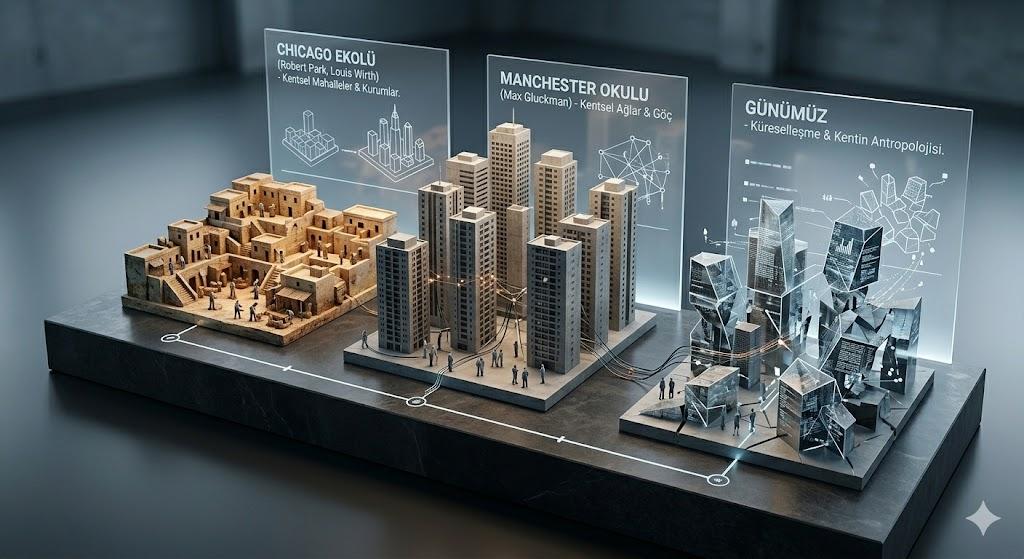
Historical Development and Schools (Generated by AI)
The discipline’s roots lie in the Chicago School of Sociology, which in the early 20th century, under the leadership of figures such as Robert Park and Louis Wirth, studied urban neighborhoods and institutions.【2】 In the 1950s, the Manchester School, led by Max Gluckman, shifted anthropological focus toward the modern city by examining processes of detachment from tribal structures and urban networks in Africa.【3】 Urban anthropology emerged as a distinct subdiscipline in the 1960s and 1970s, during which themes such as rural-to-urban migration, adaptation processes, ethnicity, and the culture of poverty came to the forefront.【4】 Today, under the influence of globalization, the blurring of boundaries between the local and the global has shifted the discipline from an anthropology of the city focused on specific groups to an anthropology of the city that analyzes the city’s own forms and processes.

Visual Related to Urban Anthropology (Generated by AI)
In urban anthropology, the cognitive and emotional bond between individuals and the city is explained through the concept of the urban image. This approach, theorized by Kevin Lynch, analyzes the city’s mental map through five primary physical elements: paths, edges, districts, nodes, and landmarks. Urban identity is defined as a composite of the natural environment, architectural fabric, socio-cultural characteristics, and historical experiences. This identity creates the city’s unique character while simultaneously providing individuals with a sense of belonging. However, processes such as urban transformation and homogenization can lead to the erosion of traditional culture and local identity, resulting in a crisis of identity.
The primary method of urban anthropology is ethnography. Adapting the traditional village model of anthropology to complex metropolises requires researchers to observe the city closely and from within. This approach seeks to go beyond statistical data to uncover the daily routines and micro-networks of urban actors. Categories such as patch, spot, trajectory, and circuit, used in the analysis of urban space, have been developed to examine how specific social groups come together and interpret space within the city’s heterogeneous structure.【5】 For example, the concept of circuit refers to continuity between points that are not physically adjacent but are connected through specific activities such as religion, leisure, or commerce.

Visual Related to Urban Anthropology (Generated by AI)
The human scale, often neglected in modern urban planning, is one of the central concerns of urban anthropology. While rational and mechanical planning focuses cities on massive structures and vehicular traffic, the anthropological perspective centers on the interaction between the human body, senses, and mobility—such as walking—and the environment. The most significant data for analyzing urban life are patterns embedded in daily routines: public transportation use, gatherings on street corners, domestic practices, and professional rituals. In this context, a broad spectrum—from rituals on metro lines to survival strategies of homeless populations, from migrant group adaptation to marginal subcultures—forms the city’s invisible social fabric.
Urban space, as emphasized by Henri Lefebvre, is not an objective reality but a social product and therefore inherently political and ideological. The city’s architectural fabric, wide boulevards, and monumental structures reflect dominant ideologies and paradigms such as modernism or postmodernism. For instance, modern architecture envisions cities as machines designed for living, guided by principles of rationality and functionality, while postmodern architecture foregrounds consumption through visuality, collage, and symbolism. Urban anthropology traces these ideological imprints on space to analyze how the city becomes a commodity and how urban space is structured as a site of social control or resistance.
Ankara Üniversitesi. "Kent Antropolojisi." acikderes.ankara.edu.tr. Accessed June 9, 2026. https://acikders.ankara.edu.tr/course/view.php?id=4176
Bhandari, Amrit Kumar. “Urban Anthropology: An Overview of the Discipline and Scope.” *Himalayan Journal of Sociology and Anthropology* 7 (2016): 1–14. Accessed June 9, 2026. https://nepjol.info/index.php/HJSA/article/view/4664
Magnani, José Guilherme Cantor. "Antropologia Urbana: Desafios e Perspectivas." *Revista de Antropologia* 46, no. 2 (2003): 174-203. Accessed June 9, 2026. https://revistas.usp.br/ra/en/article/view/124814/121506
Nacak, İbrahim. "Kent Araştırmalarında Antropolojik Açılımlar: Yeni Meseleler ve Özgünlük Arayışı." *Selçuk Üniversitesi Edebiyat Fakültesi Dergisi*, no. 50 (2023): 241-254. Accessed June 9, 2026. https://dergipark.org.tr/en/pub/sefad/article/1358813
[1]
Amrit Kumar Bhandari, “Urban Anthropology: An Overview of the Discipline and Scope,” Himalayan Journal of Sociology and Anthropology 7 (2016): 1, https://nepjol.info/index.php/HJSA/article/view/4664
[2]
Bhandari, "Urban Anthropology," 1.
[3]
José Guilherme Cantor Magnani, “Antropologia Urbana: Desafios e Perspectivas,” Revista de Antropologia 46, no. 2 (2003): 176, https://revistas.usp.br/ra/en/article/view/124814/121506
[4]
Bhandari, "Urban Anthropology," 7.
[5]
Magnani, "Antropologia Urbana," 191.

The Social Fabric of the City
General Focus | Not primitive/rural; complex, industrial metropolises | ||||||||
|---|---|---|---|---|---|---|---|---|---|
Perspective | Not physical space; social processes and human habitat | ||||||||
Main Themes | Migration, urban transformation, belonging, and social justice | ||||||||
Transformation | 1950s Manchester School (urban networks and detachment from tribe) | ||||||||
Evolution | From anthropology in the city (group-focused) to the anthropology of the city (process-focused) | ||||||||
Mental Map (K. Lynch) | Paths, edges, districts, nodes, landmark elements | ||||||||
Urban Identity | Composition of natural environment, architectural fabric, and socio-cultural lived experience | ||||||||
Production of Space | Space is not neutral; it is produced through political, ideological, and social processes | ||||||||
Method | Ethnography (close and insider micro-perspective of Kente) | ||||||||
Origin | Early 20th century Chicago School (neighborhood studies) | ||||||||
Historical Development and Schools
Urban Image and Identity Categories
Urban Ethnography and Methodology
Human Scale and Daily Routines
Production of Space and Ideological Representations