This article was automatically translated from the original Turkish version.
Launch | 2018-04-18 | ||||||||
|---|---|---|---|---|---|---|---|---|---|
Mission Type | Exoplanet Discovery | ||||||||
Cameras | Can survey 85% of the sky Four wide-angle | ||||||||
Method | To measure decreases in starlight using the transit method | ||||||||
Purpose | To detect and observe exoplanet candidates around nearby stars | ||||||||
Establishment | NASA | ||||||||
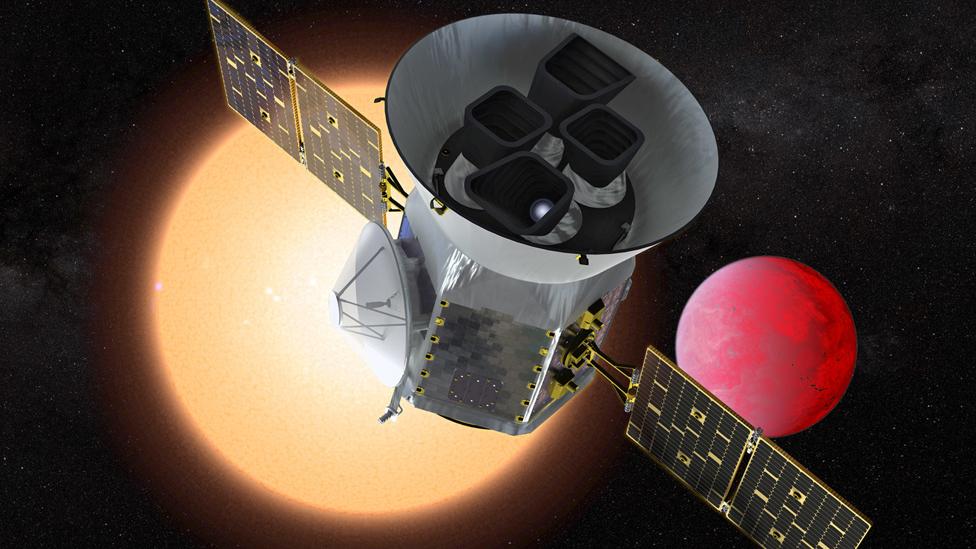
Güneş Sistemi outside the stars orbiting exoplanets is a space telescope developed to detect. Its mission is to identify regular brightness variations caused by planets passing in front of particularly nearby and bright stars relative to Earth, thereby identifying new planet candidates.
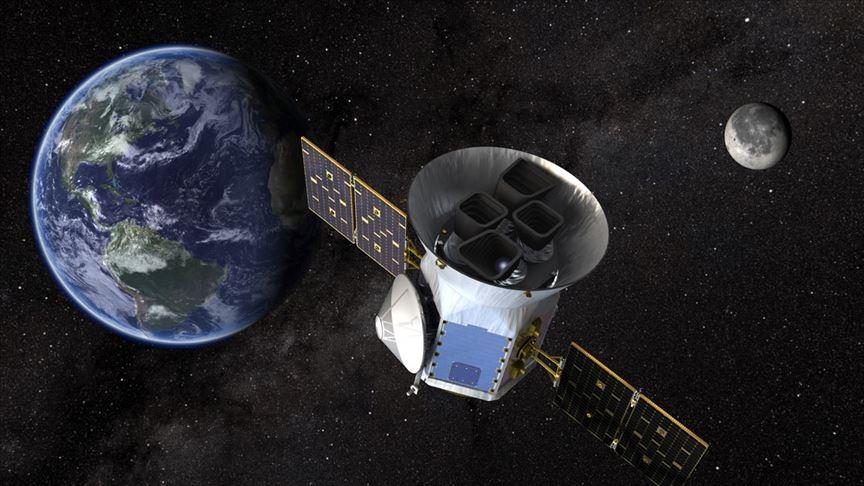
An image from the TESS Space Telescope (Anadolu Ajansı)
The primary objective of TESS is to survey a large portion of the sky to detect numerous exoplanet candidates. Unlike previous space telescopes, TESS adopts an observational strategy that covers nearly the entire sky rather than a narrow region. This approach aims to identify planets in stellar systems close to the Sun that are suitable for detailed study. The findings provide fundamental information on planetary sizes orbital periods and their relationships with host stars.
TESS divides the sky into specific sectors and observes each region continuously over fixed time intervals. This systematic survey method allows the same stars to be monitored for weeks enabling reliable detection of brightness variations caused by regular planetary transits. The mission has been planned to cover both the southern and northern hemispheres of the sky during its operational lifetime.
TESS employs the photometric observation technique known as the transit method. When a planet passes in front of its host star it causes a small but measurable dip in the star’s light. TESS’s high-sensitivity cameras record these changes. The collected data are analyzed using computer-assisted methods to identify planet candidates. These candidates are then directed to other telescopes for confirmation and detailed characterization.
The space telescope TESS is equipped with four cameras with wide fields of view positioned to observe large portions of the sky simultaneously. The satellite orbits Earth in an elliptical path designed to minimize observational interruptions caused by gravitational influences from Earth and the Moon enabling long-term stable measurements. TESS has the photometric sensitivity required to measure light from bright stars with high precision.
Observational data collected by TESS are used not only for exoplanet detection but also in stellar physics. Phenomena such as stellar oscillations variable stars and binary star systems can be studied in detail thanks to TESS data. In this regard the mission serves as a multi-purpose observational platform contributing to various subfields of astrophysics.
Daylan, Tansu. “TESS’in Mirası: Gökada Muhitimizde Geçiş Yapan Ötegezegen Sayımı.” *Turkish Journal of Astronomy and Space Sciences* 4, no. 3 (2023): 79–82. Accessed January 14, 2026.https://dergipark.org.tr/en/download/article-file/2769552
NASA. "Transiting Exoplanet Survey Satellite (TESS)." Accessed January 14, 2026.https://science.nasa.gov/mission/tess/
TÜBİTAK Bilim Genç. “Ötegezegen Avcısı TESS Uzay Teleskobu.” Accessed January 14, 2026.https://bilimgenc.tubitak.gov.tr/makale/otegezegen-avcisi-tess-uzay-teleskobu

Launch | 2018-04-18 | ||||||||
|---|---|---|---|---|---|---|---|---|---|
Mission Type | Exoplanet Discovery | ||||||||
Cameras | Can survey 85% of the sky Four wide-angle | ||||||||
Method | To measure decreases in starlight using the transit method | ||||||||
Purpose | To detect and observe exoplanet candidates around nearby stars | ||||||||
Establishment | NASA | ||||||||
No Discussion Added Yet
Start discussion for "TESS Space Telescope" article
Mission Objective and Scientific Goals
Observational Strategy and Survey Method
Working Principle
Technical Specifications
Data Usage and Scientific Contributions