


This article was automatically translated from the original Turkish version.
Ottoman coffeehouses, from the mid-16th century onward, became important public spaces in Ottoman social life. With the introduction of coffee from Yemen to Istanbul, these institutions quickly evolved beyond mere venues for beverage consumption to become centers of socialization, communication, entertainment, and even political debate.
Coffee is believed to have first arrived in Istanbul in the early 16th century following Yavuz Sultan Selim’s campaign in Egypt. According to the historian Peçevî, the first coffeehouses were opened in 1554 in Tahtakale by two individuals, Hakem from Aleppo and Şems from Damascus. Other sources cite 1551 or 1553 as the opening dates. Although initially referred to as “coffee houses,” these venues soon transformed into spaces where people from various social strata gathered to converse, form friendships, and engage in cultural activities. By the end of the reign of Kanuni Sultan Süleyman, Istanbul had around 50 coffeehouses; by the end of the 16th century, this number had risen to 600, and by the early 19th century, it reached 2,500.
Coffeehouses emerged in Ottoman society as significant spaces of socialization, distinct from traditional institutions such as the palace, madrasa, and mosque. People from different social and economic backgrounds met in these spaces to chat, socialize, and participate in various cultural activities. Theatrical performances such as meddah, Karagöz, ortaoyunu, and âşık shows were staged in coffeehouses, through which critiques and satires on current events were expressed. In particular, Karagöz plays offered social and political commentary akin to a form of free press.
In the early modern period, when written communication media were limited, coffeehouses served as vital centers for the dissemination of news and rumors. Popular political discourse known as “state conversation” took shape and spread within these spaces. With the emergence of newspapers, coffeehouses also became places where the illiterate gathered to hear newspapers read aloud and learn daily news.
The emergence and proliferation of coffeehouses were at times met with disapproval by religious and political authorities. Criticisms and prohibitions targeting coffeehouses began to surface from the second half of the 16th century. Fatwas attributed to Şeyhülislam Ebussuud Efendi condemned coffeehouses as centers of games and immorality. These fatwas targeted the coffeehouses themselves rather than coffee consumption per se.
Political authorities viewed coffeehouses as threats to social order and morality, labeling them as nests of sedition and even centers of rebellion preparation. The “state conversations” and critical discourse occurring within coffeehouses became a source of concern for the central authority. Consequently, throughout Ottoman history, coffeehouses were repeatedly closed and banned.
The first comprehensive closure orders were issued during the reigns of II. Selim (1566–1574) and III. Murat (1574–1595). Under orders for “külliyen ref” (complete eradication), all coffeehouses in Istanbul were shut down. In the reign of IV. Murat (1623–1640), in 1633, the closure of all coffeehouses in Istanbul and the prohibition of coffee drinking were decreed; only 120 coffeehouses in the Haslar kadılığı district were closed. This was the last large-scale closure attempt.
From the mid-17th century onward, the political authority’s policy toward coffeehouses began to change. Instead of wholesale closures, a policy of selective closures under the principle of “ibreten li'l-ğayr” (as a warning to others) was adopted, serving as a form of surveillance and deterrence. The increasing economic value of coffee and the revenue it generated for the state treasury played a significant role in this policy shift. Additionally, changes in the relationship between the state and its subjects, along with the inclusion of new soldiers among coffeehouse owners, led the political authority to adopt a more conciliatory stance toward coffeehouses.
Over time, various types of coffeehouses catering to different social groups emerged in Ottoman society:
Although definitive information about the architecture of classical Ottoman coffeehouses is limited, inferences can be drawn from travelers’ accounts and engravings. The earliest examples were typically single-story wooden structures. In many coffeehouses, one entered the main hall through a courtyard known as the “orta meydanı.” Around the main hall, seating areas (sedirler) were commonly arranged, and in the center, there might be a şadırvan or pool. The corner where the coffee stove was located held particular importance, housing shelves for cups, trays, and other coffee utensils. Walls could be decorated with various plaques and paintings. Janissary coffeehouses stood out particularly for their elaborate decorations, wooden carvings, floral reliefs, and gold gilding.
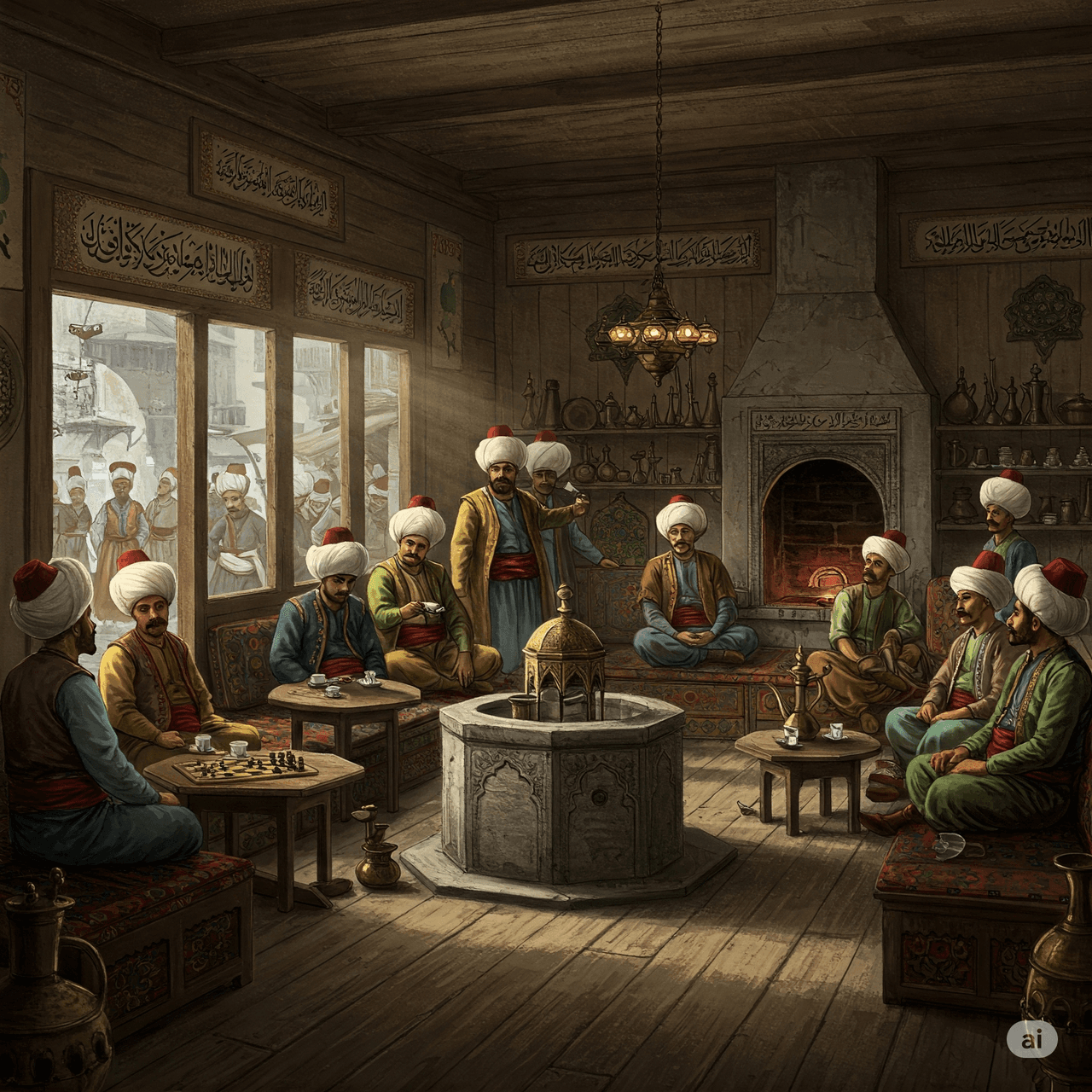
Depicts both the interior and exterior view of a bustling Ottoman coffeehouse in 17th-century Istanbul. (Generated by Artificial Intelligence)
Ottoman coffeehouses, since their emergence in the 16th century, became an indispensable part of social life and left deep imprints in social, cultural, and political spheres. As both gathering and entertainment spaces and as arenas for the formation of public opinion and political debate, they occupied a central place in shaping urban life in the Ottoman Empire. Despite facing repeated prohibitions and pressures, they endured and gradually became indispensable elements of society.
Ahmet Yaşar, “Osmanlı Şehir Mekânları: Kahvehane Literatürü,” *Türkiye Araştırmaları Literatür Dergisi*, no. 6 (September 2005): 237–56,https://dergipark.org.tr/en/pub/talid/issue/43465/530378#article_cite(Accessed May 18, 2025).
Halil Emre Deniş, *Osmanlı ve Cumhuriyet Döneminde Kahvehaneler: Sosyal ve Siyasal Yaşamın İncelenmesi* (2011),https://www.ajindex.com/dosyalar/makale/acarindex-1423868089.pdf(Accessed May 18, 2025).
Yaşar, Ahmet, ed. Osmanlı Kahvehaneleri: Mekân, Sosyalleşme, İktidar. 3. baskı. İstanbul: Kitap Yayınevi, 2018.
Ürer, H. “Osmanlı’da kahve/Kahvehane Kültürü ve Salihli’den Bir kahvehane Örneği 'Himaye-i Etfal'.” *Sanat Tarihi Dergisi* 19, no. 2 (2012): 1–26. Accessed May 18, 2025.

No Discussion Added Yet
Start discussion for "Ottoman Coffeehouses" article
Emergence and Spread
Social and Cultural Functions
Relationships with Political Authority and Prohibitions
Types of Coffeehouses
Architecture and Atmosphere