


This article was automatically translated from the original Turkish version.
+1 More

Mediterranean Diet
In Which Countries | Countries such as Greece, Italy, Morocco, Algeria, Türkiye, and Tunisia | ||||||||
|---|---|---|---|---|---|---|---|---|---|
Daily Recommended Consumption | Whole grains, Vegetables, Fruits, Legumes, Olive oil, Water | ||||||||
Weekly Recommended Consumption | Fish and seafood, Poultry, Eggs, Dairy and dairy products | ||||||||
Recommended for Limited Consumption | Red meat and processed meat products, Sweets | ||||||||
Diseases Prevented | Cardiovascular diseases, Hypertension, Diabetes, Obesity, Alzheimer, Dementia | ||||||||
The Mediterranean diet is a traditional pattern of eating adopted by countries bordering the Mediterranean Sea. It is rich in vegetables, fruits, whole grains, legumes, olive oil and fish, while featuring low consumption of red meat and saturated fats. Due to its positive health effects, it has attracted global attention and was recognized by UNESCO in 2010 as an Intangible Cultural Heritage of Humanity.【1】
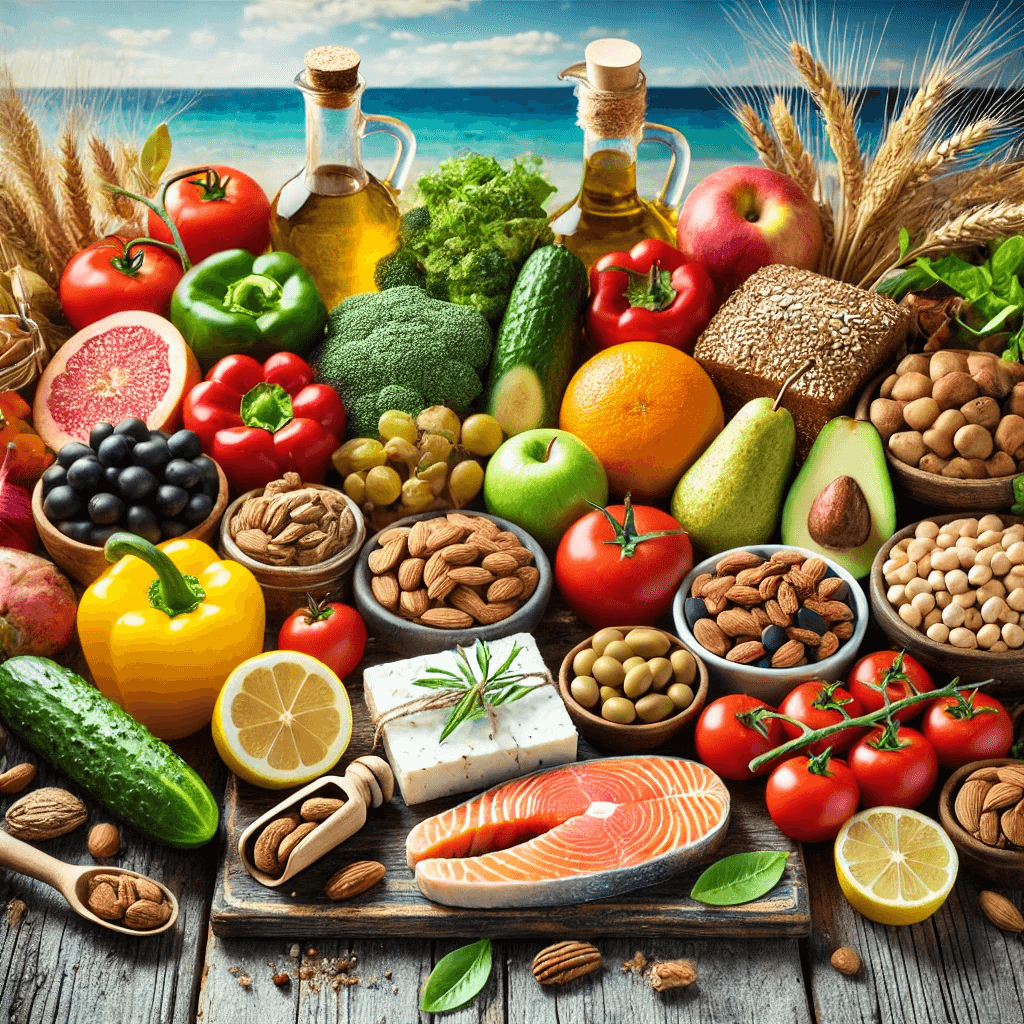
(Typical staple foods of the Mediterranean diet, image generated by artificial intelligence)
The Mediterranean diet was scientifically defined in the 1950s through the Seven Countries Study conducted by Ancel Keys and his team. The study found that cardiovascular diseases were less prevalent in Mediterranean countries compared to Western nations, and this difference was linked to dietary habits.【2】
The Mediterranean diet pyramid is structured according to the frequency of food consumption:
•Foods to Be Consumed Daily: Whole grains, water, vegetables, fruits, legumes, olive oil, herbs and spices.
•Foods to Be Consumed Weekly: Fish and seafood, poultry, eggs, dairy and dairy products.
•Foods to Be Consumed in Small Amounts: Red meat and processed meat products, sweets.【3】
Numerous studies have demonstrated that individuals who closely adhere to the Mediterranean diet have a reduced risk of cardiovascular diseases, hypertension and stroke. Meta-analyses show that this diet reduces overall mortality by 23 percent and cardiovascular mortality by 27 percent.【4】
The Mediterranean diet is known to have beneficial effects in preventing diabetes, obesity and metabolic syndrome. Adding olive oil and nuts to the diet improves insulin sensitivity and blood sugar control.【5】
Adherence to the Mediterranean diet contributes to the preservation of cognitive function. Evidence suggests it slows the progression of diseases such as Alzheimer’s and dementia. In particular, polyphenols, omega-3 fatty acids and antioxidants have been shown to support brain health.【6】
The Mediterranean diet is advantageous not only for health but also for environmental sustainability. Its emphasis on plant-based foods reduces the carbon footprint, while production based on traditional agricultural methods helps preserve biodiversity.
Furbatto, Michela, Diana Lelli, Raffaele Antonelli Incalzi, and Claudio Pedone. “Mediterranean Diet in Older Adults: Cardiovascular Outcomes and Mortality from Observational and Interventional Studies—A Systematic Review and Meta-Analysis.” Nutrients 16, no. 3947 (2024): 1–13.https://doi.org/10.3390/nu16223947
Montero Muñoz, Natalia, Pedro Juan Tárraga López, Ángel Arturo López-González, Hernán Paublini, Cristina Martorell Sánchez, Emilio Marínez-Almoyna Rifá, and José Ignacio Ramírez-Manent. “Association Between Mediterranean Diet and Other Healthy Habits and Sociodemographic Variables with the Values of Vascular and Heart Age in Spanish Workers.” Nutrients 17, no. 903 (2025): 1–20. https://doi.org/10.3390/nu17050903.
Özer, Emine Rumeysa, and Kemal Kaan Tekinşen. “Akdeniz Diyeti ve Sağlık.” Akademik Et ve Süt Kurumu Dergisi 2 (2021): 13–23.https://dergipark.org.tr/tr/download/article-file/1947956
İçen, Hayrunisa, Simay Fereli, İzel Aycan Başoğlu, and Fatma Esra Güneş. “Akdeniz Diyetinin Kognitif Fonksiyonlar Üzerine Etkileri.” Türkiye Klinikleri Journal of Health Sciences 4, no. 2 (2019): 198–204.https://doi.org/10.5336/healthsci.2018-60552
[1]
Özer, Emine Rumeysa ve Kemal Kaan Tekinşen, “Akdeniz Diyeti ve Sağlık,” Akademik Et ve Süt Kurumu Dergisi 2 (2021): 13–23.
[2]
Özer, Emine Rümeysa ve Kemal Kaan Tekinşen, Akdeniz Diyeti ve Sağlık, Akademik Et ve Süt Kurumu Dergisi, 2, 13-14
[3]
Özer, Emine Rümeysa ve Kemal Kaan Tekinşen, Akdeniz Diyeti ve Sağlık, Akademik Et ve Süt Kurumu Dergisi, 2, 14-19
[4]
Michela Furbatto et al., “Mediterranean Diet in Older Adults: Cardiovascular Outcomes and Mortality from Observational and Interventional Studies—A Systematic Review and Meta-Analysis,” Nutrients 16, no. 3947 (2024): 6-12, https://doi.org/10.3390/nu16223947.
[5]
Montero Muñoz, N., et al. Association Between Mediterranean Diet and Other Healthy Habits and Sociodemographic Variables with the Values of Vascular and Heart Age in Spanish Workers, Nutrients, 17(903), 5-6
[6]
Hayrunisa İçen et al., “Akdeniz Diyetinin Kognitif Fonksiyonlar Üzerine Etkileri,” Türkiye Klinikleri Journal of Health Sciences 4, no. 2 (2019): 202, https://doi.org/10.5336/healthsci.2018-60552.

Mediterranean Diet
In Which Countries | Countries such as Greece, Italy, Morocco, Algeria, Türkiye, and Tunisia | ||||||||
|---|---|---|---|---|---|---|---|---|---|
Daily Recommended Consumption | Whole grains, Vegetables, Fruits, Legumes, Olive oil, Water | ||||||||
Weekly Recommended Consumption | Fish and seafood, Poultry, Eggs, Dairy and dairy products | ||||||||
Recommended for Limited Consumption | Red meat and processed meat products, Sweets | ||||||||
Diseases Prevented | Cardiovascular diseases, Hypertension, Diabetes, Obesity, Alzheimer, Dementia | ||||||||
History and Definition
Core Components of the Mediterranean Diet
Health Effects
Cardiovascular Health
Metabolic Diseases
Cognitive Function
The Mediterranean Diet and Sustainability