


This article was automatically translated from the original Turkish version.
The water cycle (hydrological cycle) is a natural process that describes the continuous movement of water between the atmosphere, land, and oceans. In this process, water exists in different physical states—solid, liquid, and gas—and circulates continuously among the various components of the Earth system. The atmosphere, oceans, lakes, rivers, glaciers, soil, and living organisms are among the key components of this cycle.
The water cycle is a dynamic system that prevents water from remaining stationary on Earth and instead circulates it across different environments. In this system, water primarily rises into the atmosphere through evaporation driven by solar energy, condenses to form clouds, and then returns to the Earth’s surface as precipitation. Part of the water that reaches the surface as precipitation flows over land as surface runoff into rivers and oceans, while another portion infiltrates the soil to form groundwater or is absorbed by plants and released back into the atmosphere. Thus, water remains in constant motion across different environments, ensuring the continuous operation of the cycle.
The majority of Earth’s water is found in the oceans. Approximately 97 percent of the planet’s water resides in the oceans, while the remaining small fraction is stored in glaciers, groundwater, lakes, rivers, and the atmosphere. Although the amount of water in the atmosphere is relatively small, it plays a critical role in the water cycle. Through this cycle, water is continuously transported between different reservoirs on Earth’s surface, sustaining ecosystem continuity.
The water cycle is not merely a physical process but also a complex natural mechanism closely linked to Earth’s climate system. Processes such as the transport of water vapor in the atmosphere, cloud formation, precipitation distribution, and surface runoff play significant roles in the development of climatic events. Therefore, understanding the water cycle is of great importance for addressing climate variability, managing water resources, and ensuring the sustainability of natural ecosystems.
Scientific studies have shown that the water cycle has a structure far more complex than a simple closed system. Water circulates through numerous distinct processes, including atmospheric transport, surface runoff, groundwater movement, release back into the atmosphere via plants, and glacier melting. When all these processes are considered together, the water cycle is recognized as one of the fundamental natural systems sustaining life on Earth.
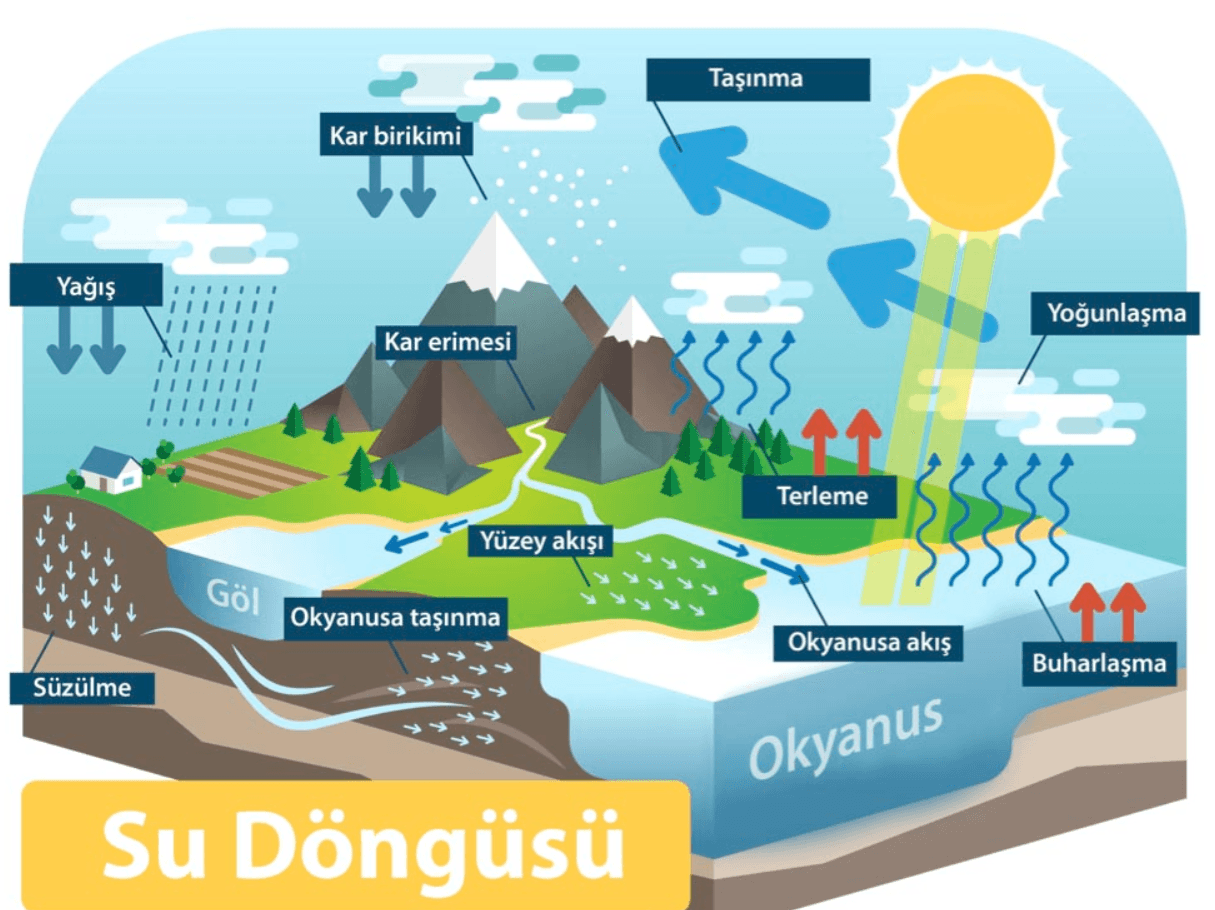
Water Cycle (TÜBİTAK Bilim Genç)
The water cycle consists of a series of interconnected physical processes that enable water to continuously move between the atmosphere, land, and subsurface environments. These processes operate together to ensure the constant circulation of water across Earth. Solar energy, gravity, and atmospheric conditions play fundamental roles in driving this cycle. During the water cycle, water transitions between liquid, gas, and solid states as it moves through different environments. This movement is a vital process for both the functioning of the natural environment and the sustainability of ecosystems.
The main stages of the water cycle generally include evaporation, transpiration, condensation, precipitation, surface runoff, and infiltration. These processes occur sequentially and often simultaneously. For example, while precipitation may occur in one region, evaporation or condensation may be ongoing in another. This demonstrates that the water cycle is a continuous and dynamic system on a global scale.
Beginning with evaporation, water transitions from liquid to gas under the influence of solar energy and rises into the atmosphere. The water vapor that ascends cools and condenses to form clouds. When the water droplets accumulated in clouds reach a critical density, they return to the Earth’s surface as precipitation. Part of the water that falls as precipitation is transported via surface runoff into seas and oceans, while another portion infiltrates the soil to replenish groundwater reserves or is absorbed by plants and returned to the atmosphere.
When considered together, these stages reveal that the water cycle is not confined to atmospheric processes alone. Rather, it is a multidirectional interaction process occurring between the atmosphere, hydrosphere, lithosphere, and biosphere. Thus, each stage of the water cycle directly influences other stages and the broader natural systems of Earth.
Evaporation is one of the fundamental processes of the water cycle and refers to the transition of liquid water into water vapor under the influence of heat energy, rising into the atmosphere. In this process, water molecules gain kinetic energy, primarily from solar radiation, and when they reach sufficient energy levels, they detach from the liquid surface and enter the atmosphere as water vapor. Evaporation is considered one of the starting points of the water cycle and is responsible for generating a large portion of the water vapor in the atmosphere.
The largest portion of evaporation on Earth occurs from oceans and seas. Since the majority of Earth’s water is contained in these bodies, a significant proportion of atmospheric water vapor originates from these vast water masses. Lakes, rivers, wetlands, and moist soil surfaces are also important contributors to evaporation. Evaporation rates are higher in warm and sunny regions, while the process proceeds more slowly in colder areas.
Several environmental factors influence the rate of evaporation. These include temperature, wind, humidity, and surface area. Higher temperatures cause water molecules to move faster, increasing evaporation. Wind removes the humid air layer above the water surface, accelerating evaporation. Conversely, high atmospheric humidity reduces evaporation rates. A larger water surface area also allows more water to enter the atmosphere.
Evaporation does not occur only over natural water bodies but also over soil surfaces and areas inhabited by living organisms. Especially after rainfall, a portion of the water on the soil surface quickly evaporates back into the atmosphere, playing a crucial role in maintaining the continuity of the water cycle. Additionally, under specific conditions, direct transition from ice and snow surfaces into vapor (sublimation) can occur, contributing to atmospheric water vapor.
The water vapor that rises into the atmosphere is transported to different regions and, under suitable conditions, contributes to condensation and the formation of clouds. Therefore, evaporation is not only the mechanism by which water enters the atmosphere but also a fundamental process that initiates cloud formation and precipitation.
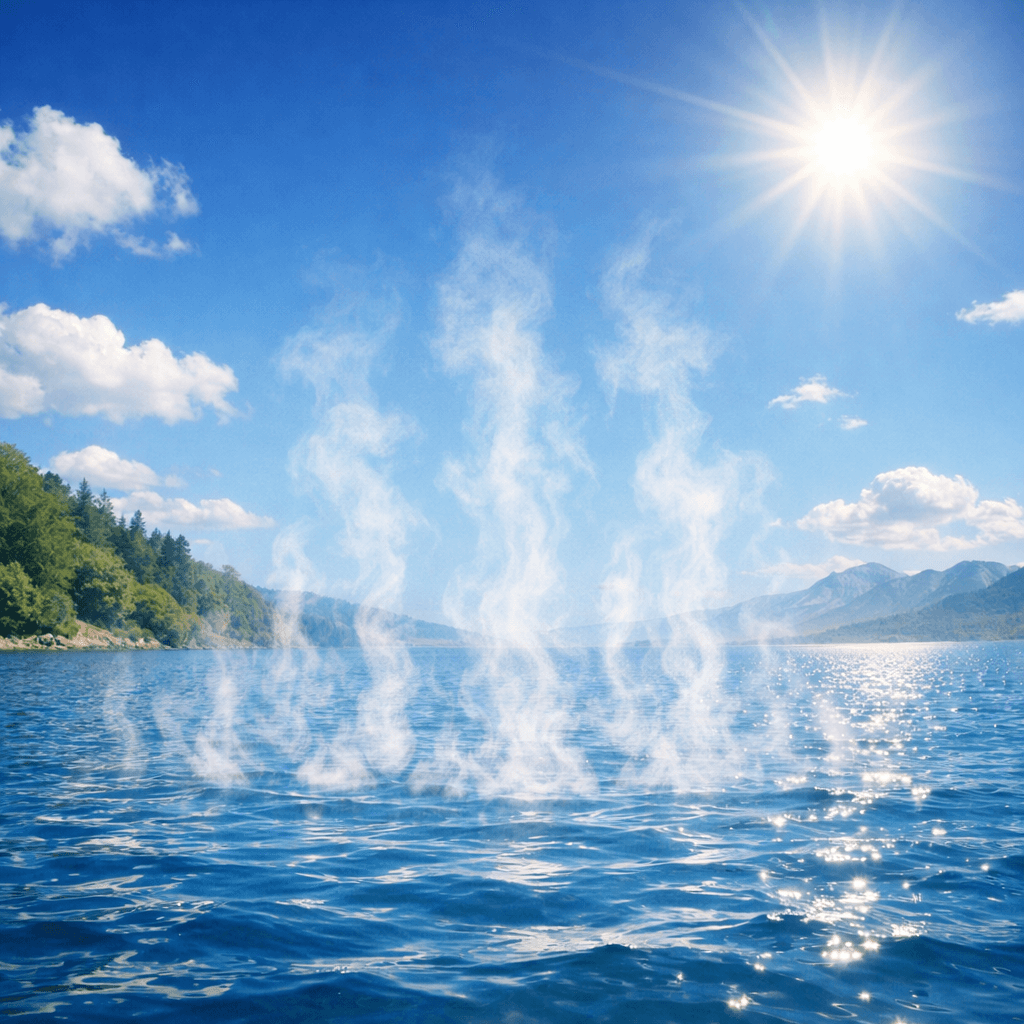
Evaporation Image (Generated by artificial intelligence.)
Transpiration is the process by which plants absorb water through their roots, transport it through their tissues, and release it as water vapor into the atmosphere through small openings on their leaves called stomata. This process is considered a biological component of the water cycle and makes a significant contribution to atmospheric water vapor, especially in regions with dense vegetation. Plants use only a small fraction of the water they absorb from the soil for growth and metabolic activities, while the majority is returned to the atmosphere through transpiration.
Transpiration occurs under the combined influence of plant physiological activities and environmental conditions. Plants draw water through their roots to support vital functions such as photosynthesis and nutrient transport, moving it to stems and leaves. Gas exchange occurs through stomata on leaf surfaces, during which water is released as vapor into the atmosphere. This process also helps regulate plant temperature.
Key factors influencing transpiration rates include temperature, sunlight, wind, air humidity, and plant species. Increased temperature and intense sunlight can activate stomata more actively, thereby increasing transpiration. Wind removes humid air around leaves, accelerating water vapor release. Conversely, high humidity reduces transpiration rates.
In forest ecosystems with dense vegetation, transpiration contributes significantly to the transfer of large volumes of water into the atmosphere. For this reason, some scientific studies combine evaporation and transpiration into a single concept known as evapotranspiration.
Evapotranspiration is a combined process encompassing both evaporation from water surfaces and water release into the atmosphere via plants, forming a vital component of the water cycle.
Condensation is the process by which water vapor in the atmosphere changes from a gaseous state to a liquid state due to cooling. This stage plays a crucial role in the water cycle and is fundamental to cloud formation. As water vapor rises into the atmosphere, it encounters cooler air layers. When the temperature drops below a certain threshold, water vapor transforms into tiny water droplets or ice crystals.
Condensation typically occurs around microscopic particles in the atmosphere such as dust, salt, or other aerosols, known as condensation nuclei, which facilitate the transition of water vapor into liquid droplets. The accumulation of numerous small water droplets forms clouds.
Clouds provide the necessary environment for the precipitation stage of the water cycle. Over time, water droplets or ice crystals within clouds coalesce and grow larger. Once they reach a critical weight, they begin to fall toward the Earth’s surface under gravity, setting the stage for precipitation.
Condensation is not limited to cloud formation. Near the Earth’s surface, cooling can lead to phenomena such as dew, frost, and fog, all of which are results of condensation. This demonstrates that the water cycle is connected not only to large-scale atmospheric events but also to local and daily weather phenomena.
Precipitation is the process by which water droplets or ice crystals formed in the atmosphere reach a sufficient size and fall to the Earth’s surface under gravity. As one of the most visible stages of the water cycle, precipitation returns atmospheric water to the Earth’s surface. Precipitation can occur in various forms, depending on temperature conditions.
The most common form of precipitation is rain. Other types include snow, hail, and sleet. Atmospheric temperature and pressure conditions determine the form precipitation takes. For instance, in colder regions, water droplets freeze into ice crystals that fall as snow.
For precipitation to occur, water droplets or ice crystals within clouds must coalesce and grow larger. As these particles become heavier, gravity pulls them downward. Upon reaching the Earth’s surface, part of the precipitation becomes surface runoff, while another portion infiltrates the soil to replenish groundwater.
Precipitation is one of the most critical stages of the water cycle for terrestrial ecosystems, as the majority of freshwater resources on Earth are replenished through precipitation. Agricultural activities, natural vegetation cover, and the continuity of water resources depend largely on the amount and distribution of precipitation.
Surface runoff is the process by which water that reaches the Earth’s surface as precipitation flows overland without infiltrating the soil or fully evaporating, moving toward bodies of water such as rivers, lakes, and seas. In this process, water flows downhill under the influence of gravity, reaching various water sources. Surface runoff plays a vital role in the water cycle because a significant portion of water delivered to the surface by precipitation is transported back to major water bodies through this mechanism.
The volume of surface runoff depends on several factors, including soil permeability, vegetation cover, terrain slope, and rainfall intensity. In soils with low permeability or those already saturated with water, infiltration is limited, resulting in increased surface runoff. Conversely, in areas with dense vegetation, some water is absorbed by the soil, reducing surface runoff.
During surface runoff, water is transported via rivers to lakes and oceans. This process can also transport soil, minerals, and various substances. Therefore, surface runoff is important not only for water movement but also for shaping and altering Earth’s surface features.
Infiltration is the process by which water that reaches the Earth’s surface as precipitation moves downward through pores in the soil into the subsurface. During this process, water passes through gaps between soil and rock particles to replenish groundwater reservoirs. Infiltration is a vital stage of the water cycle because groundwater serves as a primary source of freshwater in many regions for drinking and agriculture.
Soil structure and permeability are the primary factors determining infiltration rates. Sandy and porous soils allow water to infiltrate more easily, while dense soils such as clay slow the movement of water into the ground. Plant roots can also influence soil structure, facilitating water infiltration.
Some of the water that infiltrates the ground moves through groundwater flows and eventually resurfaces via springs, lakes, or rivers. This demonstrates that the water cycle continues not only on the surface but also within complex subsurface systems.
Groundwater reservoirs function as long-term water storage systems and can sustain water supplies during dry periods. Therefore, the infiltration process plays a critical role in the sustainability of the water cycle and the protection of water resources.
The water cycle is a dynamic process occurring under the influence of various environmental and natural conditions on Earth. Although its fundamental stages—evaporation, condensation, and precipitation—are governed by specific physical principles, the speed and distribution of these processes can vary due to natural factors. Climate conditions, temperature, atmospheric humidity, wind patterns, vegetation cover, and landforms play significant roles in the functioning of the water cycle. In addition, human activities can directly or indirectly affect certain stages of the water cycle.
One of the most important factors influencing the water cycle is climate. A region’s climatic characteristics determine the intensity of processes such as evaporation, precipitation, and surface runoff. For example, in hot and arid climates, evaporation rates are high while precipitation is generally low. In contrast, humid and rainy climates typically experience higher precipitation, enabling the water cycle to operate more rapidly.
Temperature is a decisive factor in evaporation and condensation processes. Higher temperatures cause water molecules to move faster, increasing evaporation rates. Changes in atmospheric temperature influence the condensation of water vapor into clouds. Consequently, temperature fluctuations directly affect precipitation formation and the amount of water vapor in the atmosphere.
Wind and atmospheric movements also play important roles in the water cycle. Winds transport water vapor across different regions, influencing the geographical distribution of precipitation. This is particularly significant in the movement of water vapor from oceans to landmasses. Through atmospheric circulation systems, water vapor can be transported over long distances and precipitate in different regions.
Another important factor affecting the water cycle is vegetation cover. Plants absorb water from the soil through their roots and return it to the atmosphere via transpiration. This process increases atmospheric water vapor, contributing to cloud formation and precipitation. Large forested areas play a crucial role in regulating the water cycle at regional scales.
Soil structure and landforms also influence water movement on Earth’s surface. Soil permeability determines the amount of water that infiltrates the ground, while terrain slope affects the speed and direction of surface runoff. In mountainous regions, rising air masses cool more readily, leading to more frequent condensation and precipitation events.
Finally, human activities can also affect the water cycle. Urbanization, deforestation, agricultural activities, and intensive water use can alter the natural flow of water. For example, increased concrete and asphalt surfaces from urban development reduce water infiltration into the soil, increasing surface runoff. Similarly, deforestation reduces transpiration, thereby affecting local water cycles.
When all these factors are considered together, it becomes evident that the water cycle is not merely a physical process but a complex system influenced by interactions between the natural environment and human activities.
The water cycle is one of the fundamental natural processes that govern the functioning of ecosystems on Earth. Since water is one of the most essential natural resources required for all life, its continuous circulation between the atmosphere, land, and aquatic environments is vital for maintaining ecological balance. Through the water cycle, water resources are renewed, water and nutrients are transported between ecosystems, and the continuity of natural life is supported.
Organisms in ecosystems depend directly or indirectly on water. Plants require water for vital activities such as photosynthesis, nutrient transport, and growth. Animals rely on water for drinking, feeding, and metabolic processes. Through precipitation, water reaches the Earth’s surface, is stored in the soil, and becomes available for plant use, thereby sustaining life in terrestrial ecosystems.
The water cycle is also one of the primary mechanisms that renew freshwater resources. Although the amount of freshwater on Earth is limited, the water cycle ensures these resources are continuously replenished. Lakes, rivers, and groundwater reservoirs are sustained by precipitation. This plays a crucial role in meeting the water needs of both natural ecosystems and human societies.
Another important function of the water cycle for ecosystems is the transport and distribution of nutrients. During precipitation and surface runoff, water can carry minerals and organic matter from the soil to different regions. This contributes significantly to nutrient cycling, particularly in river systems and wetland ecosystems, ensuring that essential nutrients are distributed to plants and other organisms.
The water cycle also has a climate-regulating effect. Water vapor and clouds in the atmosphere influence the distribution of solar energy across Earth’s surface, playing a role in temperature regulation. Energy exchanges during evaporation and condensation contribute to atmospheric circulation and affect the operation of the climate system. Therefore, the water cycle influences not only water movement but also the formation of climate conditions.
Wetlands, lakes, rivers, and forest ecosystems are natural environments directly affected by the water cycle. Evaporation, transpiration, and precipitation processes in these areas determine local water balance. Wetlands, in particular, are vital ecosystems for storing water and gradually releasing it into the environment, helping to stabilize the water cycle.
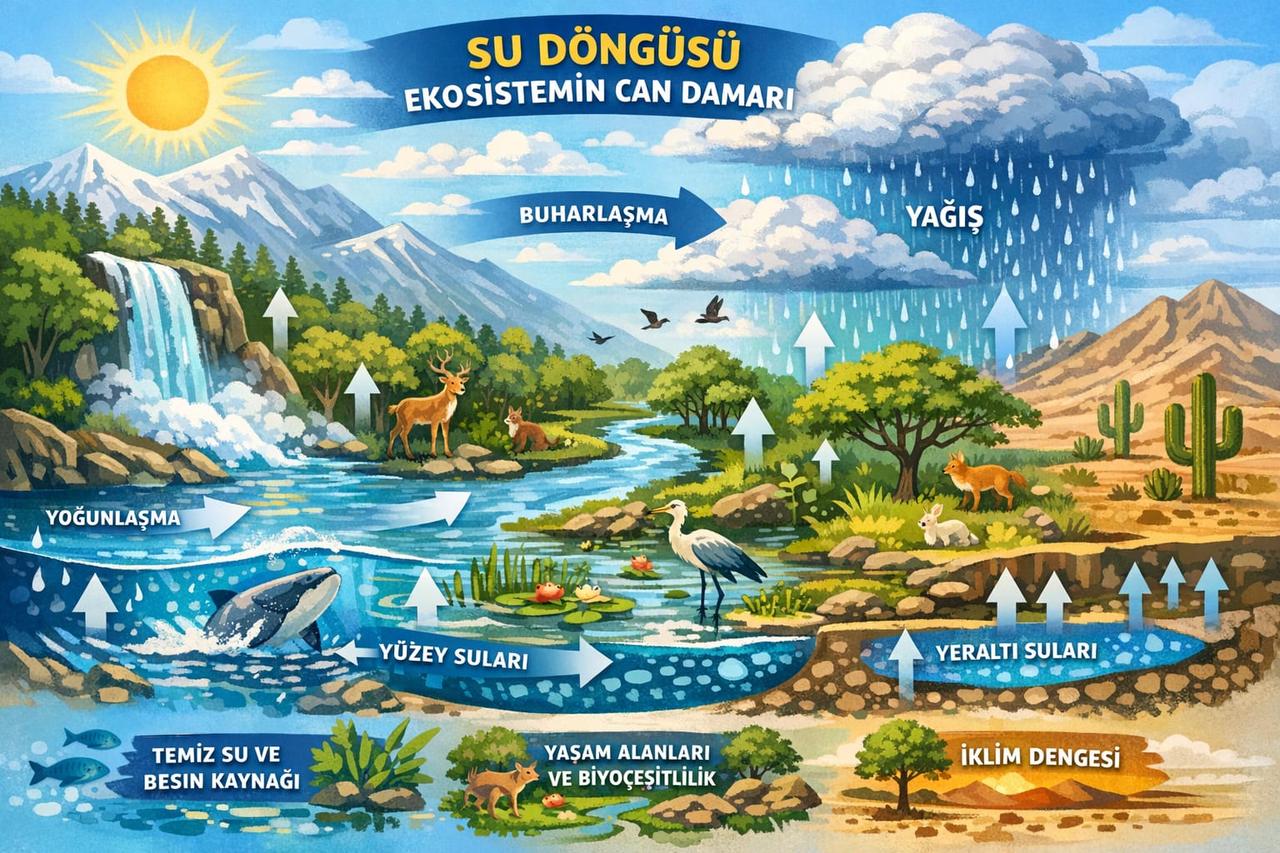
Diagram Showing the Role of the Water Cycle in Ecosystems (Generated by artificial intelligence.)
Although the water cycle is a natural process, human activities can directly and indirectly alter its functioning. Urbanization, industrialization, agricultural practices, deforestation, and intensive water use are among the primary factors that can change the natural flow of water. Human-induced impacts can cause changes in various stages of the water cycle at both local and global scales.
Urbanization and infrastructure development represent significant interventions in the water cycle. Increased concrete and asphalt surfaces from urban expansion reduce the infiltration of rainfall into the soil and increase surface runoff. This limits the replenishment of groundwater reserves and can elevate flood risk. Sewer systems and drainage structures redirect natural surface flows, altering the water balance of ecosystems.
Agricultural activities also have pronounced effects on the water cycle. Irrigation systems lead to intensive water use, which can rapidly deplete groundwater reserves and lower the water table. Additionally, fertilizers and pesticides transported by surface runoff from agricultural lands can degrade water quality and harm ecosystems. Sustainable water management and irrigation techniques are critical for mitigating these impacts.
Deforestation and land-use changes directly affect transpiration and evapotranspiration. Cutting down forests or removing natural vegetation reduces the amount of water released into the atmosphere by plants. This can indirectly affect cloud formation and precipitation levels. Furthermore, increased erosion and soil degradation accelerate surface runoff and disrupt the balance of the water cycle.
Industry and energy production can interfere with the water cycle in various ways. The volume of water used in energy generation, water recycling practices, and cooling systems in thermal power plants can alter local water availability and temperature. These changes can disrupt ecosystem water balances and reduce water quality.
Climate change and global effects intensify the indirect human impacts on the water cycle. Rising global temperatures can alter evaporation rates and precipitation patterns. As a result, some regions may experience more frequent droughts, while others face more intense rainfall and flooding. Human-caused greenhouse gas emissions are among the primary global factors disrupting the natural balance of the water cycle.
Alaettin Tuncer. *Su ve Su Döngüsü*. Hacettepe Üniversitesi. Accessed March 6, 2026. https://yunus.hacettepe.edu.tr/~alaettintuncer/docs/Su.pdf
Karabük Üniversitesi. "Su Döngüsü ve Önemi." *Karabük Üniversitesi Sertifika Blog*, 2026. Accessed March 6, 2026. https://sertifika.karabuk.edu.tr/su-dongusu-ve-onemi-blog?srsltid=AfmBOorcL_t2ERn_puwCm1cToJQG3W7dynfEo-GxUgm7xuuj0_pKBvLf
National Oceanic and Atmospheric Administration (NOAA). “The Water Cycle.” NOAA Education Resource Collections. Accessed March 6, 2026. https://www.noaa.gov/education/resource-collections/freshwater/water-cycle
Okatan, Ayşenur. "Elementlerin Doğadaki Dönüşümü." TÜBİTAK Bilim Genç, May 30, 2019. Accessed June 9, 2026. https://bilimgenc.tubitak.gov.tr/makale/elementlerin-dogadaki-donusumu
Sakarya Üniversitesi. *Su Döngüsü ve Önemi: Lisansüstü Çalışma*. Sakarya ÜniversitesiAçık Erişim. 2019. Accessed March 6, 2026. https://acikerisim.sakarya.edu.tr/bitstream/handle/20.500.12619/103047/T11822.pdf?sequence=1
Sargıncı, Murat, Abdullah Hüseyin Dönmez, and Oktay Yıldız. “Biyosferde Su Döngüsü ve Bitkiler Tarafından Suyun Alınma Mekanizmaları.” *DÜS-TIBİD Dergisi*, Volume 1, Issue 1 (2022): 8-20. Accessed March 6, 2026. https://dergipark.org.tr/en/download/article-file/3081007


No Discussion Added Yet
Start discussion for "Water Cycle (Hydrological Cycle)" article
Key Stages of the Water Cycle
Evaporation
Transpiration
Condensation
Precipitation
Surface Runoff
Infiltration
Factors Influencing the Water Cycle
Importance of the Water Cycle for Ecosystems
Human Impacts on the Water Cycle