


This article was automatically translated from the original Turkish version.
Is it possible to be the poet of a story?
Historiography is often presented as a structured answer to the question “what happened?” Documents are found, events are ordered, individuals and dates are placed in their proper context. This framework is not entirely wrong; but it is incomplete. For history is not merely a conduit for information. We cannot access the past directly; the past reaches us mostly through texts, records, labels, and other mediating tools. Therefore, in historiography, language—the medium that makes events possible and comprehensible to the reader—is just as central as the “events” themselves.
The postmodern intervention, particularly along the lines of Derrida, begins precisely here: meaning is not a fixed core already present in the text. Even when words stand alone, they carry a past; when they enter a sentence, that past becomes active. An expression functions not only by “what it says” but also by “what context it has traveled through.” Thus, even when the historian believes they are simply reporting “what happened,” they are in fact making choices: deciding which concepts to use, which terms to center, which to explain, and which to leave as they are. The postmodern critique is not meant to devalue historiography; it is essential for making these textual decisions visible.
At this point, a small distinction proves useful: “kelime” and “sözcük.” In everyday language, they are often synonymous; but in historiography, the tonal difference between them becomes more pronounced because language carries its own history. When we say “kelime,” we usually mean the unit appearing in the text—a term, a label. When we say “sözcük,” we are more likely to think of how that same unit functions within a sentence, what associations it carries, and which usage habits accompany it. At least, that is how it comes to mind in my own thinking. A similar distinction can be observed between “anlam” and “mana.” “Anlam” evokes a sense closer to a dictionary definition: what does the expression mean? “Mana,” by contrast, reminds us of a word’s historical-cultural weight, its social resonance, and the direction it opens within a sentence: what does this word normalize? What does it exclude? What values does it align with? Of course, both are context-dependent; but within historiography, the concept of “mana” makes the historical layers of language more visible.

Portrait of the Seeker of Knowledge (Generated by Artificial Intelligence)
From here we arrive at word choice. In historiography, word choice is often dismissed as “style”: “We would write this better this way rather than that.” But the issue is rarely about writing “more beautifully”; it is about constructing a “more accurate” framework; yet even that is not quite right. To label an event as an “revolt” is not merely a matter of tone compared to calling it an “uprising,” “rebellion,” or “resistance.” These words position actors differently, distribute legitimacy differently, construct state-society relations differently, and define violence differently. The reader begins to interpret the same phenomenon within a different framework. This situation continuously raises two questions: What does this labeling make visible? What does it render invisible? From whose perspective is this text constructed?
You may have noticed that after saying “two questions,” I listed three. When I first thought about this, I genuinely had two questions in mind; but as I constructed the text, a third emerged naturally. I could have gone back and corrected it, reshaping the passage to fit “two questions.” But I chose not to. After all, does the flow of thought not often proceed this way in real-life communication? When we speak, we rarely say exactly what we planned; thought expands, diverges, takes on new directions as it moves. And from that point onward, it is impossible to erase everything that passed through our minds as if it had never happened. What we can do, as I did in this paragraph, is add an explanation: “I said two, but there are actually three questions.” This clarification does not serve to correct an error so much as it reveals how thought progressed. A small inconsistency within the text becomes a trace of the natural movement of thinking. This small example also illustrates the process of filtering and revision that historians and other writers undergo when preparing texts. Writing is rarely the flawless transmission of a seamless thought; it is the sum of the paths thought has taken, the choices made, and the deliberate traces left behind. What matters here is not erasing every trace, but understanding why certain traces were left. Therefore, when reading a written text, one must take this process into account.
Let us now return to the main thread of this text. We will explore this topic further in another essay and discuss it at length.
From Derrida’s perspective, this is not a claim that “there is no truth.” Rather, it is an invitation to trace how truth is constructed within the text. The foundational act of a historical text is often “selection”: between documents, between quotations, between sentences, between concepts. Moreover, a choice appearing “neutral” does not cease to be a choice. Footnotes, bibliographies, and archival references strengthen the text; but they can also function to present the framework constructed by the text as “natural.” This is not an accusation; it is simply how writing works. Postmodern reading brings this mode of operation into discussion. It is precisely here that the question of the “archive” becomes crucial. The archive is not merely the sum of what is preserved; it is also the space of what has been organized, classified, and excluded. Which documents remain? Which are lost? Which are accessible? The language of the institution that produced the document? The type and purpose of the document? All of these provide historiography with a framework from the very beginning. Thus, the historian’s word choice is not a process that begins solely at their desk; it is often nourished by the language of the archive and the document itself.
Reflections of a Phenomenon in Different Narratives (Video: Mehmet Salih Çoban)
This nourishment has a very concrete manifestation in the context of Türkiye: the rupture between Ottoman Turkish with its Arabic-Persian influences and the language reforms and simplification movements after the Republic. The reason the “kelime/sözcük” duality sometimes evokes this rupture in historiography is precisely this. The term “kelime” may conjure a linguistic climate rich in Arabic and Persian vocabulary, abundant in compound forms, and connected to bureaucratic and madrasa writing traditions. “Sözcük,” by contrast, evokes more strongly the post-Republic Turkish emphasis on simplification and Turkification. This association, even if unintended, generates a directional sense in the text: which linguistic regime is the historian closer to? Which one do they regard as more “valid”?
We observe this not only at the level of “kelime/sözcük,” but also in more visible examples: pairs such as “mukavele/sözleşme,” “münasebet/ilişki,” “teşkilat/örgüt,” “müsadere/el koyma,” “tahkikat/soruşturma,” “tebaa/vatandaş,” “asayiş/kamu düzeni,” and “muhalefet/karşıtlık.” Choosing one term over another is rarely merely about enhancing intelligibility or making the text appear “older.” It also evokes the historical trajectory of that word: it determines which era’s conceptual world we are anchoring ourselves in, which institutional language we are aligning with, and which reading habits we are reinforcing.
The difficulty lies here: translating the language of Ottoman documents into today’s Turkish “renders” the text modern; but it also transforms the document’s own categories. Some concepts in the document do not function identically to their modern equivalents; they merely appear to carry a similar “meaning,” but their “mana” has changed. Conversely, preserving the original Ottoman Turkish terms is also problematic: doing so presents the document’s language as a “legitimate” framework, potentially legitimizing, knowingly or unknowingly, intentionally or unintentionally, the discourse of power embedded in the document. Thus, the historian must make a decision no matter which direction they turn: either they transform and make visible, or they preserve and sustain the weight carried by the term.
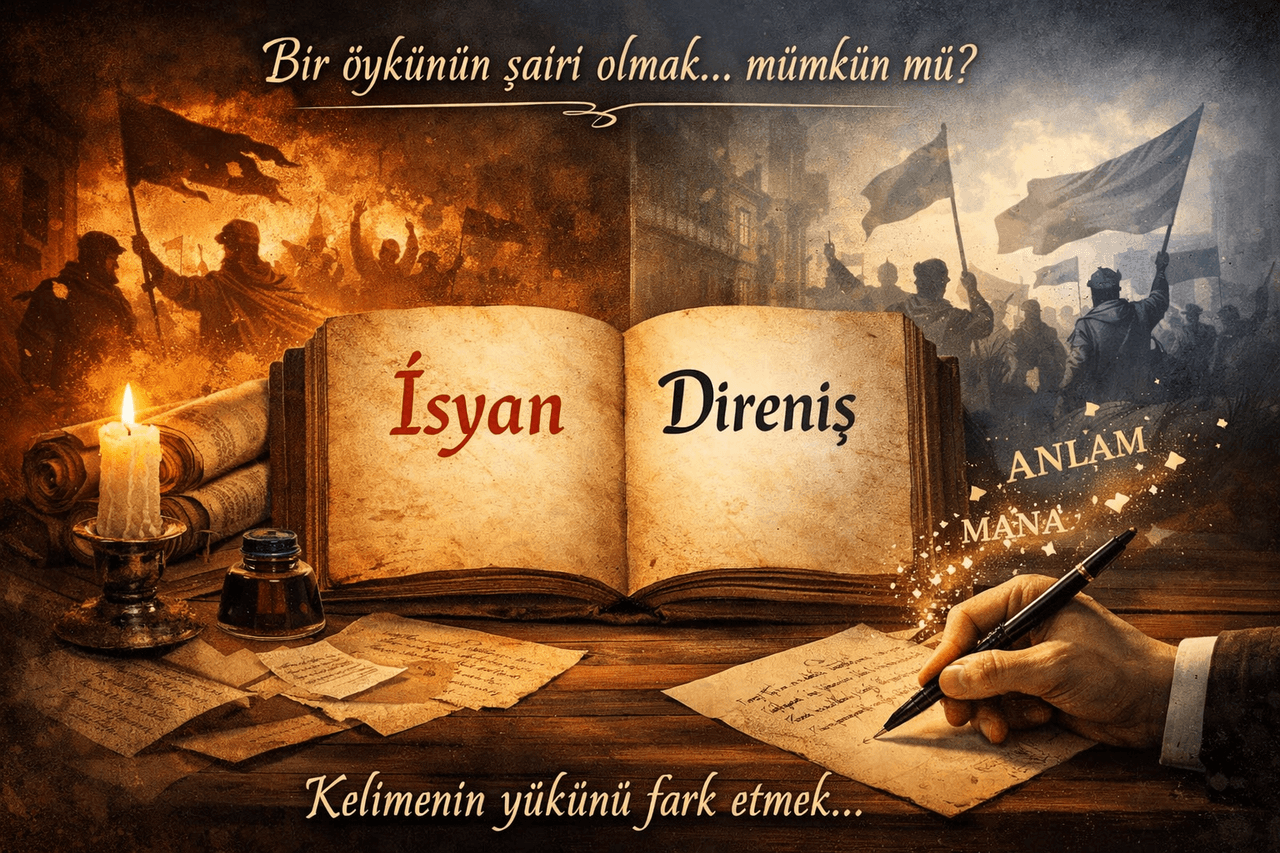
Recognizing the Weight of a Word (Generated by Artificial Intelligence)
Here the distinction between “anlam” and “mana” becomes useful again. Finding a dictionary definition of a term often provides a solution at the “anlam” level; but grasping its “mana” becomes difficult without understanding its usage during the period, its legal-administrative context, its everyday linguistic counterpart, and its position within the social hierarchy. This is precisely why historiography must read not only words, but also the world through which those words traveled.
Within this framework, the question of “narrative” becomes clearer. A historical text works not only by selecting and ordering events, but also by choosing and positioning concepts. Where does it begin? Where does it end? Which relationships does it frame as cause and effect? Which does it relegate to the background? Which actor does it treat as “central”? All of these occur within language. Therefore, word choice in historiography is not a simple stylistic preference; it is the epistemic and ethical responsibility of the text.
When we place all of this side by side, the controversial phrase from literature—“to be the poet of a story”—finds a new place. Those who object to this phrase usually wish to distinguish genres: story is one thing, poetry is another. But from the perspective of historiography, the issue is not the boundary between genres; it is how narrative is constructed through language. If we read the word “poet” here not as a title but as a mode of attention, the sentence takes on a different function: it points to a writing discipline that values the weight of language, the history of the word, and the impact of naming. For the historian, this is not “writing poetry”; it is paying attention to the “mana” of concepts as much as their “anlam,” accounting for the temporal weight of words, and making the invisible choices of the text as transparent as possible.
