


This article was automatically translated from the original Turkish version.
+1 More
Production of Space (Production of Space) is a foundational theory developed by the French thinker and sociologist Henri Lefebvre, who lived between 1901 and 1991 and is known in the literature as a Neo-Marxist, to radically analyze the relationships between city, space and politics.【1】 Lefebvre’s redefinition of space not as a physical and static void but as a social production field was significantly shaped by his experience as a taxi driver in Paris during the 1920s and 1930s and his international travels between 1966 and 1973. These experiences enabled him to conceptualize the city and space not as purely theoretical constructs but through the lens of everyday life practices.【2】
Before Lefebvre, space was generally conceived through the image of Euclidean geometry as an infinite and isotropic void. Particularly in the philosophy of René Descartes, space was objectified through the dichotomy of “thinking thing” (res cogitans) and “extended thing” (res extensa), and viewed as a static and purely mathematically designable field. 【3】Immanuel Kant advanced Cartesian thought by defining time and space as the a priori conditions (a priori) of our knowledge of the external world, reducing space to a mental category.【4】
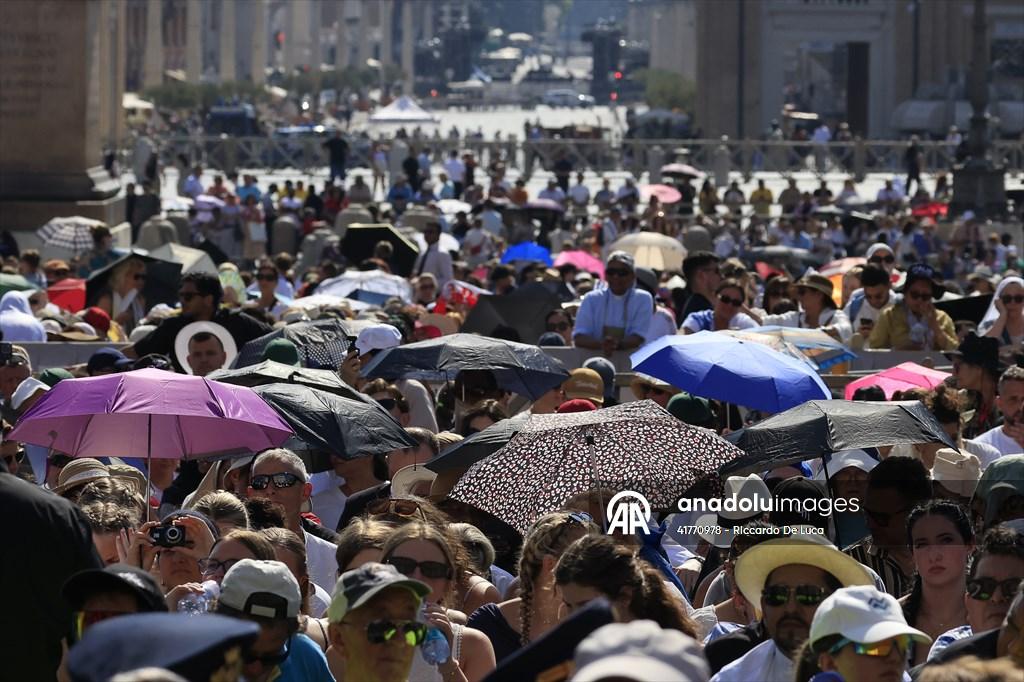
Kalabalık Şehir Meydanı (Anadolu Ajansı)
In modern philosophy, this absolute and static conception of space has been critiqued by various thinkers. Martin Heidegger explained the connection between space and existence through the example of the “bridge,” arguing that space is not a neutral physical void but exists through human actions and boundaries such as roads, rivers and structures. 【5】Maurice Merleau-Ponty placed the body at the center of spatial experience, asserting that objects are not neutral but acquire meaning through the subject’s perception and that space cannot be homogeneous. 【6】Similarly, Henri Bergson explained the relationship between space and time (duration) through human memory and consciousness, arguing that space is not passive but in a constant state of transformation and flow.【7】
Lefebvre extended the preceding philosophical tradition into the social realm by proposing the thesis that “social space is a social product,” and developed a holistic dialectic encompassing physical, mental and social dimensions to understand space. This dialectical structure, which transcends the classical binary of abstract and concrete, consists of three equivalent concepts without hierarchical precedence:【8】
In Lefebvre’s theory, space is evaluated as a political and intentional instrument used to reflect and legitimize the ideology of power.【12】 The city, rather than being a passive artifact constructed in the classical sense, is, in Marxist terms, a direct “product” and “means of production.”【13】 With industrialization, the metallization of land and nature led to the marginalization of space’s “use value” and the dominance of its “exchange value” within the capitalist cycle.【14】
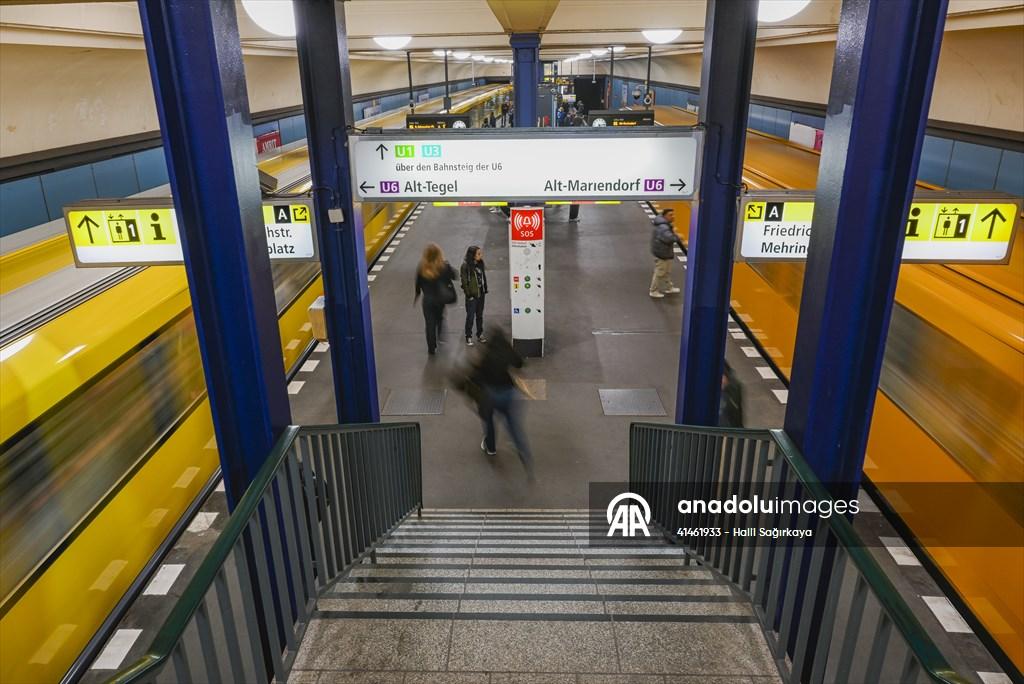
Modern Ulaşım Ağlarında Gündelik Yaşam Ritmi İçinde Bireyin Mekana Yabancılaşması (Anadolu Ajansı)
In the capitalist system, the construction and real estate sectors have ceased to be mere ancillary branches of the economy; they have become the dominant model of production to which capital turns to counter the tendency of the average rate of profit to fall and to secure high returns.【15】 The surplus value (surplus value) produced by the working class in urban space no longer remains confined to the industrial cities where it is generated; instead, it is distributed globally according to capital’s preferences, deepening spatial inequalities and fragmentation at a global scale.【16】
Everyday life is the primary arena in which the dialectic and contradictions of space are practically resolved. Lefebvre does not limit the modern human’s existence to the concepts of the rational thinker (homo sapiens) or the producer (homo faber); he expands the understanding of human existence in space by incorporating the concepts of the joyful, laughing human (homo ridens) and the playing human (homo ludens).【17】 The apex of spatial analysis is the human body. The body embodies the tension between the biological and the social through pleasure, desire, physiological needs and pain, and directly experiences the alienation brought by modern life through space.【18】 The “lost time” extracted from individuals’ lives by increasing official bureaucracy and transportation networks in urban areas is also a spatial and political manifestation of this alienation.【19】
The theory of the production of space treats urban design and architecture not merely as physical acts of construction but as creative processes integrated with human actions. For instance, in the Croatian Sea Organ project, space is experienced acoustically and bodily through wave sounds, and in applications such as China’s Red Ribbon Park, where rigid boundaries are eliminated to enable multifunctional use of open public spaces, the non-static, living nature of space as a production is demonstrated.【20】
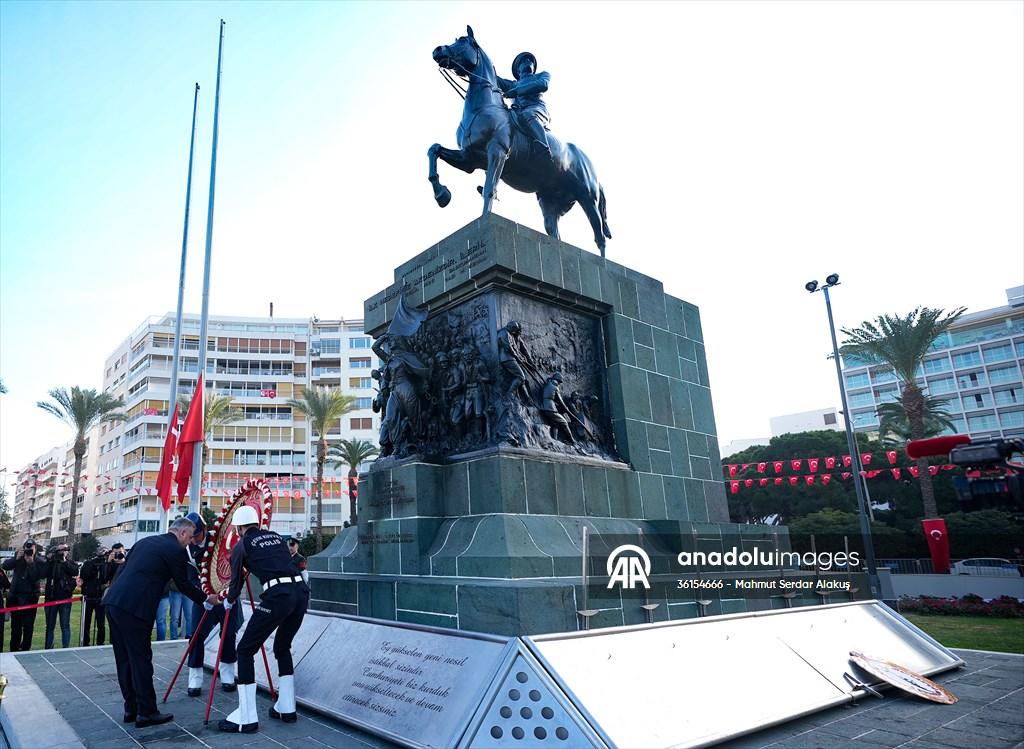
İzmir Cumhuriyet Meydanı (Anadolu Ajansı)
One of the most concrete historical examples of how space is reproduced through state decisions, ideological planning and social resistance is İzmir Republic Square. Rebuilt after the 1922 İzmir Fire according to plans by Henri Prost and René Danger (1924–1925), the square embodies the nature of “conceived space” (representation of space) as an attempt by the state to spatially assert its authority. The 1965 Law on Ownership of Floors led to the replacement of low-rise buildings in the area with high-rise commercial blocks, radically altering spatial practices and everyday life. The 1991 highway project planned for Kordonboyu represented an attempt by the authorities to shape space as a mental hegemonic domain; however, the strong social resistance and collective actions of the public transformed the space from the state’s monopoly into a “lived space” (representational space) claimed by the people. Neoliberal urban policies implemented after the 2000s (privatizations and increases in luxury housing) have reasserted capital’s dominance over space, demonstrating that space remains an endless dialectical arena of struggle and production between society and power.【21】
Anadolu Ajansı. "Berlin'de Günlük Yaşam." Photograph. *Anadolu Images*. Accessed July 6, 2026.https://www.anadoluimages.com/p/berlinde-gunluk-yasam/31783082
Anadolu Ajansı. "Büyük Önder Atatürk'ü Anıyoruz." Photograph. Anadolu Images. Accessed July 6, 2026.https://www.anadoluimages.com/p/buyuk-onder-ataturku-aniyoruz/28984518
Anadolu Ajansı. "Papa 14. Leo Genel Kabul Oturumu İçin Aziz Petrus Meydanı'na Geldi." Photograph. *Anadolu Images*. Accessed July 6, 2026.https://www.anadoluimages.com/p/papa-14-leo-genel-kabul-oturumu-icin-aziz-petrus-meydanina-geldi/31937069
Dervişoğlu, Ceren Doğan. "Space As A Social Product: Izmir Cumhuriyet Square." Dicle University Social Sciences Institute Journal, no. 28 (2021): 336-354. Accessed July 6, 2026.https://dergipark.org.tr/tr/download/article-file/1849990
Sezgin, Sezgin. "Şehir Hakkı II: Mekân ve Siyaset." *Giresun Üniversitesi İktisadi ve İdari Bilimler Dergisi* 9, no. 2 (2023): 178-182. Accessed July 6, 2026.https://dergipark.org.tr/tr/download/article-file/3326611
Çavdar, Bilal. "Mekanın Üretimi." *Sinop Üniversitesi Sosyal Bilimler Dergisi* 7, no. 2 (2023): 1857-1862. Accessed July 6, 2026.
Özçakı, Meltem. "Creating Living Urban Spaces." *Humanitas* 5, no. 10 (2017): 205–228. Accessed July 6, 2026.
[1]
Sezgin Sezgin, "Şehir Hakkı II: Mekân ve Siyaset," Giresun Üniversitesi İktisadi ve İdari Bilimler Dergisi 9, no. 2 (2023): 178, https://dergipark.org.tr/tr/download/article-file/3326611
[2]
Bilal Çavdar, "Mekanın Üretimi," Sinop Üniversitesi Sosyal Bilimler Dergisi 7, no. 2 (2023): 1858, https://dergipark.org.tr/tr/download/article-file/3305318
[3]
Çavdar, "Mekanın Üretimi," 1858.
[4]
Çavdar, "Mekanın Üretimi," 1859.
[5]
Meltem Özçakı, "Creating Living Urban Spaces," Humanitas 5, no. 10 (2017): 208, https://dergipark.org.tr/tr/download/article-file/386574
[6]
Özçakı, "Creating Living Urban Spaces," 208.
[7]
Özçakı, "Creating Living Urban Spaces," 210-211.
[8]
Ceren Doğan Dervişoğlu, "Space As A Social Product: Izmir Cumhuriyet Square," Dicle University Social Sciences Institute Journal, no. 28 (2021): 341, https://dergipark.org.tr/tr/download/article-file/1849990
[9]
Dervişoğlu, "Space As A Social Product," 341.
[10]
Dervişoğlu, "Space As A Social Product," 341.
[11]
Dervişoğlu, "Space As A Social Product," 341.
[12]
Sezgin, "Şehir Hakkı II," 179.
[13]
Sezgin, "Şehir Hakkı II," 178-179.
[14]
Sezgin, "Şehir Hakkı II," 180.
[15]
Sezgin, "Şehir Hakkı II," 180.
[16]
Sezgin, "Şehir Hakkı II," 181.
[17]
Çavdar, "Mekanın Üretimi," 1861.
[18]
Çavdar, "Mekanın Üretimi," 1861.
[19]
Sezgin, "Şehir Hakkı II," 179.
[20]
Özçakı, "Creating Living Urban Spaces," 212-214.
[21]
Dervişoğlu, "Space As A Social Product," 344-350.

No Discussion Added Yet
Start discussion for "The Production of Space" article
Historical and Philosophical Evolution of the Concept of Space
The Triple Dialectic of Space (Spatial Triad)
Capitalism, the City and Political Economy
Everyday Life, the Body and Alienation
The Example of İzmir Republic Square