


This article was automatically translated from the original Turkish version.

Cultural symbols are powerful indicators that reflect a society’s aesthetic understanding, historical experience, and way of perceiving the world. In this context, the tulip in Turk culture history is not merely an ornamental plant; it carries a multilayered world of meaning deeply interwoven with art, literature, belief, and daily life.
For centuries, the tulip found its place across a wide spectrum—from gardens to poetry, from architecture to decorative arts—and gradually transcended its role as a mere object of pleasure to become a symbolic embodiment of its era’s spirit. Indeed, its journey from Central Asia to Anatolia, its elevated position within the Ottoman aesthetic universe, and its widespread influence by the eighteenth century—so profound that it lent its name to a historical period—secure for the tulip a privileged status in Turkish cultural history.
Originating as a wild flower in the steppes of Central Asia, the tulip embarked on a long journey alongside the Turks; during this odyssey from the Seljuks to the Ottomans, it gradually became a carrier of aesthetic ideals and civilizational taste. In Anatolia, beginning in the twelfth century, the tulip was cultivated as an ornamental plant and, especially in Istanbul, evolved into the most refined expression of humanity’s relationship with nature. For the Ottoman person, the tulip was not loved merely for its beauty; its form, color, and associations carried profound symbolic meanings. For instance, in Divan poetry, the tulip is depicted as less splendid than the rose, less sorrowful than the nightingale, yet uniquely somewhat shy and solitary. Poets from Ahmed Paşa to Bâkî【1】, from Nedîm to Necâtî, portrayed the tulip alternately as the herald of spring and as a motif of wound or longing.【2】
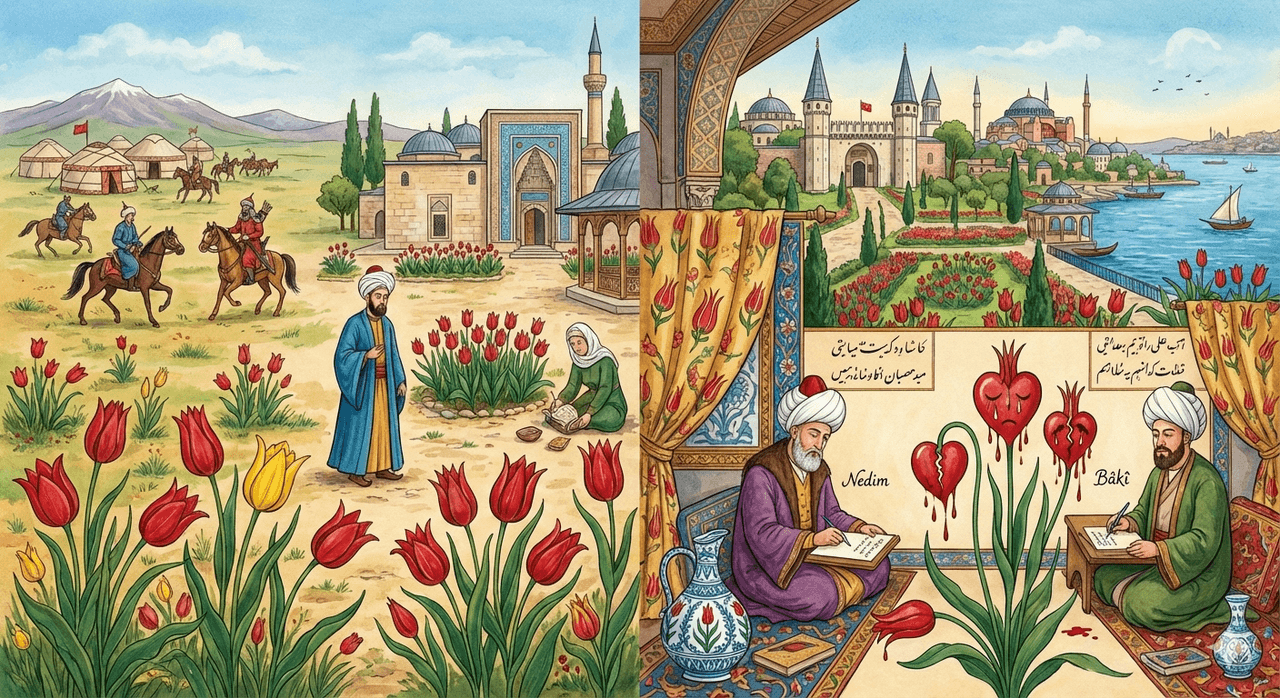
An Image Depicting the Tulip Motif in the Ottoman Era and Divan Poetry (Generated by Artificial Intelligence)
This value gradually became central to everyday life; tulip gardens, known as lalezars, became the most cherished spaces in palaces and mansions. Particularly in the eighteenth century, during the relative peace brought by years of stability, the love of tulips transformed into a social passion; compilations were compiled and names were assigned to hundreds, even thousands, of varieties.
During its journey from Istanbul to Vienna and then to the Netherlands, the tulip ceased to be merely an ornamental plant and became an economic and cultural phenomenon, giving rise to the period known in Europe as “tulip mania.”【3】 Yet in the lands that are its true homeland, the meaning carried by the tulip was never reduced to mere material value. In Europe, the tulip became a commercial commodity and a tool of speculation; in Anatolia and Istanbul, it remained closely associated with meaning and elegance. This distinction reflects two distinct civilizational conceptions of beauty. In the West, the tulip became a rare object to be possessed; in the East, it was a flower to be observed, preserved, multiplied, and imbued with meaning.
In abjad numerology, the tulip corresponds to the same numerical value as the word “Allah,” and its petals, when reversed, evoke the crescent moon; these associations elevated the tulip in the Ottoman mindset to a divine and symbolic status. The tulip motif became a symbol on tombstones, on ceramic tiles in mosques, in book illuminations, and in textile patterns. The semi-stylized tulips brought to life in Kara Memi’s embroidery opened a new aesthetic sensibility in Turkish decorative arts and endured for centuries across diverse media—from ceramics to weaving, from metal to wood.
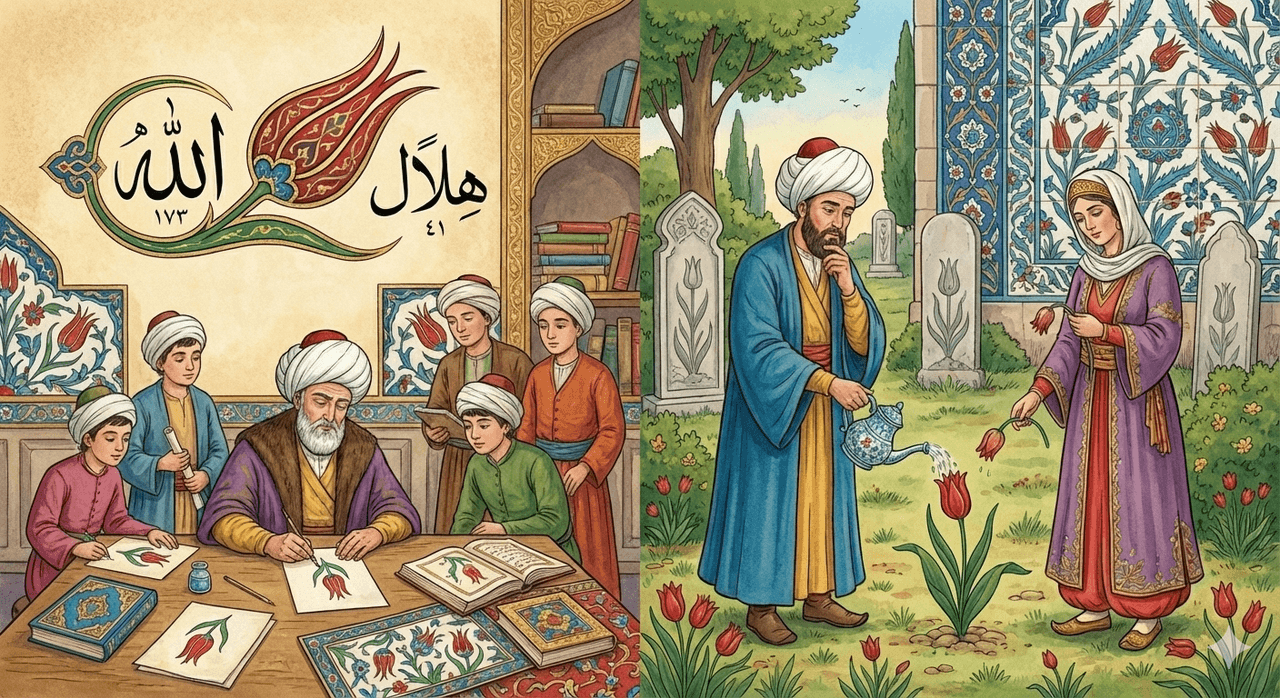
An Image Depicting the Tulip Motif and Its Applications in the Ottoman Era (Generated by Artificial Intelligence)
Moreover, the attention paid to the tulip in Ottoman society was not a simple matter of personal taste; it reflected a desire to live in harmony with nature, an effort to perceive beauty, and an appreciation for a refined way of life. Cultivating tulips required patience and distanced individuals from haste, reminding them of transience and transforming the notion of fleetingness into an aesthetic acceptance. Thus, the tulip, as much in poetry as in daily life, came to represent a state of being: its brief life was likened to human fate, and its need for water and care was seen as a symbol of love sustained through attention.
Indeed, in the Ottoman world, growing flowers was not an attempt to dominate nature but rather a part of the effort to harmonize with it; the tulip was regarded as one of its most elegant representatives. Each new tulip variety was not merely a different color or form but also carried, along with its name, a new story and new associations. These names often pointed to divine beauty, love, light, or a sense of destiny; the aesthetic constructed through language was valued as much as the flower itself. Thus, the tulip became both a blossom in the garden and an image that bloomed in language and imagination.
For Şükufeciler and tulip enthusiasts, cultivating tulips was considered a kind of knowledge and spiritual practice; knowing the right soil, the right time, and the proper care required refined experience. In this sense, the tulip was a flower resistant to impatience; it flourished not through haste but in the hands of those who knew how to wait. Perhaps for this reason, despite its short lifespan, its value did not fade; on the contrary, its transience left a lasting imprint.
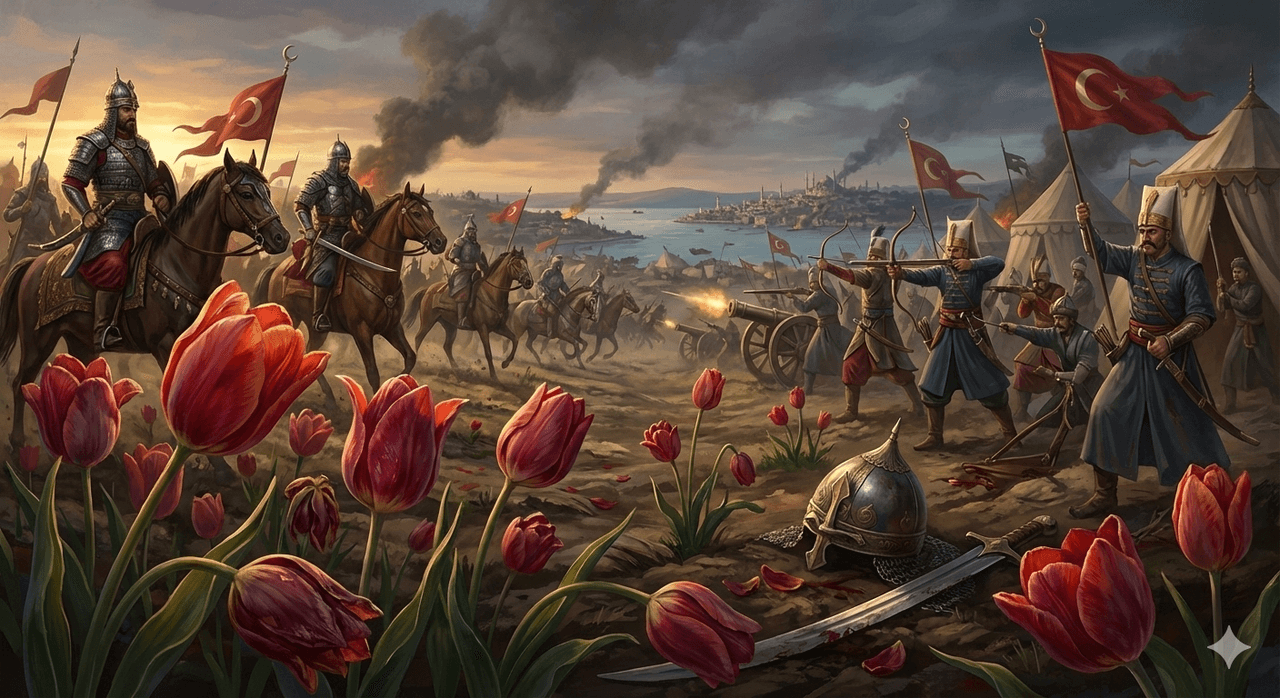
An Image Depicting the Turbulent Periods of Ottoman History and the Symbolic Resilience of the Tulip During These Difficult Times (Generated by Artificial Intelligence)
Although wars, economic crises, and social upheavals over time caused people to forget the subtleties of tulip culture, the tulip never lost its place in Turkish memory. Today, this flower, for which festivals are held in various parts of the world, continues to live as a symbol of a civilization that originated in Anatolia.
In modern times, it is often perceived merely as an aesthetic ornament, yet when examined closely, the historical and cultural legacy it carries remains legible.
With its recorded names in old compilations, its frozen images in the verses of poets, and its stylized forms in works of art, the tulip has become one of the resilient elements of cultural memory.【5】 Today, when the tulip is remembered once again, it must be thought of not merely as a festival flower or a visual motif, but together with the deep layers of meaning it carries. For the tulip is a silent narrator that conveys a civilization’s way of seeing the world, its perception of beauty, and its stance toward transience.
In art, as the tulip became stylized, it did not sever its connection with nature; it transformed its form without losing its essence. Tulip motifs found on ceramic surfaces, in manuscript pages, or in textile patterns preserve the essence of the real flower while rendering it timeless. Even when repeated over centuries, these forms have always been approached with a new aesthetic sensitivity.
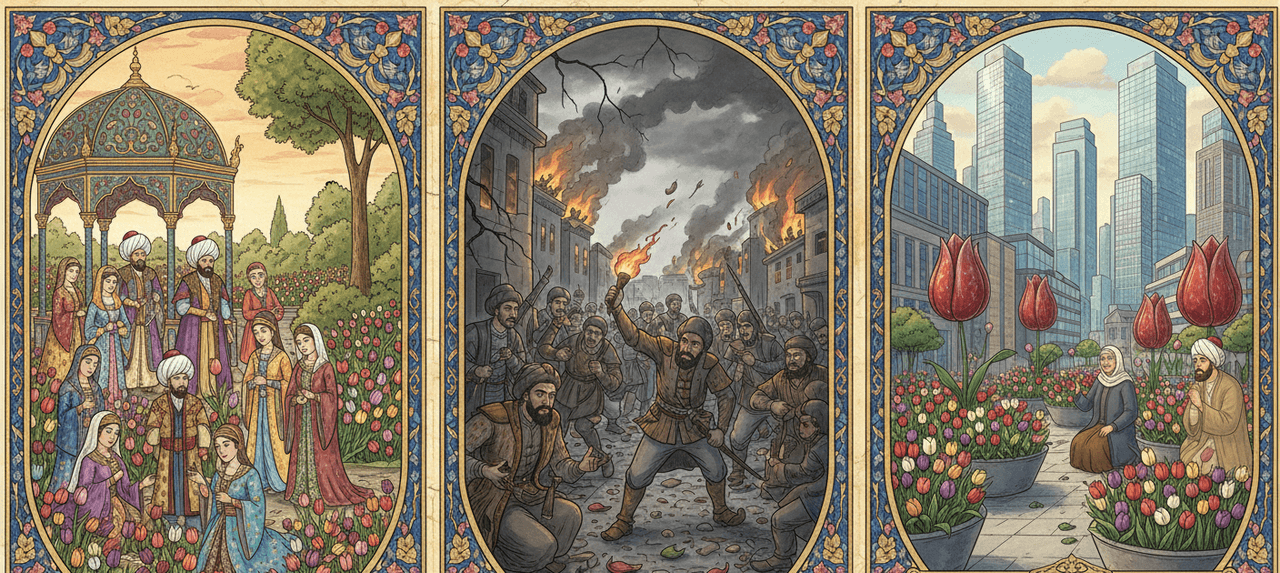
The Tulip Motif from the Ottoman Era to the Present (Generated by Artificial Intelligence)
The meanings attributed to the tulip have diversified over time: sometimes representing the grandeur of a civilization, sometimes the fragility of an era, and sometimes the silent fire within the human soul. Although the social upheavals following the Tulip Era led to the flower being associated with the excesses of that period, the cultural value of the tulip is too profound to be confined within such narrow boundaries. The renewed interest in the tulip today also embodies a longing for this lost refinement.
Tulip figures rising through the concrete of modern cities may not recreate the gardens of the past in exact detail, but they remind us of the ancient relationship between humanity and beauty. Thus, as it did in the past, the tulip continues to speak silently today:
"Beauty demands effort; elegance is born of patience; even the shortest-lived things can become enduring when infused with meaning."
Anadolu Ajansı. "Türklerin dünyaya hediye ettiği hazine: Lale." Accessed December 20, 2025.https://www.aa.com.tr/tr/turkiye/turklerin-dunyaya-hediye-ettigi-hazine-lale-/1109203
Baytop, Turhan, and Cemal Kurnaz. "LÂLE." *TDV İslam Ansiklopedisi*. Accessed December 20, 2025.https://islamansiklopedisi.org.tr/lale#1
Derman, Fatma Çiçek. "LÂLE." *TDV İslam Ansiklopedisi*. Accessed December 20, 2025.https://islamansiklopedisi.org.tr/lale#2-sanat
İstanbul Lale Vakfı. "Geçmişten Günümüze Lale..." *İLAV*. Accessed December 20, 2025.https://www.ilav.org/gecmisten-gunumuze-lale/
İstanbul Lale Vakfı. "Lalenin Türkler İçin Önemi." ILAV. Accessed December 20, 2025.https://www.ilav.org/lalenin-turkler-icin-onemi/
[1]
Turhan Baytop, Cemal Kurnaz ve Fatma Çiçek Derman. "Lale." TDV İslam Ansiklopedisi. erişim 20 Aralık 2025, https://islamansiklopedisi.org.tr/lale#1
[2]
İstanbul Lale Vakfı, "Geçmişten Günümüze Lale..." İLAV, erişim 20 Aralık 2025, https://www.ilav.org/gecmisten-gunumuze-lale/
[3]
Anadolu Ajansı, "Türklerin dünyaya hediye ettiği hazine: Lale," Anadolu Ajansı, erişim 20 Aralık 2025, https://www.aa.com.tr/tr/turkiye/turklerin-dunyaya-hediye-ettigi-hazine-lale-/1109203
[5]
İstanbul Lale Vakfı, "Geçmişten Günümüze Lale..." İLAV,