


This article was automatically translated from the original Turkish version.

Understanding a historical period, process, or historical transformation has long been constructed primarily through events, political ruptures, and prominent individuals. Classical and positivist historiography shaped history largely as a chronological sequence of events centered around “great men”; space, by contrast, occupied a passive background role in these narratives. However, from the second half of the 20th century onward, new historiographical approaches revealed that space is not merely a stage where events occur, but an active component—and in some cases a constitutive element—of historical processes. The Annales School, in particular, emphasized that historical time is not limited to short-term events (événementiel), but must also be analyzed through medium- and long-term structures. Within this framework, space is understood as the tangible arena where social relations, power practices, mentalities, and cultural codes materialize. Fernand Braudel’s conceptualization of the “longue durée” made visible the decisive role of geography and space in historical processes.
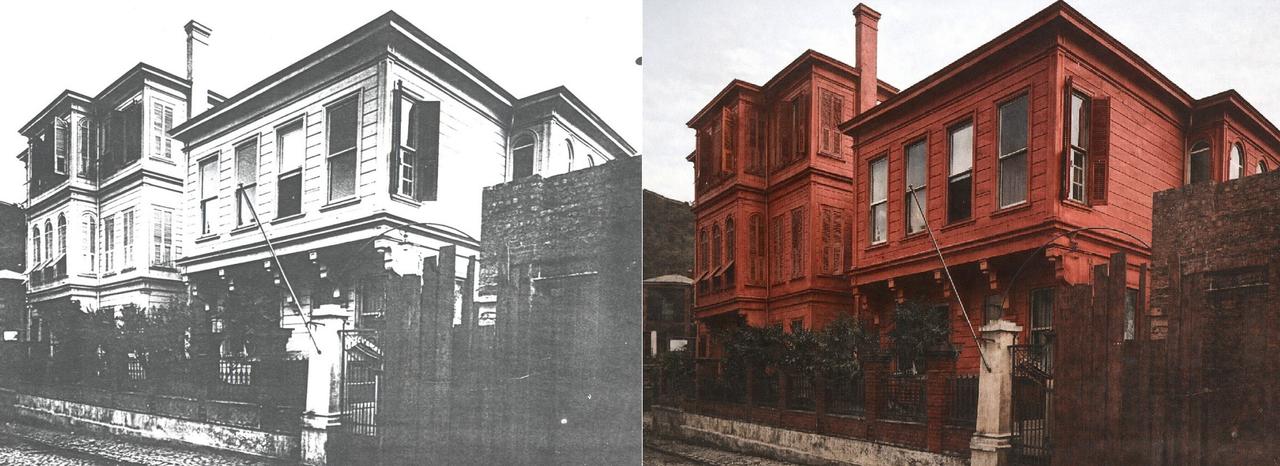
A Photograph of the Building from the 1930s–1940s and Its AI-Colored Version (İBB Cultural Heritage Preservation Directorate)
In this context, historical spaces are not merely physical structures; they are nodal points where power relations crystallize, ideologies spatialize, and collective memory intensifies. Squares, mansions, palaces, public buildings, and urban fabrics hold a central position in historical analysis as sites where political decisions are made, social tensions unfold, and intellectual transformations leave their mark. Therefore, examining the history of a space entails analyzing the political culture, conception of power, and worldview that were produced and redefined within it. This approach is also significant from the perspective of the philosophy of history. Historical continuity and rupture can be read not only through texts and discourses, but also through material culture and spatial transformations. A change in how a building is used signals a transformation in the value system it represents. The same space can be imbued with different ideological meanings in different periods; these meanings sometimes layer over one another to produce a sense of continuity, and at other times reveal radical breaks. This dynamic concretizes history’s non-linear, multi-layered, and contradictory nature.
The Kırmızı Konak (also widely known as Pembe Köşk), located in the old Istanbul neighborhood of Cağaloğlu, offers a striking example in this regard. This structure is not merely a residence or administrative building; it encapsulates the political and ideological transformations spanning the late Ottoman Empire to the Republic. Beginning as a meeting point for Ottoman intellectuals, it evolved into a center where decisions determining the empire’s fate were made; subsequently, it became one of the key spaces where a new political language was produced as the home of the young Republic’s press organ. The same building served as a vessel for different forms of power, governance concepts, and historical memory policies across distinct eras. Thus, studying the Kırmızı Konak does not mean merely writing the history of a single structure. Rather, through this building, one can read regime changes, the spatial organization of power, political decision-making processes, and how collective memory was constructed and erased. The transformations the building underwent over time are not merely a reflection of the historical process from Ottoman Empire to Republic; they are an active part of that process.
In this light, the Kırmızı Konak is not, from a historiographical standpoint, a “supporting element”; it enables us to understand historical change itself as a key space. The disappearance of space is not merely a physical loss, but also the erasure of historical memory and a multi-layered past. This situation necessitates a critical reassessment of how Türkiye relates to its historical structures and engages with its past.
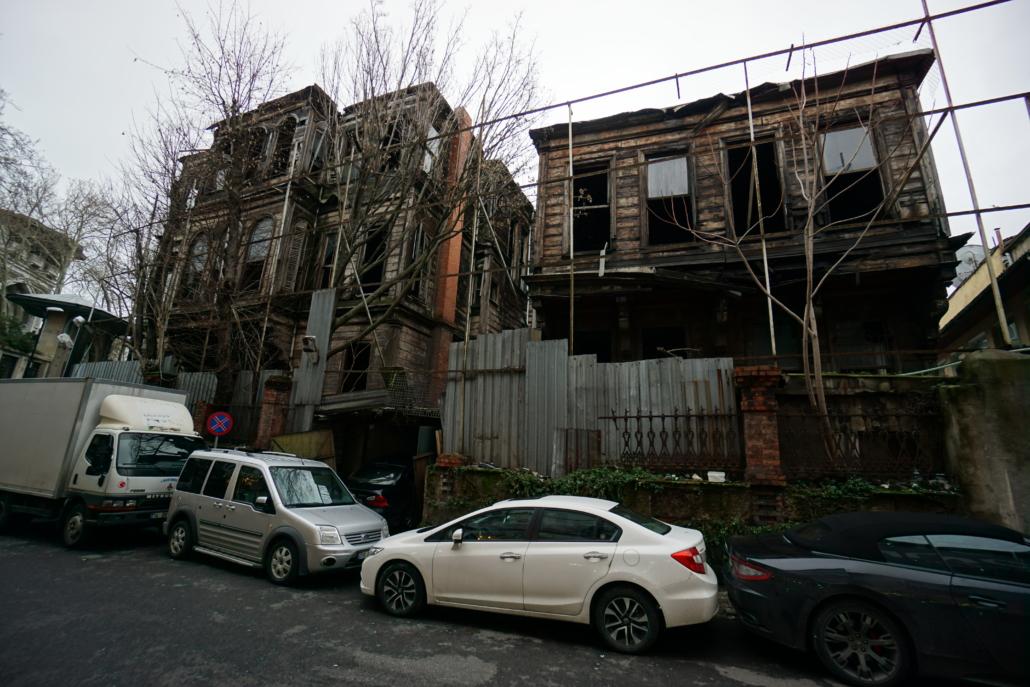
The Kırmızı Konak in Ruins Before Its Demolition – 2017 (İBB Cultural Heritage Preservation Directorate)
Regarding the name of this structure, now entirely vanished, largely forgotten, and demolished, two primary confusions persist: “red or pink?” and “konak or köşk?” During research, nearly every combination of these terms appears across various sources and media.
The color debate is not a simple matter of visual perception; it exemplifies how material culture over time reshapes naming conventions. Today, the building is most commonly referred to as “Pembe Konak” or “Pembe Köşk,” yet “Kırmızı Konak/Köşk” remains widely used. This duality does not stem from different observers seeing different colors simultaneously, but from the wood’s paint fading over a century, shifting from red to pink. Therefore, “Kırmızı Konak” appears historically accurate as the original designation; conversely, the use of “pink” reflects a contemporary memory attuned to the building’s later hue. The second question is clearer: this structure is a “konak,” not a “köşk.” A “köşk” typically evokes a smaller structure situated within a garden or open area, often following a different architectural logic and sometimes functioning as an annex to a palace. Here, however, we are dealing with an independent residence not attached to any other major building. Thus, the historically accurate designation is “Kırmızı Konak.”
Just as the building is named by its color, it is also named after its occupant during a particular era: “Münif Paşa Konağı.” The building’s visibility on the historical stage begins with Münif Paşa (1830–1910), a prominent intellectual and statesman of the late Ottoman period. Münif Paşa is described as a “hezârfen” figure—someone deeply engaged with literature, ideas, and science, in addition to his state service. He purchased the mansion in the early 1860s and renovated it with various modifications. Due to its architectural style, color, and shutters, it was referred to during this period as the “Frenk Evi.” In the second half of the 19th century, mansions were not only residences but also served as spaces for education and intellectual exchange. Münif Paşa Konağı is said to have hosted both local and foreign thinkers. Münif Paşa’s long diplomatic postings abroad and the death of his daughter contributed to a more “reclusive” lifestyle during this period. After the proclamation of the Constitution in 1908, the building’s association with public acclaim for the Meclis and Münif Paşa’s clear support for the 1908 Revolution links this phase to intellectual continuity and reformist expectations. Paşa died shortly after the revolution.
The mansion, once a relatively quiet space for Münif Paşa, underwent a sharp functional shift in the final years of the empire, becoming a center of administration and power: the Istanbul headquarters (Merkez-i Umûmi) of the Committee of Union and Progress. The exact sequence of ownership transfer—from Münif Paşa to Marshal Kâzım Paşa (1855–1936), then to Ragıp Paşa, and finally to the Committee—is unclear, and precise dates are difficult to establish. It is emphasized that the Committee’s headquarters before the 1908 Revolution was in Thessaloniki, as its organizational and operational base lay in the Macedonian and Rumelian provinces. The primary reason the headquarters was not moved to Istanbul immediately after the 1908 Revolution was security and secrecy. This is corroborated by Kâzım Karabekir’s memoirs, which mention the Istanbul headquarters being kept hidden. The Second Constitutional Monarchy was proclaimed in 1908; following the 31 March Incident in 1909, Sultan Abdülhamid II was deposed; yet the Committee’s central leadership remained in Thessaloniki.
This situation became a target of criticism by opposition circles: the fact that the Committee, officially a political party, had not relocated its headquarters to Istanbul was used by opponents to argue that the empire’s fate was being determined by “unofficial individuals.” With the outbreak of the Balkan Wars, the headquarters was finally moved to Istanbul, and the Kırmızı Konak became the headquarters of the government party ruling the empire. During this phase, the building is portrayed as the site where decisions “still debated a century later” were made. It is claimed that the 1913 Babıâli Raid was organized here and that the movement toward Babıâli originated from this location; that the decision to enter World War I was made here; and that the collapse of an empire was directed from this mansion. The building, once a gathering place for intellectuals during Münif Paşa’s time, now became the center where decisions for one of history’s largest wars were made. It is also stated that the decision and administration of the 1915 Armenian deportation were made here—a matter that remains a major point of contention in Turkish politics to this day.
After the war, the party dissolved following Talat Paşa’s resignation in 1918; the building passed to the Teceddüt Fırkası, viewed as the continuation of the Committee. However, shortly afterward, the new ruling party, the Freedom and Accord Party, accused it of being the Committee’s continuation, shut it down, and looted it. Following this brief and turbulent period, the new owner of the Kırmızı Konak became the Cumhuriyet newspaper, which would assume the role of the new regime’s spokesperson in Istanbul.
The Cumhuriyet newspaper was founded in Istanbul in 1924 by journalists known for their support of the National Struggle. According to Aysun Köktener’s claim, the Kırmızı Konak, the newspaper’s first building, was gifted to Yunus Nadi by Mustafa Kemal himself. With this gift, the mansion’s association with Cumhuriyet continued for approximately 80 years. During this period, it is noted that opposition publications were active in Istanbul’s press, and claims were made that Mustafa Kemal was establishing a dictatorship. Ekrem Karaca recounts an anecdote in which Mustafa Kemal links the Kırmızı Konak to Zekeriya (then Sertel) and describes his vision: that a newspaper be established at the heart of Babıâli to combat enemies of the Republic and supporters of the Caliphate; that Hakimiyet-i Milliye and Yeni Gün in Anatolia had fulfilled their roles; that the new newspaper’s name would be “Cumhuriyet,” fully aligned with the regime; and that its headquarters would be the former general headquarters of the Committee of Union and Progress—the Kırmızı Konak. The text notes an affirmative response: “—Yes, Paşam…”【1】
Thus, a building that had once served as the headquarters of the ruling party became the press center of the new regime. This transformation is interpreted as an attempt by Mustafa Kemal to neutralize his opponents and prevent any possible resurgence of the Committee of Union and Progress. However, it is noted that during the newspaper’s period, the building, once the center of national governance and critical decision-making in the early 20th century, lost its significance and gradually fell into ruin.
The final phase of the Kırmızı Konak illustrates how the failure to preserve a space’s historical weight transforms “change” into “loss.” One might expect Turkey’s venerable and significant newspaper, Cumhuriyet, to have valued its cultural heritage more, yet the mansion was instead neglected and even used for a time as a magazine storage facility. The gradual deterioration and lack of awareness regarding the value of many Ottoman-era wooden structures provide a broader context here. Cumhuriyet used the mansion as an office for approximately 50 years; however, when the building became inadequate for its needs, the newspaper relocated its operations to a newer, larger building nearby. With this move, the mansion was abandoned and began its descent toward demolition. In the early 2000s, the newspaper moved to its current building in Şişli. Hasan Cemal describes the building’s condition as follows: when he joined Cumhuriyet in 1973, he worked there for a time before moving to a new building in the same courtyard; thus, the “Pembe Konak” was left to its fate and was slated for sale in 2012 to become a boutique hotel. Reports indicate that the building underwent multiple renovations, yet warnings were ignored. On 10 September 1977, the Board of Monuments requested, via document no. 1024, that the owners submit a survey and restoration plan; a similar request was repeated ten years later, yet both were again disregarded. Despite all warnings and reports, the building was never restored.
The building was later purchased for conversion into a boutique hotel, but the acquiring company allegedly failed to recognize its importance and undertook no restoration work. The old wooden structure could no longer withstand the elements and collapsed in a fire. Today, curious observers cannot even see the remnants of this building, once described as European-style, because a parking lot now occupies its site. The structure has been entirely erased. Nevertheless, according to the account of an anonymous employee working in the office building across the street, in early 2019 the wooden components of the mansion were carefully dismantled and relocated elsewhere. It is noted that such methods are commonly used in wooden structure restorations, making this account plausible. Thus, the hope is expressed that the Kırmızı Konak, with its high historical and symbolic value, may one day be reconstructed faithfully. Another significant “change” highlighted in the text is this: several months after the building’s demolition, news reports appeared; Cumhuriyet even published an article criticizing the demolition—yet it made no mention of its own historical connection to the structure or its role in its destruction. This silence is not an overlooked detail, but a sign of how memory is selectively constructed.
As the building’s function changed, so too did the symbolic values and worldviews it represented. Once the home of Ottoman intellectuals, it became the epicenter of turbulent late Ottoman politics; then, with the new Republic, it became Istanbul’s press hub. From the multi-party period onward, the newspaper’s oppositional stance continued for many years. This demonstrates not only the functional continuity of the space—its constant engagement with politics—but also the transformation of the ideological world it represented.
The example of Hasan Cemal is especially striking in concretizing this transformation, for here we see not only a shift in institutional orientation but also a generational difference in mindset within the same family. In March 1981, Hasan Cemal was appointed general director of Cumhuriyet by Nadir Nadi, son of the newspaper’s founder Yunus Nadi. Hasan Cemal is the grandson of Cemal Paşa, one of the most important leaders of the Committee of Union and Progress. In other words, while Cemal Paşa’s generation held decisive positions in this very mansion when critical decisions about ruling the empire were made, now his grandson would manage a newspaper from the same space. Yet, according to the text, the grandson’s views are far from those of his grandfather.
Hasan Cemal recounts this intergenerational tension and transformation through a memory: during his time at Cumhuriyet, colleagues joked with him:
“Your grandfather, Paşa, used the basement of the Pembe Konak during the Committee of Union and Progress era as a prison for regime opponents.”
The text also quotes the murmured comment made by Nadir Nadi on the day he appointed Hasan Cemal as general director: “The grandson of Cemal Paşa is now the general director of Cumhuriyet! How interesting…”
The text sharpens this ideological rupture with another example: Cemal Paşa is remembered as one of the decision-makers behind the 1915 Armenian deportation, while his grandson Hasan Cemal authored a book acknowledging the so-called Armenian “genocide” and offering an apology. Thus, the transformation in the worldview of the Kırmızı Konak’s users becomes a concrete narrative through the space itself. Additionally, the text adds that during the founding of Cumhuriyet, the newspaper was seized from an old Armenian printing house, “Matosyan.” This detail further embeds the discussion of appropriation practices during that era and the shifts or continuities in the newspaper’s editorial mindset within an ideological framework.
The exact date of the Kırmızı Konak’s construction remains unknown. However, its historical journey begins with Münif Paşa; during the Committee of Union and Progress era, it became one of the key centers witnessing and directing the empire’s collapse; with the early Republic, it became the press hub of the new regime in Istanbul. From the multi-party period onward, the newspaper’s oppositional stance persisted for many years. In contrast, under the pretext of adapting to contemporary conditions and cost concerns, the building was abandoned to its fate; lacking adequate protection, it collapsed in a fire, and today its site is remembered only as a parking lot.
The story of the mansion illustrates how the values and ideas it represented transformed with each change in ownership and use. While there is an expectation in Türkiye that historical and cultural structures should be recognized for their true value, the Kırmızı Konak remains an example of how this expectation has been deferred and how the material foundation of memory has been lost.
Ahunbay, Zeynep. Tarihi Çevre Koruma ve Restorasyon. Istanbul: YEM Yayın. 1999.
Aydemir, Şevket Süreyya. “The Tale of Pink Mansion (Pembe Konak)”. Cumhuriyet. May 13. 1974.
Bayazoğlu, Ümit. “Güle Güle Pembe Konak”. Chronicle Dergisi, April 25, 2013.
Budak, Ali. Batılılaşma Sürecinde Çok Yönlü Bir Osmanlı Aydını: Münif Paşa. İstanbul: Bilgi Kütür Sanat. 2012.
Cemal, Hasan. 1915: Ermeni Soykırımı. Istanbul: Everest Yayınları. 2012.
Denknalbant, Ayşe. “Köşk”. TDV İslâm Ansiklopedisi, vol. 26. Ankara: TDV Yayınları. 2002.
Diyarbekirli, Nejat. “Türk Sanatının Büyük Kaybı: Celal Esad Arseven (1875–13.XI.1971).” *Türk Kültürü* 10, no. 113 (1972): 31–42. Ankara: Türk Kültürünü Araştırma Enstitüsü. Accessed December 24, 2025.https://makale.isam.org.tr/items/7b3e3334-21d1-4279-a879-ffb9bd753eb4.
Istanbul Metropolitan Municipality Cultural Heritage. "Cağaloğlu Pembe Konak." Accessed December 24, 2025.https://kulturelmiras.ibb.istanbul/cagaloglu-pembe-konak/.
Karaca, Emin. Cumhuriyet Olayı. Istanbul: Altın Kitaplar Yayınevi. 1994.
Köktener, Aysun. Bir Gazetenin Tarihi: Cumhuriyet. Istanbul: Yapı Kredi Yayınları. 2005.
Özgül, M. Kayahan. Münif Paşa. Istanbul: Elips Kitap. 2005.
[1]
Emin Karaca, Cumhuriyet Olayı, (İstanbul: Altın Kitaplar Yayınevi, 1994), s. 30.
Naming Debate: Red or Pink? Konak or Köşk?
The Münif Paşa Era: Intellectual Continuity
The Committee of Union and Progress Era: Transformation into a Center of Power
The Cumhuriyet Newspaper Era: New Regime, Old Space
Neglect, Abandonment, and Demolition: The Threshold Where Continuity Becomes Loss
Symbolic Continuity and Rupture: From Cemal Paşa to Hasan Cemal
In Conclusion