


This article was automatically translated from the original Turkish version.
+1 More
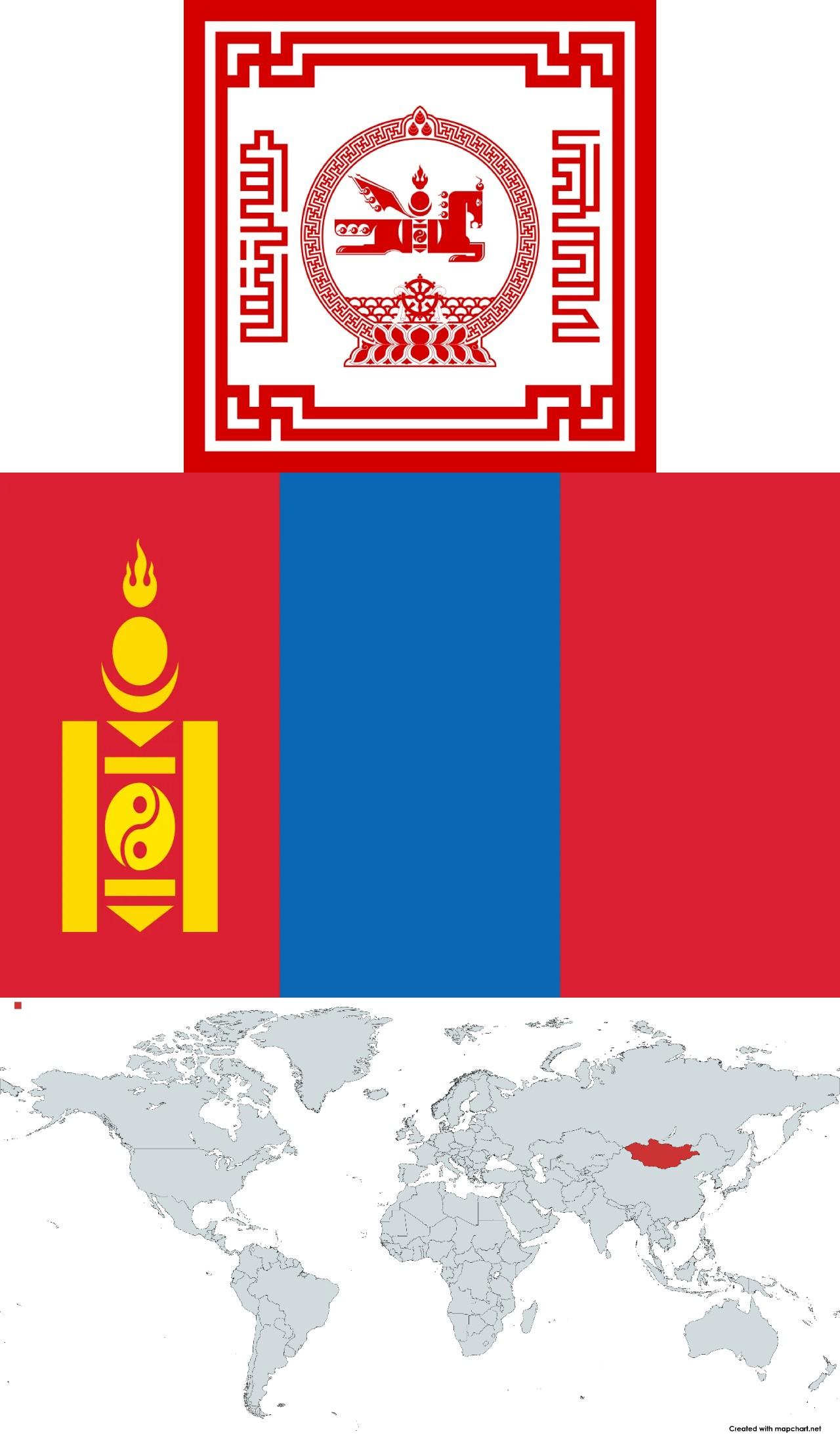
Mongolia
Form of Government | Republic Governed by a Semi-Presidential System | ||||||||
|---|---|---|---|---|---|---|---|---|---|
Date of Independence | 12 Şubat 1992 | ||||||||
Capital | Ulan Batur | ||||||||
Head of State | Ukhnaagiin Khürelsükh | ||||||||
Official Languages | Mongolian | ||||||||
Official Scripts | Mongolian Alphabet Cyrillic | ||||||||
National Day | July 11 | ||||||||
Area | 1,564,116 km² | ||||||||
Total Population | 3.5 Million | ||||||||
Climate | Cold and Arid Desert Climate | ||||||||
GDP (Nominal) | 25.8 Billion US Dollars | ||||||||
GDP per Capita | 7,200 US Dollars | ||||||||
Ethnic Groups | 95.6% Mongol, 3.8% Kazakh, 0.6% Others | ||||||||
Religious Composition | 40.6% Non-religious 3.2% Islamic 2.5% Shamanist 0.7% Others 1.3% Christian 51.7% Buddhist | ||||||||
Telephone Code | +976 | ||||||||
Internet Domain Code | .mn | ||||||||
Mongolia is a vast landlocked steppe country located in the interior of East Asia. Throughout history it has been one of the political and cultural centers of Central Asia. Bordered by Russia to the north and China to the south this country with an area of 1,564,116 square kilometers ranks among the world’s largest landlocked nations. With a population of around 3.5 million it is also the least densely populated country on Earth. Most of its territory has been inhabited for thousands of years by nomadic pastoral communities. The capital Ulaanbaatar serves as the economic cultural and political center of Mongolia hosting nearly half of the country’s population.
Mongolia is known on one hand for its historical legacy particularly the vast empire established under Genghis Khan in the 13th century that reshaped Eurasian history. On the other hand it transitioned through a socialist period under the influence of the Soviet Union and became a multi-party democracy beginning in 1990. Today a Buddhist culture dominates the country; however modern Mongolian society is seeking a dynamic balance between its historical nomadic traditions and the urbanization driven by a market economy.
Its economy is largely based on mining; copper coal gold and rare earth elements are the country’s main export items. Despite its rich natural resources geographic isolation harsh climatic conditions and inadequate infrastructure limit economic growth. Nevertheless Mongolia remains one of Asia’s strategically important landlocked countries in terms of energy and mineral resources.
Mongolia’s national anthem is titled “Монгол Улсын төрийн дуулал” (Mongol Ulsyn Töriyn Duulal) which can be translated into English as “The National Anthem of the Mongolian State.” Adopted in 1950 the lyrics glorify the nation’s independence and unity the heroism of its ancestors and the sanctity of the homeland known as the “Land of the Eternal Blue Sky.” The music was composed by Bilegiin Damdinsüren Luvsanjambyn Mördorj and Norovyn Byambasüren while the lyrics were written by Tsendiin Damdinsüren. In 1991 socialist elements were removed and the anthem assumed its current form. It is sung at state ceremonies schools and official gatherings as one of the most important symbols of national identity.
Mongolia National Anthem (Youtube)
Archaeological findings indicate that human settlement in present-day Mongolia dates back approximately 20,000 years to the Upper Paleolithic period. The cave paintings at Khoit Tsenkher in the Hovd region reflect the artistic level of this era with vivid depictions of animals such as mammoths ostriches and two-humped camels. During the Bronze and Iron Ages the region became a vital part of the Eurasian steppe culture. In the 3rd century BCE the Xiongnu (Hiung-nu) Confederation emerged as a powerful political entity threatening China’s northern borders; the construction of the Great Wall of China was largely motivated by defense against this threat.
Following the Xiongnu the Xianbei Rouran Göktürk and Uyghur Khaganates ruled these lands. Each contributed to the steppe imperial tradition by bequeathing to later states the kurultai system hierarchical military organization and nomadic economy. This cultural continuity despite the westward shift of political centers in Central Asia established Mongolia as the cradle of steppe empires.
The Orhon Inscriptions are key sources for Central Asia in linguistic political and ideological terms. Because they directly convey Turkic history the legitimacy of khanship nomadic law and warrior ethics the Orhon texts are essential for understanding the geographical boundaries of the “Turk” identity prior to the Mongol era. Archaeological excavations in the region together with these inscriptions horse burials bronze artifacts horse sacrifices and rock art document the continuity of Turkic and Mongolic interactions.
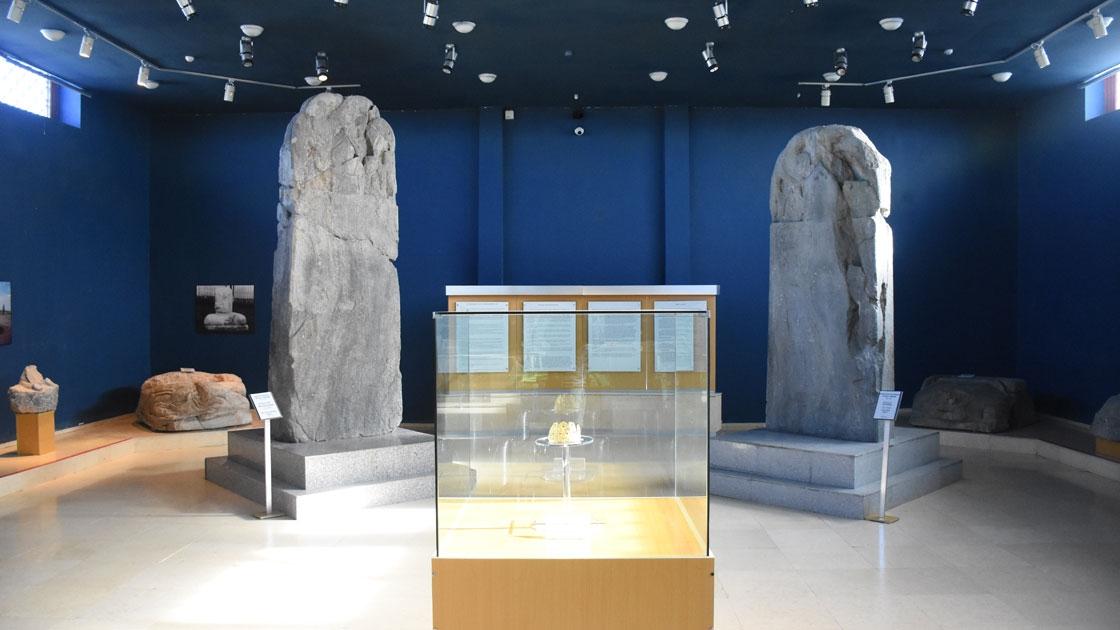
Orhon Inscriptions (Anadolu Ajansı)
In the late 12th century a tribal leader named Temüjin united disparate clans and in 1206 assumed the title Genghis Khan founding the Yekhe Monggol Ulus or Great Mongol Nation. Under his leadership the Mongol Empire became the largest contiguous land empire in history. Across territories stretching from China to Central Europe a period of commercial and cultural stability known as the “Pax Mongolica” emerged. However the empire’s division into four khanates gradually eroded central authority. Temüjin’s unification of the tribes under a single center transformed the Mongol steppe tradition into an empire. Genghis Khan’s implementation of centralized discipline a meritocratic command system cavalry tactics (such as rapid maneuvering and feigned retreats) and an organized signal/intelligence network elevated the Mongol army beyond the capabilities of other powers of the era. This military-technical superiority did not merely control regions; it triggered major political transformations across Transoxiana the Middle East and China.
During the Mongol campaigns the Kipchak and other western steppe communities either resisted or formed alliances with the Mongols.【1】 The Kuman (Kipchak) Confederation that emerged in the western steppes interacted with Russian principalities as well as the Hungarian and Byzantine worlds. As one of the most powerful cavalry confederations before the Mongols the Kipchaks became both a commercial and military actor; large groups fled westward under subsequent Mongol pressure permanently altering the demographic and military balance of Eastern Europe. Traces of these migrations are visible in the integration of Kipchak elements into Russian Hungarian and Balkan societies.
In the post-Genghis era commanders such as Subutai and Batu advanced into Eastern Europe targeting Russian principalities Hungary and Poland. As a result of these western campaigns the Golden Horde was established and became the master of the Russian steppes. This khanate long served as an intermediary force in economic and military exchanges between Europe and Asia. The existence of the Golden Horde reshaped Eastern European history transforming tribal organization into feudal relations and military tactics into tax systems.
The southern front of the Mongol campaigns led to the establishment of the Ilkhanate in the Middle East and Iran while the eastern front under Kublai Khan resulted in the founding of the Yuan Dynasty in China. These major political fractures prompted a global reorganization of local governance models trade routes (including the security and revival of the Silk Road) and cultural exchanges. Although Mongol rule brought destruction in the short term it long-term facilitated increased trade and information flow establishing the “Pax Mongolica.”
The Mongol invasions caused destruction of cities population movements and economic disruptions; however rural centers and nomadic economies strengthened. The Mongols implemented a flexible taxation and obedience system that incorporated local elites into their administration thereby facilitating imperial expansion and reducing governance costs. Culturally the Mongol period accelerated religious and technological transfers: for example it laid the groundwork for the reconfiguration of Islam Christianity and Buddhism across different geographies. Writing language and administrative practices changed.
By the end of the 14th century as the Yuan Dynasty withdrew from China the Mongol core returned north initiating the period known as the “Northern Yuan.” By the 17th century the Manchu Qing Dynasty brought the Mongol tribes under hierarchical control; Qing administration integrated Mongolia’s political fabric into the Chinese imperial order for over two centuries.
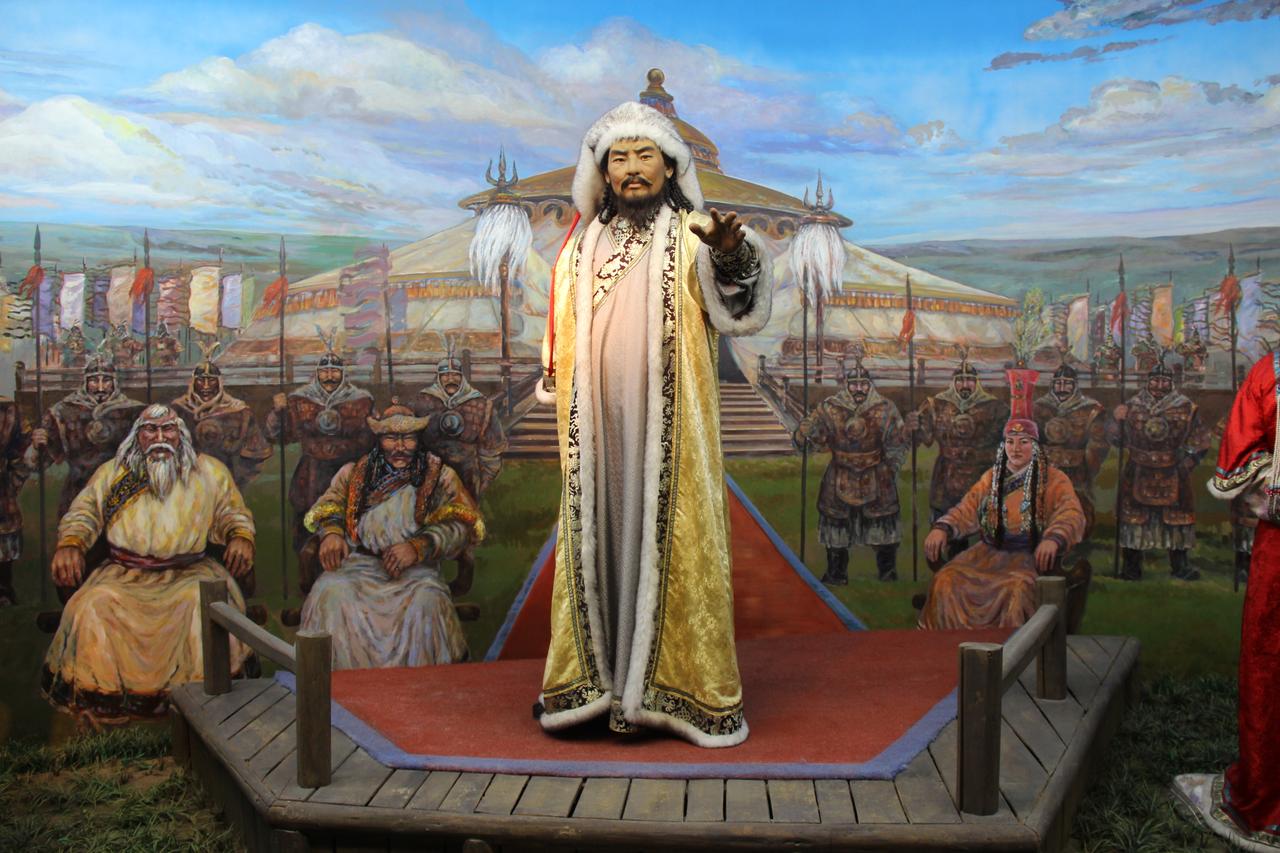
Depiction of Genghis Khan and the Kurultai (Flickr)
With the collapse of the Qing Dynasty in 1911 the Mongols declared their independence; however prolonged instability followed due to competition between Chinese and Russian influence. In 1921 a popular revolution backed by the Soviet Union ended the Bogd Khan regime and in 1924 the Mongolian People’s Republic was established.
During the socialist period modeled on the Soviet Union the country remained isolated religious institutions were suppressed and nomadic lifestyles were forcibly converted to sedentary living. The democratic revolution beginning in 1990 introduced a multi-party system and a market economy. The 1992 Constitution officially renamed the country “Mongolia.” Today Mongolia maintains its democratic system and follows an independent and neutral course amid Asia’s rapidly shifting geopolitical balances.
Mongolia is a vast landlocked country located at the center of the Asian continent. It lies in the interior of East Asia between latitudes 41° and 52° N and longitudes 87° and 120° E. With an area of 1,564,116 square kilometers it is the 18th largest country in the world and the second largest landlocked country after Kazakhstan. The territory extends 2,400 kilometers from west to east and 1,250 kilometers from north to south. Its average elevation of 1,580 meters makes it one of the world’s highest landlocked countries. Geographically the north is dominated by forested mountainous regions the center by vast grassland steppes and the south by arid plains dominated by the Gobi Desert.
The majority of its land is unsuitable for agriculture; however pastures are of critical importance for the pastoral economy. The country’s natural environment climate and nomadic culture have mutually shaped one another. Known as the “Land of the Eternal Blue Sky” Mongolia with an average of 250 sunny days per year is one of Asia’s sunniest countries.
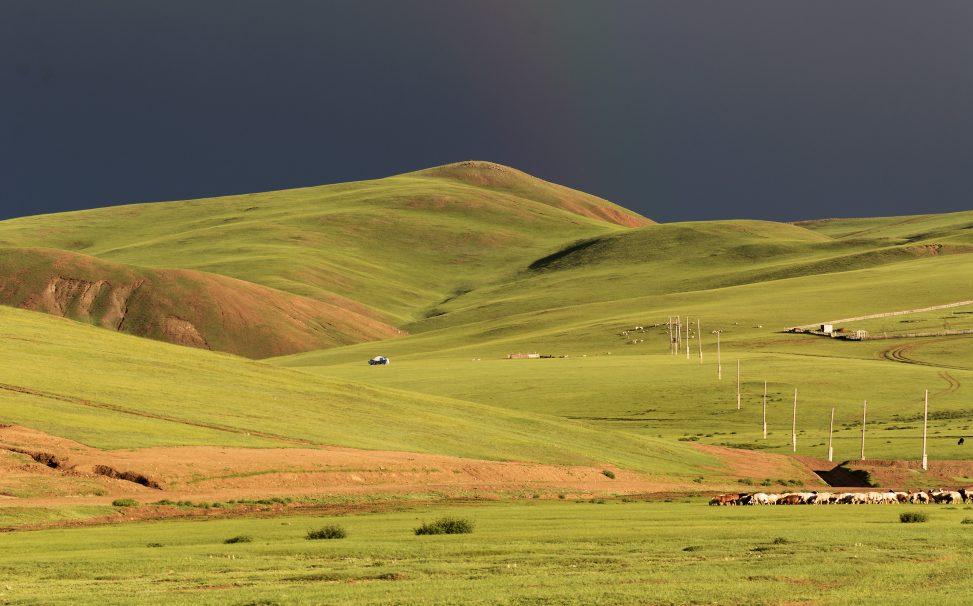
Green Steppe Hills in Mongolia (Libreshot)
Mongolia is bordered by the Russian Federation to the north and the People’s Republic of China to the south east and west. At its westernmost point it lies only 36 kilometers from Kazakhstan making the country nearly quadruple-bound. The total border length is 8,220 kilometers: 4,677 kilometers with China and 3,543 kilometers with Russia. Lacking access to the sea Mongolia is heavily dependent on Chinese ports for international trade. This geopolitical position has historically rendered Mongolia a buffer zone between two major powers. The most important border crossings are Zamyn-Üüd (on the Inner Mongolia–Erenhot route) toward China and Sühbaatar–Kyakhta toward Russia.
One third of the country’s terrain consists of mountainous regions. In the west the Altai Mountains are among the highest massifs in Central Asia; Khüiten Peak at 4,374 meters is the country’s highest point. In the north the Sayan and Khentei ranges form a natural transition zone between Siberian forests and the steppe. The Khentei Mountains are considered a national symbol both for their ecological diversity and because they are the birthplace of Genghis Khan. The Khangai Mountains lie in the center and form the country’s hydrological spine; they are the source of major rivers.
The central and eastern parts of Mongolia consist of vast plateaus. The Orhon Selenge and Tuul valleys are the country’s most productive areas both historically and agriculturally. The Dornogovi and Dundgovi regions north of the Gobi are known as semi-arid steppe plains and serve as the primary zone for nomadic herding. The Orhon Valley contains the ruins of Karakorum the 13th-century capital and is listed as a UNESCO World Heritage Site.
Mongolia has over 4,000 lakes and more than 3,000 rivers and streams most of which belong to closed basin systems. The longest river is the Orhon River at 992 kilometers. The Selenge River flows into Lake Baikal providing natural drainage in the north. The Kherlen Onon and Tuul rivers water Central and Eastern Mongolia. The largest lake is Khövsgöl Nuur known as “Mongolia’s Blue” with a surface area of 2,760 square kilometers. The lakes Uvs Buir and Khar Us in the Gobi are shallow and saline ecosystems. These water sources are natural reservoirs sustaining the country’s pastoral life despite climatic extremes.
Mongolia has a harsh continental climate. Winters are long dry and freezing with temperatures dropping as low as -40°C in the north. Summers are short and dry; daytime temperatures can reach 30°C while nights fall below 10°C. The annual average temperature is around -1.3°C. Annual precipitation ranges from 300–350 mm in the north to under 100 mm near the Gobi Desert. During winter months “zud” storms of sudden freezing and heavy snowfall can kill millions of livestock. These harsh conditions are the primary reason the Mongolian society has preserved its nomadic way of life throughout history.
The economy is heavily based on mining and raw material exports. Copper coal gold uranium and rare earth elements account for nearly 90% of total exports. Agriculture and livestock contribute approximately 10% to GDP; one third of the population still depends on pastoral economics.
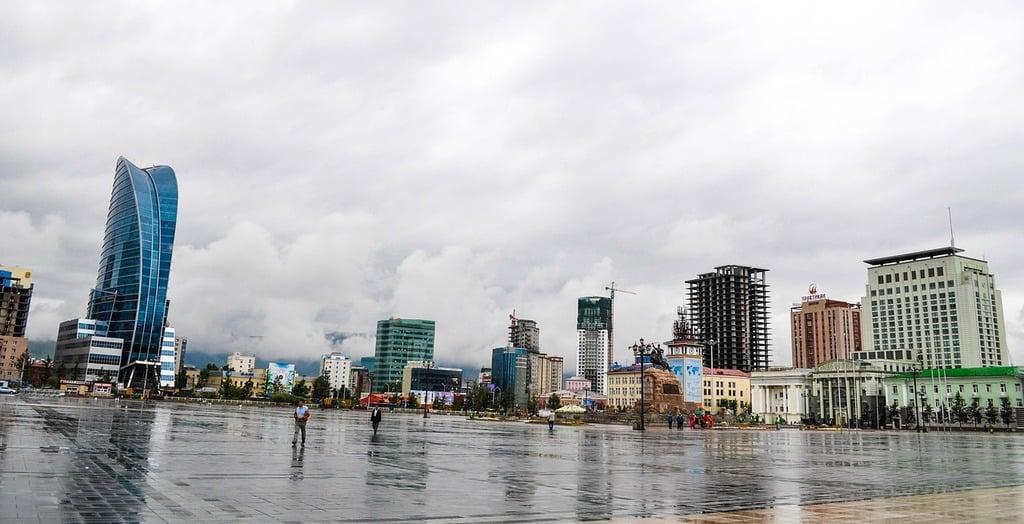
Ulaanbaatar City Center (Picryl)
The services sector is growing particularly in finance transportation and tourism. Industry is dominated by mining energy and unprocessed metal exports. Food processing wool and cashmere production remain traditional sectors.
China is Mongolia’s largest trading partner accounting for approximately 80% of exports. Major exports include copper ore coal crude oil and gold. Imports are dominated by machinery fuel construction materials and food products. Russia South Korea and Japan are other important trade partners. As of 2025 Mongolia’s total foreign trade volume stands at around $22 billion USD.
The majority of foreign investment is concentrated in mining and energy. One of the largest projects is the Oyu Tolgoi copper-gold mine operated by Rio Tinto which alone contributes approximately 30% to the national economy. In 2023 the Mongolian Government enacted the “Foreign Investor Protection Law” to improve the investment climate. Nevertheless infrastructure deficiencies bureaucracy and climatic challenges remain significant risks for investors.
Energy production is primarily coal-based with 90% of electricity generated by thermal power plants. Renewable energy particularly wind and solar has been developing in recent years; the Sainshand and Tsetsii wind farms are pioneering projects in this field. The railway network spans approximately 1,800 kilometers and is largely connected to Russian and Chinese lines. Road infrastructure is improving; however steppe roads remain common in rural areas. The “Steppe Road” and “China–Mongolia–Russia Economic Corridor” projects are strategically important for the country’s future logistical integration.
Mongolia’s population as of 2024 is 3,504,741. 50.7% of the population is female and 49.3% male. The population growth rate is around 1.2%. Life expectancy is 75 years for women and 67 years for men. The youth population under 15 years constitutes 28% while the elderly population over 65 is 5%. These figures indicate that Mongolia has a young population structure. The total fertility rate stands at 2.6 children per woman.
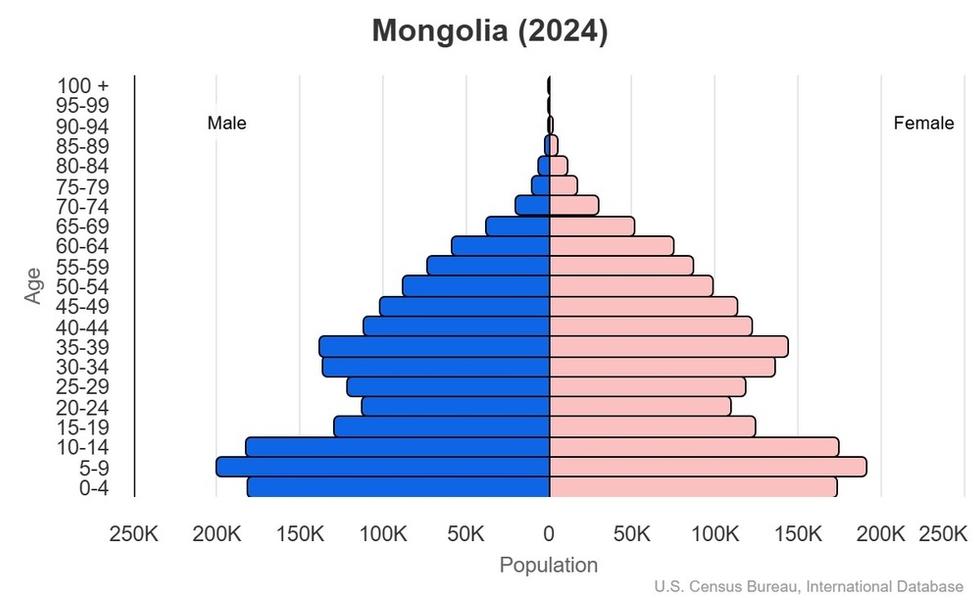
Population Distribution in Mongolia (CIA World Factbook)
Mongolia is one of the world’s least densely populated countries with an average of 2.2 people per square kilometer. Approximately half the population is concentrated in the capital Ulaanbaatar and its surroundings. Ulaanbaatar as the country’s economic cultural and educational hub hosts over 1.6 million people. Other major cities include Erdenet Darkhan Choibalsan and Mörön. The urbanization rate is 71% and urban infrastructure is strained particularly during winter months due to severe air pollution and housing shortages. A large portion of the rural population continues to rely on semi-nomadic herding.
95.6% of the population is ethnically Mongol. The largest subgroup within this group is the Khalkha Mongols (86%). The remainder consists of subgroups such as the Buryats Darhad and Oirats. The Kazakhs living in the western regions of Bayan-Ölgii and Khovd constitute 3.8% of the population and are the country’s largest ethnic minority. Smaller communities of Tuvans Russians and Chinese also exist. Ethnic diversity is maintained peacefully across the country. Constitutional guarantees protect the rights of ethnic minorities to education in their native languages.
Religious life in Mongolia is centered on Buddhism. According to the 2020 census 51.7% of the population identifies as Buddhist 40.6% as non-religious 3.2% as Muslim 2.5% as Shamanist and 1.3% as Christian. Buddhism spread primarily through the Tibetan-origin Gelug school. Islam is practiced among Kazakh minorities and Shamanism persists in small northern communities. Although religion was banned during the Soviet era monasteries reopened after 1990 and Buddhist belief has regained symbolic importance in public life.
Mongolia has one of the highest educational achievement rates in Central Asia. The literacy rate is 99%. The education system is based on a 12-year basic education. The National University of Mongolia and the University of Science and Technology in Ulaanbaatar are the country’s academic centers. Since the 2020s English has become a mandatory second foreign language in primary and secondary education. Influenced by the Soviet era engineering and natural sciences were prioritized; recently there has been growing emphasis on economics law and environmental sciences.
Due to economic hardship harsh climatic conditions and difficulties in rural life some Mongolians migrate temporarily as laborers particularly to South Korea Japan and European countries. As of 2023 approximately 200,000 Mongolians live abroad. Internal migration from rural areas to cities is also intense contributing to rapid growth in Ulaanbaatar and increasing pressure on its infrastructure. The government is attempting to balance internal migration through investments in agriculture livestock and renewable energy in rural regions.
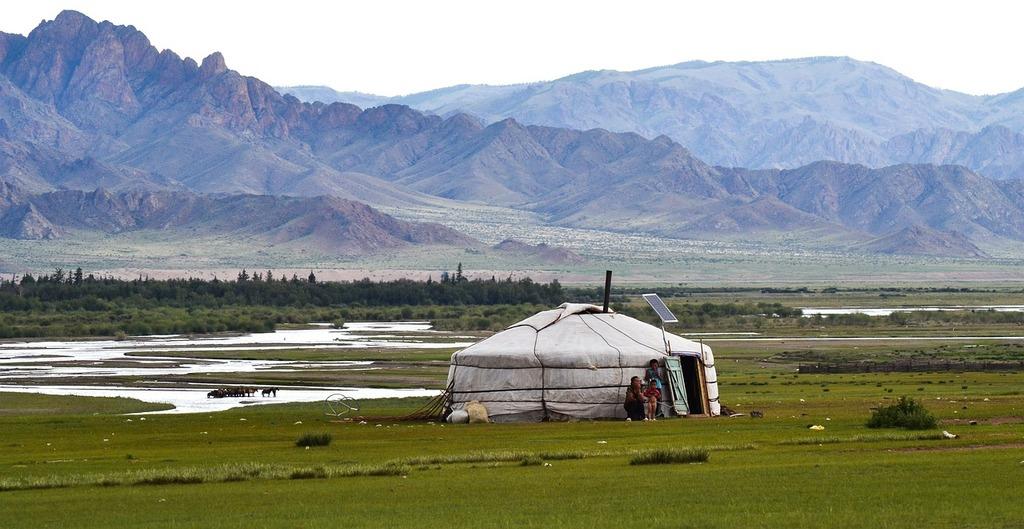
Yurt Associated with Mongolian Culture (Picryl)
Mongolia’s most important cultural heritage site is the Orhon Valley Cultural Landscape. Designated a UNESCO World Heritage Site in 2004 it holds a special place in the shared memory of Turkic and Mongolian history. The Orhon Inscriptions (Kül Tigin Bilge Kağan and Tonyukuk Monuments) located in the valley are archaeological artifacts that document not only the origins of the Turkic language and state tradition but also the roots of all Eurasian steppe cultures. The area around the inscriptions is now organized as an open-air museum and attracts approximately 50,000 visitors annually.
Additionally the ancient capital Karakorum founded by Genghis Khan in the 13th century and the nearby Erdene Zuu Monastery are among the most significant examples of Buddhist and imperial-era architecture. Karakorum is not merely a historical symbol but also an important emblem in the reconstruction of Mongolian identity.
The Orhon Inscriptions are not merely archaeological relics but also a strategic asset in Mongolia’s “international cultural heritage diplomacy.” Recognized as the spiritual heritage of the Turkic world these inscriptions have strengthened Mongolia’s cultural tourism at the regional level. Turkey and Mongolia have since the 2000s implemented restoration environmental improvement and visitor center projects in the Orhon Valley through the Turkish Cooperation and Coordination Agency (TİKA).
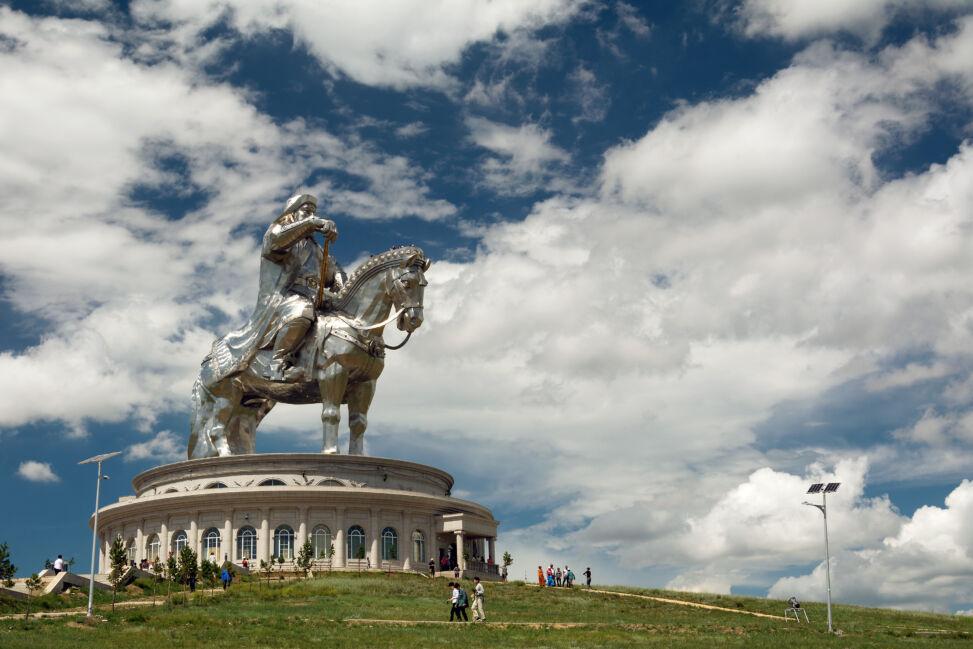
The World’s Largest and Tallest Equestrian Statue of Genghis Khan (Libreshot)
Mongolia’s pristine natural environment forms the foundation of eco and adventure tourism. The Gobi Desert the fossil-rich “Flaming Cliffs” of Bayanzag the Khövsgöl Lake the Altai Mountains and Terelj National Park are the country’s most visited natural sites. The red rock formations and dinosaur fossils of the Gobi attract paleontology enthusiasts. Khövsgöl Lake known as “Asia’s Blue” offers accommodation in nomadic yurts alongside local pastoral communities.
Long-distance horseback treks camel safaris fishing mountain biking and camping are among Mongolia’s nature-based tourism activities. Additionally the traditional nomadic dwelling known as the “ger” (yurt) is a symbolic structure that merges traditional lifestyle experiences with modern tourism.
Mongolia’s rural tourism directly contributes to local community cultural production. Short-term stays with nomadic families are combined with handicrafts dairy product making and horseback riding. This experiential tourism generates sustainable income while helping preserve the nomadic way of life.
During winter months festivals skiing events and sledding races are held in the northern regions of Khangai and Khövsgöl. The Khövsgöl Ice Festival welcomes thousands of local and foreign tourists each March. In summer the largest national celebration the Naadam Festival brings together three traditional sports: wrestling archery and horse racing and is listed by UNESCO as Intangible Cultural Heritage.
Tourism is a strategic sector for economic diversification in Mongolia. As of 2024 the number of visitors exceeded 650,000 and the sector’s contribution to GDP reached 7%. The government aims to raise this share above 10% by 2030. The majority of tourism revenue is generated from nature history and culture-oriented travel. Mongolia’s vast steppes nomadic culture and Genghis Khan heritage attract tourists from Western and Asian countries.
Factors limiting sector growth include harsh climatic conditions low-density transportation infrastructure and long distances between cities which cause tourism to be highly seasonal. Nevertheless particularly during summer months (June–August) eco-tourism historical heritage tours and festival tourism remain vital segments of the national economy.
The Mongolian government is promoting sustainable and year-round tourism under the national plan titled “One Million Tourists Initiative”. The plan focuses on environmentally friendly infrastructure investments income generation for local communities and preservation of cultural heritage.
Since its transition to democracy in 1990 Mongolia has pursued a neutral peaceful and multilateral foreign policy. Its diplomatic approach known as the “Third Neighbor Policy” aims to prevent overreliance on China and Russia by cultivating balanced relations with the United States Japan South Korea India and European countries. The country has been a member of the United Nations since 1961 and also holds global partnership status with the Asia Cooperation Dialogue the Asian Development Bank the World Trade Organization and NATO.
Foreign policy is primarily conducted along the axes of sovereignty energy security and economic diversification. China is Mongolia’s largest trading partner; however Beijing’s economic weight compels Ulaanbaatar to adopt a cautious stance. Russia remains a historical ally and plays a key role in energy supply. Due to its geographic position sandwiched between these two powers Mongolia has elevated diplomatic balance into a national security policy.
Thanks to its peaceful foreign policy Mongolia actively participates in international peacekeeping missions. Mongolian soldiers have served in UN operations in Iraq Afghanistan and South Sudan since the 2000s. Furthermore the country secured formal recognition from the UN in 2012 for its nuclear-free status and has begun assuming a “mediator” role in regional security.
In terms of internal security Mongolia is a stable country with low crime rates and strong social cohesion. However economic imbalances environmental crises (especially desertification) and increasing competition between China and Russia are the main factors that could affect future security balances.
Diplomatic relations between Mongolia and Turkey were formally established on June 24 1969 and accelerated after Mongolia’s democratic revolution in 1990. Turkey was among the first countries to support Mongolia’s democratic transition in the new era. The Turkish Cooperation and Coordination Agency (TİKA) in Ulaanbaatar has implemented hundreds of projects particularly in education health and cultural heritage. The Turk–Mongol Archaeology Project in Karakorum and the Tonyukuk Monument Conservation Projects are concrete examples of the historical ties between the two nations.
Direct air connectivity cultural exchange programs and scholarship opportunities exist between the two countries. Turkey regards Mongolia as the “northern ring” of the Central Asian Turkic world; Mongolia in turn recognizes Turkey as a key partner in its “Third Neighbor” strategy. As of 2023 bilateral trade volume stands at approximately $90 million USD; both countries aim to triple this volume in the short term.
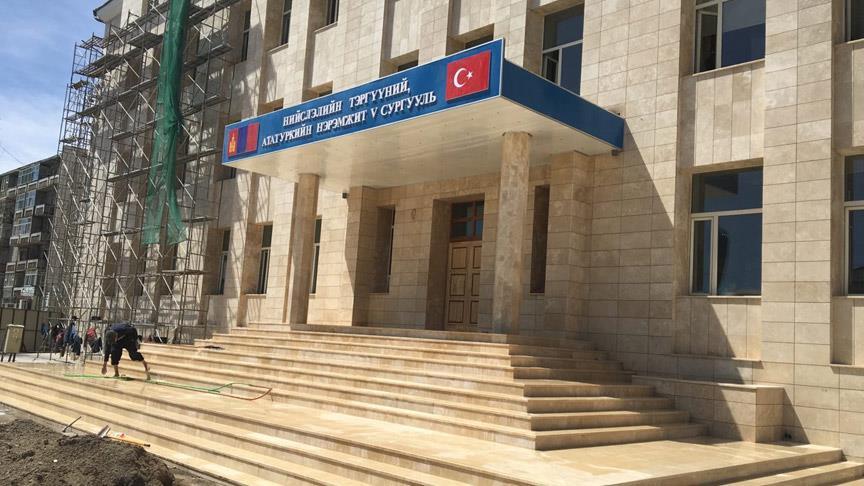
TİKA’s Renovated Atatürk School in Mongolia (Anadolu Ajansı)
The Mongolian Armed Forces (Монгол Улсын Зэвсэгт Хүчин) are the constitutional force responsible for safeguarding national sovereignty and territorial integrity. The defense system is based on compulsory military service with a 12-month term for men. As of 2025 the active military personnel number approximately 11,500 and the total force including reserves is around 35,000.
The military structure consists of ground forces air defense units and paramilitary border guards. The air force has limited capacity using several transport aircraft and Soviet-era helicopters. As part of modernization efforts Mongolia has acquired Mi-171 helicopters and radar systems from Russia and tactical vehicles from South Korea. Moreover Mongolia has developed a small but disciplined professional unit that contributes to United Nations peacekeeping operations.
The defense industry remains in its early stages. Aside from ammunition and light weapons maintenance facilities there is no significant domestic production infrastructure. Instead military modernization largely relies on foreign partnerships. Technical cooperation with Russia and defense training programs with India are prominent while joint exercises with the United States under the name “Khaan Quest” are regularly conducted.
The Mongolian military’s core strategy focuses not on external threats but on maintaining internal stability border security and readiness for peacekeeping missions. Due to its geopolitical position the country views economic and environmental security challenges as integral components of national defense.
Anadolu Ajansı. "TİKA Moğolistan ile Türkiye'yi yakınlaştırıyor." Anadolu Ajansı, March 2, 2019. Accessed November 5, 2025.https://www.aa.com.tr/tr/dunya/tika-mogolistan-ile-turkiyeyi-yakinlastiriyor/1407048
Anadolu Ajansı. "TİKA'dan Moğolistan'ın eğitimine destek." Anadolu Ajansı, May 20, 2016. Accessed November 5, 2025.https://www.aa.com.tr/tr/turkiye/tikadan-mogolistanin-egitimine-destek-/575615
Asian Development Bank. *Mongolia Country Partnership Strategy 2025–2028.* Manila: ADB, April 2025. Accessed November 1, 2025.https://www.adb.org/documents/mongolia-country-partnership-strategy-2025-2028
Atwood, Christopher Pratt. Encyclopedia of Mongolia and the Mongol Empire. New York: Facts On File, 2004.
Bawden, Charles R. The Modern History of Mongolia. London: Kegan Paul International, 1989.
Central Intelligence Agency. "Mongolia." The World Factbook. Accessed November 1, 2025.https://www.cia.gov/the-world-factbook/countries/mongolia/.
Ian Berwick, “National Anthem: Mongolia – Монгол Улсын төрийн дуулал.” YouTube video, 2:16. December 21, 2016. Accessed November 1, 2025.https://www.youtube.com/watch?v=jt8pvqVul80.
International Monetary Fund. *Mongolia: 2025 Article IV Consultation—Press Release; Staff Report; and Statement by the Alternate Executive Director for Mongolia. IMF Country Report No. 25/265.* Washington, DC: International Monetary Fund, 2025. Accessed November 5, 2025.https://www.imf.org/en/-/media/files/publications/cr/2025/english/1mngea2025001-source-pdf.pdf.
Kaplonski, C. Truth, History and Politics in Mongolia: Memory of Heroes. Routledge. New York, 2004.
Krusekopf, Charles. “Mongolia’s Development of Critical Minerals: Opportunities and Challenges.” The National Bureau of Asian Research (NBR), August 16, 2023. Accessed November 1, 2025.https://www.nbr.org/publication/mongolias-development-of-critical-minerals-opportunities-and-challenges/.
Ministry of Economy and Development of Mongolia. *Economic and Social Development Report 2023–2024.* Ulaanbaatar: MED, 2024. Accessed November 1, 2025.https://med.gov.mn/uploads/users/3962/files/M24Q3EN.pdf
National Statistics Office of Mongolia. *Mongolian Statistical Yearbook 2024*. Ulaanbaatar: NSO, 2025. Accessed November 1, 2025.https://www.nso.mn/uploads/yG8XiROLDF_Vn-uKuh-V_hLI63_jXzWHOckz4NHN.pdf
Picryl. "A yurt in a field with mountains in the background. Yurt Mongolia Steppe." Picryl, 2016. Accessed November 5, 2025.https://picryl.com/media/yurt-mongolia-steppe-ee41ff
Picryl. “Ulaanbaatar city square building.” Picryl, 2016. Accessed November 1, 2025.https://picryl.com/media/ulaanbaatar-city-square-architecture-buildings-228984/
Todd, Gary. "Genghis Khan & His Court." Flickr, July 20, 2015. Accessed November 5, 2025.https://www.flickr.com/photos/101561334@N08/19842038355
United Nations Development Programme (UNDP). *2024 National Human Development Paper.* UNDP. Mongolia 2024. Accessed November 1, 2025.https://www.undp.org/mongolia/publications/2024-national-human-development-paper
United Nations Population Fund. "Mongolia Population 2025 - United Nations Population Fund." UNFPA. Accessed November 10, 2025.https://www.unfpa.org/data/world-population/MN
Vorel, Martin. "Green steppe in Mongolia." LibreShot. April 11, 2019. Accessed November 1, 2025.https://libreshot.com/green-steppe-in-mongolia/
Vorel, Martin. “Genghis Khan Equestrian Statue.” LibreShot. November 7, 2018. Accessed November 1, 2025.https://libreshot.com/genghis-khan-equestrian-statue/
World Bank. "Mongolia Country Overview." Washington, D.C.: World Bank Group, 2024. Accessed November 1, 2025.https://www.worldbank.org/en/country/mongolia/overview
[1]
Birçok Kıpçak unsur, Moğol ordusuna katılarak Batı seferlerinde (Batu Han önderliğindeki Balkanlar / Rusya seferleri) kilit lojistik ve süvari gücü sağladı. Bu melez askerî yapı, Moğol başarısının nedenlerinden biridir: Moğol hiyerarşisi içine katılan yerel konfederasyonlar hem bölge hakimiyetini kolaylaştırdı hem de Batı’ya taşınan teknik ve kültürel etkileşimleri hızlandırdı.

Mongolia
Form of Government | Republic Governed by a Semi-Presidential System | ||||||||
|---|---|---|---|---|---|---|---|---|---|
Date of Independence | 12 Şubat 1992 | ||||||||
Capital | Ulan Batur | ||||||||
Head of State | Ukhnaagiin Khürelsükh | ||||||||
Official Languages | Mongolian | ||||||||
Official Scripts | Mongolian Alphabet Cyrillic | ||||||||
National Day | July 11 | ||||||||
Area | 1,564,116 km² | ||||||||
Total Population | 3.5 Million | ||||||||
Climate | Cold and Arid Desert Climate | ||||||||
GDP (Nominal) | 25.8 Billion US Dollars | ||||||||
GDP per Capita | 7,200 US Dollars | ||||||||
Ethnic Groups | 95.6% Mongol, 3.8% Kazakh, 0.6% Others | ||||||||
Religious Composition | 40.6% Non-religious 3.2% Islamic 2.5% Shamanist 0.7% Others 1.3% Christian 51.7% Buddhist | ||||||||
Telephone Code | +976 | ||||||||
Internet Domain Code | .mn | ||||||||
National Anthem
History
Early Communities and Antiquity
Orhon Inscriptions and the Turk-Mongol Cultural Heritage
Medieval Period and the Mongol Invasions
Post-Mongol Invasion and Chinese Control
Modern Era
Geography
Borders and Neighbors
Mountains
Plains and Valleys
Rivers and Lakes
Climate
Economy
Key Economic Indicators (2025)
Sectoral Distribution
Foreign Trade
Foreign Investment and Business Environment
Energy and Transportation Infrastructure
Demography Education and Culture
Key Demographic Indicators (2024)
Population Distribution and Urbanization
Ethnic Composition
Religious Distribution
Education and Literacy Rate
Migration and Population Decline
Tourism
Tourist Regions and Types
Cultural and Historical Tourism
Significance of the Orhon Inscriptions and Cultural Heritage Tourism
Nature and Adventure Tourism
Eco and Rural Tourism
Winter Tourism and Festivals
Tourism’s Role in the Economy
Foreign Policy and Security
Mongolia–Turkey Relations
Military and Defense Industry