


This article was automatically translated from the original Turkish version.
+2 More
Modern Myths
Basic Function | The interpretation of ontological reality and social continuity. The organization of collective experiences. | ||||||||
|---|---|---|---|---|---|---|---|---|---|
Definition | Secular sacreds; contemporary and rational forms of mythic thought. | ||||||||
Enlightenment Effect | The transformation of traditional myths (in contrast to logos) into science, converting it into a mythical authority. | ||||||||
Postmodern Sacred | The break from the traditional sacred and the construction of new secular sacreds rooted in the earthly realm. | ||||||||
Political Ideologies | Systems that replace traditional religions by offering ideological recipes for salvation and cults of leadership. | ||||||||
Eschatological Model | The assignment of prophetic role to the proletariat and earthly paradise to a classless society by Marxism. | ||||||||
Consumption and Brand Totemism | The deification of brands through advertising and the legitimation of consumption through discourses such as 'Green Myth'. | ||||||||
Modern Pantheon | Stars replacing ancient heroes; new figures produced by cinema and popular culture. | ||||||||
Mythopia and Heroes | Modern cinematic universes constructed using Campbell's 'Hero's Journey' model. | ||||||||
Technological Utopia | The assignment of a mission of universal peace and absolute democracy to communication technologies (telegraph, internet, etc.). | ||||||||
Tower Myth | The reproduction of skyscrapers as symbols of capitalist power and wealth, embodying the desire to reach the heavens. | ||||||||
Modern Myths, despite the Enlightenment’s rationalist worldview and the dominance of the positivist paradigm, refer to the new forms and secular sacralities that mythic thought has assumed in contemporary society.【1】 Traditionally defined, myth encompasses sacred narratives such as folk tales and creation stories, but at its core it is a philosophy and mode of thought belonging to every era of human existence. The fundamental function of myths is to impose order on complex experiences, knowledge, and behavioral models within society, enabling individuals to make sense of their lives and experiences. Although the central position of the mythic tradition in social life has shifted in the modern world, mythic behaviors have not disappeared; rather, they have infiltrated fields such as technology, politics, and consumer culture, continuing to be pragmatically reproduced. In this sense, modern myths function as coherent systems of thought that sustain social continuity, not as rationalist assumptions but as integral components of human ontological reality.【2】
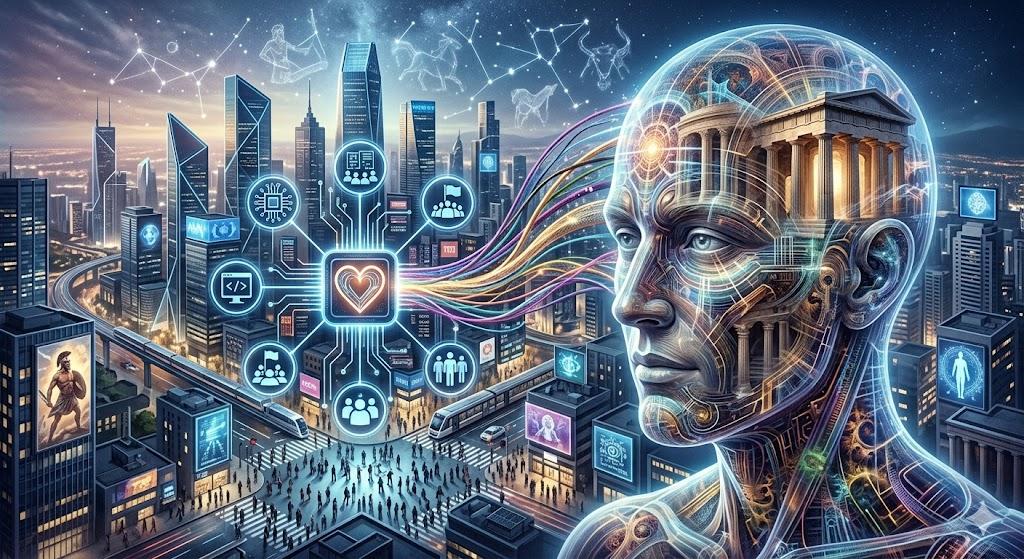
Representative Image Related to Modern Myths (Generated by Artificial Intelligence)
With the rise of rationalism in the eighteenth century, traditional myths were devalued in the face of logos and labeled as superstitions. The aim of the Enlightenment was to liberate humanity from the old order represented by myths and place it under the protection of emancipatory reason.【3】 However, this process did not eliminate myths entirely but transformed their forms. Mythic narratives excluded by positivist scientific circles led modern humans to create their own secular sacralities. While scientific advancements dismantled some traditional myths, science itself gradually acquired mythic authority, and the scientific truths of past centuries have become today’s myths. By the end of the nineteenth century, Nietzsche’s declaration of the death of God marked the culmination of the process of disengagement from the sacred, yet it also laid the groundwork for the postmodern reconstruction of the sacred within the secular world.【4】
In the modern era, the structures most structurally and functionally similar to myths are political ideologies. In Western civilization, ideologies have replaced traditional myths by providing legitimacy frameworks and salvation blueprints for social order. For instance, Marxism carries an eschatological mythic character through the role assigned to the proletariat, the apocalyptic struggle against the bourgeoisie, and the promise of a final earthly paradise. Similarly, movements such as Nazism, Bolshevism, and Fascism mobilized masses by constructing their visions of social order, struggles against the Other, and ideal societies through mythic narratives and charismatic leader cults.
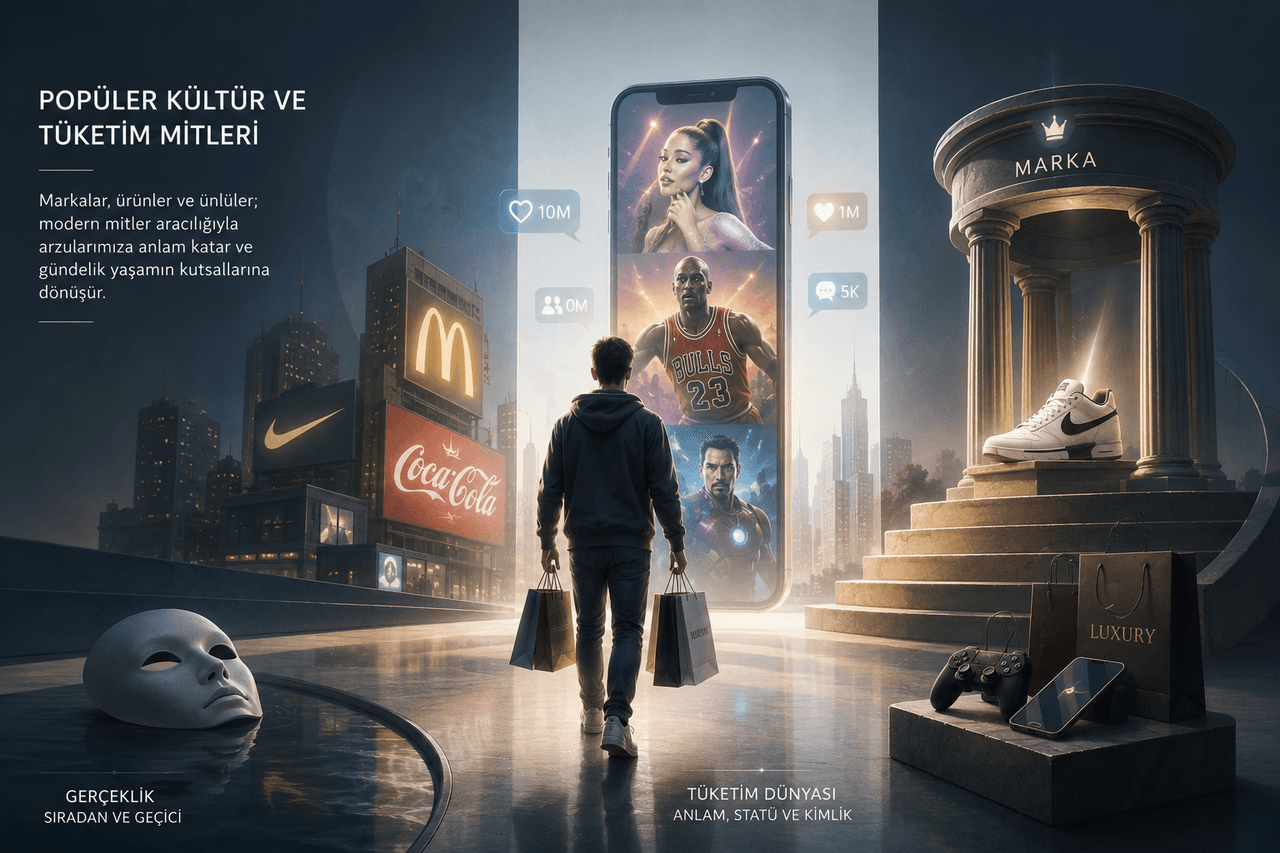
Representative Image Related to Modern Myths (Generated by Artificial Intelligence)
Consumer society disseminates products and lifestyles to individuals by mythologizing them through mass media and advertising.【5】 Modern myths work to legitimize the core values of the new consumer-oriented world system, assigning symbolic meanings to brands and transforming products into idols or totems. In this process, new movements such as the Green Myth have emerged; green consciousness, born of anxiety over modern life’s destruction of nature, is mythologized in advertising messages as an environmental sensitivity. Moreover, popular culture constructs a modern pantheon by replacing ancient heroes with celebrities such as singers, actors, and athletes, transforming these figures into star myths through idealization and mass adoration.
Cinema functions as a central dream factory in modern society, producing and transmitting mythic narratives to the masses. Seen as the modern counterpart to the shadows in Plato’s allegory of the cave, cinema detaches viewers from mundane time and offers them an intense mythic experience within concentrated time. Hollywood cinema, particularly through the use of Joseph Campbell’s Hero’s Journey archetype, constructs modern hero myths through characters such as Star Wars, Superman, and Batman.【6】 Characters like Superman fulfill the modern individual’s longing for a savior amid the erosion of human agency by machines and industrial chaos; meanwhile, series such as The Lord of the Rings and Harry Potter fuse traditional mythology elements with the spirit of the contemporary world to create fictional universes known as Mythopia.
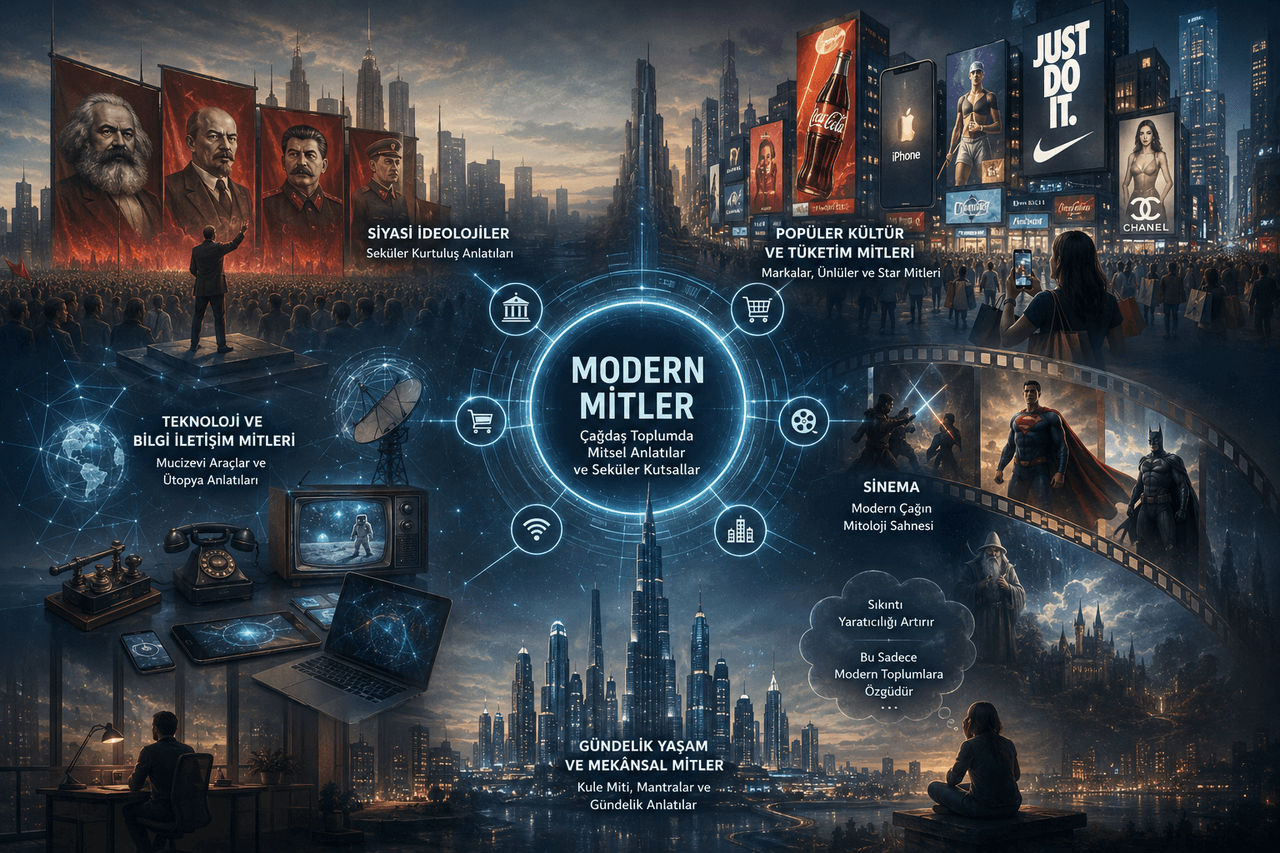
Representative Image Related to Modern Myths (Generated by Artificial Intelligence)
Technological innovations, in their initial stages, frequently acquired a mythic dimension through narratives of miraculous salvation and universal peace. Electricity, upon its discovery, was hailed as a divine force illuminating darkness; the telegraph and telephone were mythologized as technologies that would dissolve distances and unite humanity within a global village. Radio and television gained sacred status as the magicians of their age, bringing distant sounds and images into the home; the internet was envisioned as a magical utopia promising unlimited information flow and absolute democracy.【7】 These tools are not merely technical devices; they have become the primary mechanisms through which mythic values are transmitted to the masses and collective consciousness is shaped.
Modern myths have penetrated every domain of life, from architecture to everyday psychological experience. Modern architecture’s high-rise buildings and skyscrapers represent the tower myth, a modern reflection of humanity’s desire to reach the heavens and the divine.【8】 These structures have now lost their sacred meaning and transformed into ideological symbols representing the power and wealth of capitalism. In everyday life, various mythic mantras have formed around concepts such as stress; beliefs that stress enhances creativity or is unique to modern societies are popular cultural narratives that obscure the true nature of this phenomenon. Ultimately, modern myths are continuously updated in parallel with changing cultural elements, continuing to interpret life by fulfilling humanity’s need for the unknown and the sacred in new forms.
Akgün, Melek, and Şerif Esendemir. "Çağdaş Dünyada Kutsalın ve Mitlerin Dönüşümü: Post Modern Kutsallık ve Yansımaları." *Eskiyeni*, no. 49 (September 2023): 1090-1109. Accessed June 9, 2026. https://dergipark.org.tr/en/pub/eskiyeni/article/1307153
Horzum, Işıl. "Reklamlarda İşlenen Modern Mitler ve Yeşil Mitin Göstergebilimsel İncelemesi." e-Journal of New World Sciences Academy 6, no. 4 (2011): 29-41. Accessed June 9, 2026. https://dergipark.org.tr/tr/download/article-file/186751
Ros Velasco, Josefa. "Contemporary Myths on Boredom." *Frontiers in Sociology* 8 (2023): 1–8. Accessed June 9, 2026. https://www.frontiersin.org/journals/sociology/articles/10.3389/fsoc.2023.1183875/full
Topal, Gökhan. “Modern Toplumda Mitlerin Dönüşümü Ve Sinemanın Rolü: Kültür Dünyası İnsanının Gündüz Düşleri Üzerine Bir İnceleme”. *Kronotop İletişim Dergisi* 1, no. 2 (2024): 139–68. Accessed June 9, 2026. https://izlik.org/JA95HU24ZL
Özüdoğru, Büşra. "Toplumsal Bir Kavram Olarak Mitler ve Modern Dünyanın Yeni Mitleri." Pearson Journal of Social Sciences 6, no. 14 (2021): 154–166. Accessed June 9, 2026. https://www.pearsonjournal.com/index.php/pub/article/view/401
[1]
Melek Akgün and Şerif Esendemir, “The Transformation of the Sacred and Myths in the Contemporary World: Postmodern Sacredness and Its Reflections,” Eskiyeni, no. 49 (September 2023): 1090,
[2]
Akgün and Esendemir, “The Transformation of the Sacred and Myths in the Contemporary World,” 1106.
[3]
Büşra Özüdoğru, “Myths as a Social Concept and the New Myths of the Modern World,” Pearson Journal of Social Sciences 6, no. 14 (2021): 155, https://www.pearsonjournal.com/index.php/pub/article/view/401
[4]
Gökhan Topal, “The Transformation of Myths in Modern Society and the Role of Cinema: An Examination of the Daydreams of the Cultural Human,” Kronotop Communication Journal 4, no. 1 (2024): 144, https://dergipark.org.tr/en/pub/kronotop/article/1475247
[5]
Özüdoğru, “Myths as a Social Concept,” 155.
[6]
Özüdoğru, “Myths as a Social Concept,” 161.
[7]
Topal, “The Transformation of Myths in Modern Society and the Role of Cinema,” 148.
[8]
Akgün and Esendemir, “The Transformation of the Sacred and Myths in the Contemporary World,” 1105.

Modern Myths
Basic Function | The interpretation of ontological reality and social continuity. The organization of collective experiences. | ||||||||
|---|---|---|---|---|---|---|---|---|---|
Definition | Secular sacreds; contemporary and rational forms of mythic thought. | ||||||||
Enlightenment Effect | The transformation of traditional myths (in contrast to logos) into science, converting it into a mythical authority. | ||||||||
Postmodern Sacred | The break from the traditional sacred and the construction of new secular sacreds rooted in the earthly realm. | ||||||||
Political Ideologies | Systems that replace traditional religions by offering ideological recipes for salvation and cults of leadership. | ||||||||
Eschatological Model | The assignment of prophetic role to the proletariat and earthly paradise to a classless society by Marxism. | ||||||||
Consumption and Brand Totemism | The deification of brands through advertising and the legitimation of consumption through discourses such as 'Green Myth'. | ||||||||
Modern Pantheon | Stars replacing ancient heroes; new figures produced by cinema and popular culture. | ||||||||
Mythopia and Heroes | Modern cinematic universes constructed using Campbell's 'Hero's Journey' model. | ||||||||
Technological Utopia | The assignment of a mission of universal peace and absolute democracy to communication technologies (telegraph, internet, etc.). | ||||||||
Tower Myth | The reproduction of skyscrapers as symbols of capitalist power and wealth, embodying the desire to reach the heavens. | ||||||||
Enlightenment, Science, and the Transformation of Myth
Political Ideologies and Secular Narratives of Salvation
Popular Culture and Consumer Myths
Mythic Structure and Modern Heroism in Cinema
Technology and Information Communication Myths
Everyday Life and Spatial Myths