


This article was automatically translated from the original Turkish version.
+1 More
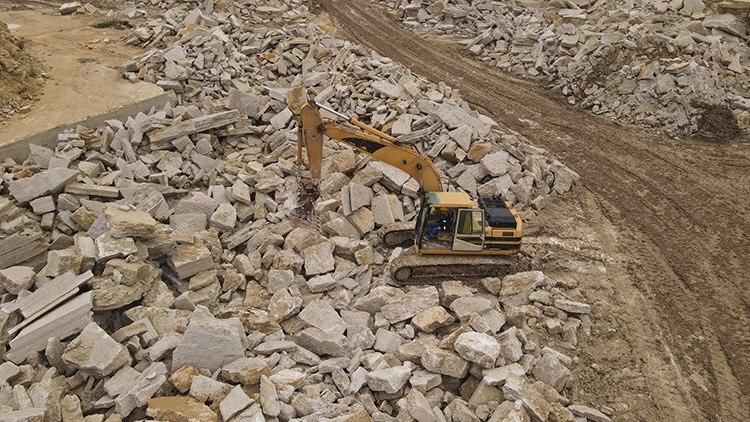
Küfeki Taşı
Places of Origin | Istanbul, Edirne and Surroundings | ||||||||
|---|---|---|---|---|---|---|---|---|---|
Type | Natural Building Stone | ||||||||
Geological Class | Limestone | ||||||||
Structural Property | Porous | ||||||||
Formation Environment | Marine Sedimentary Environment | ||||||||
Historical Uses | Historical Buildings in Istanbul and Thrace Ottoman Architecture Ancient Period Structures | ||||||||
Current Uses | Restorations Compatible with Traditional Architecture Historical Building Restorations | ||||||||
Küfeki stone is a natural building stone belonging to the limestone group, characterized by a fossiliferous and porous structure. In the literature, it is also referred to as lumasheli limestone, maktrali limestone, and Bakırköy stone. This type of stone formed in marine environments and contains abundant quantities of oysters and other marine shells, giving it a high carbonate content. When first extracted from the quarry, Küfeki stone is soft and easily workable; however, upon exposure to the atmosphere, chemical and physical processes within the stone cause it to harden and gain strength. Due to this property, it is regarded as one of the durable building stones capable of maintaining its integrity for approximately 2,000 to 2,500 years.
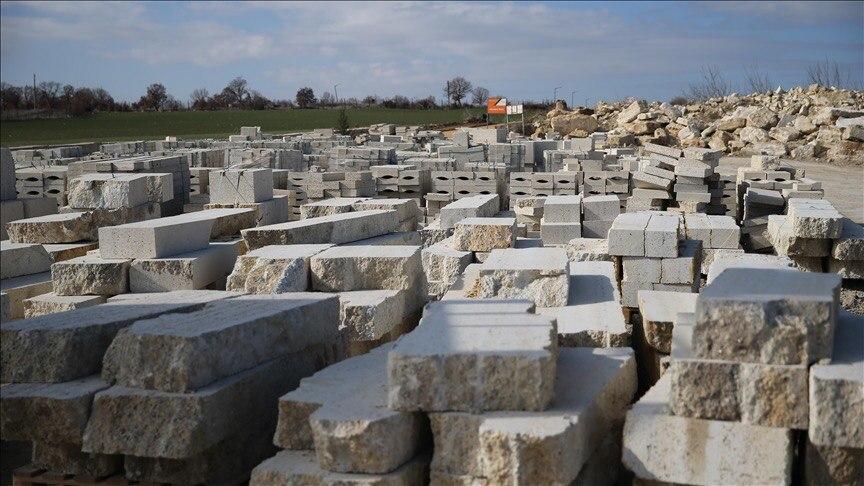
Küfeki Stone (Anadolu Ajansı)
Küfeki stone is a fossiliferous limestone formed through the lithification of upper Miocene marine sediments. It is widely found in units belonging to the Bakırköy Formation, located between Davutpaşa and Küçükçekmece on the Istanbul side of Thrace. The stone contains abundant nummulite fossils and exhibits a porous, calcite-rich texture. It displays a fine-grained, compact rock structure in light beige and white tones.
The primary chemical component of Küfeki stone is calcium carbonate (CaCO₃). Due to its high carbonate content, it exhibits a rapid effervescence reaction when in contact with acids. Its porous structure allows it to be easily worked upon extraction from the quarry. Upon exposure to atmospheric carbon dioxide, secondary hydration processes occur, leading to gradual hardening and increased strength over time.
One of the most distinctive features of Küfeki stone is its hardening behavior over time, known as weathering. Experimental studies have shown that before weathering, the stone exhibits high water absorption rates and low mechanical strength values. Before weathering, the water absorption rate of Küfeki stone in boiling water was measured at 10.06%, while its weight-based water absorption was 15.33%. These values indicate that the stone is unsuitable for use as a natural building material in its initial, unweathered state.【1】
Over time, the stone’s porosity decreases, and its permeability to water and gases diminishes. Consequently, tensile, compressive, and shear strengths increase. Once the weathering process is complete, Küfeki stone develops a more resistant structure and demonstrates long-term durability against environmental influences.
Long-term observations of Küfeki stone’s physico-mechanical behavior under atmospheric conditions have revealed that water drainage and moisture exposure are decisive factors affecting its properties. After a three-year observation period, samples stored in environments allowing water drainage showed increased water absorption and porosity values, while sonic velocity and uniaxial compressive strength values decreased. These findings demonstrate that the stone’s performance is significantly influenced by its placement and surrounding environmental conditions.【2】
Küfeki stone was widely used throughout the Roman, Byzantine, and Ottoman periods in the Marmara and Thrace regions. It was preferred as a primary building material in walls, aqueducts, mosques, caravanserais, baths, madrasas, and palaces in Istanbul and Thrace. Particularly during the Ottoman period, it is known that Küfeki stone was extensively employed in the works of Mimar Sinan in Thrace and Istanbul. In monumental structures such as the Selimiye Camii, the stone’s workability and durability provided significant architectural advantages.
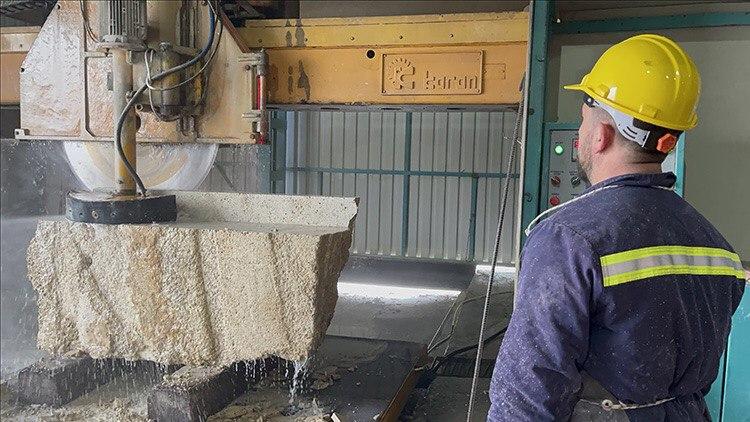
Processing of Küfeki Stone (Anadolu Ajansı)
Küfeki stone has been extracted from quarries located in the Thrace region of Istanbul, including Bakırköy, Zeytinburnu, Sefaköy, Yeşilköy, Şirinevler, Merter, Haznedar Çiftliği, and Küçükçekmece. Additionally, quarries in Süloğlu district of Edirne and Pınarhisar district of Kırklareli have been significant production sites throughout history and into the present day. These quarries were typically operated in locations where the rock layers appear nearly horizontal and are exposed along valley slopes.
Today, Küfeki stone is preferred in the restoration of historical structures due to its compatibility with original materials. Within the framework of restoration ethics, it is essential to use stones with physical and mechanical properties similar to those of the original building material. Therefore, the physico-mechanical properties of Küfeki stone extracted from the Süloğlu and Pınarhisar quarries have been determined through experimental studies and evaluated comparatively. The results demonstrate that the use of scientific criteria in stone selection significantly enhances restoration practices.
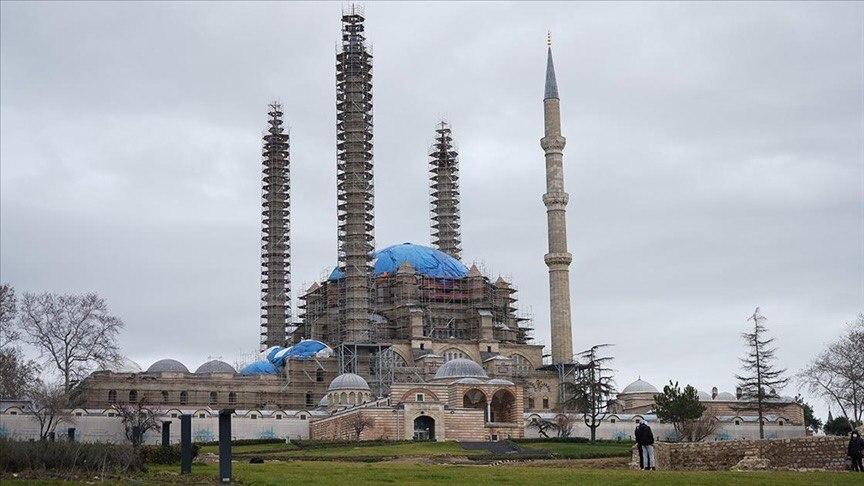
Restoration Using Küfeki Stone (Anadolu Ajansı)
Anadolu Ajansı. “Edirne’de çıkarılan küfeki taşı anıt eserlerin restorasyonunda kullanılıyor.” Accessed January 5, 2026.https://www.aa.com.tr/tr/kultur/edirnede-cikarilan-kufeki-tasi-anit-eserlerin-restorasyonunda-kullaniliyor/2790386?utm
Anadolu Ajansı. “Edirne’de çıkarılan küfeki taşı tarihi eserlerin geleceğe güvenle taşınmasını sağlıyor.” Accessed January 5, 2026.https://www.aa.com.tr/tr/yasam/edirnede-cikarilan-kufeki-tasi-tarihi-eserlerin-gelecege-guvenle-tasinmasini-sagliyor/3590971
Binal, Adil. “Küfeki (İstanbul) Taşının Atmosferik Etkiler Altında Arazi Performansı ve Fizikomekanik Özellikleri.” Paper, *70. Türkiye Jeoloji Kurultayı*, April 10–14, 2017, Ankara. Accessed January 5, 2026.https://www.jmo.org.tr/resimler/ekler/28ceff0e6ff24da_ek.pdf?utm
Kumral, Mustafa, Gökhan Şans, Cihan Yalçın, Mustafa Kaya, and Murat Budakoğlu. 2019. “Çatalca (İstanbul) Civarındaki Tarihi Küfeki Taşının Oluşumunda Fiziksel ve Kimyasal Özelliklerin Etkileri.” *Ömer Halisdemir Üniversitesi Mühendislik Bilimleri Dergisi* 8 (1) (2019): 278–287. Accessed January 5, 2026.https://dergipark.org.tr/tr/download/article-file/632855
Umaroğulları, Gökhan. "Erken Dönem Osmanlı Yapılarında Kullanılan Trakya Bölgesi Küfeki Taşlarının Fiziksel ve Mekanik Özelliklerinin Sonuçları Üzerine Bir Model Önerisi." PhD thesis, Trakya Üniversitesi Fen Bilimleri Enstitüsü, Edirne, 2015. Accessed January 5, 2026.https://acikerisim.trakya.edu.tr/items/72e2f171-1535-4985-9b37-6c749ca006f6?utm=
Çapar, Emine Merve. *Bazı Küfeki Taşlarının Fiziksel ve Mekanik Özelliklerinin Karşılaştırmalı Olarak İncelenmesi*. Master's thesis, İstanbul Teknik Üniversitesi Fen Bilimleri Enstitüsü, 2019. Accessed January 5, 2026.https://tez.yok.gov.tr/UlusalTezMerkezi/tezDetay.jsp?id=4IVn2ErPz1ryh3uqTRz-Ww&no=UHBoX3idZZ4XcpSibkC1tw
[1]
Mustafa Kumral vd., "Çatalca (İstanbul) Civarındaki Tarihi Küfeki Taşının Oluşumunda Fiziksel ve Kimyasal Özelliklerin Etkileri," Ömer Halisdemir Üniversitesi Mühendislik Bilimleri Dergisi 8 (1), (2019): 278-287, Son Erişim: 5 Ocak 2026, https://dergipark.org.tr/tr/download/article-file/632855
[2]
Adil Binal, “Küfeki (İstanbul) Taşının Atmosferik Etkiler Altında Arazi Performansı ve Fizikomekanik Özellikleri,” Bildiri, 70. Türkiye Jeoloji Kurultayı, 10-14 Nisan 2017, Ankara, Son Erişim: 5 Ocak 2026, https://www.jmo.org.tr/resimler/ekler/28ceff0e6ff24da_ek.pdf?utm

Küfeki Taşı
Places of Origin | Istanbul, Edirne and Surroundings | ||||||||
|---|---|---|---|---|---|---|---|---|---|
Type | Natural Building Stone | ||||||||
Geological Class | Limestone | ||||||||
Structural Property | Porous | ||||||||
Formation Environment | Marine Sedimentary Environment | ||||||||
Historical Uses | Historical Buildings in Istanbul and Thrace Ottoman Architecture Ancient Period Structures | ||||||||
Current Uses | Restorations Compatible with Traditional Architecture Historical Building Restorations | ||||||||
Formation and Geological Characteristics
Physical and Chemical Properties
Weathering and Strength Development
Performance Under Atmospheric Conditions
Historical and Architectural Use
Quarry Locations
Restoration and Contemporary Use