


This article was automatically translated from the original Turkish version.
+1 More
Karakoncolos is a malevolent supernatural entity believed in Turkish, Balkan, and Caucasian folk cultures to emerge onto the earth during the coldest days of winter. In mythology, it is imagined as a type of winter demon, gulyabani, umacı, witch, or devil. Across different regions and dialects, it is known by numerous names including Karakoncul, Koncolos, Congolos, Coraz, Karakura, Kalikancaros, Karakondzho, Karakoncalas, Karacingolos, and Goncoloz.【1】 In the Balkans, especially in Greek culture, it is widely known as "Kalikancaros" (plural: Kalikancari), particularly in Greece, Bulgaria, and Serbia.【2】
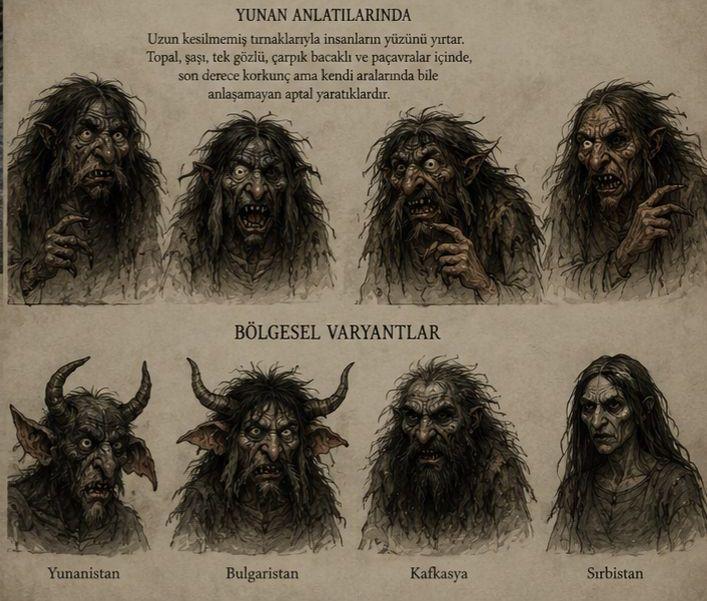
Karakoncolos (Yapay Zeka ile Oluşturulmuştur)
There are various theories regarding the origin of the word Karakoncolos. Turkish sources suggest it derives from the combination of "kara" (black) and "konçlu" (referring to the end of trousers or boots), forming "kara konçlu". It is also proposed that the term may be linked to the Kipchak Turkish word "konç/koncol/konçul" or to the verb "kon", meaning mountain pass. In Greek and Balkan regions, the entity is referred to as "Kalikancaros" and "Karakondzho".【3】
These uniquely named evil spirits in Turkish mythological tradition are regional variants of widely recognized figures such as jinn, al karısı, or karabasan, shaped by local dialects and expressions. Specific names like Conguluz or Karakoncolos are shaped according to the time and place of appearance, the harm inflicted on people, or the linguistic characteristics of the region.
According to modern etymological studies, the first component of the Greek word "Kalikancaros", "kali" (good/beautiful), may be a form of linguistic negation or euphemism used to ward off the entity’s malevolence. Greek folklorist Nikolaos Politis, however, links the word’s origin to the Egyptians known as "Gancari" who arrived in Greece in the 14th century. He argues that "kali" was a name given to these Egyptians and over time merged into the form "kali-kancari".【4】
The earliest recorded use of the name Karakoncolos in Turkish written sources appears in Evliya Çelebi’s Seyahatname. In the first volume, while describing the 17 talismans protecting Istanbul, he mentions the koncolos residing in a cave under the thirteenth heading. According to belief, these entities emerge onto the earth during the Zemheri month. Evliya Çelebi describes their appearance on winter nights but does not elaborate on their effects on living beings.
In the third volume, Evliya Çelebi recounts the case of a woman in the Balkan village of Çalıkkavak who used ash from the hearth to transform her children into chicks and herself into a chicken. The local people described this woman’s transformation into a "kara koncoloz" during winter nights with these words:
"Sultânım, this woman is of another lineage. Once a year on winter nights she becomes a kara koncoloz. But this year she became a chicken. She harms no one."【6】
In the seventh volume, Evliya Çelebi recounts a bloody battle in the sky between Circassian and Abkhazian witches ("oburlar") in the village of Pedsi in the Caucasus during a stormy winter night corresponding to the month of Shawwal in the year 1076. He records the locals’ account as follows:
"... when the end of the world came, thunder cracked and lightning flashed, and the sky became darker than the Day of Judgment. Then the heavens caught fire, the dark night vanished, and a bright day emerged, so bright that Circassian women could have embroidered on the sky. We asked the Circassians, 'By God, once a year on these kara koncoloz nights, Circassian oburlar and Abkhazian oburlar fly into the sky and fight fiercely. Now go outside and watch without fear.' They told us that 'obur' is what they call sorcerers and witches."【7】
In the same volume, Evliya Çelebi records the connection between the oburlar appearing on Karakoncolos nights and disease with these words:
"In this land, plague never occurs. If a man falls slightly ill but does not die, then on a kara koncoloz night the oburlar drink the blood of the sick or even a healthy person from a gourd or a pot, killing them and thus freeing themselves from their obur nature, yet the mark of the obur remains forever in their eyes."【8】
The epic poem Saltuknâme, which recounts the legends of the 14th-century warrior Sarı Saltuk, also features witches and koncolos motifs extensively. Unlike the observational accounts in the Seyahatname, in the Saltuknâme the witches are depicted as creatures allied with demons who oppose Sarı Saltuk’s mission to spread Islam. These beings are extravagantly portrayed as fantastical figures living in palaces guarded by dragons, riding winged lions, pards, or elephants (Cazu Semayil, Cazu Çengal). Sarı Saltuk destroys them using his sword, slingshot, and prayer power.【9】
The most distinctive physiological feature of this entity is its generally black skin tone and ugly, frightening appearance. In many narratives, it is described as a short, unkempt creature covered in shaggy fur resembling bear hide, resembling a monkey or a goat.【10】 Some descriptions depict a male with large bells on his waist, a stick in hand, and perforated palms; others portray an old, hunched, wrinkled-faced woman.【11】
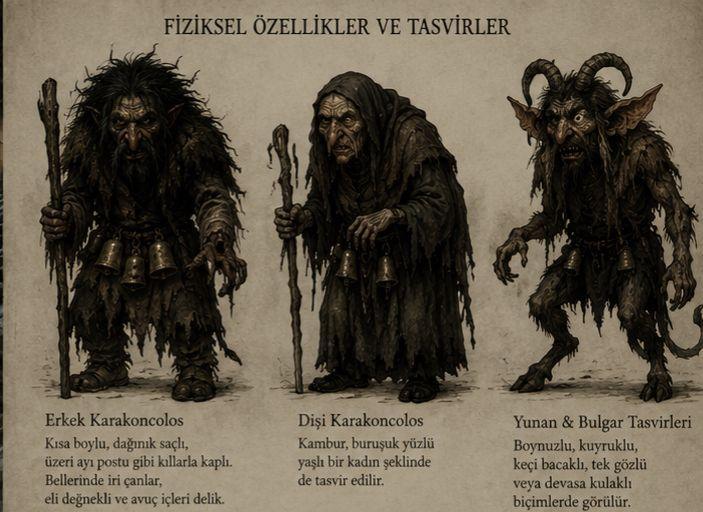
Karakoncolos (Yapay Zeka ile Oluşturuluştur)
In classical Turkish literature, Karakoncolos became a symbol of exaggerated ugliness, and poets used the term "koncolos yapılı" to describe their rivals. In Greek narratives, they are depicted as grotesque, foolish creatures with uncut long nails that tear people’s faces, limping, cross-eyed, one-eyed, crooked-legged, and dressed in rags, unable even to agree among themselves.【12】
In Greece and Bulgaria, it is depicted with horns, a tail, goat legs, one eye, or enormous ears; in some regions such as Serbia, it is described solely as a female demon.【13】
The period during which Karakoncolos emerges onto the earth coincides with the harshest days of winter, known as the Zemheri month and the "unclean days" from December 24 to January 20. In Greek and Orthodox tradition, it is believed that the Kalikancaros dwell beneath the earth, where they attempt to chop down the roots of the Tree of Life with axes. Just before the tree is about to collapse, they emerge onto the earth on Christmas Eve, December 24, to haunt humans. When the waters are blessed on January 6, they return underground and, seeing the Tree of Life renewed, begin their chopping anew.
The entity’s most fundamental behavior is to approach people at night and ask questions such as: "What is your name?", "Where are you from?", and "Where are you going?". To escape, the person confronted must answer using the word "kara" (black), as in "Kara Mahmut", "from Karaköy", or "from Karadağ". Otherwise, it is believed that the entity strikes the victim with its woolen comb, causing harm or death.【14】
According to folkloric accounts collected from regional legends, Conguluz/Congolos appears as a man emerging from the snow, calling out to household members in the voice of someone familiar, luring them outside and leading them far away. It is believed that those who respond to this call and lose their way freeze to death or drown. In the Yozgat variant of this belief, the entity is said to spit on or defile water or food left uncovered in homes during the coldest days of winter.
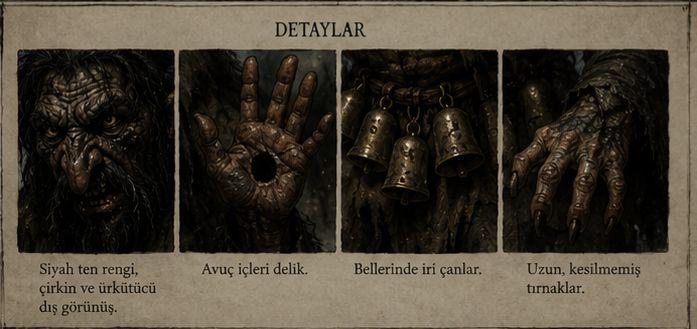
Karakoncolos (Yapay Zeka ile Oluşturulmuştur)
Karakoncolos possesses a strong ability to mimic voices, deceiving sleeping people by calling them in the voice of someone they know, leading them outside where they freeze to death. In Greek narratives, it is said that the entity captures those who leave their homes at night and forces them to dance, during which time it abducts those who speak. It is also believed to enter homes through chimneys, damaging exposed food and water and bringing illness into the household. The entity has a particular fondness for festive foods prepared for Christmas, such as the pig’s head. It is said that it only captures young girls, painfully combing their hair with its woolen comb, and when it cannot find food, it eats newly born calves in stables or even young boys. According to Greek belief, children born between December 24 and January 1 who are not baptized will transform into Kalikancaros.【15】
Various methods are employed in folk beliefs to protect against Karakoncolos. To prevent its entry into homes, food such as beetroot, pumpkin, or kuymak is left on doors and thresholds, or beetroot is buried in the ground. Traditionally, keeping beetroot in the house, boiling beetroot, or burying it near the doorstep is considered a protective measure against Congolos.
During the Bocuk Gecesi in Thrace, pumpkin pie is baked to prevent its entry; it is believed that the smoke from the pie blinds the witches. Sprinkling ash from the hearth around the home or making loud noises are also practiced methods. According to beliefs on Gökçeada and Greek islands, Kalikancaros fear fire the most: they cannot approach when people go out at night with torches, and if struck by a torch, they revert to human form.【16】
In Bulgarian and Greek cultures, garlic and a sieve or sieve-like object are hung on doors for protection. Karakoncolos begins counting the holes, but since it cannot count beyond two, it wastes time or disappears at sunrise. To prevent children born during the unclean days from transforming into Karakoncolos, garlic is placed around infants, their heel soles are held to the fire, their thumbnail is slightly burned so they cannot grow claws, or needles are stuck into the corpses of the deceased.【17】 To prevent the child from becoming a clawless monster, the thumbnail of the thumb is lightly burned or needles are inserted into the corpses of the dead.【18】
The belief in Karakoncolos has been used in classical Turkish literature as a distinctive form of the witch motif, employed for humorous and satirical purposes:
In modern literature, the portrayal of this entity has changed. In modern Greek children’s literature, Kalikancaros have been stripped of their terrifying qualities. Through authors such as Filippos Mandilaras, they have been transformed into lovable, mischievous characters in children’s fairy tales.【23】 Today in Greece, Kalikancaros have become iconic figures in Christmas-time children’s books and school performances. In Turkish literature and cinema, the entity appears as a harmless, fairy-tale-like image in Evangelinos Misailidis’s Temaşa-i Dünya, Elif Şafak’s novel Bit Palas, and Yeşim Ustaoğlu’s film Bulutları Beklerken.【24】
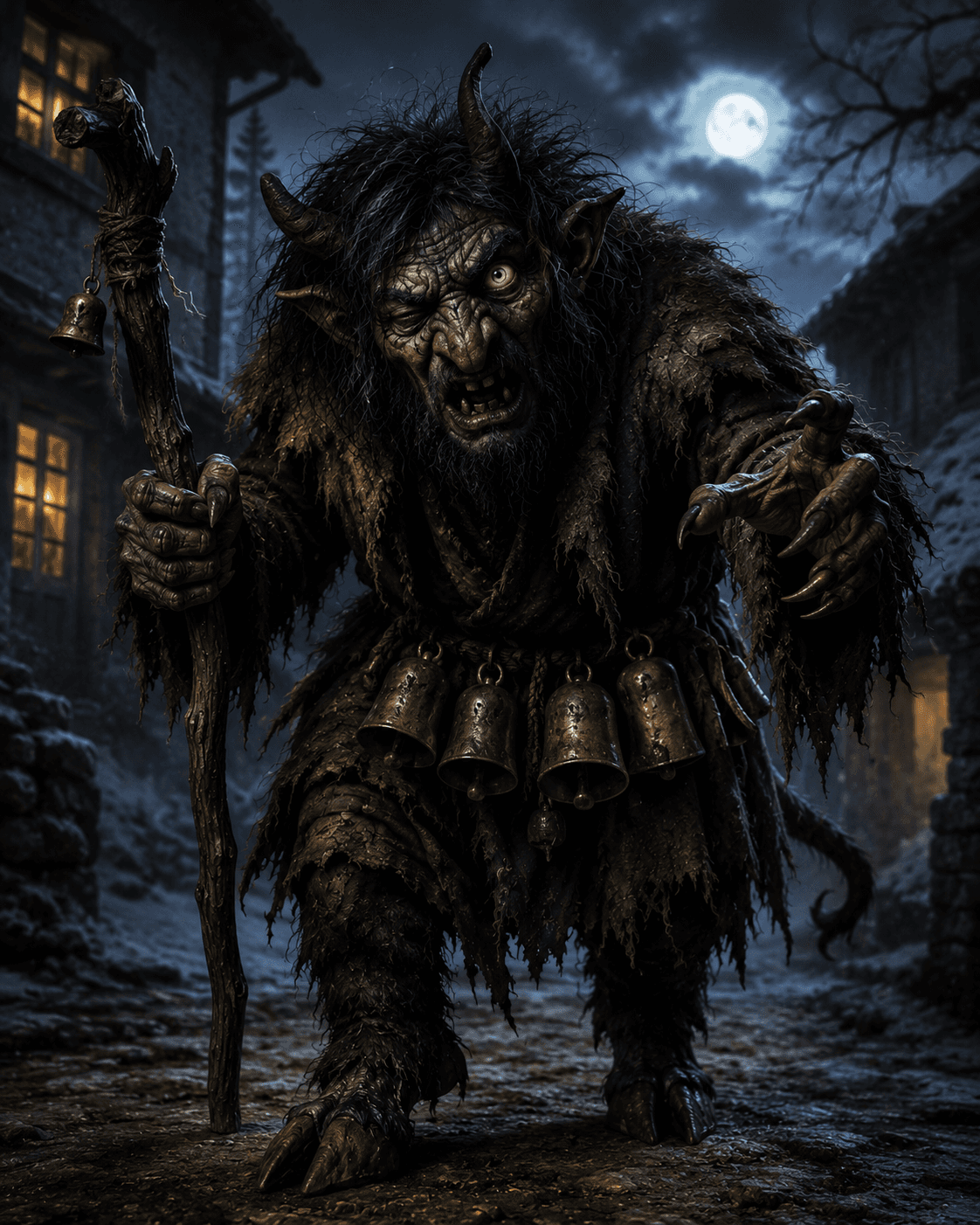
Karakoncolos (Yapay Zeka ile Oluşturulmuştur)
The Karakoncolos belief has also influenced regional folk calendars and climatic events. In Anatolia, December is called "Evvel-i Koncolos" and January 6 is known as "Ahir-i Koncolos". In the Black Sea region, strong winter winds blowing from sea to land are called "Karakoncolos storms". In Yozgat and its surroundings, the period between January 10 and 17 is referred to as the "Congolos month".
As a legacy of Balkan culture, the "Bocuk Gecesi" festival held during the first week of January in Thrace—especially in the village of Çamlıca near Edirne—is a reflection of this belief. Young people paint their faces with starch, wrap themselves in white sheets, and frighten neighbors, offering protective wishes. This tradition has now become a registered horror tourism festival. In the eastern Black Sea region, particularly in Trabzon, "Kalandar" (Karakoncilo) events are held on January 13, which according to the Rumi calendar marks the beginning of the new year.【25】
These festivals, rooted in ancient Greek and Roman celebrations, mark the end of winter and the arrival of fertility. Young men dress in goat skins, tie bells around their waists, and blacken their faces with soot to assume the guise of Momoyer. This tradition serves to drive away evil, and the local people give the youths gifts of food. These cultural practices, preserved to this day, are now organized as festive events and promoted for tourism. The "Coraz nights" in Tire district of İzmir are another variant of this belief.
Beyond its folkloric and cultural influence, the term Karakoncolos has entered scientific literature. A newly discovered species of flesh fly in the Isparta region of Türkiye, notable for its large size (approximately 22 millimeters) within its genus and its unusual (hairy) phenotype, has been scientifically named Sarcophaga karakoncolos.【26】
Akelma, Şeyma. "Evliya Çelebi Seyahatnâmesi ve Saltuknâme'de Cadı Motifi Üzerine Karşılaştırmalı Bir İnceleme." Hacettepe Üniversitesi Edebiyat Fakültesi Dergisi 42, no. 2 (2025): 676–687. Accessed July 21, 2026.https://doi.org/10.32600/huefd.1648451
Duvarcı, Ayşe. "Türklerde Tabiat Üstü Varlıklar ve Bunlarla İlgili Kabuller, İnanmalar, Uygulamalar." *bilig*, no. 32 (2005): 125–139. Accessed July 21, 2026.https://dergipark.org.tr/tr/pub/bilig/article/267804
Kanbir, Ayşe Eren. "New Year Celebrations as a Cultural Heritage in Trabzon: Kalandar Tradition." *International Journal of Economics, Politics, Humanities & Social Sciences* 8, (2025): 264–276. Accessed July 21, 2026.https://dergipark.org.tr/en/download/article-file/4691932
Sarpkaya, Seçkin. "Türkiye Sahası Efsanelerinde Özel Adlı Kötü Ruhlar." In *Korku Kitabı*. Istanbul: Kitabevi, 2014. Accessed July 21, 2026.https://makale.isam.org.tr/server/api/core/bitstreams/a6eb1766
T.C. Ministry of Culture and Tourism. "Karakoncolos." Türkiye Kültür Portalı. Accessed July 21, 2026.https://www.kulturportali.gov.tr/portal/karakoncolos
Whitmore, Daniel, Eliana Buenaventura, Casey Barr, et al. "Odd, Outsized, and Obscure: *Sarcophaga (Hadroxena) karakoncolos* sp. n. (Diptera: Sarcophagidae) from Turkey." *Zootaxa* 4422, no. 3 (2018): 385–394. Accessed July 21, 2026.https://doi.org/10.11646/zootaxa.4422.3.4
Yıldırım, Hacı Mehmet, and Emine Eskin. "Ortak Balkan Kültürü Bocuk Gecesinin Korku Folkloru ve Korku Turizmi Açısından Değerlendirilmesi." *Kültür Araştırmaları Dergisi*, no. 25 (2025): 195–225. Accessed July 21, 2026.https://dergipark.org.tr/en/download/article-file/4710493
Yılmaz, Gökçehan Aysel. "Klasik Türk Edebiyatında Koncolos İnanışı." *Korkut Ata Türkiyat Araştırmaları Dergisi*, no. 8 (2022): 538–547. Accessed July 21, 2026.https://doi.org/10.51531/korkutataturkiyat.1133387
Şişmanoğlu Şimşek, Şehnaz. "Türkçe ve Yunanca Kaynaklarda Karakoncolos / Kalikancaros İnancı." *Millî Folklor*, no. 120 (2018): 184–197. Accessed July 21, 2026.https://www.academia.edu/37962975/T%C3%BCrk%C3%A7e
[1]
Hacı Mehmet Yıldırım ve Emine Eskin, "Ortak Balkan Kültürü Bocuk Gecesinin Korku Folkloru ve Korku Turizmi Açısından Değerlendirilmesi," Kültür Araştırmaları Dergisi 2025, no. 25 (2025): 211, Erişim tarihi: 20 Temmuz 2026, https://dergipark.org.tr/en/download/article-file/4710493
[2]
Şehnaz Şişmanoğlu Şimşek, "Türkçe ve Yunanca Kaynaklarda Karakoncolos / Kalikancaros İnancı," Millî Folklor, no. 120 (2018): 184, Erişim tarihi: 21 Temmuz 2026,
[3]
Yıldırım ve Eskin, "Ortak Balkan Kültürü Bocuk Gecesi," 211.
[4]
Şişmanoğlu Şimşek, "Türkçe ve Yunanca Kaynaklarda Karakoncolos / Kalikancaros İnancı," 188.
[6]
Şeyma Akelma, "Evliya Çelebi Seyahatnâmesi ve Saltuknâme'de Cadı Motifi Üzerine Karşılaştırmalı Bir İnceleme," *Hacettepe Üniversitesi Edebiyat Fakültesi Dergisi* 42, no. 2 (2025): 678, Accessed July 21, 2026,https://doi.org/10.32600/huefd.1648451
[7]
Gökçehan Aysel Yılmaz, "Klasik Türk Edebiyatında Koncolos İnanışı," Korkut Ata Türkiyat Araştırmaları Dergisi, no. 8 (2022): 541, Erişim tarihi: 21 Temmuz 2026, https://doi.org/10.51531/korkutataturkiyat.1133387
[8]
Akelma, "Evliya Çelebi Seyahatnâmesi ve Saltuknâme'de Cadı Motifi," 679.
[9]
Akelma, "Evliya Çelebi Seyahatnâmesi ve Saltuknâme'de Cadı Motifi," 680.
[10]
Yıldırım ve Eskin, "Ortak Balkan Kültürü Bocuk Gecesi," 199.
[11]
Türkiye Kültür Portalı, "Karakoncolos."
[12]
Şişmanoğlu Şimşek, "Türkçe ve Yunanca Kaynaklarda Karakoncolos / Kalikancaros İnancı," 191.
[13]
Yıldırım ve Eskin, "Ortak Balkan Kültürü Bocuk Gecesi," 199.
[14]
Türkiye Kültür Portalı, "Karakoncolos."
[15]
Şişmanoğlu Şimşek, "Türkçe ve Yunanca Kaynaklarda Karakoncolos / Kalikancaros İnancı," 192.
[16]
Şişmanoğlu Şimşek, "Türkçe ve Yunanca Kaynaklarda Karakoncolos / Kalikancaros İnancı," 192.
[17]
Yıldırım ve Eskin, "Ortak Balkan Kültürü Bocuk Gecesi," 212.
[18]
Yıldırım ve Eskin, "Ortak Balkan Kültürü Bocuk Gecesi," 199.
[19]
Yılmaz, "Klasik Türk Edebiyatında Koncolos İnanışı," 542.
[20]
Yılmaz, "Klasik Türk Edebiyatında Koncolos İnanışı," 542.
[21]
Yılmaz, "Klasik Türk Edebiyatında Koncolos İnanışı," 543.
[22]
Yılmaz, "Klasik Türk Edebiyatında Koncolos İnanışı," 544.
[23]
Şişmanoğlu Şimşek, "Türkçe ve Yunanca Kaynaklarda Karakoncolos / Kalikancaros İnancı," 194.
[24]
Şişmanoğlu Şimşek, "Türkçe ve Yunanca Kaynaklarda Karakoncolos / Kalikancaros İnancı," 189.
[25]
Ayşe Duvarcı, "Türklerde Tabiat Üstü Varlıklar ve Bunlarla İlgili Kabuller, İnanmalar, Uygulamalar," bilig, no. 32 (2005): 126, Erişim tarihi: 20 Temmuz 2026, https://dergipark.org.tr/tr/pub/bilig/article/267804
[26]
Daniel Whitmore ve ark., "Odd, Outsized, and Obscure: Sarcophaga (Hadroxena) karakoncolos sp. n. (Diptera: Sarcophagidae) from Turkey," Zootaxa 4422, no. 3 (2018): 386, Erişim tarihi: 20 Temmuz 2026, https://doi.org/10.11646/zootaxa.4422.3.4

Etymology and Historical Sources
Physical Characteristics
Behavior and Beliefs
Protective Methods
Role in Classical Turkish Literature and Modern Narratives
Role in Folk Culture, Calendar, and Festivals
Role in Biological Nomenclature