


This article was automatically translated from the original Turkish version.
+1 More
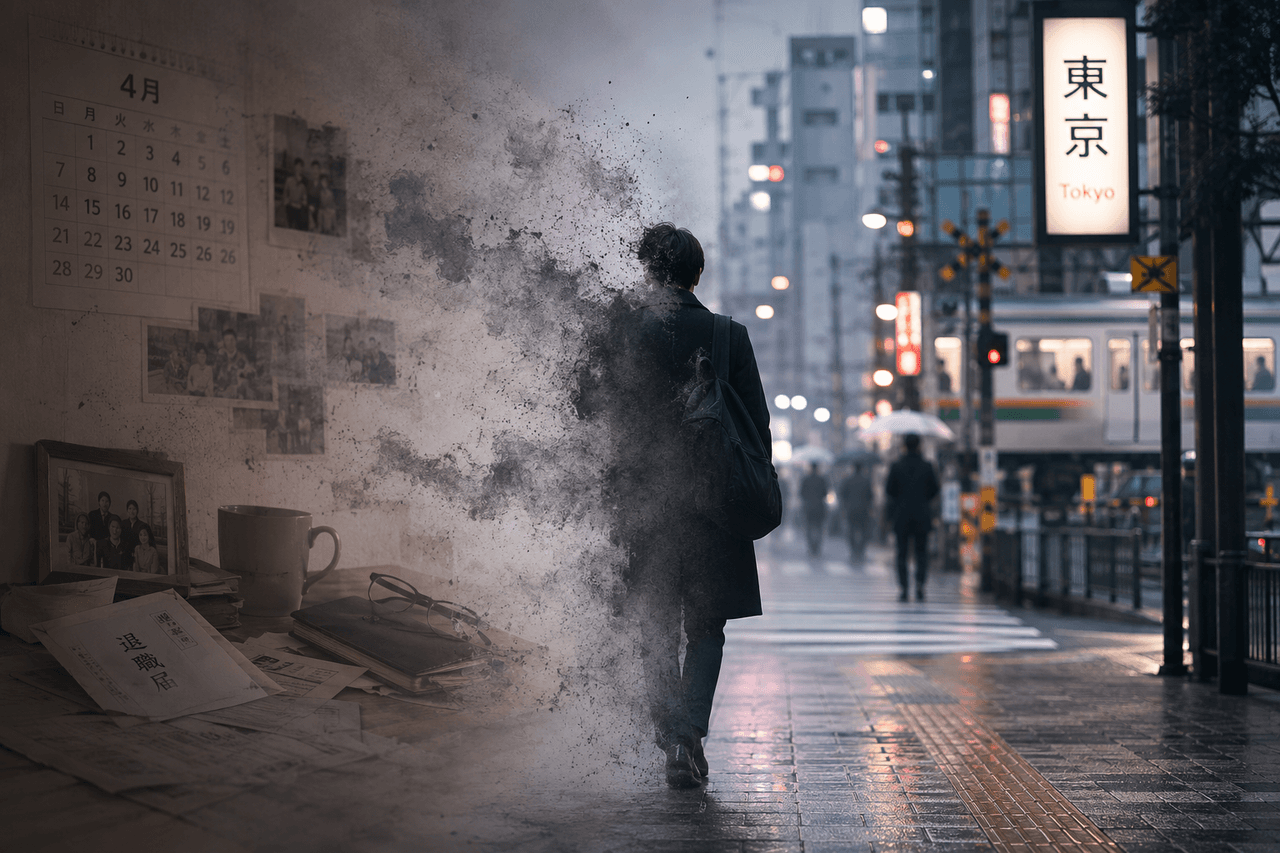
Johatsu (Generated with Artificial Intelligence.)
Word Meaning | Evaporation or "Evaporated humans" | ||||||||
|---|---|---|---|---|---|---|---|---|---|
Origin | Japan | ||||||||
Type | Sociological and Psychological Phenomenon | ||||||||
Basic Causes | Feeling of failure Death from overwork (karoshi) Gambling addiction Toxic relationships | ||||||||
Related Works | The Lost Man (1967, Dir: Shohei Imamura) Johatsu: Into Thin Air (2024 documentary) | ||||||||
Way of Life | Complete anonymity Low-profile jobs Fear of capture | ||||||||
Concentrated Areas | Sanya (Tokyo) Kotobukicho (Yokohama) Kamagasaki (Osaka) | ||||||||
Johatsu is a sociological term derived from the Japanese word meaning "evaporation" or "evaporated people" that describes the act of individuals voluntarily abandoning their current lives, families, jobs, and identities without leaving any trace.
This phenomenon first entered social literature in the 1960s when individuals seeking to escape unhappy marriages abandoned their spouses due to the difficulty of divorce proceedings.【1】 In later decades, during the early 1990s, the economic downturn and collapse in Japan, along with the resulting unstable employment conditions, led to salaried workers struggling under financial crises and debt burdens deliberately abandoning their lives, bringing the phenomenon back into public discourse.
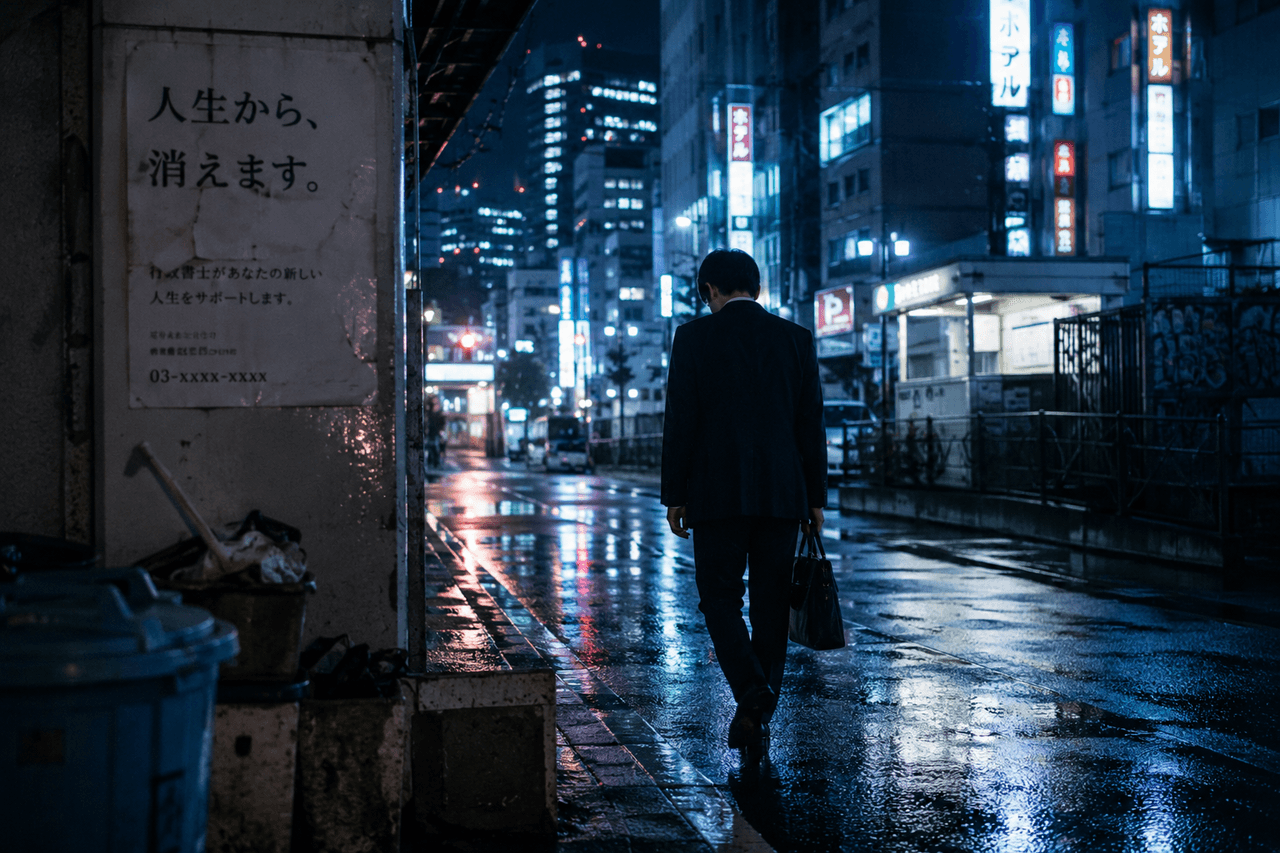
Johatsu (Yapay Zeka ile Oluşturulmuştur.)
As a concept with social resonance, it has been depicted in artistic works such as Shohei Imamura’s 1967 film The Man Who Left His Will on Film, which semi-documentarily portrays the disappearance of a sales representative and his fiancée’s search for him, as well as in the work of journalist Léna Mauger and photographer Stéphane Remael titled The Vanished: Stories and Photographs of Japan’s “Evaporated People”, and the 2024 documentary Johatsu: Into Thin Air.【2】
While conceptually paralleling the Japanese folkloric term kamikakushi, which means "hidden by the gods" and refers to people vanishing in inexplicable ways, those who undergo johatsu do not disappear due to supernatural forces but rather choose invisibility entirely through their own will and deliberate decisions.【3】
The decision of individuals to completely abandon their lives stems from sociological and psychological pressures arising from structural features of Japanese society, where honor, pride, and social standing are held in the highest regard. Situations such as being fired from a job, failing entrance examinations, or being unable to bear the responsibility expected of taking over a family business create intense pressure on individuals.
Rather than confront their families or communities over failure, individuals may view the silence and invisibility of disappearance as their only viable escape.【4】 Financially, motivations include escaping gambling addiction (particularly to pachinko), overwhelming debt, and threats from loan sharks; individuals held financially liable for others’ debts due to Japan’s guarantor system may also resort to this path.
In addition, women seeking to flee abusive relationships, domestic violence, or persistent stalkers, as well as spouses unwilling to endure the social stigma associated with formally ending loveless marriages, voluntarily choose to evaporate.
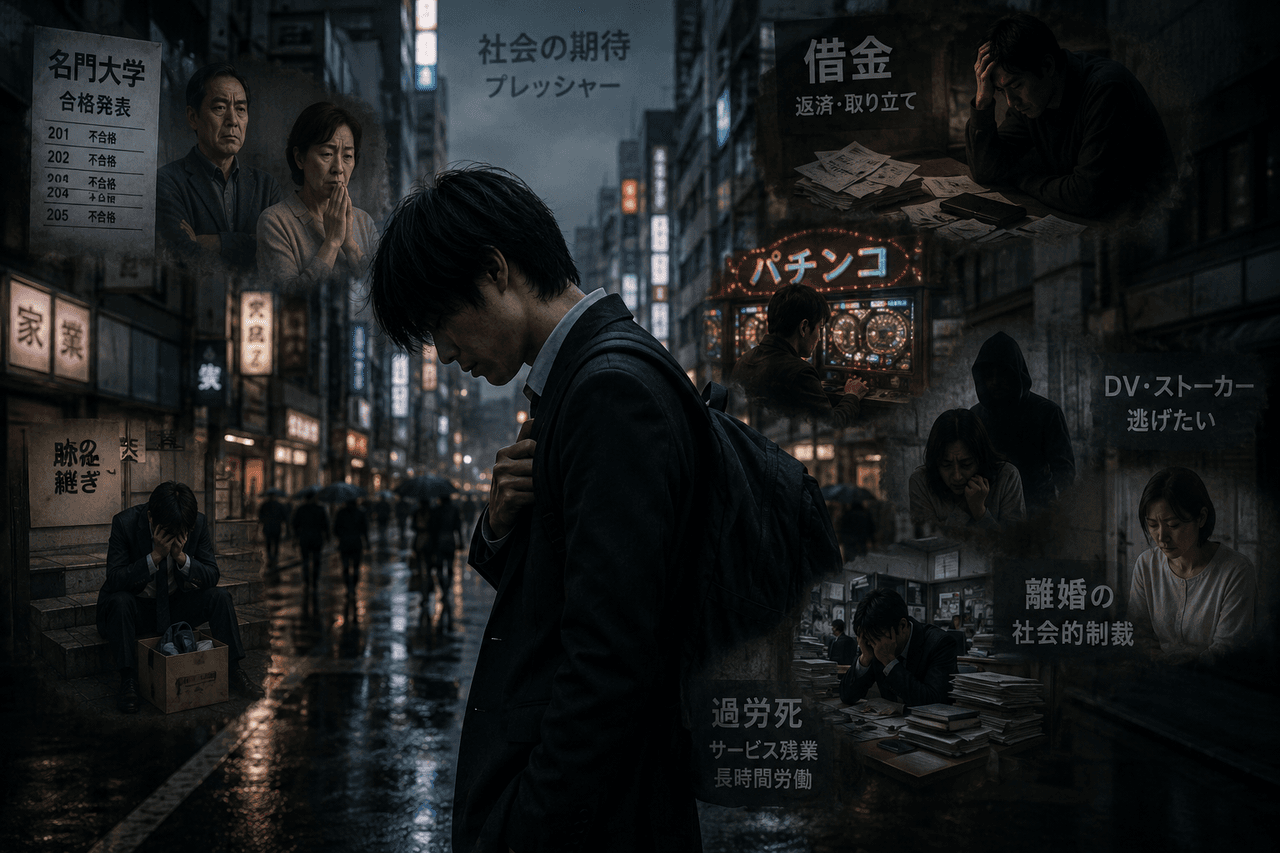
A Visual Representing the Primary Causes of Johatsu (Generated by Artificial Intelligence.)
In the workplace, the desire to avoid oppressive managers, toxic work environments, and the risk of karoshi—death from overwork—has made disappearance an acceptable alternative for some individuals seeking to preserve their lives.
In Japan, specialized companies and commercial entities known as "night movers" or "night escape agencies" (yonige-ya) facilitate the practice of johatsu. These organizations offer services to clients seeking to start new lives without a trace, including midnight evacuations of homes, cancellation of phone numbers, termination of subscription contracts, and establishment of informal, untraceable identity mechanisms.
Operations are typically conducted at night to ensure discretion and complete secrecy, with service costs varying between 50,000 yen (approximately 450 dollars) and 300,000 yen (approximately 2,600 dollars), depending on the volume of belongings to be moved, distance, whether children are involved, or the need to evade creditors.【5】
Agencies conduct background checks on clients to avoid assisting those involved in illegal activities or fleeing justice, provide financial counseling to debtors, and search for hidden tracking devices in the living spaces of abuse victims. Individuals who choose to disappear on their own often rely on guidebooks sold online that offer practical escape instructions.【6】
Japan’s strict legal and social protections of personal privacy facilitate the erasure of traces by those who disappear, allowing them to live undetected by modern technological surveillance systems. Unless there is evidence of a crime, accident, or suspected suicide, Japanese police are legally prohibited from intervening in or initiating searches for adult individuals who voluntarily vanish.【7】
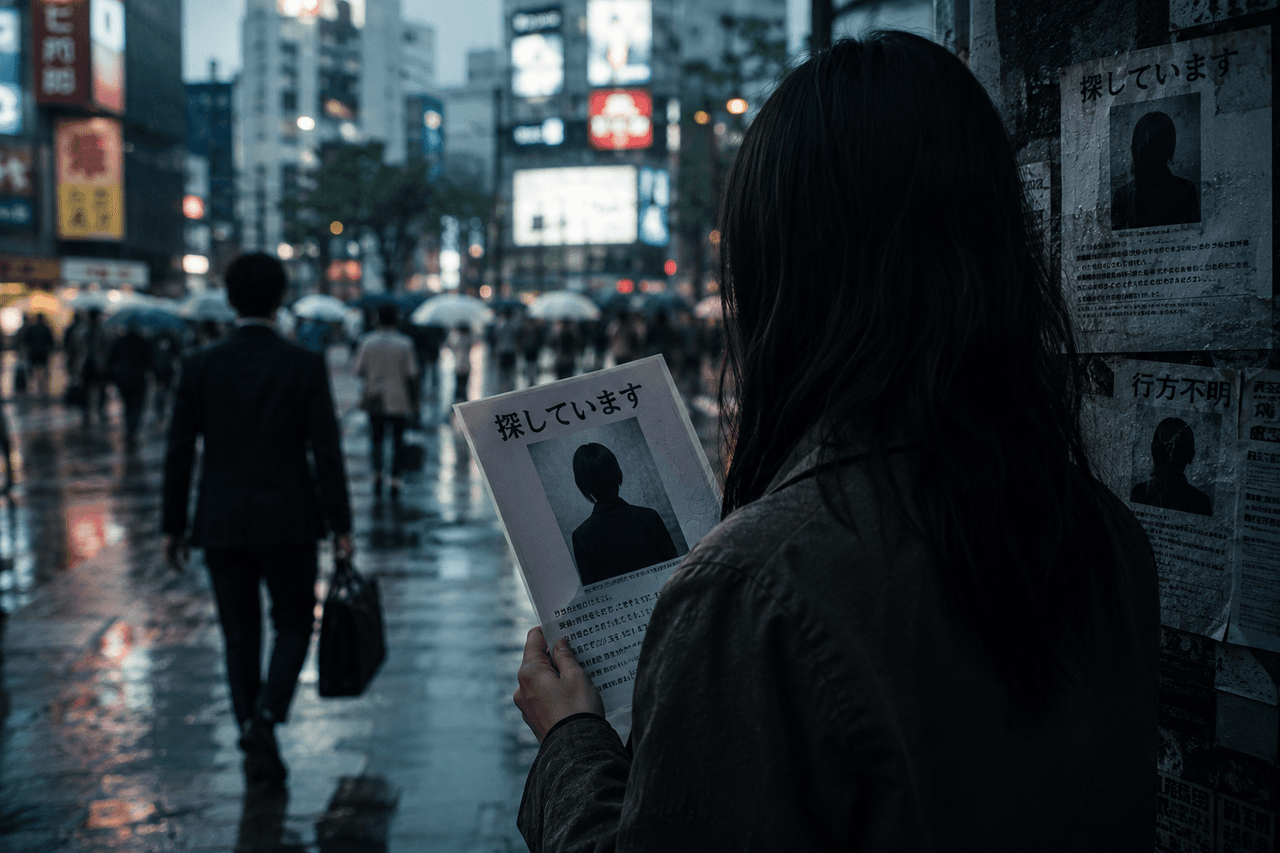
Kaybolan Yakınını Arayan Bir Kişinin Görseli (Yapay Zeka ile Oluşturulmuştur.)
Due to this legal protection regime, missing persons can withdraw money from bank ATMs, and security camera footage or official records are not shared with third parties, including family members. As a result, left-behind families are often forced to pay private detectives for information or simply wait without any leads.
This legal protection, designed to deter persistent stalkers, treats parents searching for their children and fugitives equally, creating emotional trauma for those left behind.
Individuals who disappear rebuild their lives around anonymity, secrecy, and low visibility. They typically settle in sparsely populated areas or suburban districts such as Sanya in Tokyo, Kotobukicho in Yokohama, and Kamagasaki in Osaka—areas historically inhabited by daily laborers and now characterized by inexpensive rooms and affordable restaurants.【8】 There, they survive by working in jobs that require no background checks, are unofficial, or have low profiles. While some find relief in the freedom from social pressures and the expectations of their former lives, others struggle with fear of capture, loneliness, guilt over abandoning their families, and feelings of remorse.【9】
According to statistics from the National Police Agency of Japan, approximately 80,000 to 82,000 official missing persons reports are filed annually, and most of these individuals are located within days or weeks.【10】 However, sociologists and civil society organizations estimate that the true number of johatsu—those who deliberately avoid official records, refuse to be found, or lack access to search support—is several times higher, reaching hundreds of thousands.【11】
BBC. "The companies that help people vanish." Accessed July 19, 2026.https://www.bbc.com/worklife/article/20200903-the-companies-that-help-people-vanish
Hingott, Moritz. "Why people voluntarily disappear in Japan." Japan Today. Accessed July 19, 2026.https://japantoday.com/category/features/lifestyle/why-people-voluntarily-disappear-in-japan?comment-order=latest
TIME. "Do Stressed-Out Japanese Really Stage Elaborate Disappearances? On the Trail of the Johatsu or 'Evaporated People'". Accessed July 19, 2026.https://time.com/4646293/japan-missing-people-johatsu-evaporated/.
Times of India. "What is 'Johatsu' the scary Japanese phenomenon where people VANISH." Accessed July 19, 2026.https://timesofindia.indiatimes.com/life-style/relationships/work/what-is-johatsu-the-scary-japanese-phenomenon-where-people-vanish/articleshow/117892018.cms
[1]
BBC, "The companies that help people vanish", erişim 19 Temmuz 2026, https://www.bbc.com/worklife/article/20200903-the-companies-that-help-people-vanish.
[2]
Moritz Hingott, "Why people voluntarily disappear in Japan", Japan Today, erişim 19 Temmuz 2026, https://japantoday.com/category/features/lifestyle/why-people-voluntarily-disappear-in-japan?comment-order=latest.
[3]
Moritz Hingott, "Why people voluntarily disappear in Japan", Japan Today.
[4]
Times of India, "What is 'Johatsu' the scary Japanese phenomenon where people VANISH," Accessed July 19, 2026.
[5]
TIME, "Do Stressed-Out Japanese Really Stage Elaborate Disappearances? On the Trail of the Johatsu or 'Evaporated People'", Accessed July 19, 2026.
[6]
Moritz Hingott, "Why people voluntarily disappear in Japan", Japan Today.
[7]
BBC, "The companies that help people vanish".
[8]
TIME, "Do Stressed-Out Japanese Really Stage Elaborate Disappearances? On the Trail of the Johatsu or 'Evaporated People'".
[9]
BBC, "The companies that help people vanish".
[10]
TIME, "Do Stressed-Out Japanese Really Stage Elaborate Disappearances? On the Trail of the Johatsu or 'Evaporated People'".
[11]
TIME, "Do Stressed-Out Japanese Really Stage Elaborate Disappearances? On the Trail of the Johatsu or 'Evaporated People'".

Johatsu (Generated with Artificial Intelligence.)
Word Meaning | Evaporation or "Evaporated humans" | ||||||||
|---|---|---|---|---|---|---|---|---|---|
Origin | Japan | ||||||||
Type | Sociological and Psychological Phenomenon | ||||||||
Basic Causes | Feeling of failure Death from overwork (karoshi) Gambling addiction Toxic relationships | ||||||||
Related Works | The Lost Man (1967, Dir: Shohei Imamura) Johatsu: Into Thin Air (2024 documentary) | ||||||||
Way of Life | Complete anonymity Low-profile jobs Fear of capture | ||||||||
Concentrated Areas | Sanya (Tokyo) Kotobukicho (Yokohama) Kamagasaki (Osaka) | ||||||||
Historical Development
Primary Causes
Logistics of the Disappearance Process
Social Regime of Privacy
Post-Disappearance Lifestyle and Statistical Indicators