


This article was automatically translated from the original Turkish version.

Jan Schmidt was born in 1951 in Arnhem, Netherlands. He studied at Leiden University in the Department of History, Middle Eastern Languages and Cultures from 1969 to 1985 and continued his academic work at the same institution. In 1992, he completed his doctorate at Leiden University with a new perspective on the work Künhü’l-Ahbar, written in 1590 by Gelibolulu Mustafa Âli, a figure of major importance in Turkish literature. While continuing his research in the Netherlands, he taught for a period before moving to England, where he taught courses on Turkish and Ottoman studies at the University of Manchester. He later returned to Leiden to focus on Ottoman linguistics, history and literature. He compiled a catalogue of Turkish manuscripts held in the Leiden University Library, a work that increased his recognition among academic circles in Türkiye. His catalogue covers a broad chronological range from the 16th to the 20th centuries. His research has primarily focused on the political and cultural relations between Europe and the Ottoman Empire.
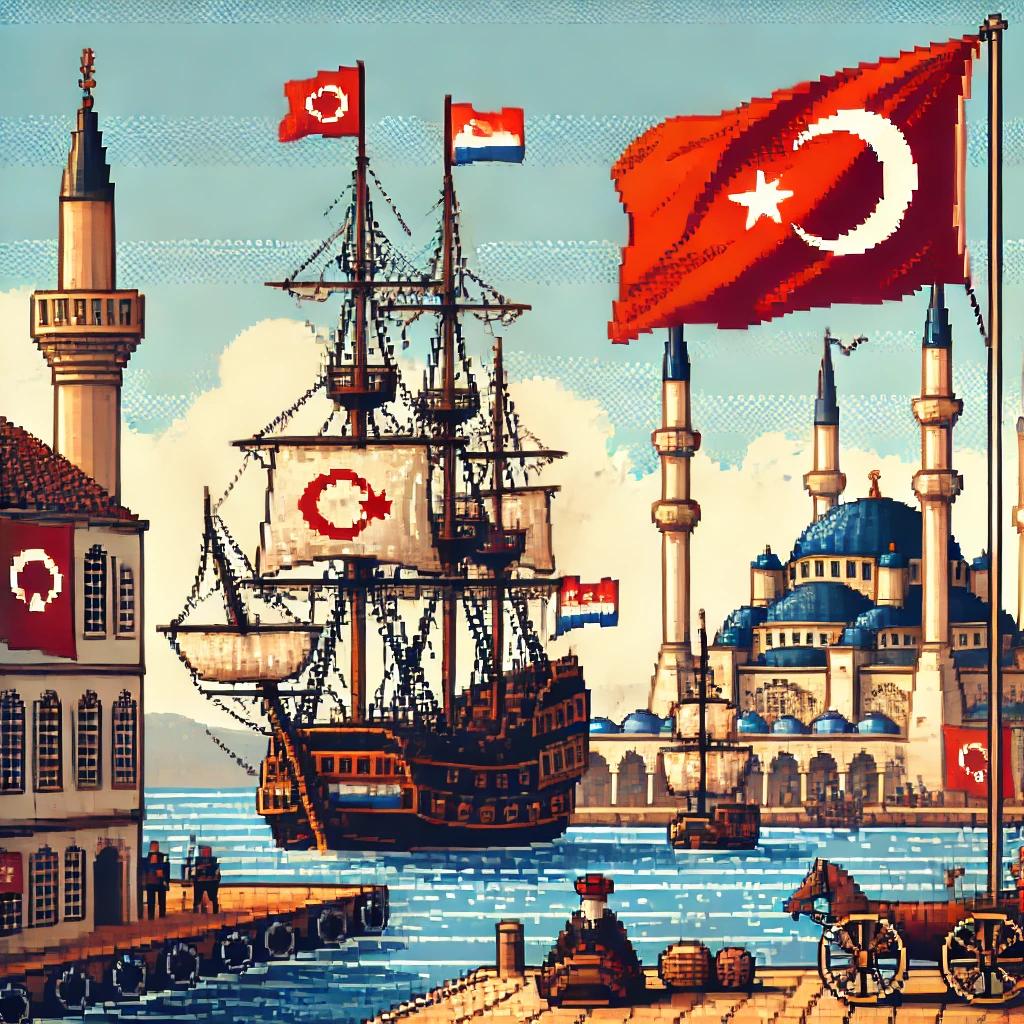
Dutch Ship in Ottoman Waters (Generated by Artificial Intelligence)
Schmidt has also authored various works related to this research. Focusing on topics that served as a bridge between the Dutch East Indies and the Ottoman Empire, he completed the works From Anatolia to Indonesia: Opium Trade and the Dutch Community of Izmir, 1820-1940 and Through the Legation Window 1876-1926: Four Essays on Dutch, Dutch-Indian and Ottoman History. In both works, he approaches his subjects from multiple angles. While social, cultural and political perspectives are predominant, economic and trade aspects play a significant role in his study of the opium trade. This study involves an analysis of these two works to provide a short evaluation of Jan Schmidt and his contributions.
First, the work Through the Legation Window 1876-1926: Four Essays on Dutch, Dutch-Indian and Ottoman History will be examined. As the title suggests, the book consists of four essays on Dutch history, the Dutch colonial territories in Southeast Asia and Ottoman history. The essays are as follows:
Although each essay addresses specific topics, when considered as a whole, the book presents a general picture of Ottoman-Dutch relations and Dutch colonial territories during the Modern Era. Through case studies on social, economic and political issues, readers can gain insight into Ottoman-Dutch relations and the context of Dutch colonies. A closer examination of the essays can now proceed in order.
The first article in Schmidt’s work, Banditry and the Dutch Colony in the Vilayet of Aydın, examines Ottoman society’s reactions against Europeans. The article details numerous incidents of abduction of European merchants and colonists living on Ottoman territory. With many examples, it explores how these abductions were carried out and their consequences, such as demands for ransom.
The perpetrators of these abductions were not only Turks; Bulgarian committees also played an active role in such incidents. In this article, Schmidt analyzes the local resistance dynamics within Ottoman society and the motivations behind these violent acts against Europeans. The abduction of Europeans provides an important perspective for understanding Ottoman-European relations and social unrest in the Aydın vilayet during this period. It can be argued that the primary motivation for these acts was to demonstrate opposition to the economic and political influence exerted by European imperialists and their supporters.
Another topic addressed in the article is the Dutch colony in İzmir. Like other European powers pursuing imperialist aims, the Dutch established colonies to expand their trade networks and strengthen their influence at strategic locations. The Dutch chose İzmir, the gateway from Anatolia to Europe, as their base in Ottoman territory. Their first settlement in the region dates back to 1612. In summary, the article focuses on Dutch activities in the region and incidents of robbery and violence.
The second article in the work is Dutch Involvement in the Armenian Question. This article examines how the Netherlands became involved in Armenian affairs. From the 1878 Congress of Berlin onward, Armenians were used by European powers as a tool to interfere in Ottoman internal affairs. As events unfolded with the outbreak of the First World War, European powers sought to send observers to the region. Since it was inappropriate for an active belligerent to send inspectors, the idea arose to appoint a Dutch observer. A key point discussed in the article is the appointment in 1914 of Louis Constant Westenenk, Governor of the Dutch East Indies, as inspector to the region. His appointment is one of the most important details in this study.
The Sublime Porte also welcomed the idea of a Dutch inspector from the outset, and even Said Halim Pasha personally contacted Dutch authorities to determine whether any Dutch East Indian was suitable for the position. Other European powers preferred the appointment of an inspector from a neutral country. A candidate had already emerged in the Netherlands: Louis Constant Westenenk, a distinguished Dutch East Indian administrator who had been twice honored with royal orders and was in the Netherlands on a ten-month leave while teaching in the provinces.
Other strong candidates considered for the inspectorship were a Belgian who had served in the Congo and a Swiss national. However, the Belgian candidate’s nomination was not favorably received due to the argument that “the Armenians were not Black.” Ultimately, the Dutchman Westenenk and the Norwegian Colonel Nicolai Hoff were accepted. When appointing an inspector to Eastern Anatolia, the preference for someone who had served in the East of Asia suggests that the Dutch viewed the “East” as similar, if not identical, to other Europeans.
Pan-Islamism Between the Porte, the Hague and Buitenzorg is Schmidt’s third essay in the book. The article reveals the Dutch approach to Pan-Islamism. It examines the efforts of Muslims in the Dutch colonies to assert their rights within the triangle formed by the Sublime Porte (Istanbul), The Hague and Buitenzorg (today known as Bogor, a city in Indonesia) and their activities under the banner of Pan-Islamism. The article suggests that the Dutch had no reason to fear Pan-Islamism as other colonial European powers did, because the Netherlands was not a threat to the Ottoman Caliphate, unlike Britain or Russia. The Caliphate had no incentive to incite Muslims in the Dutch colonies.
The article also notes that Muslims in Indonesia frequently communicated their grievances to Ottoman authorities and sought protection from colonial powers under the Ottoman Empire. As a result, the article includes details of diplomatic processes between the Ottoman Empire and the Netherlands. This essay is valuable for understanding the Ottoman Empire’s relations with Muslims in its Dutch colonial territories during the Modern Era.
Schmidt’s fourth essay, Showing the Flag: The Dutch Navy in Ottoman Waters, examines how the Netherlands sent ships into Ottoman waters to advance its commercial and political interests. However, according to Schmidt, the Dutch navy’s attempts to “show the flag” in Ottoman waters revealed that the Netherlands was no longer a naval power as it had been during the Golden Age of the Republic. The Dutch fleet was too small and its manpower insufficient in quality. Most importantly, Dutch naval presence depended on British approval and support; they could not undertake such activities without British consent. This essay analyzes the minor maritime conflicts and diplomatic maneuvers between the Ottoman Empire and the Netherlands.
From Anatolia to Indonesia: Opium Trade and The Dutch Community of Izmir, 1820-1940 is Schmidt’s other major work on Dutch colonial territories in Southeast Asia and the Ottoman Empire. The book generally provides information on opium production and trade. It explains, within a historical context, how opium production and trade developed globally during the 19th century and their economic and political significance. Schmidt compares opium consumption in Asia and Europe. More specifically, in the section relevant to this study, he details the role of opium within the Ottoman Empire, presenting data on its production, trade and consumption in Anatolia and İzmir. He emphasizes the Ottoman Empire’s strict control over opium.
More specifically, the book describes the role of Dutch merchants and seafarers in Ottoman opium trade. Schmidt provides detailed numerical data and statistics showing how opium produced in Anatolia was exported via Dutch merchants and colonists in İzmir to Dutch colonies in Southeast Asia. Fluctuating prices from year to year are also documented. For example, in 1825, the price of one çeki of opium in İzmir ranged between 40 and 62 kuruş, rising to 160–390 kuruş by 1868, before falling again. The primary source used in the book is Dutch archives.
In both works, Jan Schmidt focuses on relations between the Ottoman Empire and the Dutch colonies in Southeast Asia. He does not examine these relations from a single perspective but analyzes them politically, culturally, commercially and even militarily in terms of maritime affairs. Schmidt’s approach, grounded in documentary evidence and avoiding subjective interpretations, makes the two works—Through the Legation Window 1876-1926: Four Essays on Dutch, Dutch-Indian and Ottoman History and From Anatolia to Indonesia: Opium Trade and The Dutch Community of Izmir, 1820-1940—valuable resources for future research on Dutch colonial ties with the Ottoman Empire.
Schmidt, Jan. From Anatolia to Indonesia: Opium Trade and The Dutch Community of Izmir. Leiden: Nederlands Historisch-Archaeologisch Instituut Te Istanbul, 1998.
Schmidt, Jan. Through the Legation Window 1876-1926: Four Essays on Dutch, Dutch-Indian and Ottoman History. Leiden: Nederlands Historisch-Archaeologisch Instituut Te Istanbul, 1992.