This article was automatically translated from the original Turkish version.
Type(s) | Food | ||||||||
|---|---|---|---|---|---|---|---|---|---|
Region(s) | Black Sea | ||||||||
Cooking | Frying | ||||||||
Main Ingredients | Anchovy, Corn Flour | ||||||||
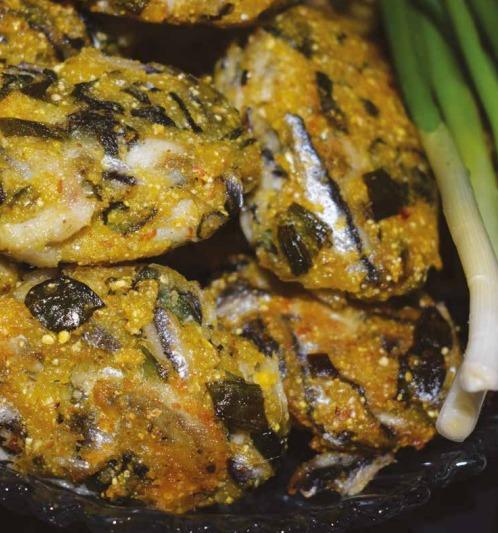
Hamsikuşu is a traditional dish from Türkiye’s Eastern Black Sea Region, particularly in the areas of Trabzon and Rize, prepared by shaping minced fillets of hamsi fish mixed with corn flour, wheat flour, various green vegetables, water, and spices into meatball-like forms. This product, an original component of the regional culinary culture shaped by the area’s geographical, climatic, and cultural characteristics, can be produced using either fresh or salted hamsi. In local dialects, the term also refers to the seagull bird.
In the Eastern Black Sea Region, where climate and geography have shaped the culinary culture, fish-based dishes hold a prominent place due to coastal settlement patterns. The hamsi fish has become an important cultural symbol for the region and forms the foundation of its regional cuisine, contributing to its distinct identity. Hamsikuşu is among the quick-preparing and practical dishes characteristic of Eastern Black Sea cuisine. One of the main reasons for its rapid preparation and enduring popularity is the fact that local women have traditionally engaged in regular work outside the home, leaving limited time for cooking.
Historically, this dish has been produced and consumed continuously throughout summer and winter. During the fishing season, which spans November to March, hamsikuşu is made with fresh hamsi. In the summer months outside the fishing season, it is prepared using salted hamsi that have been matured for one month in a 25% salt solution. Traditionally, butter or olive oil was used in preparation, but today sunflower oil has replaced these fats.
During the early years of the Republic, as part of language standardization efforts, the Turkish Language Research Society (Turkish Language Association) established the Provincial Dialect Collection Commission to document vernacular expressions. Fieldwork conducted in the region recorded the term “hamsikuşu.” The word was published between 23 March 1933 and 10 August 1933 in the “Language Corner” section of the Rize newspaper, as part of a collection effort led by Governor Ekrem Bey and local schoolteachers. In these surveys covering the Çoruh Province, which included Artvin and Rize regions excluding Yusufeli, the dish was described as “seagull, fried hamsi, and grilled hamsi” and incorporated into the region’s written cultural inventory.
The percentage composition by weight of ingredients used in hamsikuşu preparation follows these standard formulations depending on whether fresh or salted raw materials are used:
For preparations using salted hamsi, the fish are soaked in water overnight, with the water changed several times until the salt is sufficiently removed. After cleaning, the heads and internal organs are removed, and the bones are manually extracted to obtain fillets.
The vegetables used in the dish—chard, green onion, and parsley—are washed in clean water, dried, and finely chopped with a knife. In a large container, corn flour and wheat flour are gradually mixed with hot water to form a dough. The prepared hamsi fillets, chopped vegetables, and spices are then added to this dough matrix and thoroughly blended. From this mixture, small portions weighing approximately 20–25 grams are hand-shaped into meatball forms.
Traditionally, the dish is cooked by pan-frying. The meatballs are placed in a preheated pan with sunflower oil, fried on one side until browned, then turned to cook the other side. The product is also suitable for baking or grilling.
Hamsikuşu is consumed as a main dish in Eastern Black Sea regional gastronomy, often served with salad, or as a breakfast item accompanied by tea. Due to its corn flour content, the dish tends to harden quickly upon cooling. This physical change negatively affects its textural quality; therefore, it must be consumed hot immediately after cooking, without cooling.
Accessed November 26, 2025. https://www.aa.com.tr/tr/kultur/ahlatta-acilan-kurslarla-geleneksel-tas-isciligi-yasatiliyor/3116279.
Accessed November 26, 2025. https://www.aa.com.tr/tr/kultur/ahlatta-acilan-kurslarla-geleneksel-tas-isciligi-yasatiliyor/3116279.
Accessed November 26, 2025. https://www.aa.com.tr/tr/kultur/ahlatta-acilan-kurslarla-geleneksel-tas-isciligi-yasatiliyor/3116279.
Accessed November 26, 2025. https://www.aa.com.tr/tr/kultur/ahlatta-acilan-kurslarla-geleneksel-tas-isciligi-yasatiliyor/3116279.
Accessed November 26, 2025. https://www.aa.com.tr/tr/kultur/ahlatta-acilan-kurslarla-geleneksel-tas-isciligi-yasatiliyor/3116279.
Kamber Taş, Songül Seda, and Sedat Taş. "Doğu Karadeniz Bölgesi Gastronomik Unsurlarının Gastronomi Turizmi Açısından Değerlendirilmesi." Dokap Bölgesi Uluslararası Turizm Sempozyumu Bildiriler Kitabı (October 2017): 1-9.
Köse, Sevim, Hikmet Karaçam, Sebahattin Kutlu, and Muhammet Boran. "Investigating the Shelf-Life of the Anchovy Dish Called 'Hamsikusu' in Frozen Storage at -18±1ºC." Turkish Journal of Veterinary and Animal Sciences 25, no. 4 (2001): 651-656.
Trabzon Büyükşehir Belediyesi. Trabzon Kültür Mirası ve Gastronomi Rehberi. Trabzon: Trabzon Büyükşehir Belediyesi Yayınları, 2024.
Trabzon Valiliği. "Yöresel Yemeklerimiz." Accessed May 18, 2026.
Trabzon İl Kültür ve Turizm Müdürlüğü. "Yöresel Yemekler." Accessed May 18, 2026.
Uzun, Muzaffer. "Dil Seferberliği Kapsamında Birinci Derleme Çalışması: Rize Örneği." Karadeniz İncelemeleri Dergisi 22 (2017): 109-138.
https://www.researchgate.net/publication/331070723_DOGU_KARADENIZ_BOLGESI_GASTRONOMIK_UNSURLARININ_GASTRONOMI_TURIZMI_ACISINDAN_DEGERLENDIRILMESI

Type(s) | Food | ||||||||
|---|---|---|---|---|---|---|---|---|---|
Region(s) | Black Sea | ||||||||
Cooking | Frying | ||||||||
Main Ingredients | Anchovy, Corn Flour | ||||||||
History and Cultural Background
Ingredient Composition and Formulation
Preparation and Cooking Methods
Consumption Characteristics