


This article was automatically translated from the original Turkish version.
+1 More
Yada Stone is a stone known in Turkish cultural history to have been used in a manner akin to magic to control weather phenomena such as snow and rain. The Yada stone is mentioned under various names in Turkish dialects and Islamic sources: in Yakut as sata, in Kyrgyz as cay taş, in Kazakh as jadı taş and jay taş, in Bashkir as balataş and yeytaş, in Uyghur as kaştaş, in Altai as cada taş, and in Tuvan as çat taş.
In Arabic Islamic sources it is referred to as hacerü'l-metar (rain stone), el-câlibü’l-matar; in Persian sources as seng-i metar (rain stone), seng-i ceda (Ceda stone), seng-i yede; and in Mongolian sources as dzada (rainy) or ced. Other descriptions include magical stone, bezoar, and rain bead. Those who perform the practice are called yatçı, yedeci, yadacı, yedaa, cedeci, or yağmurcu.【1】
It is known that this practice has been carried out among the Turks since very ancient times. The earliest information about the Yada stone is found in Chinese sources. Information regarding the Yada stone appears in Islamic sources from the 10th and 11th centuries onward. In old Turkic traditions the Yada stone is regarded as a magical element that grants dominion over the world. While some sources identify the Yada stone as the same as jade, other researchers hold the view that the Yada stone and jade or kaş taş are distinct entities.【2】 【3】

Yadacılık (Yapay Zeka ile Oluşturulmuştur)
The Yada stone comes in various colors: yellow, red, blue, green, brown, earth-toned, white, pure white, dark red, white with red spots, dusty, black, and reddish or olive green. It is a hard stone composed of silica, alumina, calcium, and magnesium.
It is also described as a semi-transparent silicate stone. It may be the size of a large bird’s egg, the thickness of a walnut, the length of a sheep’s egg, round, very small, or shaped like a human head. According to Yakut belief (the sata stone), it is a living entity resembling a human head, with a visible face, eyes, ears, and mouth. If touched by a woman or an outsider’s hand or gaze, it dies and loses its power.
The primary function of the Yada stone is to alter weather conditions, a practice known as yadacılık or yat. Numerous examples exist of snow and rain being induced through magical means using the stone. Kaşgarlı Mahmud recorded having witnessed with his own eyes how snow was summoned to extinguish a fire during summer in the land of Yagma.
It was commonly believed that those who practiced yadacılık as a profession lived in poverty. It was widely held that with every use of the Yada stone, they suffered a calamity such as the death of a family member or damage to their property or livestock.
Various legends about the origin of the Yada stone appear in sources from different nations and cultures. According to some Arabic and Persian sources, the origin of the Yada stone traces back to the Prophet Noah (Hz. Nuh). After the Flood, Noah sent his son Japheth to the northwestern regions encompassing Turkic, Slavic, and Chinese lands. Japheth, when in need, asked his father for a gift that could bring rain. Noah prayed to God, and the angel Gabriel brought a blessed name, which Noah inscribed on a stone and gave to Japheth. Japheth wore the stone around his neck like an amulet.【4】 According to sources, when this name is invoked, snow and rain fall; when invoked again, they cease. It was believed that this stone remained among the Turks descended from Japheth, and this is cited as the reason why the Turks practiced rain-making with stones.【5】
Another widely held view regarding the origin of the Yada stone is that it has an animal source. According to some legends, the Yada stone is found in the nest of a large, red-winged wild duck called Sürhab, native to regions of China and Iran. This bird builds its nest in shallow lakes, and when waters recede in summer, the stone is extracted from the nest. Among the Kyrgyz, the stone is said to be found in the stomach of a sheep. In a Kyrgyz-Kazakh epic, it is stated that the stone resides in the liver of a horse. The Yakuts report that it must be sought in places struck by lightning and also within the intestines of oxen, bears, wolves, dogs, ducks, geese, and eagles. It is also rumored to emerge from the belly of a pig-like animal.
Kaşgarlı Mahmud’s work, Dîvânu Lügâti’t-Türk, dating from the Karakhanid period, is one of the sources demonstrating how widespread the Yada tradition was. Kaşgarlı Mahmud referred to the Yada stone as yat. He defined it as follows:
''Yat is a form of sorcery. It is performed with certain stones (the Yada stone), causing rain and snow to fall and wind to blow. This is a well-known practice among the Turks. I witnessed it myself in the land of Yagma. There was a fire there during summer, and by this means snow was summoned, and by God’s permission the fire was extinguished.
Yatlamak: To cause rain to fall.
Yatçıy atladı. The shaman performed sorcery with the Yada stone.
Yatlatmak: To have a soothsayer perform rites with the Yada stone.
Beg yatlattı: The lord caused rain, wind, and cold by reciting spells over the Yada stone.【6】
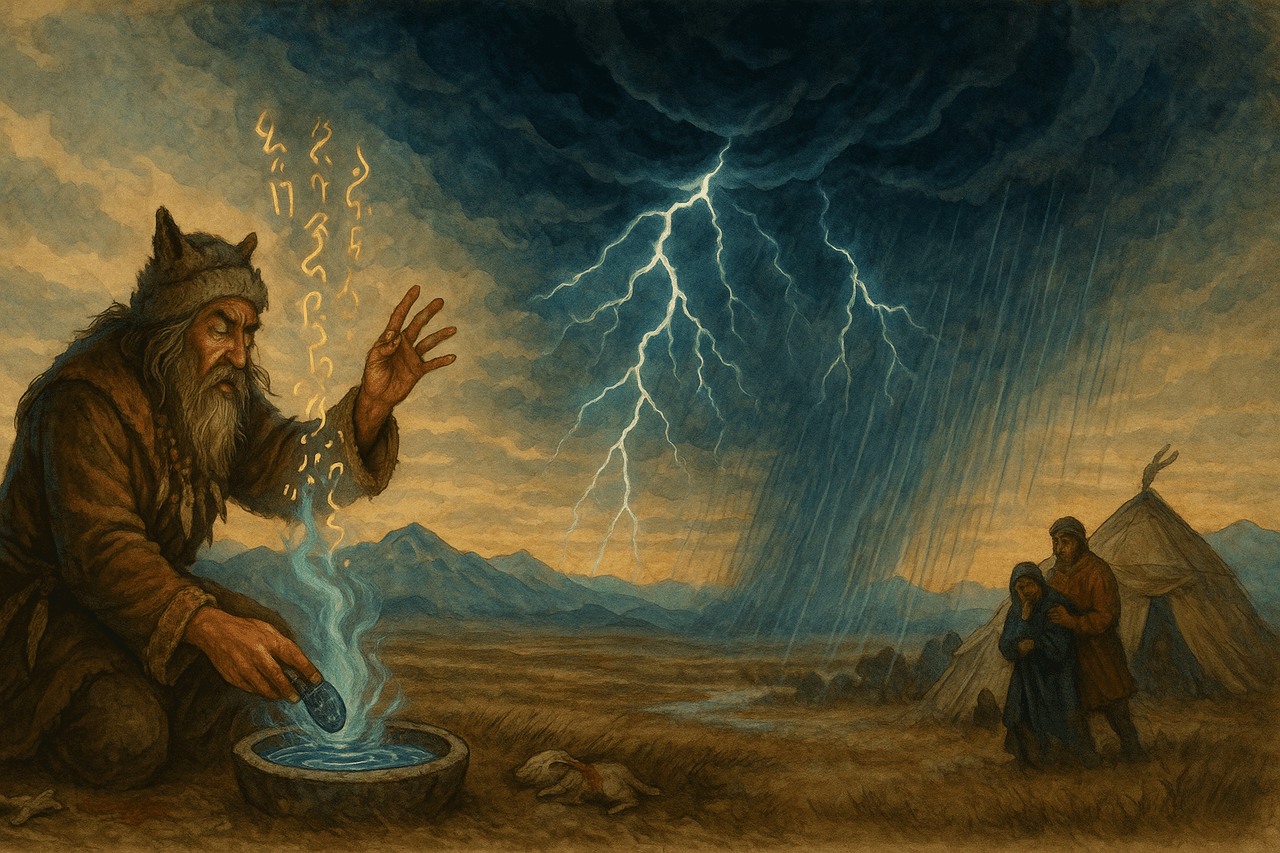
Yadacılık (Yapay Zeka ile Oluşturulmuştur)
Babur Shah recorded in his own work, the Baburnama, direct observations and impressions regarding the profession of yadacı (one who controls weather phenomena by magic) and the act of yada yapma (performing the ritual). Babur mentions Ali Dost Tagayi, a relative of his mother from the Sagarıcı tümen, who served under Sultan Abu Said Mirza (Babur’s grandfather) and was accused of practicing yadacılık. Although Babur describes this individual with negative moral labels such as envious, scheming, and immoral, he nonetheless notes the accusation of yadacılık. Babur also states that Hoca Kelan’s elder brother, Haceki Molla Sadr, was a noble man, devoted to scholarship, of fine character, and knowledgeable in birding and yadacılık. This indicates that yadacılık was regarded at the time as a skill or a respected pursuit.
According to Babur’s records, the yadacılık tradition was used for practical purposes in warfare and daily life. Babur recounts that during the events of 935 AH (1528–1529 CE), the Uzbeks planned to use yadacılık to defeat the army of the Iranian prince Tahmasp. The Uzbek nobles ordered their yadacı to perform the ritual when the sun entered the sign of Scorpio, aiming to harass and defeat the Qizilbash forces. This illustrates how the Yada stone was viewed as a weapon capable of altering the course of battle.
Babur, complaining of the dust and heat of India, recounts that during their arrival in Shiravali in the spring of 1529, one of his commanders, Tohta Buğa Sultan, had performed yadacılık. As a result, a strong wind arose and rain fell, improving the weather. Babur personally witnessed and confirmed this event, noting that the practice of yadacılık produced tangible results.
The records in Babur’s work demonstrate that the practice of yadacılık (inducing snow, rain, and wind through magic with the Yada stone) was not merely an ancient Turkic myth but remained a living, widespread, and effective practice in 16th-century Turkistan and the Turk-Mongol regions during Babur’s reign. Even after the Turks converted to Islam, they continued the custom of performing yada. However, in Anatolia it became Islamicized or faded into the background. Nevertheless, this tradition persisted until the last century among Turkic communities such as the Kalmyks, Kazakhs, Kyrgyz, and Uzbeks.
In ancient Turkic and Mongol cultures, the Yada stone and the tradition of yadacılık were widely employed based on the belief that they possessed the power to control weather phenomena. This tradition was especially regarded as a weapon against enemies in warfare. According to epics, the Yada stone was among the weapons carried by heroes. With its magical power, heroes could alter the weather at will, summoning rain, snow, and hail. The Turks carried the Yada stone into battle and thereby gained victories over their enemies. Individuals who performed these rites were retained in the army for the purpose of securing triumph.
Huns: They defeated their enemies by summoning rain, hail, and snow or by creating storms and winds. In the 5th century, during the rule of the Northern Huns, the shamans of the Yüeban people summoned violent rain and storms to resist attacks by the Cücen; as a result, one-third of the Cücen forces drowned in floods or perished from the cold.【7】
Naimans: The Naimans, a Turkic tribe that became Mongolized, used their yadacı in a battle against Genghis Khan in 1202.【8】
Khwarezmians: Jalal ad-Din Khwarezmshah (d. 1231) possessed a Yada stone and carried it with him on campaigns for use when necessary. Muhammad Khwarezmshah, before Genghis Khan’s invasion, was forced to bury alive the yadacı wrapped in a black goat’s hide after the weather turned uncontrollably bad during a campaign into Chinese territory; this caused the snow, rain, and severe cold to cease.【9】
The last documented instance of the Yada stone being used as a weapon in warfare occurred during the Ottoman-Russian War of 1768–1774, at the end of the 18th century. It is claimed that the Ottoman army’s first major defeat in this war was caused by this weapon. The non-Muslim Kalmyk Turks, who constituted about one-quarter of the Russian army, used it against the Muslim Ottoman Turks. As a result of the practice, the Ottoman army suffered heavy losses and was forced to retreat from all territories north of the Black Sea to the opposite bank of the Danube River.【10】
Hotin Battles: During the Hotin Battles of 1768–1774, Ottoman defenders returning after clashes with Russian cavalry were caught in a heavy rainstorm. The rain caused the river to swell, and many soldiers drowned while attempting to cross. The Lipkans and Hotin yamaks claimed that the rain was caused by magic and sorcery, identifying the Kalmyk Tatars as its source.【11】
In 1769, as Serdar-ı Ekrem Ali Pasha attempted to cross the Turla River and attack Russian forces, a violent rainstorm began. This caused the river to swell and the bridge to collapse, forcing Ottoman soldiers into panic and resulting in heavy casualties. After the rain, snow began to fall, and it was recorded that Russian forces remained unaffected and launched an attack.【12】
Kartal Defeat: The heavy losses suffered in the 1770 Kartal defeat were similarly attributed to heavy rain causing the Danube River to overflow and a bridge to collapse. Serdar-ı Ekrem Halil Pasha noted that the river’s fury matched that seen 59 years earlier during the time of Baltacı Mehmed Pasha. The source interprets this as possibly indicating that Baltacı had also been subjected to a similar Yada disaster.【13】
Gömeç, Saadettin Yağmur. “Türklerde Töz, Fal ve Yadacılığa Dair Bazı Tespitler.” *Selçuk Üniversitesi Selçuklu Araştırmaları Dergisi* 11 (2019): 37–62. Accessed October 22, 2025.https://dergipark.org.tr/en/download/article-file/929841
Güler, Mehmet. “Babürnâme’deki Örneklerden Hareketle Türk-Moğol Kültüründe Yadacılık Geleneği.” *Journal of Old Turkic Studies* 7, no. 2 (2023): 444–459. Accessed October 22, 2025.https://dergipark.org.tr/en/download/article-file/2971251
Öğreten, Ahmet. “Türk kültüründe ‘Yada Taşı’ ve XVIII. Yüzyıl Sonu Osmanlı-Rus Savaşlarında Kullanılması.” *Belleten* 64, no. 241 (2000): 863–900. Accessed October 22, 2025.https://belleten.gov.tr/tam-metin-pdf/2578/tur
[1]
Ahmet Öğreten. "Türk Kültüründe" Yada Taşı" ve XVIII. Yüzyıl Sonu Osmanlı-Rus Savaşlarında Kullanılması." Belleten 64.241 (2000): 863 https://belleten.gov.tr/tam-metin-pdf/2578/tur
[2]
Muvaffak Eflatun. "Klasik Türk Şiirinde Türk Mitolojisinin İzleri: Yada ve Galebe Taşı Örnekleri." Eski Türk Edebiyatı Araştırmaları Dergisi [Journal Of Old Turkish Literature Researches] 6.3 (2023): 578 https://dergipark.org.tr/en/download/article-file/3377126
[3]
Mehmet Güler. "Babürnâme’deki Örneklerden Hareketle Türk-Moğol Kültüründe Yadacılık Geleneği." Journal of Old Turkic Studies 7.2 (2023): 455 https://dergipark.org.tr/en/download/article-file/2971251
[4]
Saadettin Yağmur Gömeç. "Türklerde Töz, Fal ve Yadacılığa Dair Bazı Tespitler." Selçuk Üniversitesi Selçuklu Araştırmaları Dergisi 11 (2019): 47 https://dergipark.org.tr/en/download/article-file/929841
[5]
Eflatun. "Klasik Türk Şiirinde Türk Mitolojisinin İzleri: Yada ve Galebe Taşı Örnekleri." s. 574 https://dergipark.org.tr/en/download/article-file/3377126
[6]
Güler. "Babürâme’deki Örneklerden Hareketle Türk-Moğol Kültüründe Yadacılık Geleneği." s. 448. Son Erişim: 9.12.2025. https://dergipark.org.tr/en/download/article-file/2971251
[7]
Öğreten. "Türk Kültüründe" Yada Taşı" ve XVIII. Yüzyıl Sonu Osmanlı-Rus Savaşlarında Kullanılması." s. 867 https://belleten.gov.tr/tam-metin-pdf/2578/tur
[8]
Öğreten. "Türk Kültüründe" Yada Taşı" ve XVIII. Yüzyıl Sonu Osmanlı-Rus Savaşlarında Kullanılması." s. 891 https://belleten.gov.tr/tam-metin-pdf/2578/tur
[9]
Öğreten. "Türk Kültüründe" Yada Taşı" ve XVIII. Yüzyıl Sonu Osmanlı-Rus Savaşlarında Kullanılması." s. 886 https://belleten.gov.tr/tam-metin-pdf/2578/tur
[10]
Öğreten. "Türk Kültüründe" Yada Taşı" ve XVIII. Yüzyıl Sonu Osmanlı-Rus Savaşlarında Kullanılması." s. 895 https://belleten.gov.tr/tam-metin-pdf/2578/tur
[11]
Öğreten. "Türk Kültüründe" Yada Taşı" ve XVIII. Yüzyıl Sonu Osmanlı-Rus Savaşlarında Kullanılması." s. 896 https://belleten.gov.tr/tam-metin-pdf/2578/tur
[12]
Öğreten. "Türk Kültüründe" Yada Taşı" ve XVIII. Yüzyıl Sonu Osmanlı-Rus Savaşlarında Kullanılması." s. 897 https://belleten.gov.tr/tam-metin-pdf/2578/tur
[13]
Öğreten. "Türk Kültüründe" Yada Taşı" ve XVIII. Yüzyıl Sonu Osmanlı-Rus Savaşlarında Kullanılması." s. 898 https://belleten.gov.tr/tam-metin-pdf/2578/tur

Physical Characteristics and Structure
Primary Function and Applications
Legends Regarding the Origin of the Stone
Legends About Yada
Yadacılık Tradition in the Baburnama
Use of the Yada Stone in Warfare
Yada Stone in the Ottoman-Russian War