This article was automatically translated from the original Turkish version.
+1 More
Location | Cerro Pachón Chile | ||||||||
|---|---|---|---|---|---|---|---|---|---|
Establishment | United States National Science Foundation (NSF) and United States Department of Energy (DOE) | ||||||||
Telescope | 8.4-meter diameter three-mirror optical telescope | ||||||||
Camera | 3.2-gigapixel LSST Camera | ||||||||
First Images | June 2025, including the Trifid Nebula (M20) and the Lagoon Nebula (M8) | ||||||||
Mission Duration | Systematic survey of the southern sky for 10 years | ||||||||
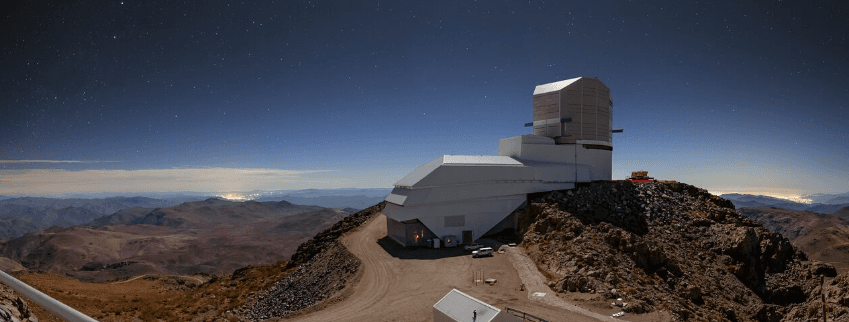
The Vera C. Rubin Observatory is an astronomical research facility jointly funded by the U.S. National Science Foundation (NSF) and the U.S. Department of Energy (DOE). The observatory is named after astronomer Vera C. Rubin, whose pioneering work on galaxy rotation rates provided some of the first evidence for the existence of dark matter.
The facility is located on the summit of Cerro Pachón in Chile, in a region characterized by dry air and dark skies. The site selection process was conducted based on criteria such as atmospheric stability, low humidity and low light pollution. Planning for the observatory began in the early 2000s, with mirror production for the telescope starting in 2007 and construction of the observatory building commencing in 2015.
Vera Rubin Observatory’s planning dates back to the early 2000s. Mirror production for the Simonyi Survey Telescope began in 2007, and construction of the observatory building started in 2015. The observatory began scientific operations in 2025 with its first light observations and has since focused on long-term observations under the Legacy Survey of Space and Time (LSST).
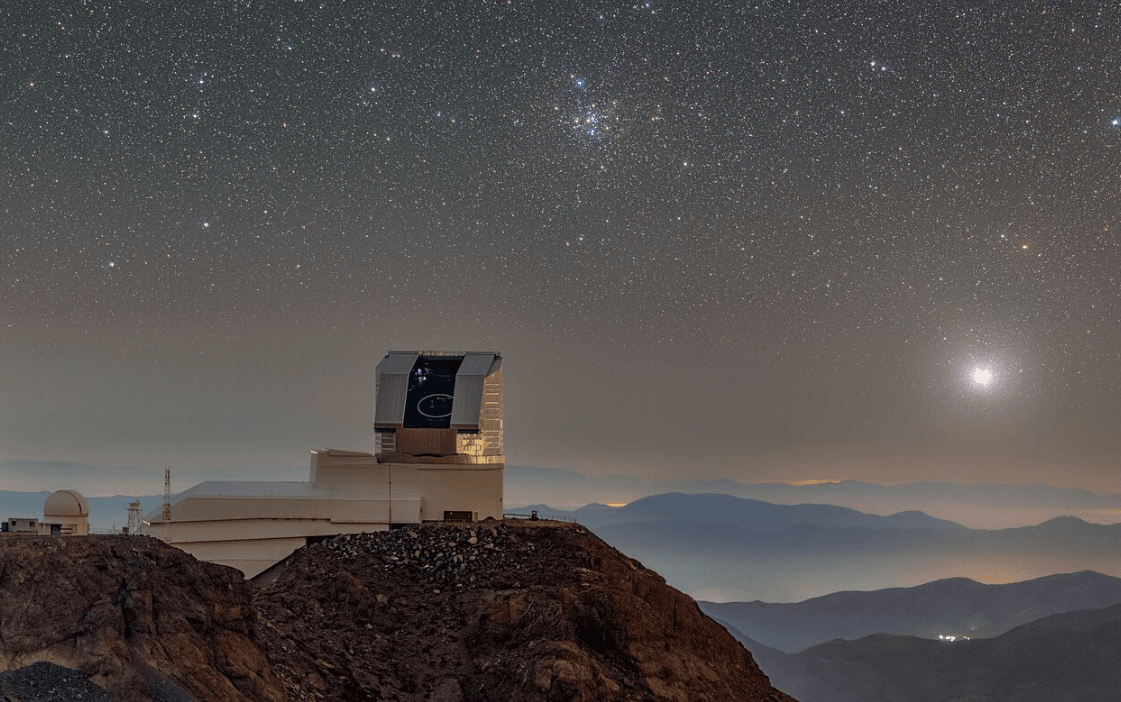
NSF–DOE Vera C. Rubin Observatory, with its dome open during First Light observation activities in April 2025. (NOIRLab)
The observatory was named in honor of astronomer Vera C. Rubin’s contributions to dark matter research. Rubin demonstrated the presence of invisible mass—dark matter—by studying the rotation speeds of galaxies.
The primary mission of the Rubin Observatory is the Legacy Survey of Space and Time (LSST). Under this program, the observatory will systematically survey the southern sky over a ten-year period, recording changes in the universe over time.
The Vera Rubin Observatory is located on the summit of Cerro Pachón in Chile. After a long and rigorous site selection process, scientists identified this location as the most suitable in the world for the observatory.
A number of scientific and practical criteria were considered in determining the ideal location for the observatory:
The selection of the Cerro Pachón site resulted from a comprehensive three-year process conducted between 2003 and 2006. The Rubin Observatory’s expert team evaluated existing telescope sites worldwide and narrowed down four candidate locations based on cost and scheduling targets:
In 2005, based on atmospheric conditions and astronomical seeing quality, these four sites were narrowed to two: Cerro Pachón and San Pedro Mártir. After detailed geotechnical and environmental studies, Cerro Pachón was selected as the more suitable and cost-effective location for observatory construction.
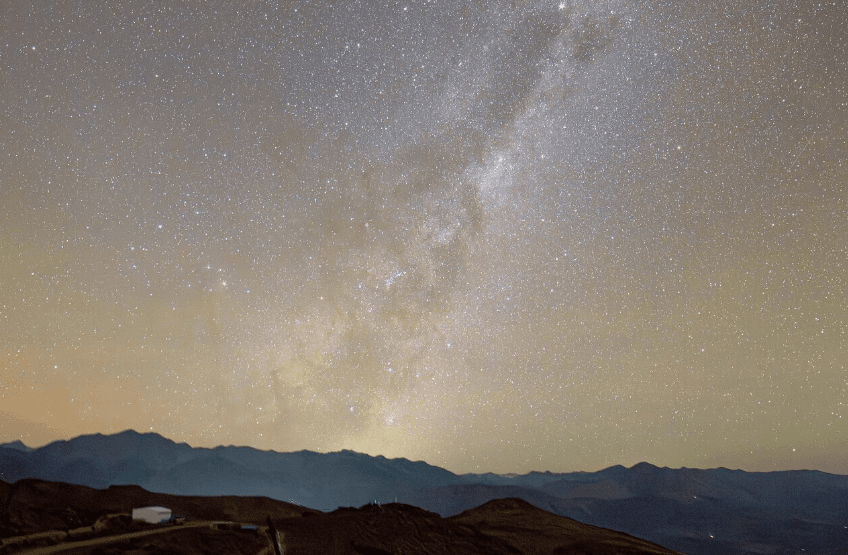
The Milky Way over Pachón (NOIRLab)
Cerro Pachón is an ideal location that enables the construction of a facility meeting international standards for high-quality astronomical and astrophysical observations. This selection ensures the Rubin Observatory can most effectively fulfill its scientific mission.
The main telescope of the Vera Rubin Observatory is the Simonyi Survey Telescope, featuring a three-mirror optical design with a primary mirror 8.4 meters in diameter. This optical system provides a wide field of view of 3.5 degrees and directs collected light to the 3.2-gigapixel LSST Camera. These features enable the telescope to capture large numbers of high-resolution images in short time intervals.
The telescope’s high light-gathering capacity and rapid scanning ability make the Rubin Observatory uniquely suited for studying changes over time. The facility will scan the entire southern sky each night and collect millions of images over a ten-year period.
The NSF and DOE jointly funded Vera C. Rubin Observatory released its first images to the public on June 23, 2025. These images reveal cosmic objects and phenomena—from distant regions of the universe to nearby asteroids—at an unprecedented scale. The Rubin Observatory’s first images constitute a brief preview of the observations it will conduct over its ten-year Legacy Survey of Space and Time (LSST) program.
During approximately 10 hours of test observations, the Rubin Observatory recorded millions of galaxies, Milky Way stars and thousands of asteroids. This initial dataset includes approximately 10 million galaxies, representing 0.05% of the roughly 20 billion galaxies the observatory will capture during its ten-year mission. The images begin with a video zooming in on two galaxies and then expand to show a wide field containing approximately 10 million galaxies.
NSF-DOE, Vera C. Rubin Observatory First Images (Rubin Observatory)
During the first images, a total of 2,104 new asteroids were discovered. Seven of these belong to the category of near-Earth asteroids; however, none pose any threat. The Rubin Observatory aims to detect millions of new asteroids and other solar system objects annually in future observations.
The NSF–DOE Vera C. Rubin Observatory has presented high-resolution images of star-forming regions such as the Trifid Nebula (Messier 20) and the Lagoon Nebula (Messier 8) in its first images. These images demonstrate the combination of the Rubin Observatory’s wide field of view and rapid data collection capability. The 5-gigapixel image, composed of 678 individual exposures taken over just 7.2 hours, is derived from approximately two trillion pixels of data.
The Trifid Nebula is a bright cloud of gas and dust located approximately 5,000 light-years away in the constellation Sagittarius. Its structure is divided into three regions characterized by a pink emission nebula, a blue reflection nebula and dark dust lanes. New stars are forming within it, and these stars shape the nebula by emitting powerful winds and radiation into their surroundings.
The Lagoon Nebula is another star-forming region located below the Trifid Nebula, approximately 4,000 light-years away. At its center lies a cluster of young, massive stars that illuminate the surrounding gas, creating swirling clouds. The Lagoon Nebula offers scientists a unique opportunity to observe the early stages of star formation.
Trifid and Lagoon Nebulae - VIDEO - EN (Youtube-Rubin Observatory)
These images were captured using the Rubin Observatory’s 3.2-gigapixel LSST Camera. The composite images reveal fine details within gas and dust clouds and clearly resolve star clusters. Over ten years, the Rubin Observatory will scan every point in the sky approximately 800 times, collecting millions of images and revealing the cosmic structure of the universe in ways never before possible.
The observatory was established in collaboration with local Chilean institutions, REUNA (Chilean Research and Education Network), and local authorities. The project, led by AURA in partnership with NSF and DOE, ensures privileged access to LSST data for Chilean scientists. Additionally, numerous Chilean citizens contributed to the construction and operational phases.
Brookhaven National Laboratory. “Ever-changing Universe Revealed in First Imagery From NSF–DOE Vera C. Rubin Observatory”. Brookhaven National Laboratory. Accessed November 4, 2025.https://www.bnl.gov/lsst/news/news.php?a=122514
National Science Foundation (NSF). “First Imagery: NSF-DOE Vera C. Rubin Observatory.” National Science Foundation (NSF). Accessed November 4, 2025.https://www.nsf.gov/news/first-imagery-nsf-doe-vera-c-rubin-observatory
Noirlab. “iotw2229a.” Noirlab. Accessed November 4, 2025.https://noirlab.edu/public/images/iotw2229a/
Noirlab. “noirlab2521i.” Noirlab. Accessed November 4, 2025.https://noirlab.edu/public/images/noirlab2521i/
Noirlab. “rubin-PachonSkyJune23-1.” Accessed November 4, 2025.https://noirlab.edu/public/images/rubin-PachonSkyJune23-1/
Rubin Observatory. “About.” Rubin Observatory. Accessed November 4, 2025.https://rubinobservatory.org/about
Rubin Observatory. “Cerro Pachón.” Rubin Observatory. Accessed November 4, 2025.https://rubinobservatory.org/about/rubin-in-chile/cerro-pachón
Rubin Observatory. “First Look / Trifid Lagoon.” Rubin Observatory News. Accessed November 4, 2025.https://rubinobservatory.org/news/rubin-first-look/trifid-lagoon
Rubin Observatory. “Rubin in Chile.” Rubin Observatory. Accessed November 4, 2025.https://rubinobservatory.org/about/rubin-in-chile
Rubin Observatory. “Site Selection.” Rubin Observatory. Accessed November 4, 2025.https://rubinobservatory.org/about/rubin-in-chile/site-selection
Rubin Observatory. “The Cosmic Treasure Chest - VIDEO - EN.” YouTube video, 0:57. Date Published June 23, 2025. Accessed November 4, 2025.https://www.youtube.com/watch?v=Gitit3LwQ20
Rubin Observatory. “Trifid and Lagoon Nebulae - VIDEO - EN.” YouTube video, 1:00. Date Published June 23, 2025. Accessed November 4, 2025.https://www.youtube.com/watch?v=MIJfPOGnDFg
Vera C. Rubin Observatory. “About.” Vera C. Rubin Observatory. Accessed November 4, 2025.https://www.lsst.org/about

Location | Cerro Pachón Chile | ||||||||
|---|---|---|---|---|---|---|---|---|---|
Establishment | United States National Science Foundation (NSF) and United States Department of Energy (DOE) | ||||||||
Telescope | 8.4-meter diameter three-mirror optical telescope | ||||||||
Camera | 3.2-gigapixel LSST Camera | ||||||||
First Images | June 2025, including the Trifid Nebula (M20) and the Lagoon Nebula (M8) | ||||||||
Mission Duration | Systematic survey of the southern sky for 10 years | ||||||||
No Discussion Added Yet
Start discussion for "Vera Rubin Observatory" article
History and Development
Scientific Mission
Key Objectives
Location and Site Selection
Factors Influencing Site Selection
Selection Process
Advantages of Cerro Pachón
Telescope and Technical Specifications
First Images
Observation Content and Scale
Asteroids and Solar System Objects
Trifid and Lagoon Nebulae
Lagoon Nebula
Scientific Contributions and Technical Details
International Contributions and Collaborations