


This article was automatically translated from the original Turkish version.
+2 More
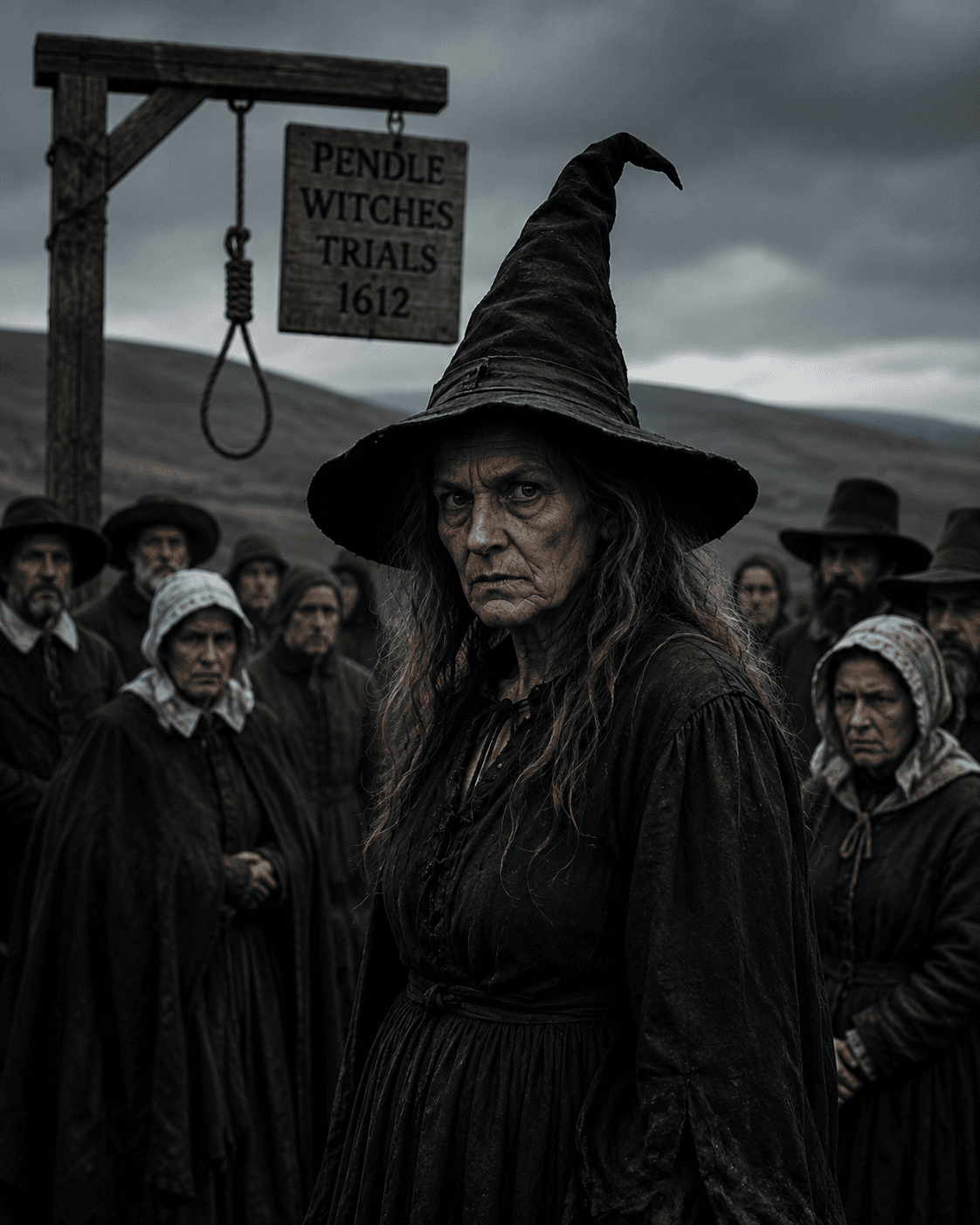
The Pendle Witch Trials (Generated with Artificial Intelligence)
History | 1612 | ||||||||
|---|---|---|---|---|---|---|---|---|---|
Location | Pendle, England | ||||||||
Ruler of the Period | King James (James I) | ||||||||
Important Places | Malkin Tower Lancaster Castle Gallows Hill | ||||||||
Dominant Families | Southerns ("Demdike") Whittle ("Chattox") | ||||||||
Judge Conducting the Investigation | Justice Robert Nowell | ||||||||
Judge | Justice Robert Nowell | ||||||||
The Pendle Witch Trials, which took place in 1612 in the county of Lancashire, England, are among the most extensive witch trials in the country’s history. Considering that fewer than 500 people were executed for witchcraft over a period of more than 300 years in England, the death sentences handed down in the Pendle case alone accounted for approximately 2 percent of all witch executions in English history.【1】 Details of the case have reached us through the official records compiled and published by court clerk Thomas Potts under the title The Wonderfull Discoverie of Witches in the Countie of Lancaster (The Wonderful Discovery of Witches in the County of Lancaster).【2】
The emergence of the Pendle witch trials was shaped by the political, religious and social climate of early 17th century England and the monarchy’s attitude toward witchcraft. The reigning monarch, King James (James I of England / James VI of Scotland), viewed witchcraft as a threat to royal authority and state security. His personal obsession with the subject stemmed from events that occurred during his marriage to the Danish Princess Anne in 1589.【3】 The storms that struck the ship carrying the princess to England and later the fleet in which James was returning from Denmark across the North Sea were interpreted by the King as signs directed against him.【4】 Upon returning to Scotland, James launched an investigation into those accused of causing the storms and closely followed the trials of Agnes Sampson and others. He later theorized his observations and views on combating supernatural forces in his 1597 treatise Daemonologie.【5】
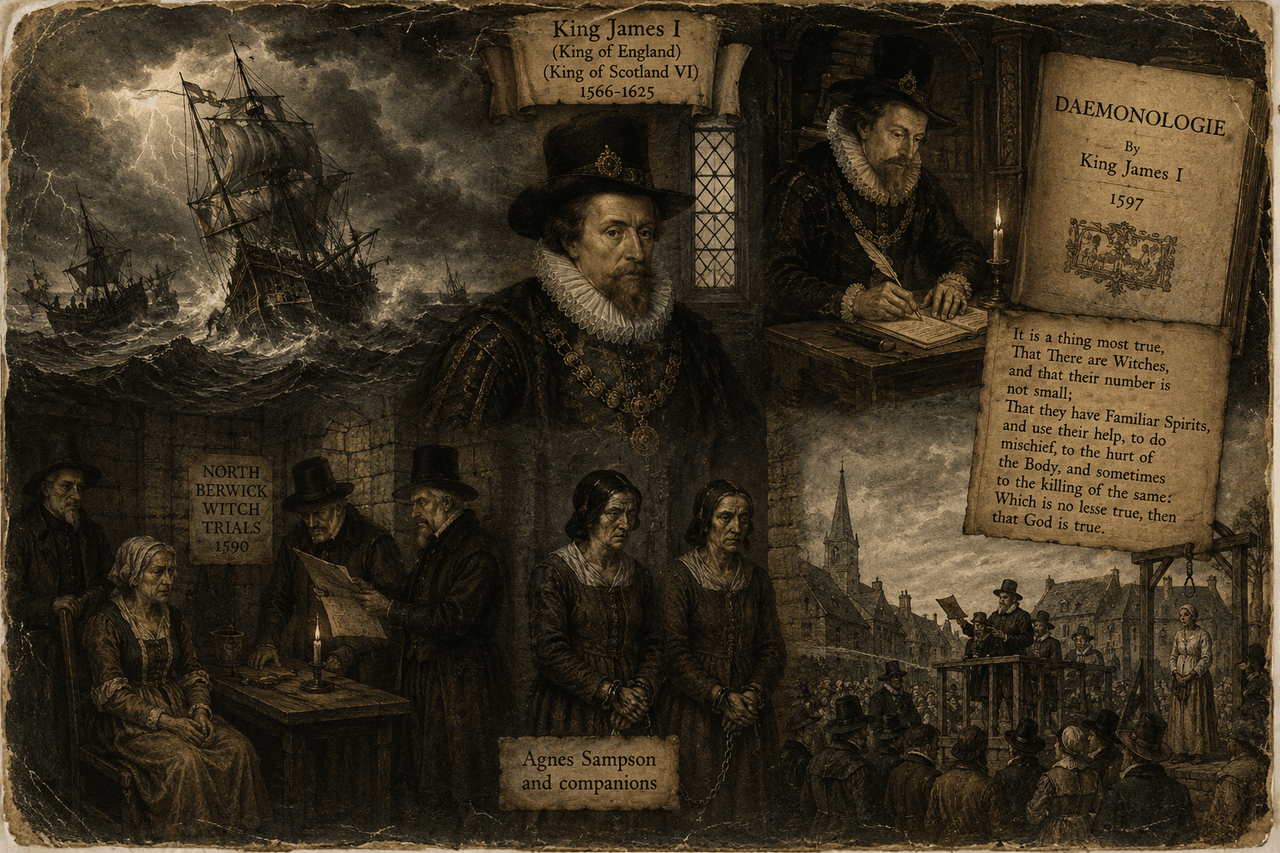
Davanın Arka Planını İfade Eden Bir Görsel (Yapay Zeka ile Oluşturulmuştur)
With the death of Queen Elizabeth I in 1603, James ascended the English throne and brought his Scottish views and attitudes toward witchcraft to London. The local manifestation of this broader political atmosphere was found in Lancashire.
In early 1612, an order was issued to the local Justices of the Peace to suppress Catholic resistance by compiling lists of individuals within their jurisdictions who refused to attend Anglican Church services or receive communion. These individuals were known as “recusants.”【6】
At this very time, Justice of the Peace Robert Nowell in the Pendle region acted out of administrative ambition and a desire to gain favor with King James I to advance his political career. While identifying those who avoided church services, Nowell seized upon longstanding feuds and accusations of sorcery among impoverished families as opportunities.【7】
The accusations of witchcraft in Pendle were rooted in a social and economic feud between two impoverished and rival families. The matriarchs of these families, Elizabeth Southerns (known locally as “Demdike”) and Anne Whittle (“Chattox”), were both in their eighties by 1612, had lost their eyesight and lived in poverty.【8】 In the early 17th century, in rural and impoverished communities like Pendle, herbal medicine, charms and folk magic practices served both as a social necessity and a vital source of income for disadvantaged families. However, these opportunities in the healing market created competition between the Demdike and Chattox families. Tensions between the families escalated in 1601 following a concrete incident: a member of the Chattox family entered Malkin Tower, the residence of the Demdike family, and stole clothing valued at approximately one pound sterling.【9】
The event that transformed this long-standing rivalry into an official witch trial occurred on 21 March 1612, when Alizon Device, Demdike’s granddaughter, encountered the traveling peddler John Law.【10】 While traveling along the road through Trawden Forest, Alizon Device asked Law for metal needles used in lace-making; Law refused her request and turned her away. Believing she had been insulted, Alizon cursed him as he walked off. Within minutes, John Law suddenly collapsed and suffered a paralysis.【11】
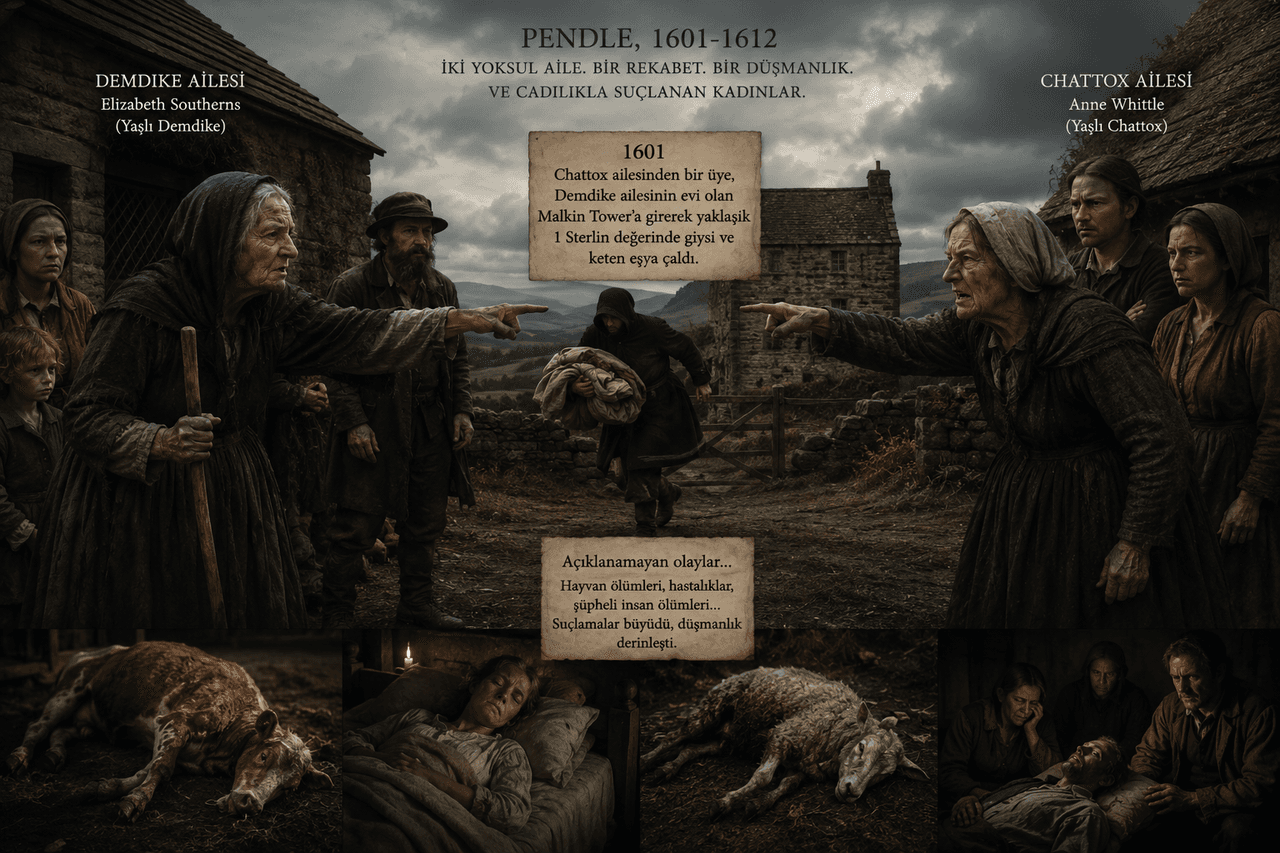
Olayın Gelişimini İfade Eden Bir Görsel (Yapay Zeka ile Oluşturulmuştur)
When news of the incident reached local authorities, Justice Robert Nowell interrogated Alizon Device. Under the influence of guilt and fear, Alizon confessed to making a pact with the devil, who appeared to her in the form of a black dog and caused Law’s disability.【12】 However, Alizon’s testimony did not remain limited to her own confession; driven by a desire to protect her family or seek revenge against the rival family, she expanded the investigation.
After stating that her great-grandmother Demdike had led her into witchcraft, Alizon accused her rivals Chattox and her daughter Anne Redferne of various alleged murders and witchcraft practices.【13】 Those summoned before Nowell to establish the truth, instead of defending each other, turned against one another with accusations and counter-accusations.
Following the initial interrogations conducted by Justice Robert Nowell, the main suspects in the case—Demdike (Elizabeth Southerns), her rival Chattox (Anne Whittle), the confessor Alizon Device, and Chattox’s daughter Anne Redferne—were formally arrested on 2 April 1612.【14】 The accused were sent to Lancaster Castle to be held until the formal trials (Assizes) scheduled for the coming summer.
On Good Friday, 10 April 1612, Elizabeth Device, daughter of the imprisoned Demdike, organized a gathering at Malkin Tower, the family’s residence. Neighbors and close associates attended the meeting. Justice Nowell launched an investigation into those present at Malkin Tower. Based on raids and testimonies, eight additional individuals—including Elizabeth Device, her children James and Jennet, and Alice Nutter—were accused of witchcraft and sent to Lancaster Castle.【15】
The anticipated trials were held at the Lancaster Assizes between 17 and 19 August 1612. The accused were forced to defend themselves alone against charges guided by leading questions from the official court clerk, Thomas Potts.【16】
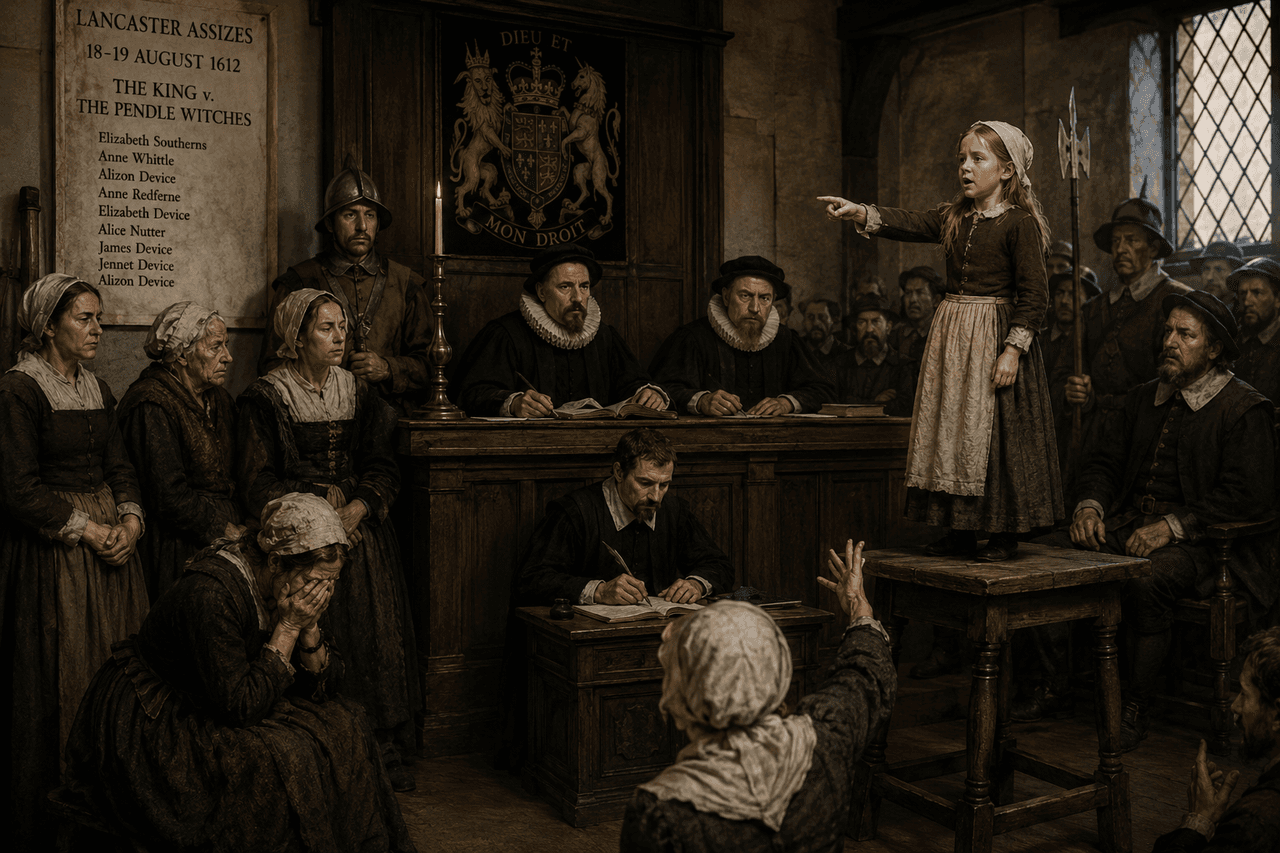
Mahkeme Sürecini İfade Eden Bir Görsel (Yapay Zeka ile Oluşturulmuştur)
Indeed, the judge accepted the testimony of nine-year-old Jennet Device. Jennet was placed on a stool in the courtroom and testified against her own family. When her mother Elizabeth Device screamed and cursed her daughter upon hearing the testimony, the judge ordered her removed from the courtroom.【17】 Jennet described her mother’s spirit dog named “Ball.” These statements from a nine-year-old child influenced the jury and played a role in securing her mother’s conviction and death sentence.【18】
The damp, unhealthy conditions of the underground dungeons of Lancaster Castle became a death sentence for those awaiting trial. The elderly matriarch and central figure of the investigation, 80-year-old Demdike (Elizabeth Southerns), could not withstand the prison conditions and illness and died before the trials even began.【19】 However, Demdike’s death did not halt the proceedings; the court continued its trials against the remaining accused.
Following the hearings on 18–19 August 1612, the jury found the majority of the accused guilty and sentences were carried out:
Nutter, accused solely for attending the meeting at Malkin Tower, remained silent throughout the trial, denying all charges and asserting her innocence.【22】
Of all those tried in the Pendle group at the Assizes, only one person was acquitted and spared the death penalty. Alice Grey was released after the evidence against her was deemed insufficient.【23】
Jennet Device, who at age nine in 1612 gave testimony that led to the execution of her mother, sister and brother, reappears in historical records approximately 22 years later. On 24 March 1634, in Lancashire, a 10-year-old boy named Edmund Robinson claimed he had been abducted by spiritual entities and taken to a secret witch gathering, accusing 20 people—including Jennet Device—of witchcraft.【24】
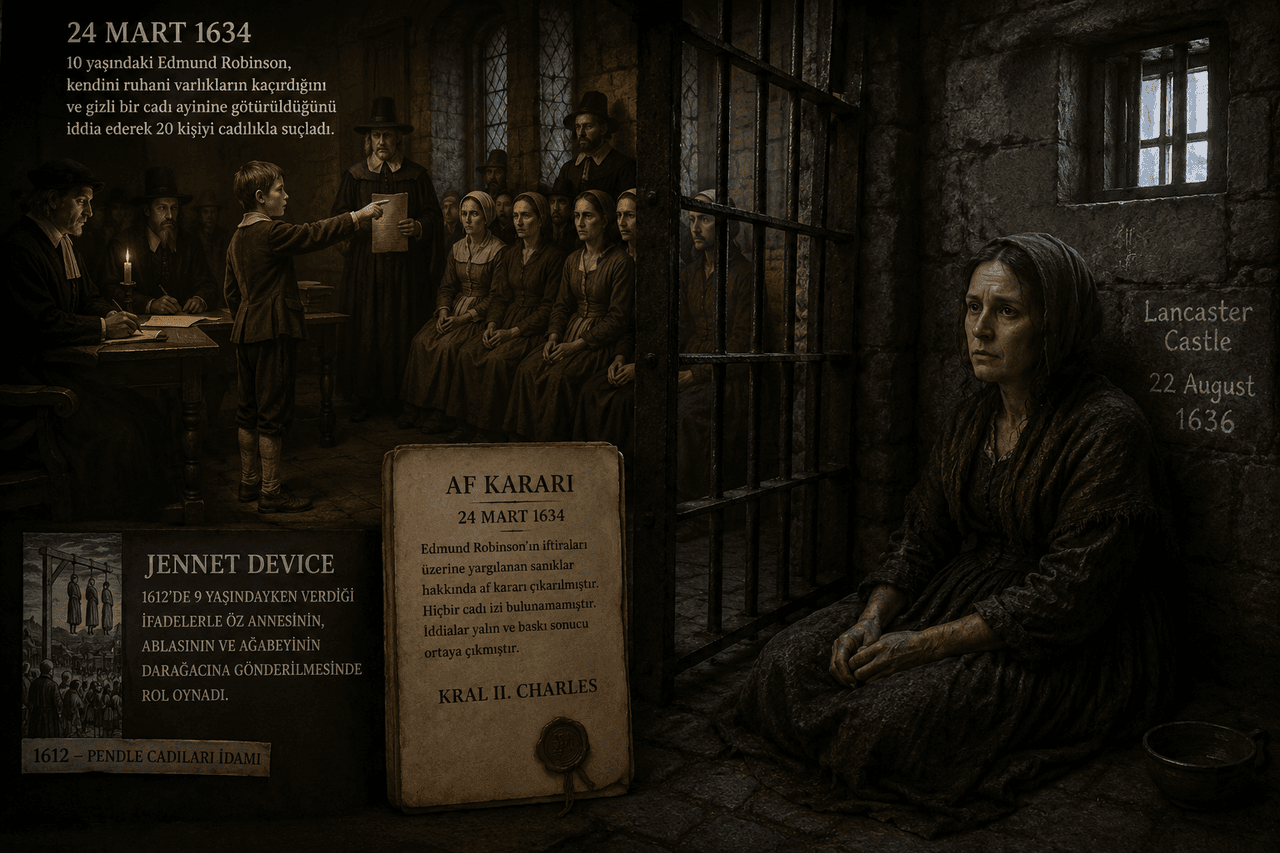
A Visual Representation of Jennet Device's Life (Generated by Artificial Intelligence)
When the case reached London, investigators found no “witch’s mark” on any of the accused, and Edmund Robinson eventually confessed that his allegations were fabricated.【25】 Although an official pardon was issued for the accused following the boy’s confession, the prison procedures and mandatory costs of incarceration at the time complicated the process.【26】
Despite the pardon, Jennet Device was not released; as of 22 August 1636, she remained imprisoned in the dungeons of Lancaster Castle, just as her great-grandmother Demdike had decades earlier.【27】
Today, institutions and local symbols in the Lancashire region continue to preserve this legacy; for example, Pendle College at Lancaster University incorporates a witch figure into its institutional emblem as a reference to these events.【28】
Agecroft Hall. "The Trials of the Pendle Witches: The Assize in Action". Accessed July 20, 2026.https://www.agecrofthall.org/single-post/the-trials-of-the-pendle-witches-the-assize-in-action.
Historic UK. "The Pendle Witches." Accessed July 20, 2026.https://www.historic-uk.com/CultureUK/The-Pendle-Witches/
Stevens, David. "The Pendle Witch Trials: A Rational Choice Analysis." *International Journal of Social Economics* 53, no. 6 (2026): 925–937. Accessed July 20, 2026.https://www.sciencedirect.com/org/science/article/abs/pii/S0306829326000054
The History Press. "The Pendle witches." Accessed July 20, 2026.https://thehistorypress.co.uk/article/the-pendle-witches/
University College Oxford. "The Pendle Witch Trials of 1612". Accessed July 20, 2026.https://www.univ.ox.ac.uk/book/the-pendle-witch-trials-of-1612/
[1]
Historic UK, "The Pendle Witches", erişim 20 Temmuz 2026, https://www.historic-uk.com/CultureUK/The-Pendle-Witches/.
[2]
Historic UK, "The Pendle Witches".
[3]
The History Press, "The Pendle witches", erişim 20 Temmuz 2026, https://thehistorypress.co.uk/article/the-pendle-witches/.
[4]
The History Press, "The Pendle witches".
[5]
The History Press, "The Pendle witches".
[6]
Historic UK, "The Pendle Witches".
[7]
The History Press, "The Pendle witches".
[8]
The History Press, "The Pendle witches".
[9]
Historic UK, "The Pendle Witches".
[10]
The History Press, "The Pendle witches".
[11]
The History Press, "The Pendle witches".
[12]
Historic UK, "The Pendle Witches".
[13]
The History Press, "The Pendle witches".
[14]
Historic UK, "The Pendle Witches".
[15]
Historic UK, "The Pendle Witches".
[16]
Agecroft Hall, "The Trials of the Pendle Witches: The Assize in Action", erişim 20 Temmuz 2026, https://www.agecrofthall.org/single-post/the-trials-of-the-pendle-witches-the-assize-in-action.
[17]
Historic UK, "The Pendle Witches".
[18]
The History Press, "The Pendle witches".
[19]
The History Press, "The Pendle witches".
[20]
The History Press, "The Pendle witches".
[21]
The History Press, "The Pendle witches".
[22]
The History Press, "The Pendle witches".
[23]
The History Press, "The Pendle witches".
[24]
The History Press, "The Pendle witches".
[25]
The History Press, "The Pendle witches".
[26]
Agecroft Hall, "The Trials of the Pendle Witches: The Assize in Action".
[27]
The History Press, "The Pendle witches".
[28]
The History Press, "The Pendle witches".

The Pendle Witch Trials (Generated with Artificial Intelligence)
History | 1612 | ||||||||
|---|---|---|---|---|---|---|---|---|---|
Location | Pendle, England | ||||||||
Ruler of the Period | King James (James I) | ||||||||
Important Places | Malkin Tower Lancaster Castle Gallows Hill | ||||||||
Dominant Families | Southerns ("Demdike") Whittle ("Chattox") | ||||||||
Judge Conducting the Investigation | Justice Robert Nowell | ||||||||
Judge | Justice Robert Nowell | ||||||||
No Discussion Added Yet
Start discussion for "The Pendle Witch Trials" article
Historical and Political Context
Development of Events and Local Conflicts
Arrests and Trial Proceedings
Outcomes and Executions
Jennet Device’s Later Life and the Historical Legacy of the Case