


This article was automatically translated from the original Turkish version.
Hepatocentrism, the belief that the liver is the center of the body, was embraced by humanity for centuries. The term hepat derives from the Greek word for liver or related to the liver. This perspective gained widespread acceptance across a vast geographical area, from China to Ancient Greece, and from the Arab world to Europe. Indeed, traces of this view can be found in paintings, written sources, and historical accounts from various civilizations that have survived to the present day.
In ancient Chinese medical texts, the liver was regarded as the center of anger and tear production. Similarly, in the famous Greek myth of Prometheus, an eagle feeds on Prometheus’s liver while he is chained to a rock.
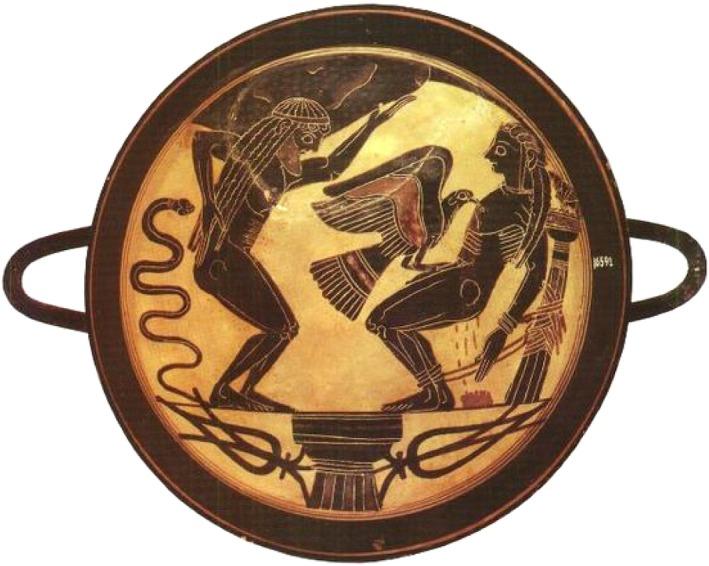
Prometheus tormented by an eagle, Black-figure kylix, 560–550 BCE (Ankara University)
Hebrew texts similarly describe the liver as the vessel of the human soul. In the Arab world, too, accounts emphasize the liver’s significance. It is reported that during the Battle of Uhud, Wahshi ibn Harb killed Hamza ibn Abd al-Muttalib with his spear and then tore out and bit his liver.
In Mesopotamia, priests examined the livers of sacrificial animals to discern the gods’ approval. They interpreted signs and made predictions based on these observations. All these examples demonstrate that the liver was not merely viewed as a physical organ but as intrinsically connected to the essence and vital force of human life. Its relatively large size, high blood content, and warmth provided sufficient evidence for ancient societies relying on observation to regard it as the central organ. However, with the advancement of anatomical science, in the 17th century, the heart was recognized as the body’s central organ instead of the liver.
As with anatomy, the perceived importance of the liver in fields outside of science, such as the fine arts, also began to decline. Literary narratives that once centered on the liver increasingly shifted to focus on the heart.
Nevertheless, the liver’s significance continues to endure today through proverbs and idioms embedded in nearly every ancient language. In Anatolia, numerous expressions relate to the liver: one might say, “I know your liver,” or “My soul, my liver,” among many others. Examples can also be found across many societies from Asia to Europe, even in Norway: the phrase “Å snakke rett fra levra” emphasizes speaking openly and honestly, directly referencing the liver.
Yet over time, one paradigm gave way to another. What once was read in the liver by ancient priests is now sought in the stars or in coffee grounds. While conversing with an elder about this historical shift, the discussion turned to artificial intelligence and similar transformations taking place there.
I mentioned that a quarter of the new code developed within Google is generated by artificial intelligence. I added that I am not speaking of a future possibility but of current changes in the industry. The skills once prized in software engineers—writing code from scratch or developing algorithms—are now being replaced by the ability to ask the right questions, craft accurate inputs, and verify the correctness of outputs produced by AI models.
I continued by suggesting that, in this light, most software developers will evolve into input engineers—prompt engineers. After listening attentively, he replied: What you describe resembles what petition writers used to do until recently.
People who came to court or government offices and could not read or write could not express their grievances in writing. Instead, they would go to a petition writer, explain their situation, and the petition writer would draft a formal petition on their behalf.
However, as literacy rates increased and technology advanced, the profession of petition writing began to disappear.
Just as in so many other historical examples.
Viewed from a broader perspective, perhaps petition writing is undergoing a metamorphosis and will continue its journey under the name of Petition Engineering—who knows.
In sum, this transformation—from the liver to the stars, from the petition writer’s desk to artificial intelligence—reminds us of an ancient truth: the wheel of change has turned since time immemorial. And in this sense, there is nothing new under the heavens.
Edwards, B., and Edwards, B. "Google CEO says over 25% of new Google code is generated by AI." Ars Technica. October 30, 2024. https://arstechnica.com/ai/2024/10/google-ceo-says-over-25-of-new-google-code-is-generated-by-ai/
Orlandi, Riccardo, Nicole Cianci, Pietro Invernizzi, Giancarlo Cesana, and Michele Augusto Riva. "I Miss My Liver: Nonmedical Sources in the History of Hepatocentrism." Hepatology Communications 2, no. 8 (2018): 982–989. https://doi.org/10.1002/hep4.1224.
“İnsanın Yaratılışı.” Ankara University Open Course Materials. Accessed April 29, 2025. https://acikders.ankara.edu.tr/pluginfile.php/206418/mod_resource/content/0/4-%20Insan%C4%B1n%20Yarat%C4%B1l%C4%B1s%C4%B1.pdf
