


This article was automatically translated from the original Turkish version.
Temple of Augustus in Ankara is one of the most important structures from the Roman period in Anatolia, located in the Ulus district of Ankara, the capital of Türkiye, immediately next to the Hacı Bayram Camii on Hacı Bayram Square. Built on the acropolis of the ancient city known as Ankyra, the temple was dedicated to Emperor Augustus (27 BCE – 14 CE) and the goddess Roma. It is generally believed to have been constructed in 25 BCE as a token of loyalty from Pylamenes, son of the last Galatian ruler Amyntas, to commemorate the incorporation of the Galatia region into the Roman Empire. The temple holds great significance in world history and archaeology due to both its architectural features and the inscription “Res Gestae Divi Augusti” inscribed on its walls.
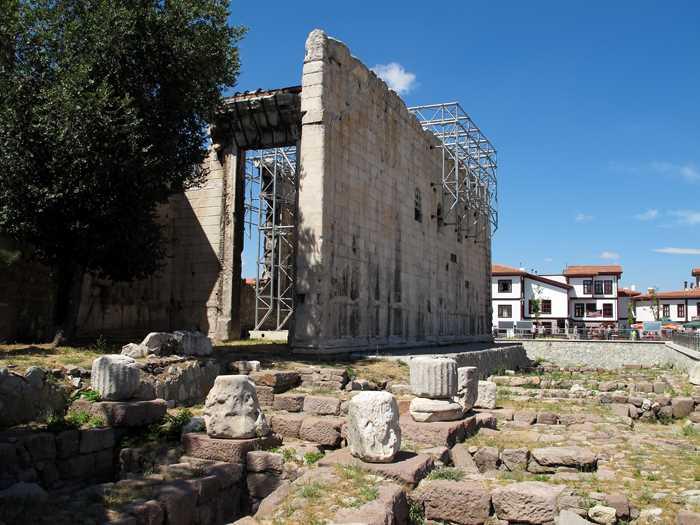
Temple of Augustus (Culture Portal)
The Temple of Augustus is a Corinthian-order pseudo-dipteral structure measuring 36 by 54.82 meters along a southwest-northeast axis. It stands on an eight-step podium approximately two meters high. The surrounding colonnade (peristasis) originally consisted of eight columns on the short sides and fifteen on the long sides; however, most of these columns have not survived to the present day, and some scholars suggest the peristasis may have been left unfinished. The front chamber (pronaos) had four columns in front, while the rear chamber (opisthodomos) featured two columns in antis style. Today, large portions of the temple’s southern and southeast foundations remain, including the stepped platform and foundation walls. The anta walls of the pronaos, the entrance door of the cella, its side walls, and part of the opisthodomos have been preserved. However, a large section of the northwest wall of the cella was destroyed in 1834.
The temple’s architecture underwent modifications over time. In the early 6th century, the Byzantines converted it into a church: the floor of the cella was leveled, the wall between the cella and the opisthodomos was removed to create an apse at the rear, and three large windows were opened in the southeast wall. Between 1427 and 1428, the Hacı Bayram Camii was constructed adjacent to the temple’s northwest corner. The addition of an eyvan behind the opisthodomos and the graffiti on the walls suggest the structure may have been used for a period as a medrese.
The Temple of Augustus is renowned for the “Res Gestae Divi Augusti” (The Deeds of the Divine Augustus), known as the “Queen of Inscriptions.” Written after Augustus’s death, this document was carved into the temple’s walls in both Latin and Ancient Greek, with red-painted letters. The Latin text is inscribed on the inner surfaces of the pronaos anta walls, while the Greek text appears on the southeast outer wall of the cella. Since the original inscription in Rome has been lost, this copy in Ankara is the only complete version preserved and stands as one of the most valuable sources for understanding the institutional functioning of the Roman Empire and the achievements of Augustus in detail. Additionally, on the anta walls there is a “List of Priests” dedicated to the imperial cult priests and a brief inscription concerning another priestess.
The inscription was discovered between 1553 and 1555 by Augier Ghiselin de Busbeck and later studied in the 19th century by researchers such as W.J. Hamilton, C. Humann, O. Puchstein and T. Mommsen. The historian Theodor Mommsen named it the “Queen of Inscriptions.” The two other known copies in Anatolia—one in Latin at Pisidian Antiocheia and one in Greek at Apollonia—contain incomplete fragments.
The area where the temple stands has been used as a sacred region since the 8th century BCE. The presence of a cult structure dedicated to Anatolian deities (Men, Cybele) during the Phrygian period and the temple’s western orientation suggest continuity with local traditions. The temple built during the Roman period was converted into a church during the Byzantine era and later associated with a medrese and mosque during the Ottoman period. The Hacı Bayram Camii and its türbe, situated immediately beside the temple, have preserved the sacred character of the site into the present day.
The temple was excavated between 1926 and 1928 by the German Archaeological Institute under the leadership of Daniel Krenker and Martin Schede, and further studies were conducted in 1938–1939 by Hamit Z. Koşay on behalf of the Turkish Historical Society. Koşay revealed that the temple’s foundation walls extend to a depth of four meters and that there is an underground passage to the east. In the 2000s, the Ankara Metropolitan Municipality reinforced leaning walls with steel structures and carried out environmental improvements. However, erosion of the inscription due to natural factors and the temple’s lack of protection have created an urgent need for conservation. Conservation initiatives initiated in 1985 under the leadership of Sencer Şahin and the “Progetto Ancyra” project by the University of Trieste between 1997 and 2008 marked significant steps in documenting the temple and proposing restoration measures. Since 2016, the temple has been on UNESCO’s Temporary List of World Heritage Sites for Türkiye and is currently closed to visitors.
The Temple of Augustus, with its architectural features, the Res Gestae inscription, and its millennia-old history as a sacred site, is one of Ankara’s most important historical monuments. As the only known temple in Türkiye with an inscription of this scale, it holds a unique position. It bears traces from the Roman, Byzantine and Ottoman periods. Although conservation efforts continue, more comprehensive measures are needed to secure its future.
Ankara Büyükşehir Municipality. “Augustus Tapınağı’na Büyükşehir Desteği,” Accessed April 3, 2025.https://www.ankara.bel.tr/haberler/augustus-tapinagi-na-buyuksehir-destegi-1180.
Culture Portal. "Fotoğraf Detay | Kültür Portalı." Accessed April 3, 2025.https://www.kulturportali.gov.tr/medya/fotograf/fotodetay/17639
Turkish Museums. "Ankara Augustus Tapınağı | Turkish Museums." Accessed April 3, 2025.https://www.turkishmuseums.com/museum/detail/1946-ankara-augustus-tapinagi/1946/1.
Türkiye Turizm Ansiklopedisi. "Augustus ve Roma Tapınağı Kazı Çalışmaları." Accessed April 3, 2025.https://turkiyeturizmansiklopedisi.com/augustus-ve-roma-tapinagi-kazi-calismalari

Architectural Features
The Res Gestae Divi Augusti Inscription
Historical Development and Use
Modern Research and Conservation