


This article was automatically translated from the original Turkish version.
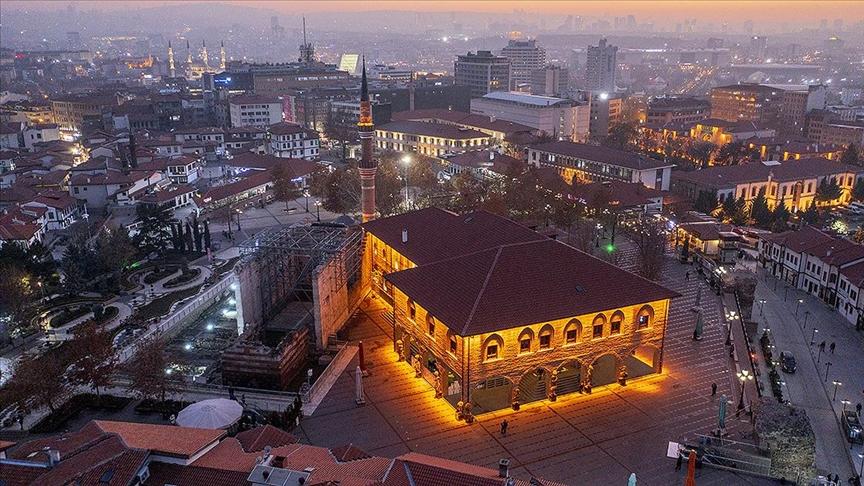
Hacı Bayram Veli Camii
Location | Ankara Ulus Augustus Square Bayram Street | ||||||||
|---|---|---|---|---|---|---|---|---|---|
Original Construction Date | 1427–1428 (Hijri 831) | ||||||||
Repairs | 1714 (by Mehmet Baba, grandson of Hacı Bayram Veli) | ||||||||
Architectural Style | Characteristic of Ankara mosques at the end of the 17th century and beginning of the 18th century | ||||||||
Neighboring Structures | To the east the Temple of Augustus, to the south the Tomb of Hacı Bayram Veli | ||||||||
Hacı Bayram Veli Camii is a historical mosque located in the Ankara district of Ulus, on Augustus Square in the capital of Türkiye. This structure features a stone base, brick walls and a tiled roof. It has a longitudinal rectangular plan. The eastern side of the mosque rests against the walls of the Augustus Tapınağı from the Roman period while its southern side leans against the Bayram Veli Türbesi. Originally constructed in 1427–1428 (Hijri 831), the mosque retains the architectural characteristics of late 17th and early 18th century Ankara mosques. It was restored in 1714 by Mehmet Baba, a grandson of Hacı Bayram Veli, and is regarded as one of Ankara’s most important religious structures.
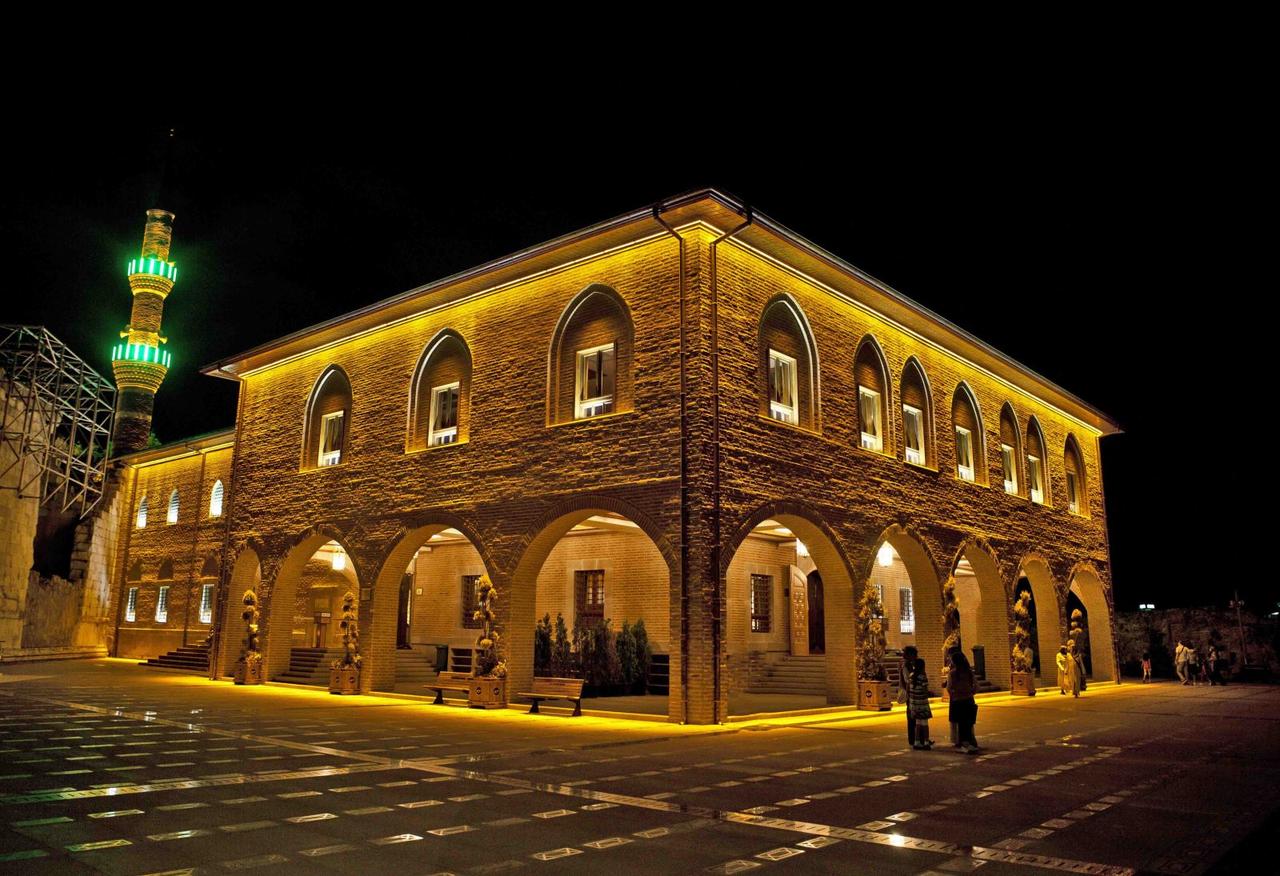
Hacı Bayram Camii (Ankara İl Kültür ve Turizm Müdürlüğü)
Hacı Bayram Veli Camii was originally built in 1427–1428 (Hijri 831). Over time, through various additions and repairs, it acquired its present form. The mosque’s core structure is based on a longitudinal rectangular plan and was constructed using a rubble masonry system with cut stone and ahşap materials. Since its inception it has served as a religious center closely associated with Hacı Bayram Veli, the founder of the Bayrami Tarikatı.
One of the mosque’s most significant restorations was carried out in 1714 by Mehmet Baba, a grandson of Hacı Bayram Veli. This restoration endowed the mosque with the characteristic architectural features of late 17th and early 18th century Ankara mosques. Details of the restoration are clearly inscribed on two tablets located on the qibla wall. The renovations of this period, particularly the ceiling, mihrap, minber and tile decorations, gave the mosque its current aesthetic appearance.
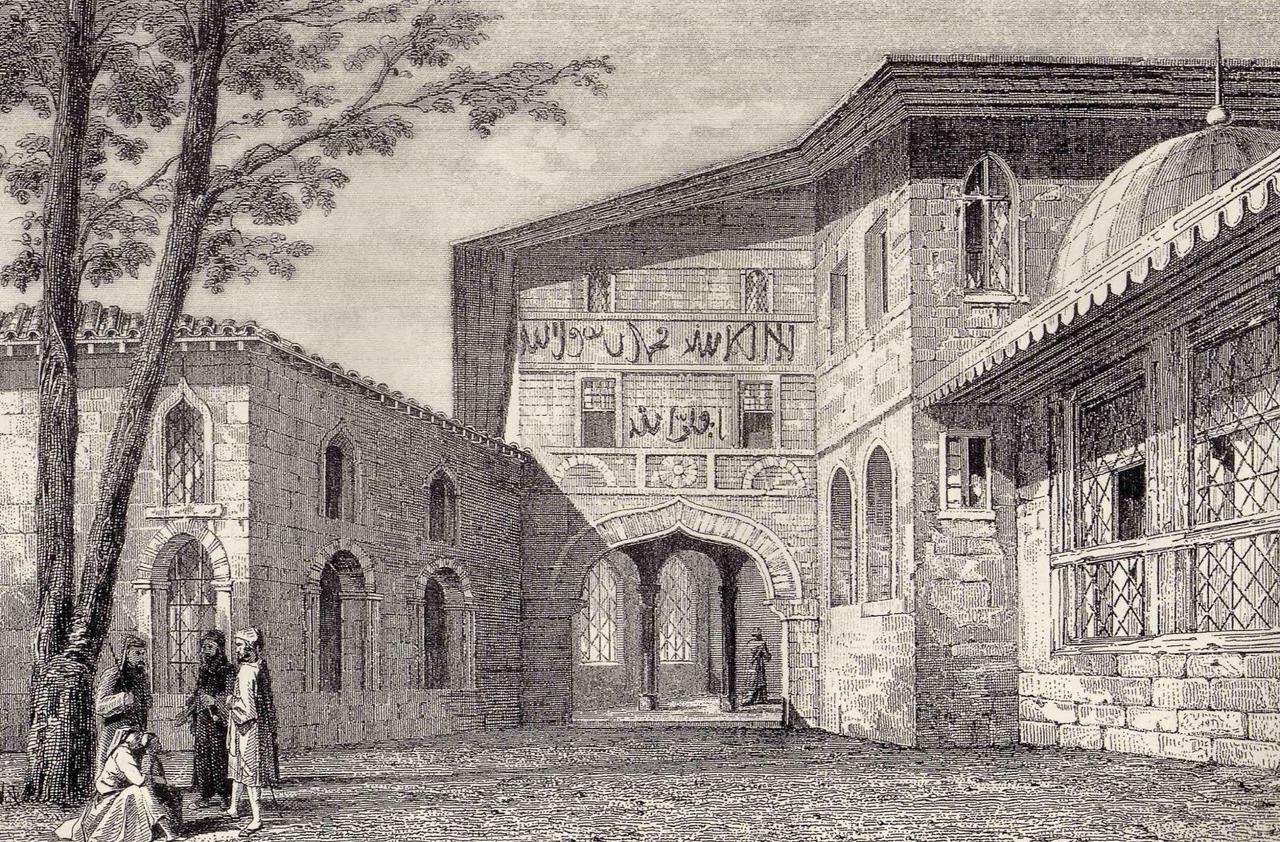
Hacı Bayram Camii (Charles Texier. Asia Mineure. Paris, 1849)
The mosque’s exterior is built on a stone base with brick walls. The roof is designed with a four-sloped hipped form, and the lower edges of the wide eaves are enclosed with wooden elements. The final congregational space, which covers more than half of the northern and batı sides, was added later. This area is open with a wooden balcony above and supported by six stone columns. The minaret rising from the southeast wall of the türbe has a square stone base and a cylindrical brick shaft; sources indicate it had either two or three balconies, reflecting additions from different periods.
Two rows of windows are notable on the facades. The lower windows are rectangular, framed with iron grilles and set within pointed stone niches. The upper windows feature pointed brick arches, plaster latticework and stained glass, adorned with kalemişi floral motifs. On the southern protruding wall of the final congregational space, the phrase “Kelime-i Tevhid” is inscribed in sülüs script using oil paint resembling green-glazed brick, highlighting the elegance of the mosque’s exterior ornamentation.
The interior space of the mosque is single-domed and covered with a wooden ceiling. The ceiling is crafted with coffered work and framed by ornate moldings decorated with various çiçek floral patterns. At the center of the ceiling is a large hexagonal rosette; this motif is repeated on the ceiling of the smaller annex west of the women’s gallery. The wooden women’s gallery on the north side is supported by four wooden pillars and accessed via a single-flight staircase on the west. The harim entrance is located on the north facade; it features a round-arched, double-leaf wooden door richly decorated with intricate woodwork. The mosque’s foundation tablet is situated in the upper right corner of the door.
The interior walls are clad with Kütahya tiles up to the level of the windows. The 18th-century tiles beneath the muezzin’s gallery are among the mosque’s original decorative elements. The plaster mihrap is a molded mukarnas niche that was later painted. It is framed by a mukarnas frieze and crowned with palmette leaves. The borders repeat the phrase “Kelime-i Tevhid” in neshi script; other borders are filled with star-shaped polygons and floral motifs. The minber is made of wood and painted using a simulated kündekari technique, demonstrating exceptional craftsmanship. All painted woodwork in the mosque was executed by the renowned artist of the period, Nakkaş Mustafa.
Hacı Bayram Veli, born Ahmed bin Koyunluca in 1352 (Hijri 753) in Solfasol Village near Ankara, was a mystic poet and the founder of the Bayrami Tarikatı. After completing his education in Ankara and Bursa, he began teaching at the Karamedrese, built by the benefactor Meklike Hatun in Ankara. Invited by Şeyh Hamideddin Aksarayi of Kayseri, he joined the tarikat and traveled with his master to Şam and the Hijaz, where he stayed for three years before returning to Ankara to establish his order. Hacı Bayram Veli died in 1429 (Hijri 833), leaving behind thousands of disciples and two ilahis and several gazels that have survived to the present day. His türbe, located south of the mosque, preserves his memory.
Since the 15th century, Hacı Bayram Veli Camii has played a vital role in the spread of the Bayrami Tarikatı across Anadolu. As the central mosque of the order, it stands as a monumental example of religious architecture. Moreover, the mosque and its surroundings contain layers from different cultures and eras. The coexistence of the Augustus Tapınağı, Hacı Bayram Camii and Türbesi clearly demonstrates the area’s multicultural and universal value. This combination reflects a continuous historical trajectory from the Roman period through to the Ottoman era.
Hacı Bayram Veli Camii reflects the architectural character of 17th and 18th century Ankara mosques and remains one of Anadolu’s most significant religious structures in both spiritual and cultural terms. Noted for its ceiling decorations, Kütahya tiles, and the craftsmanship of its mihrap and minber, the mosque continues to serve as a symbol of Ankara for both worship and tourism. Its location on Augustus Square makes it easily accessible to both local halk and visitors. Bugün, the mosque and türbe complex are among the principal structures representing Ankara’s historical and spiritual identity.
Culture Inventory. "Hacı Bayram-ı Veli Camii." Accessed April 4, 2025.https://kulturenvanteri.com/yer/haci-bayram-i-veli-camii/#17.1/39.944351/32.85791
Culture and Museums General Directorate. "Hacı Bayram Camii." Accessed April 4, 2025.http://www.kulturvarliklari.gov.tr/yazdir?CE5D73CE24036F2ACF9725D000A801F2
Culture and Museums General Directorate. "Hacıbayram Camii - Ankara 2016." Accessed April 4, 2025.https://kvmgm.ktb.gov.tr/TR-163970/hacibayram-camii-ankara-2016.html
Karadeniz Valiliği. "Hacı Bayram Camii." Accessed April 4, 2025.http://karadeniz.gov.tr/haci-bayram-camii/
Kültür Portalı. "Hacı Bayram Camii | Kültür Portalı." Accessed April 4, 2025.https://kulturportali.gov.tr/turkiye/ankara/gezilecekyer/haci-bayram-camii

Hacı Bayram Veli Camii
Location | Ankara Ulus Augustus Square Bayram Street | ||||||||
|---|---|---|---|---|---|---|---|---|---|
Original Construction Date | 1427–1428 (Hijri 831) | ||||||||
Repairs | 1714 (by Mehmet Baba, grandson of Hacı Bayram Veli) | ||||||||
Architectural Style | Characteristic of Ankara mosques at the end of the 17th century and beginning of the 18th century | ||||||||
Neighboring Structures | To the east the Temple of Augustus, to the south the Tomb of Hacı Bayram Veli | ||||||||
History
Initial Construction and Development
1714 Restoration
Architectural Features
Exterior Architecture
Interior Architecture
Hacı Bayram Veli and Cultural Significance
Who Was Hacı Bayram Veli?
Religious and Cultural Value
Current Status and Significance