


This article was automatically translated from the original Turkish version.
+1 More

Trans-Anatolian Natural Gas Pipeline Project (TANAP)
Trans-Anatolian Natural Gas Pipeline Project (TANAP)
Full Name | Trans-Anatolian Natural Gas Pipeline Project (TANAP) | ||||||||
|---|---|---|---|---|---|---|---|---|---|
Location | Türkiye | ||||||||
Starting Point | Türkgözü (Posof/Ardahan) – Türkiye-Georgia border | ||||||||
End Point | İpsala (Edirne) – Türkiye-Greece border | ||||||||
Source Gas Field | Shah Deniz Phase 2 (Azerbaijan) | ||||||||
Number of Provinces It Passes Through | 20 | ||||||||
Trans-Anatolian Natural Gas Pipeline Project (TANAP), is the central link of the Southern Gas Corridor, transporting Azerbaijani gas through Türkiye to Europe. The project acquired its institutional framework through agreements reached between 2011 and 2012, entered the construction phase in 2015, delivered its first gas to Türkiye in 2018, and enabled gas delivery to Europe by the end of 2020 following the completion of TAP. Technically, the system extends from the Türkgözü entry point at the Türkiye-Georgia border to the TAP connection at İpsala in Türkiye; it is defined by two national exit points, compressor and measurement infrastructure, an initial annual transport capacity of 16 billion cubic meters, and expansion potential. 【1】 The core function of TANAP remains constant: to form a strategic transmission backbone connecting Caspian gas to the markets of Türkiye and Europe.
The Trans-Anatolian Natural Gas Pipeline Project is a natural gas transmission initiative that carries natural gas produced from Azerbaijan’s Shah Deniz Phase II field through Georgia to Türkiye, and from Türkiye to Europe, linking the South Caucasus Pipeline with the Trans Adriatic Pipeline and forming the central segment of the Southern Gas Corridor. The primary objective of the project is to deliver Azerbaijani gas first to Türkiye and then to European markets. Within this framework, TANAP functions as a system that simultaneously enables gas entry into Türkiye’s domestic market and serves as the carrier for export routes extending to Europe. Together, SCP, TANAP and TAP form an energy chain of approximately 3,500 kilometers within the Southern Gas Corridor. 【2】
The emergence of TANAP is rooted in the deepening pipeline cooperation between Türkiye and Azerbaijan during the 2000s. The Baku-Tbilisi-Ceyhan Crude Oil Pipeline and the Baku-Tbilisi-Erzurum Natural Gas Pipeline established the first major framework for transporting Caspian hydrocarbons through Türkiye; with the commissioning of Shah Deniz Phase II production, TANAP became the natural gas component of this framework. During this period, alternatives such as Nabucco, ITGI, SEEP and TAP were considered for transporting Azerbaijani gas to Europe; however, TANAP rose to prominence due to the clear reliability of its supply source and the direct political support from Türkiye and Azerbaijan. In early assessments, TANAP was regarded as a more feasible and concrete alternative to Nabucco.
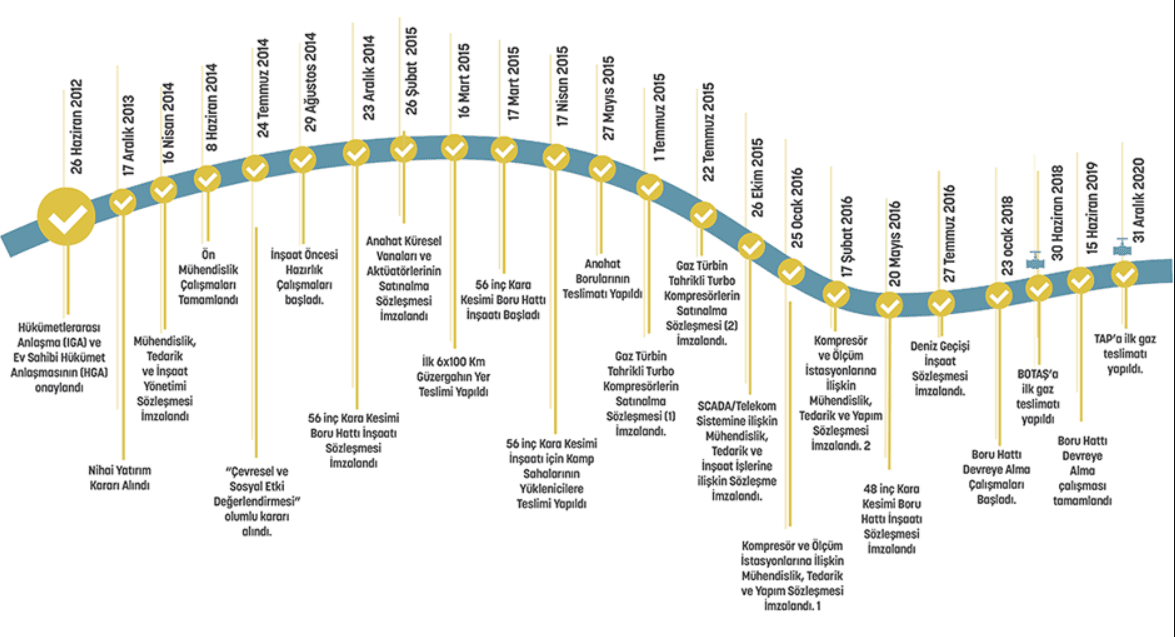
TANAP Project Timeline (TANAP)
The chronological timeline of its establishment began with the intergovernmental framework agreement signed in İzmir on 25 October 2011. The project name was publicly announced on 17 November 2011, the memorandum of understanding was signed on 26 December 2011, and on 27 June 2012, the intergovernmental final agreement established the institutional foundation for the Host Government Agreement. 【3】 Subsequently, on 28 June 2013, the Shah Deniz Consortium selected TAP as the preferred route for the European segment; on 17 December 2013, the final investment decision was made for Shah Deniz Phase II and the South Caucasus Pipeline Expansion Project. The partnership agreement was signed on 13 March 2015, and the groundbreaking ceremony took place on 17 March 2015.
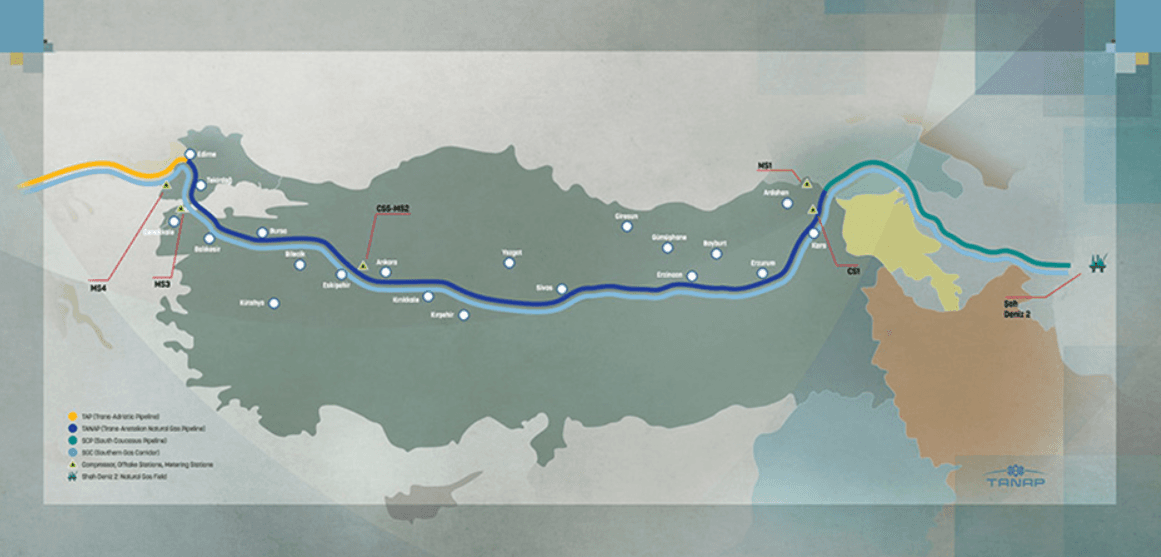
TANAP Route (TANAP)
TANAP is designed as a mainline running from the Türkgözü entry point in the Posof district of Ardahan Province at the Türkiye-Georgia border to the TAP connection in the İpsala district of Edirne Province. The exit points within Türkiye are located in Eskişehir and Thrace. The route passes through the provinces of Ardahan, Kars, Erzurum, Erzincan, Bayburt, Gümüşhane, Giresun, Sivas, Yozgat, Kırşehir, Kırıkkale, Ankara, Eskişehir, Bilecik, Kütahya, Bursa, Balıkesir, Çanakkale, Tekirdağ and Edirne.
The institutional architecture of TANAP features a partnership structure that has evolved over time while maintaining Türkiye and Azerbaijan as its core. In the initial agreement phase, SOCAR, BOTAŞ and TPAO emerged as founding partners. Early studies indicated that the consortium was initially designed with an 80 percent share for SOCAR and a combined 20 percent share for Türkiye’s BOTAŞ and TPAO. Later, during the late 2013 and 2015 phases, the partnership structure was reconfigured; the widely adopted arrangement became SOCAR 58 percent, BOTAŞ 30 percent and BP 12 percent. 【4】
The institutional actors are not limited to the pipeline company alone. On the production side, BP, Statoil, SOCAR, Lukoil, NIOC and Türkiye Petrolleri are involved in the Shah Deniz field; within the transportation chain, the South Caucasus Pipeline, TANAP and TAP form a sequential structure. Türkiye Petrolleri’s approximately 19 percent stake in Shah Deniz and the South Caucasus Pipeline, combined with BOTAŞ’s 30 percent share in TANAP, position Türkiye not merely as a transit country but as a stakeholder in multiple segments of the supply chain. Regarding investment, early estimates placed the total at around USD 7 billion, while some sources suggest figures of USD 10 billion or a range of USD 10–12 billion. Documents related to World Bank financing indicate that a USD 800 million loan was allocated, with USD 400 million assigned to BOTAŞ and USD 400 million to SGC. 【5】
The strategic significance of TANAP lies in its contribution to diversifying both supply sources and transit routes for Türkiye and Europe. For Türkiye, this importance is clearly evident in the structural profile of its energy dependency. According to 2015 data, Türkiye imports approximately 99 percent of its natural gas consumption, with 51 billion cubic meters of imports sourced 58 percent from Russia, 15 percent from Iran and 12 percent from Azerbaijan. 【6】
The planned expansion for TANAP is based on increasing capacity from an initial annual volume of 16 billion cubic meters to 23 billion cubic meters by 2023 and to 31 billion cubic meters by 2026. Institutional documents from 2023 project further growth, anticipating a capacity of 32 billion cubic meters by 2027.【7】 【8】
Aras, Osman Nuri, Elchin Suleymanov, and Fakhri Hasanov. “Trans-Anadolu Doğal Gaz Boru Hattı Projesi’nden Ekonomik ve Stratejik Beklentiler / Economic and Strategic Expectations of Trans-Anatolian Natural Gas Pipeline Project.” *International Conference on Eurasian Economies*. Accessed June 10, 2026. https://congress.avekon.org/papers/604.pdf.
BBC Türkçe. “TANAP: Avrupa Bağlantısı Açılan Doğal Gaz Boru Hattı Projesi Hakkında Neler Biliniyor?” March 30, 2019. Accessed June 10, 2026. https://www.bbc.com/turkce/haberler-turkiye-50614446
Daştan, Samet. “Anadolu Geçişli Bir Doğalgaz Boru Hattının Türk Dış Enerji Politikasına Etkileri.” Academia.edu. Accessed June 10, 2026. https://www.academia.edu/29908365/Anadolu_Ge%C3%A7i%C5%9Fli_Bir_Do%C4%9Falgaz_Boru_Hatt%C4%B1n%C4%B1n_T%C3%BCrk_D%C4%B1%C5%9F_Enerji_Politikas%C4%B1na_Etkileri.
Erdoğan, Nuray. “TANAP Projesinin Türkiye ve Azerbaycan Enerji Politikalarındaki Yeri ve Önemi.” *Ömer Halisdemir Üniversitesi İktisadi ve İdari Bilimler Fakültesi Dergisi* 10, no. 3 (July 2017): 10–26. https://doi.org/10.25287/ohuiibf.319259. Accessed June 10, 2026. https://dergipark.org.tr/en/pub/ohuiibf/article/319259.
Erdoğan, Recep Tayyip. “TANAP: Bölgesel Kalkınma ve Barış Projesi.” T.C. İletişim Başkanlığı, April 30, 2020. Accessed June 10, 2026. https://www.iletisim.gov.tr/turkce/cumhurbaskanimizin_kaleminden/detay/tanap-bolgesel-kalkinma-ve-baris-projesi
Gönül, Özkan. “Ortadoğu’nun Enerji Güvenliği ve Karadeniz.” Academia.edu. Accessed June 10, 2026. https://www.academia.edu/83456565/ORTADO%C4%9EUNUN_ENERJ%C4%B0_G%C3%9CVENL%C4%B0%C4%9E%C4%B0_VE_KARADEN%C4%B0Z
IDEAS/RePEc. "Trans Anadolu Doğal Gaz Boru Hattı Projesinin Ekonomik ve Stratejik Beklentileri." Accessed June 10, 2026. https://ideas.repec.org/p/pra/mprapa/52187.html
Ilter, Emel, and Hülya Kınık. “Türkiye’nin Enerji Denklemi: Trans Anadolu Doğalgaz Boru Hattı ve Türk Akımı.” *Uluslararası İktisadi ve İdari İncelemeler Dergisi*, no. 18 (January 1, 2017). Accessed June 10, 2026. https://dergipark.org.tr/tr/pub/ulikidince/article/279897
Kolcuoğlu Demirkan Koçaklı. “Trans Anadolu Doğal Gaz Boru Hattı Projesi.” *Enerji ve Altyapı*, March 2023. Accessed June 10, 2026. https://www.kolcuoglu.av.tr/Uploads/Publication/trans_anadolu_dogal_gaz_boru_hatti_projesi_tanap-q4A8FzJf.pdf
Suleymanov, Elchin, Fakhri Hasanov, and Osman Nuri Aras. “Trans Anadolu Doğal Gaz Boru Hattı Projesinin Ekonomik ve Stratejik Beklentileri / Economic and Strategic Expectations from Trans Anatolian Natural Gas Pipeline Project.” MPRA Paper no. 52187, September 15, 2013. Accessed June 10, 2026. https://mpra.ub.uni-muenchen.de/52187/1/MPRA_paper_52187.pdf
TANAP. "TANAP Proje Geçmişi." Accessed June 10, 2026. https://www.tanap.com/proje-gecmisi.
TANAP. "TANAP Projesi." Accessed June 10, 2026. https://www.tanap.com/tanap-projesi.
Önce, Asım Günal ve Sadettin Paksoy. “Trans Anadolu Doğal Gaz Boru Hattı Projesi’nin (TANAP) Bölge Ekonomisi ve Barışı Açısından Önemi.” *I. Uluslararası Kafkasya-Orta Asya Dış Ticaret ve Lojistik Kongresi*, 2015. Accessed June 10, 2026. https://ulk.ist/media/kitap/I-UKODTLK/trans-anadolu-dogal-gaz-boru-hatti-projesinin-tanap-bolge-ekonomisi-ve-b_pg4fXN4.pdf.
[1]
Nuray Erdoğan, “TANAP Projesinin Türkiye ve Azerbaycan Enerji Politikalarındaki Yeri ve Önemi,” Ömer Halisdemir Üniversitesi İktisadi ve İdari Bilimler Fakültesi Dergisi 10, no. 3 (Temmuz 2017): 10–26, https://doi.org/10.25287/ohuiibf.319259, Erişim Tarihi: 10 Haziran 2026, https://dergipark.org.tr/en/download/article-file/322410.
[2]
Nuray Erdoğan, “TANAP Projesinin Türkiye ve Azerbaycan Enerji Politikalarındaki Yeri ve Önemi,” Ömer Halisdemir Üniversitesi İktisadi ve İdari Bilimler Fakültesi Dergisi 10, no. 3 (Temmuz 2017): 10–26, https://doi.org/10.25287/ohuiibf.319259, Erişim Tarihi: 10 Haziran 2026, https://dergipark.org.tr/en/download/article-file/322410.
[3]
Osman Nuri Aras, Elchin Suleymanov ve Fakhri Hasanov, “Trans-Anadolu Doğal Gaz Boru Hattı Projesi’nden Ekonomik ve Stratejik Beklentiler / Economic and Strategic Expectations of Trans-Anatolian Natural Gas Pipeline Project,” Erişim Tarihi: 10 Haziran 2026, https://congress.avekon.org/papers/604.pdf.
[4]
Emel İlter ve Hülya Kınık, “Türkiye’nin Enerji Denklemi: Trans Anadolu Doğalgaz Boru Hattı ve Türk Akımı,” Uluslararası İktisadi ve İdari İncelemeler Dergisi, no. 18 (2017), Erişim Tarihi: 10 Haziran 2026, https://dergipark.org.tr/tr/download/article-file/261292.
[5]
Asım Günal Önce ve Sadettin Paksoy, “Trans Anadolu Doğal Gaz Boru Hattı Projesi’nin (TANAP) Bölge Ekonomisi ve Barışı Açısından Önemi,” Erişim Tarihi: 10 Haziran 2026, https://ulk.ist/media/kitap/I-UKODTLK/trans-anadolu-dogal-gaz-boru-hatti-projesinin-tanap-bolge-ekonomisi-ve-b_pg4fXN4.pdf.
[6]
Emel İlter ve Hülya Kınık, “Türkiye’nin Enerji Denklemi: Trans Anadolu Doğalgaz Boru Hattı ve Türk Akımı,” Uluslararası İktisadi ve İdari İncelemeler Dergisi, no. 18 (2017), Erişim Tarihi: 10 Haziran 2026, https://dergipark.org.tr/tr/download/article-file/261292.
[7]
Elchin Suleymanov, Fakhri Hasanov ve Osman Nuri Aras, “Trans Anadolu Doğal Gaz Boru Hattı Projesinin Ekonomik ve Stratejik Beklentileri,” MPRA Paper no. 52187, 15 Eylül 2013, Erişim Tarihi: 10 Haziran 2026, https://mpra.ub.uni-muenchen.de/52187/1/MPRA_paper_52187.pdf.
[8]
“Trans Anadolu Doğal Gaz Boru Hattı Projesi,” Kolcuoğlu Demirkan Koçaklı, Enerji ve Altyapı, Mart 2023, Erişim Tarihi: 10 Haziran 2026, https://www.kolcuoglu.av.tr/Uploads/Publication/trans_anadolu_dogal_gaz_boru_hatti_projesi_tanap-q4A8FzJf.pdf.

Trans-Anatolian Natural Gas Pipeline Project (TANAP)
Trans-Anatolian Natural Gas Pipeline Project (TANAP)
Full Name | Trans-Anatolian Natural Gas Pipeline Project (TANAP) | ||||||||
|---|---|---|---|---|---|---|---|---|---|
Location | Türkiye | ||||||||
Starting Point | Türkgözü (Posof/Ardahan) – Türkiye-Georgia border | ||||||||
End Point | İpsala (Edirne) – Türkiye-Greece border | ||||||||
Source Gas Field | Shah Deniz Phase 2 (Azerbaijan) | ||||||||
Number of Provinces It Passes Through | 20 | ||||||||
No Discussion Added Yet
Start discussion for "TANAP (Trans-Anatolian Natural Gas Pipeline Project)" article
History and Establishment Process
Route and Technical Specifications
Partnership Structure
Energy Supply
Capacity Expansion Plans