


This article was automatically translated from the original Turkish version.
+1 More
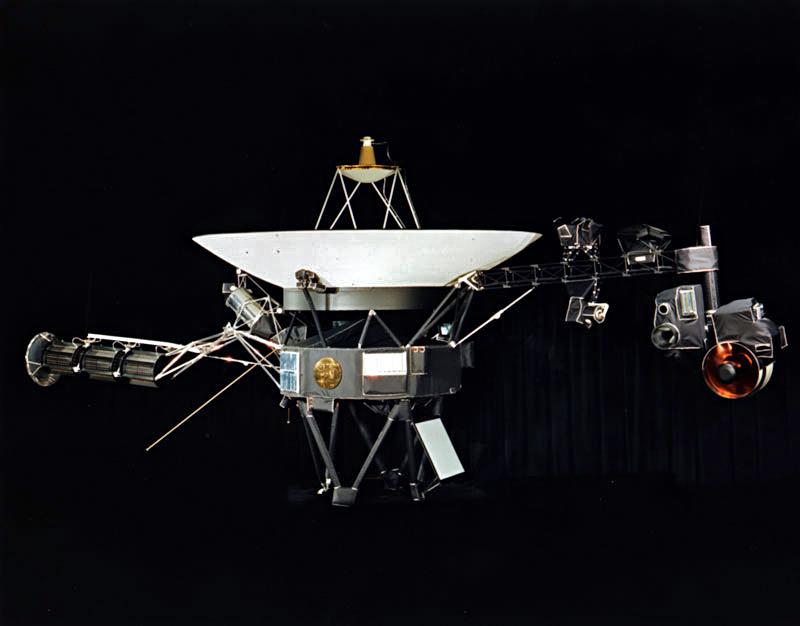
Satellite | Voyager 1 | ||||||||
|---|---|---|---|---|---|---|---|---|---|
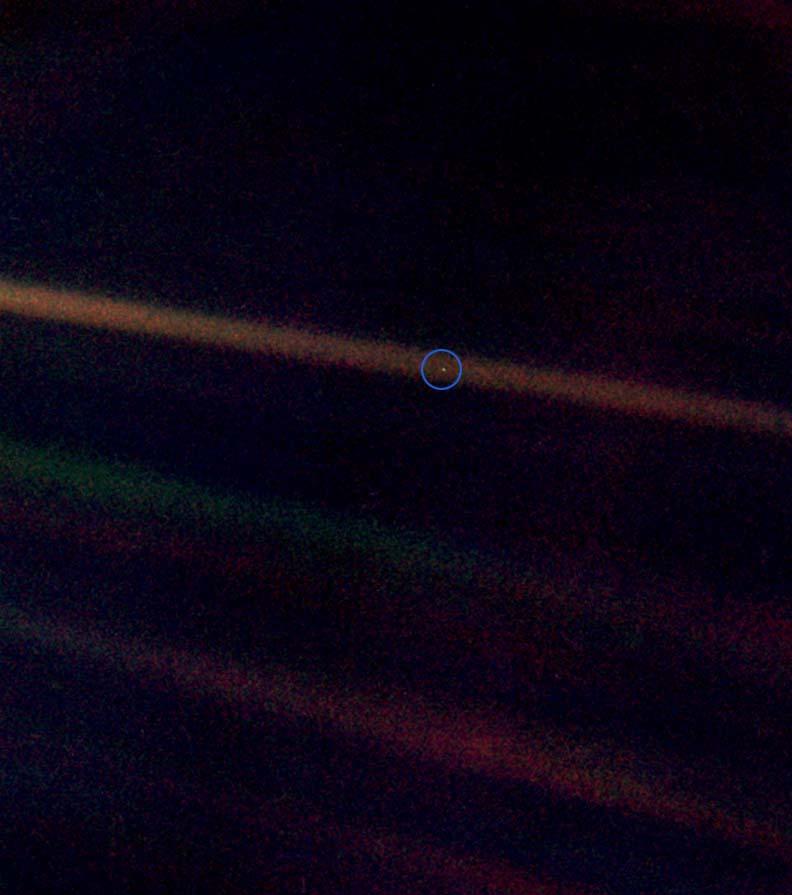
"Pale Blue Dot" (Soluk Mavi Nokta), 14 Nokta 1990 tarihinde Voyager 1 uzay aracı tarafından çekilen ve Dünya'nın uzaydaki konumunu gösteren bir fotoğraftır. Bu görüntü, Dünya'nın sonsuz gibi görünen evrendeki yerini gözler önüne sererek çeşitli bilimsel ve felsefi tartışmalara kaynak olmuştur.
【1】
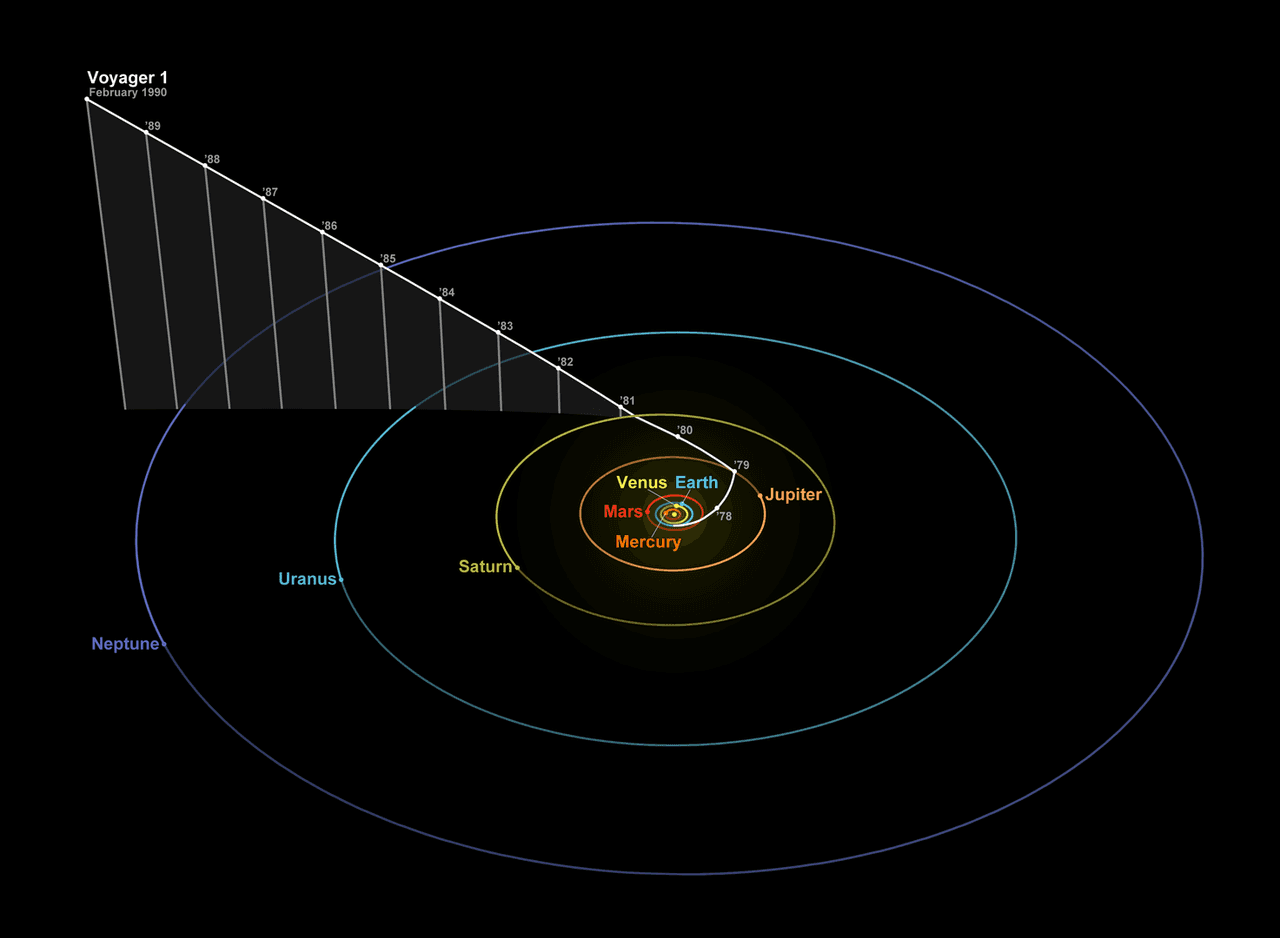
Voyager 1 is an unmanned spacecraft launched by NASA on 5 September 1977 to study the Sun System. Initially designed to explore Jupiter and Saturn, Voyager 1 provided comprehensive data on the atmospheric structure magnetic fields and moons of these planets. It reached Jupiter in 1979 and Saturn in 1980 capturing close-up images of both worlds.
After completing this phase its mission shifted to "interplanetary exploration." In this context it reached the heliosphere the boundary region influenced by solar wind and studied its structure. In 2012 Voyager 1 became the first human-made craft to enter interstellar space.
The broad perspective gained by Voyager 1 after this stage contributed to the creation of the "Pale Blue Dot" photograph. The idea to take the image was proposed by astronomer Carl Sagan. On his request NASA issued commands to Voyager 1 to take one final look at the Sun System and capture an image of Earth. However this process posed technical challenges. The spacecraft's camera had not been used for a long time and needed to be reactivated and there was a risk of direct sunlight reflecting into the lens. Despite these difficulties the camera was successfully activated and an image of Earth was obtained.
After completing the majority of its mission Voyager 1 was instructed at Carl Sagan's suggestion to capture a panorama of the Sun System including Earth. Voyager 1 took this image from approximately six billion kilometers away from Earth. In the photograph Earth appears as a pale blue dot within a sunbeam.
To capture this image Voyager 1 had traveled continuously for about 13 years at a speed of 61000 kilometers per hour. During this time the spacecraft covered a distance of about six billion kilometers and the light from this distance took approximately five hours and 28 minutes to reach Earth. This situation is significant in demonstrating the temporal scale on which the photograph was captured.
【2】
The photograph reveals the vastness of the universe and Earth's position within it. On a cosmic scale Earth occupies an extremely small place. This underscores the relative insignificance of human existence beyond the geocentric view of the universe.
【3】
NASA Science. "Voyager 1's Pale Blue Dot." NASA Science. Accessed March 27, 2025.https://science.nasa.gov/mission/voyager/voyager-1s-pale-blue-dot/.
NASA. "Earth." Eyes on the Solar System. Accessed March 27, 2025.https://eyes.nasa.gov/apps/solar-system/#/earth.
NASA. "Our Pale Blue Dot." NASA. Accessed March 27, 2025.https://www.nasa.gov/image-article/our-pale-blue-dot/.
NASA. "Voyager Grand Tour." Eyes on the Solar System. Accessed March 27, 2025.https://eyes.nasa.gov/apps/solar-system/#/story/voyager_grand_tour?slide=slide_2.
The Planetary Society. "Pale Blue Dot." Accessed March 27, 2025.https://www.planetary.org/worlds/pale-blue-dot.
[1]
Bulutsu.org. "Soluk Mavi Nokta." Erişim 27 Mart 2025. https://www.bulutsu.org/smn.php.
[2]
Universe Magazine. "Pale Blue Dot: 35 Years Old – How the Most Distant Photo of Earth Was Taken." Universe Magazine, March 14, 2025. https://universemagazine.com/en/pale-blue-dot-35-years-old-how-the-most-distant-photo-of-earth-was-taken/.
[3]
NASA. "Voyager Grand Tour." Eyes on the Solar System. Erişim 27 Mart 2025. https://eyes.nasa.gov/apps/solar-system/#/story/voyager_grand_tour?slide=slide_2

Satellite | Voyager 1 | ||||||||
|---|---|---|---|---|---|---|---|---|---|
Voyager 1 Mission
Formation and Technical Details of the Photograph
Astronomical Significance