This article was automatically translated from the original Turkish version.
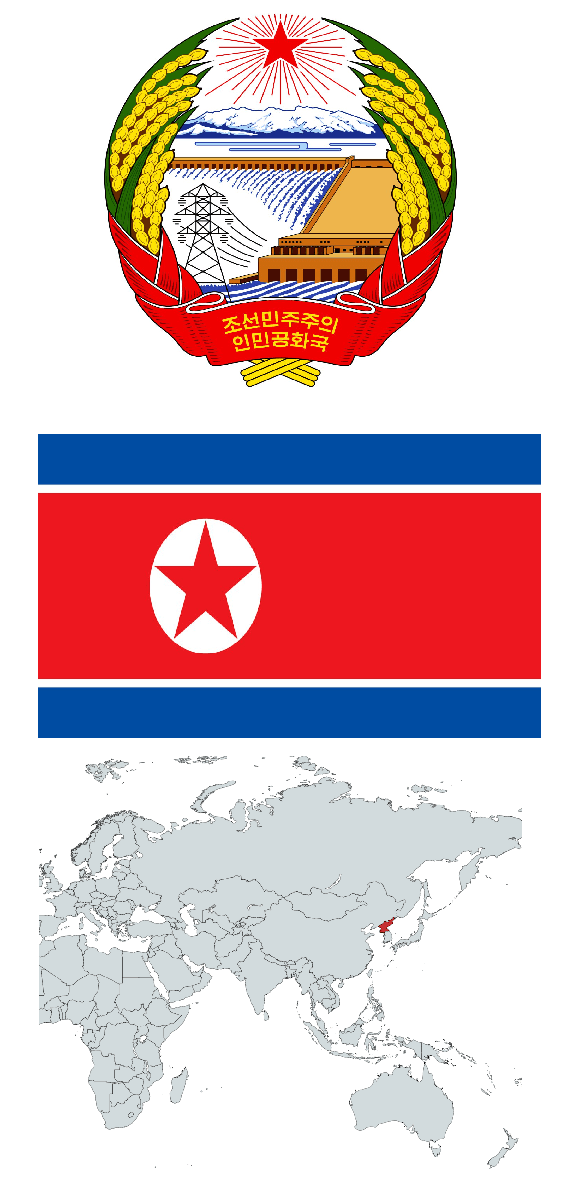
North Korea (Democratic People's Republic of Korea)
Official Name | Democratic People's Republic of Korea | ||||||||
|---|---|---|---|---|---|---|---|---|---|
Form of Government | Unitary One-Party Socialist Republic | ||||||||
Date of Independence | 9 Eylül 1948 | ||||||||
Capital | Pyongyang | ||||||||
Head of State | Kim Jong-Un | ||||||||
Official Language | Korean | ||||||||
Common Languages | Korean (Munhwaŏ) | ||||||||
National Day | September 9 | ||||||||
Area | 120,538 km² | ||||||||
Total Population | 26.3 Million | ||||||||
Climate | Continental | ||||||||
GDP (Nominal) | 26 billion US Dollars | ||||||||
GDP per Capita | 1,261 US Dollars | ||||||||
Ethnic Groups | Korean majority, Chinese and Japanese minorities | ||||||||
Telephone Code | +850 | ||||||||
Internet Domain Code | .kp | ||||||||
Religious Structure | 73% Non-religious 13% Cheondoist 12% Shamanist 1.5% Buddhist 0.5% Other | ||||||||
Democratic People's Republic of Korea (DPRK), East Asia’s northern Korean Peninsula is a socialist state based on central planning. It is bordered by the People's Republic of China to the north, the Russian Federation to the northeast, and the Republic of Korea (South Korea) to the south. Its eastern coast borders the Sea of Japan (East Sea), while its western coast borders the Yellow Sea. The capital and largest city is Pyongyang.
North Korea was established in 1948 as a socialist state supported by the Soviet Union following the division of the Korean Peninsula. Since its founding, the country has been ruled by three generations of the same family: Kim Il-sung, Kim Jong-il, and Kim Jong-un. The state ideology is built on the principles of Juche (self-reliance) and Songun (military-first policy). This ideological framework emphasizes political independence, economic self-sufficiency, and complete sovereignty in military defense.
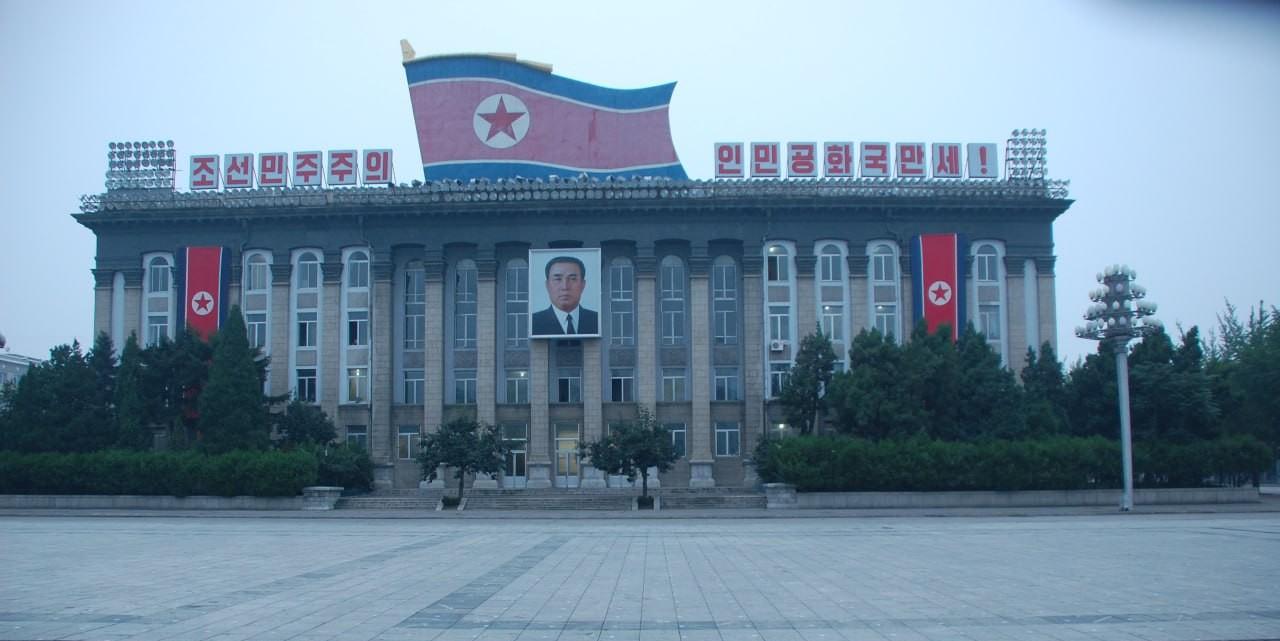
North Korea - Pyongyang, Kim Il-sung Square (Flickr)
The country’s governance is single-party, with the Workers’ Party of Korea holding a decisive position in all state and societal institutions. The current constitution defines Kim Il-sung as the “Eternal President of the State” and Kim Jong-il as the “Eternal Chairman of the National Defence Commission.” Today, Kim Jong-un is the supreme authority of the country as General Secretary of the Workers’ Party of Korea, Chairman of the State Affairs Commission, and Commander-in-Chief of the Korean People’s Army.
As of 2025, North Korea’s population is approximately 26 million. The vast majority of the population is of ethnic Korean origin, and the country is nearly entirely homogeneous. The official language is Korean, and the de facto official religion is atheism; religious institutions are under state control. Education and healthcare services are free, and public life is subject to strict ideological control.
The national anthem of the Democratic People's Republic of Korea is titled “Aegukka” (애국가 – Patriotic Song). Composed in 1947 by Kim Won-gyun with lyrics by poet Pak Se-yong, it was officially adopted as the national anthem on 9 September 1948, coinciding with the founding of the state.
The anthem glorifies the Korean people’s struggle for independence, their natural wealth, and their loyalty to the state. It makes no direct reference to the Kim family, maintaining a focus on national unity rather than party propaganda. Its melodic structure, shaped by Soviet influence after 1945, became a central element of state ceremonies following its orchestral arrangement in the 1950s.
North Korea National Anthem (Urumaxi Anthems)
The northern region of the Korean Peninsula has been home to small communities practicing agriculture and hunting since prehistoric times. The Gojoseon Kingdom, traditionally said to have been founded in 2333 BCE, is the earliest known political entity in Korean history. From 108 BCE, the region came under the influence of China’s Han Dynasty and became an area where Chinese cultural influence merged with local traditions over centuries.
From the 1st century CE, the Goguryeo Kingdom (37 BCE–668 CE) established a powerful state on the territory of today’s North Korea, competing with China and other Korean kingdoms. Goguryeo made present-day Pyongyang its capital and laid the cultural foundations of the region through its military structure.
With the rise of the Silla Kingdom in the 7th century, the peninsula became unified, though northern territories fell under the influence of China’s Tang Dynasty. During the Goryeo Dynasty (founded in 918, from which the name Korea derives), Pyongyang regained prominence as a major city, and Buddhism and Confucianism coexisted. The Joseon Dynasty, established in 1392, was Korea’s longest-lasting regime and ruled until the late 19th century. During this period, the Pyongyang region served more as a frontier fortress than a cultural center.
After the First Sino-Japanese War in 1895, Chinese influence over Korea declined, and in 1910 the Japanese Empire fully annexed Korea. Japanese colonial rule imposed harsh assimilation policies under the guise of industrialization, with intense pressure on language, religion, and culture concentrated in northern regions. During this period, Pyongyang and Hamhung became industrial centers, and the foundations of heavy industry infrastructure were laid.
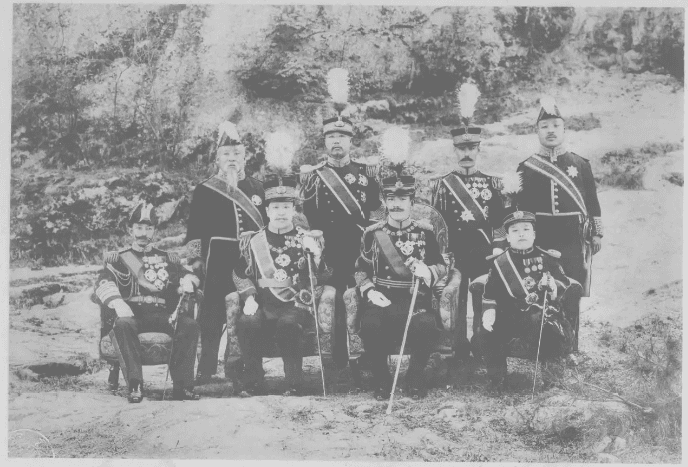
Photograph of the Delegations of Two Pre-Occupation Leaders, 1953 (The National Diet Library)
At the end of World War II, Japan’s surrender led to Korea being divided along the 38th parallel into two occupation zones: the north under the Soviet Union and the south under the United States. This temporary division quickly solidified into a permanent political split. In 1948, the Democratic People's Republic of Korea (DPRK) was proclaimed in Pyongyang, and the Republic of Korea (South Korea) in Seoul. Kim Il-sung became prime minister of North Korea with Soviet support, while Syngman Rhee led the U.S.-backed government in the South.
The Korean War, which began in 1950, erupted when North Korea attempted to invade the South. On the morning of 25 June 1950, the Korean People’s Army under Kim Il-sung crossed the southern border and launched a large-scale offensive. Backed by Soviet arms, this attack resulted in the fall of Seoul within days. North Korean forces quickly gained control of most of the South. In response, the United Nations Security Council formed an international military coalition led by the United States to defend South Korea. Thus, the war became a theater of ideological conflict between two superpowers beyond Korea’s borders.
In September 1950, the Inchon Landing led by U.S. General Douglas MacArthur changed the course of the war. UN forces swiftly recaptured Seoul and advanced north of the 38th parallel to Pyongyang. This development triggered direct intervention by the People's Republic of China. The Chinese leadership viewed the advance of American forces toward its border as a threat to its national security and entered the war in November 1950 with the “Chinese People’s Volunteers.” As a result of large-scale Chinese counteroffensives, UN forces were forced to retreat, and Pyongyang returned to North Korean control.
By early 1951, the front line stabilized near the 38th parallel. The following two years of fighting turned into a war of attrition marked by intense artillery fire, aerial bombardments, and trench warfare. Both sides suffered heavy losses; millions of civilians were displaced, and much of the Korean Peninsula was devastated.
During this period, Turkey responded to the United Nations’ call and joined the countries participating in the war. The Turkish government decided on 17 July 1950 to send a 4,500-strong Turkish Brigade under UN command. The Turkish unit arrived in Korea in October 1950 and demonstrated significant defensive success in the Battle of Kunuri and the Wawon Engagement. A total of 721 Turkish soldiers lost their lives during the war. Turkey’s military contribution to the Korean War became a crucial diplomatic factor in its process of joining NATO in 1952.
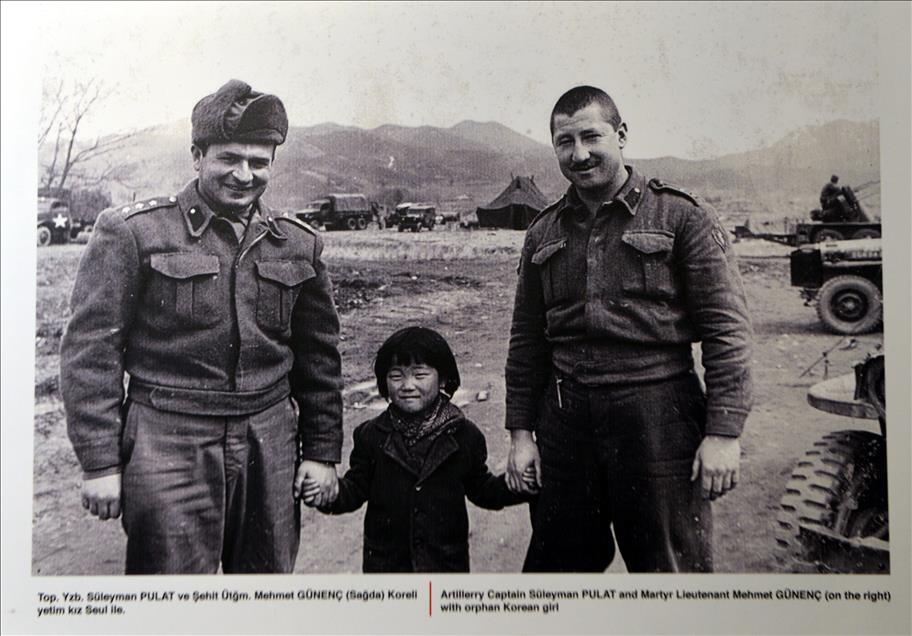
Turkish soldiers during the Korean War (Anadolu Ajansı)
The Panmunjom Armistice Agreement signed on 27 July 1953 effectively ended the war. However, no permanent peace treaty was concluded between the two sides. In accordance with the armistice, a Demilitarized Zone (DMZ) was established along the 38th parallel, which remains the border between the two Koreas to this day. The war, which claimed approximately three million lives, permanently divided the Korean Peninsula into two separate states. North Korea interprets the conflict as a “victory against American imperialism,” while South Korea and the Western world view it as the repulsion of an unprovoked attack.
The Korean War fundamentally altered global political balances, not only militarily but also politically. The Cold War’s frontline shifted to Asia. The foundations of a long-term strategic rivalry between the United States and China were laid. At the same time, it established the historical starting point for North Korea’s construction of its regime on a persistent perception of security threat.
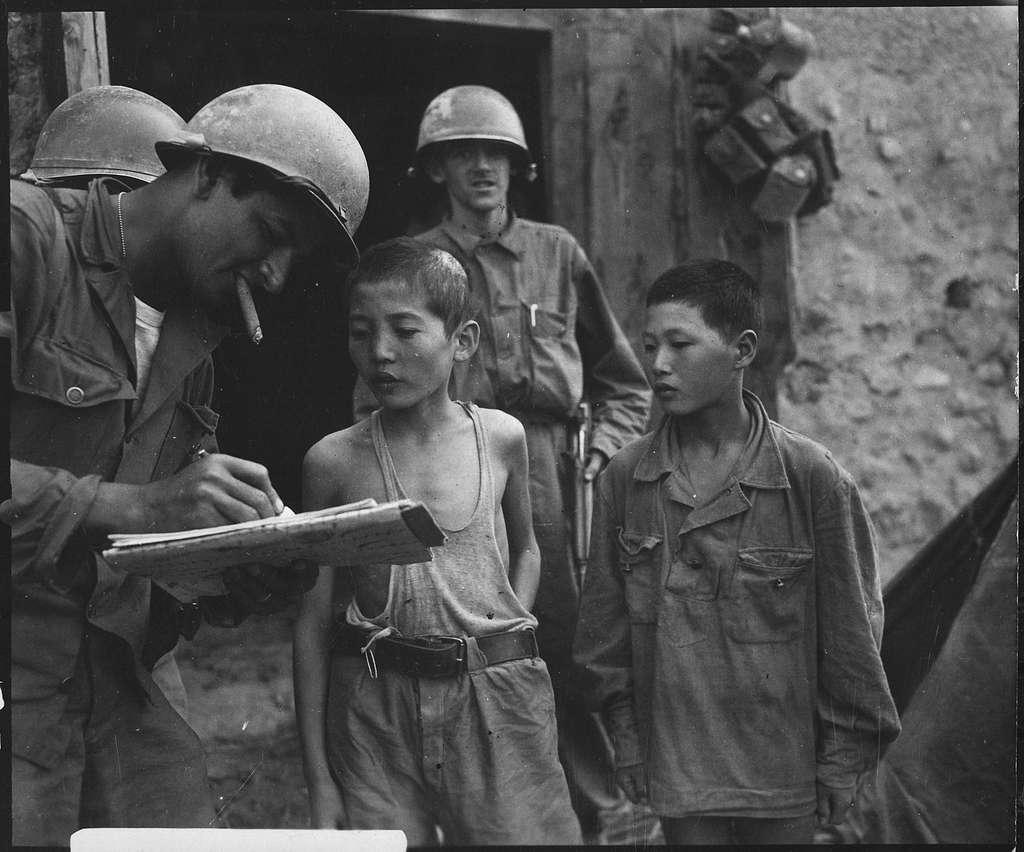
North Korean Child Soldiers Captured by U.S. Soldiers, 1953 (National Archives)
Kim Il-sung developed the ideology of “Juche,” or self-reliant socialism, from the 1950s onward. This ideology implied rejection of external dependence and centralization of the cult of leadership. In the 1972 Constitution, Kim Il-sung was declared the “Eternal President of the State.”
In the 1980s, the economy survived with support from China and the Soviet Union, but the collapse of the Soviet bloc in the 1990s pushed North Korea into economic isolation. Upon Kim Il-sung’s death in 1994, his son Kim Jong-il succeeded him.
Kim Jong-il’s period (1994–2011) is defined by the “Songun” policy of military-first governance. During the famines of the late 1990s, triggered by this policy, hundreds of thousands perished. Nevertheless, the regime pursued its nuclear program, deepening international isolation.
Upon Kim Jong-il’s death in 2011, Kim Jong-un came to power. From 2016, nuclear weapons and intercontinental ballistic missile tests accelerated. Although diplomatic contacts occurred with the United States in 2018, no lasting agreement was reached. Today, the country sustains itself through strict regime control, international sanctions, and a nuclear deterrence policy.
North Korea has a total area of 120,540 km². It shares a 1,416 km border with the People's Republic of China to the north, a short 17 km border with the Russian Federation to the northeast, and a 238 km border with South Korea along the Demilitarized Zone (DMZ) to the south. The Sea of Japan (East Sea) lies to the east and the Yellow Sea to the west.
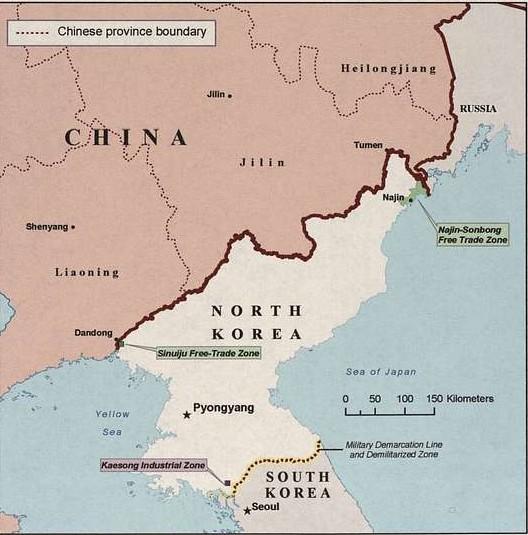
Geographical Location of North Korea (Picry)
Approximately 80% of the country’s surface is mountainous and rugged. The highest point is Mount Paektu (2,744 m) on the Chinese border, considered sacred and symbolizing revolutionary struggle and the origin of the Korean people in national mythology. Other important mountain ranges include Hamgyong, Rangrim, and Myohyang.
Plains cover only about 20% of the country’s surface and are concentrated along the western coast. The Pyongyang Plain, Chaeryong Valley, and Hwangju Valley are agricultural production centers. Coastal plains are vital for rice cultivation, while inland areas are unsuitable for agriculture due to mountainous terrain.
The main rivers are the Yalu (Amnok), Tumen (Duman), Taedong, and Chongchon. The Yalu and Tumen rivers form natural borders with China and Russia. The Taedong River, the country’s most important inland waterway, flows through Pyongyang and empties into the Yellow Sea. Lake Chon, located in the crater of Mount Paektu, is the country’s highest natural lake.
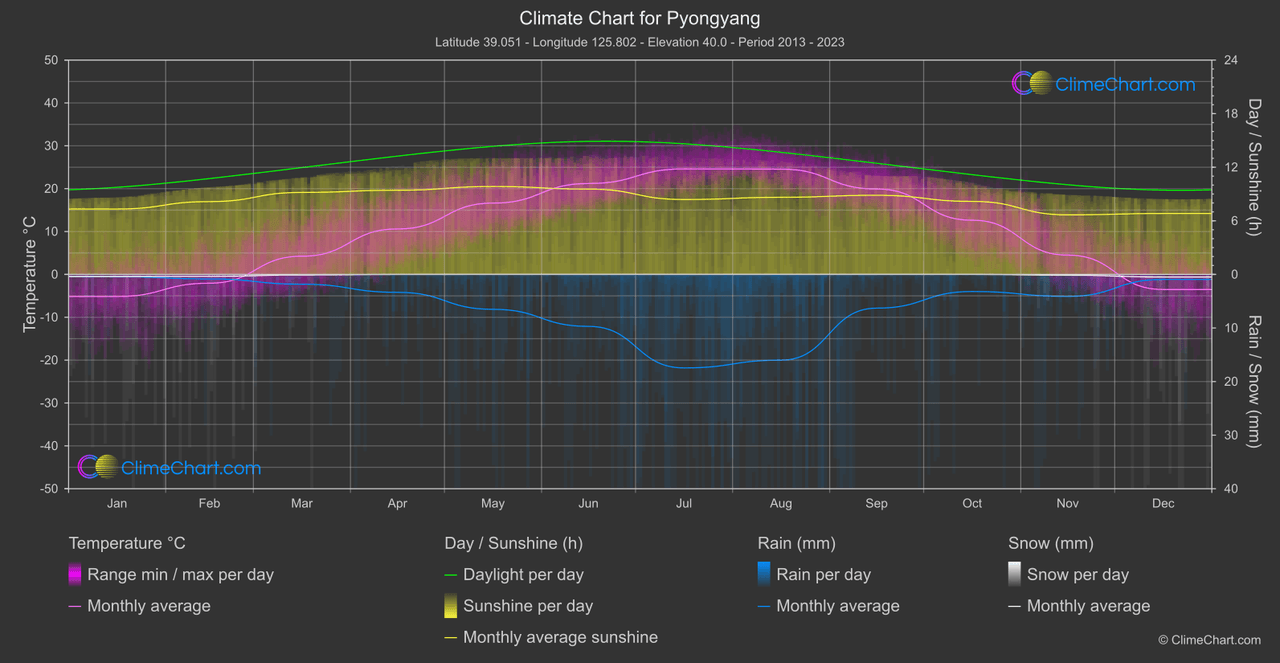
North Korea lies in the humid continental climate zone. Winters are long, cold, and dry; summers are short, hot, and humid. Average January temperatures range from –10°C in the north to –3°C in the south. July averages reach 25°C. Rainfall is concentrated in summer months, with annual precipitation between 1,000 and 1,500 mm. Monsoon rains frequently cause flooding and landslides. Severe cold and drought in winter limit agricultural productivity.
North Korea’s economy is a closed system entirely based on state planning. Market mechanisms operate only to a limited extent at the local level, and private property is not legally recognized. The country has been under United Nations and U.S. sanctions for many years, severely restricting foreign trade, finance, and energy access.
Due to the impossibility of obtaining reliable data from international organizations, economic indicators are based on estimates. As of 2023, Gross Domestic Product (GDP) is estimated at $28–30 billion, and per capita income at approximately $1,200. Economic growth rate is below 1%.
The inflation rate is not officially disclosed; calculations based on black-market and food prices suggest around 15%. Unemployment is officially reported at 3–4%, but hidden unemployment is estimated to exceed 25%. Foreign debt is approximately $8 billion, and foreign exchange reserves stand at around $500 million.
Agriculture, industry, and services are conducted according to state-planned directives. The agricultural sector contributes 22% of GDP. Major products include rice, maize, potatoes, soybeans, and barley. The agricultural cooperative system remains in place, but drought, flooding, and fuel shortages reduce productivity.
The industrial sector accounts for approximately 45% of GDP. Key areas include mining (coal, iron, zinc, gold), chemicals, steel, construction materials, arms, and munitions production. The arms industry is central to the economy both in terms of employment and foreign currency generation.
The services sector contributes 33% of GDP. Tourism, trade, and domestic transportation are under state control. A limited number of hotels in Pyongyang serve foreign diplomats and specific tourist groups.
North Korea’s foreign trade is extremely limited. As of 2023, exports are estimated at $2.1 billion and imports at $3.9 billion. Major export items include coal, iron ore, textiles, seafood, and arms components. Key imports include petroleum, machinery parts, grain, and pharmaceuticals.
China is the largest trading partner, accounting for approximately 90% of total trade. Russia has become the secondary trading partner in recent years, providing grain and fuel support. Due to sanctions, trade with the European Union, Japan, and South Korea is virtually nonexistent.
North Korea is closed to foreign investors. The Rason Special Economic Zone, established in 1991 near the Chinese border, is the only area permitting limited commercial activity. Chinese and Russian companies operate small-scale mining and port businesses there.
Direct foreign investment is legally possible but practically requires state approval. The country is not a member of international financial institutions (IMF, World Bank, Asian Development Bank).
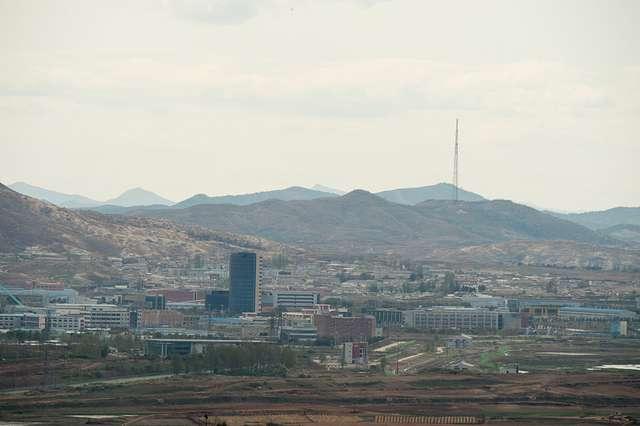
Jointly Used with South Korea Until 2016
Energy production relies heavily on coal. Approximately 60% of electricity is generated by thermal power plants and 40% by hydroelectric plants. The country produces about 20 billion kWh annually, but frequent outages occur. There is no domestic oil production; nearly all imports come via China.
The transportation network consists of 5,200 km of railway, 25,000 km of roads, 12 ports, and 24 airports. However, only one-third of roads are paved. Major ports are Nampo, Chongjin, and Rajin. The railway system, established by Japan in the 1930s, remains the backbone of national transportation.
North Korea’s population is approximately 26.2 million as of 2025. The population growth rate is 0.4%. Life expectancy is 69 years for men and 76 years for women. The birth rate is 13 per 1,000, and the death rate is 9 per 1,000. Infant mortality is around 20 per 1,000 live births. The urbanization rate is 63%.
About one-third of the population is concentrated in and around the capital, Pyongyang. Other major cities include Hamhung, Chongjin, Nampo, and Wonsan. Rural life remains organized around collective production units. Urbanization is state-planned; internal migration is tightly controlled through a permit system.
Over 99% of the population is ethnically Korean. Minority populations are extremely limited; apart from small Chinese and Japanese communities, no other ethnic groups exist. This homogeneity reinforces the regime’s ideological narrative of “one nation, one leader.”
Although the constitution guarantees freedom of religion, religious life is under state control. The majority of the population is atheist. Christianity and Buddhism are officially recognized only as “historical heritage.” A few churches and temples in Pyongyang are used for diplomatic purposes. The regime’s ideological core presents Juche as quasi-religious; loyalty to the Kim dynasty has become a social belief system.
Education is free and compulsory for 12 years. The literacy rate is 99.8%. The curriculum is heavily infused with ideological education; the works of Kim Il-sung and Kim Jong-il are mandatory subjects at all levels. The most prestigious university is Kim Il-sung University. Science and engineering are prioritized, and foreign language education is limited.
Legal emigration from the country is nearly impossible. During the famines of the 1990s, tens of thousands illegally crossed into China. Today, attempts to leave are met with severe penalties. Population mobility occurs only within the country and under state direction. The low population growth rate and rising elderly population are viewed by the regime as a long-term economic risk.
Cultural life is based on collective production and loyalty. Literature, music, theater, and cinema are under state control. Every year on 15 April, Kim Il-sung’s birthday is celebrated as the “Day of the Sun,” a national holiday. Mass demonstrations, group dancing, and march ceremonies are integral to cultural identity.
Tourism in North Korea is a highly restricted activity under strict state control. Entry is permitted only through state-approved tours; independent travel is banned. Visitors are accompanied by state-appointed guides, and deviation from designated routes is considered a crime.
Tourism revenue accounts for a marginal share of the economy (approximately 1% of GDP). All earnings go directly to the state treasury. Annual visitor numbers average 100,000–150,000, the majority of whom are Chinese tourists. Visitors from Western countries are exceptional.
Tourist sites are designed around ideological and historical themes. Pyongyang highlights modern monuments and mass rally venues; Kaesong features historic Korean architecture; Myohyang and Paektu Mountains showcase revolutionary museums. The Wonsan–Kumgang Tourism Zone on the eastern coast was planned as a foreign investment destination but remains limited due to sanctions.
For the regime, tourism serves less as an economic activity than as an ideological propaganda tool. The state uses tourism during diplomatic thaw periods to showcase the country’s prosperity and system’s “order.” However, borders were fully closed during the COVID-19 pandemic; no tourists were admitted between 2020 and 2023.
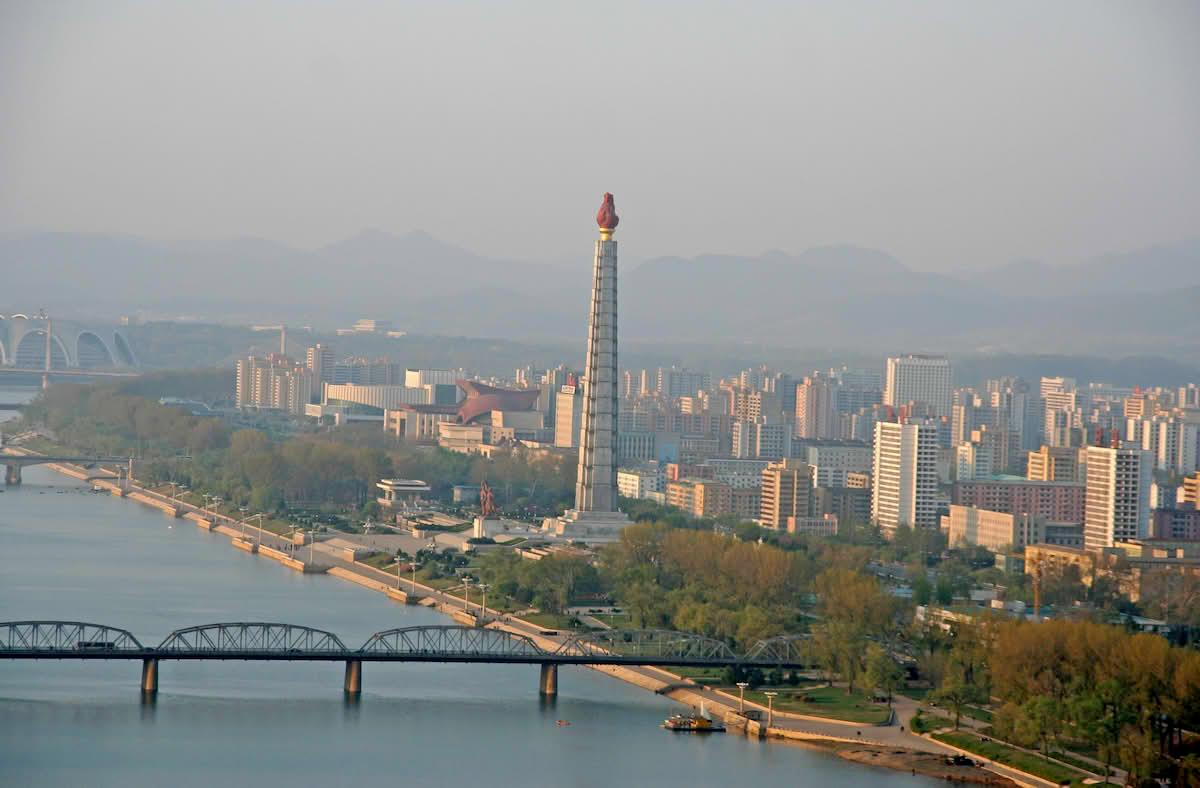
Taedong River and Pyongyang (Eric Bolstad - Store Norske Leksikon)
North Korea’s foreign policy is based on preserving sovereignty, regime survival, and deterrence against external intervention. Since the 1950s, the state has made independence and self-reliance (Juche) the ideological foundation of its international relations. Foreign policy is entirely under the control of the Workers’ Party of Korea; decision-making is conducted under the absolute authority of the leader.
The Korean Peninsula is one of Asia’s most militarized regions since the Cold War. No formal peace treaty has been signed since the 1953 Armistice, and approximately two million troops are deployed along the border (DMZ). North Korea views joint military exercises by the United States and South Korea as threats to its national security and maintains its military readiness at a consistently high level.
China is North Korea’s historically most important ally. It intervened in the Korean War in 1950 to save the Pyongyang regime and provided economic and military support afterward. Today, bilateral trade is the lifeline of North Korea’s economy. China is the only actor with real diplomatic leverage over Pyongyang. However, Beijing–Pyongyang relations are not fully trust-based. China has occasionally supported UN sanctions against North Korea due to nuclear tests. Nevertheless, Beijing views instability in Pyongyang as a risk to border security and potential refugee flows.
North Korea–Russia relations originate from the founding of the Democratic People's Republic of Korea in 1948 with Soviet support. During the Cold War, Pyongyang remained Moscow’s ideological and military ally. Relations weakened after the Soviet Union’s collapse but strengthened again in the 2020s. Moscow views Pyongyang as a strategic counterweight to the United States and the West. Since 2023, exchanges of food, oil, and munitions have increased; in 2024, the two countries signed a “Mutual Defense and Economic Cooperation Agreement.” During this period, Moscow has provided Pyongyang with food, oil, and technology support, while North Korea has begun supplying Russia with munitions and logistical assistance.
The prolongation of the Russia–Ukraine War has solidified military cooperation between the two countries. According to Western and South Korean intelligence reports, North Korea sent thousands of containers of artillery ammunition and rocket systems to Russia between 2023 and 2024. In 2025, allegations emerged that some North Korean engineers and small military units were providing technical support in Russian-occupied regions of Ukraine. Russian President Vladimir Putin thanked North Korean soldiers in a speech in September 2025.
Russia does not officially support North Korea’s nuclear program but provides diplomatic protection by advocating for the easing of sanctions.
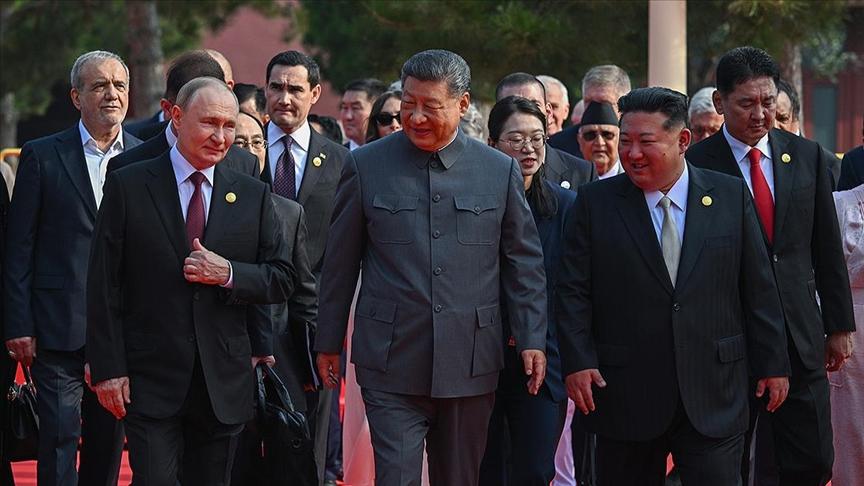
Russian President Vladimir Putin, Chinese President Xi Jinping, and North Korean leader Kim Jong-un (Anadolu Ajansı)
North–South relations are a decisive element in the security equation of the Korean Peninsula. During the early 2000s “Sunshine Policy,” limited dialogue and economic cooperation occurred (e.g., the Kaesong Industrial Complex). However, this region was closed in 2016, and relations deteriorated again.
Brief diplomatic contacts occurred in the 2020s, but lasting normalization has not been achieved due to disagreements over the nuclear program and human rights. As of 2025, there are no direct contacts between the two countries.
The United States has regarded North Korea as a potential threat since the 1950s. The 1994 Agreed Framework and the 2000s Six-Party Talks aimed to curb Pyongyang’s nuclear activities but failed.
Summits between Kim Jong-un and U.S. President Donald Trump in Singapore in 2018 and Hanoi in 2019 raised hopes for nuclear disarmament but yielded no results. The United States continues to impose economic, financial, and technological embargoes on North Korea. In its 2025 defense doctrine, Washington classifies North Korea as a “strategic nuclear threat.”
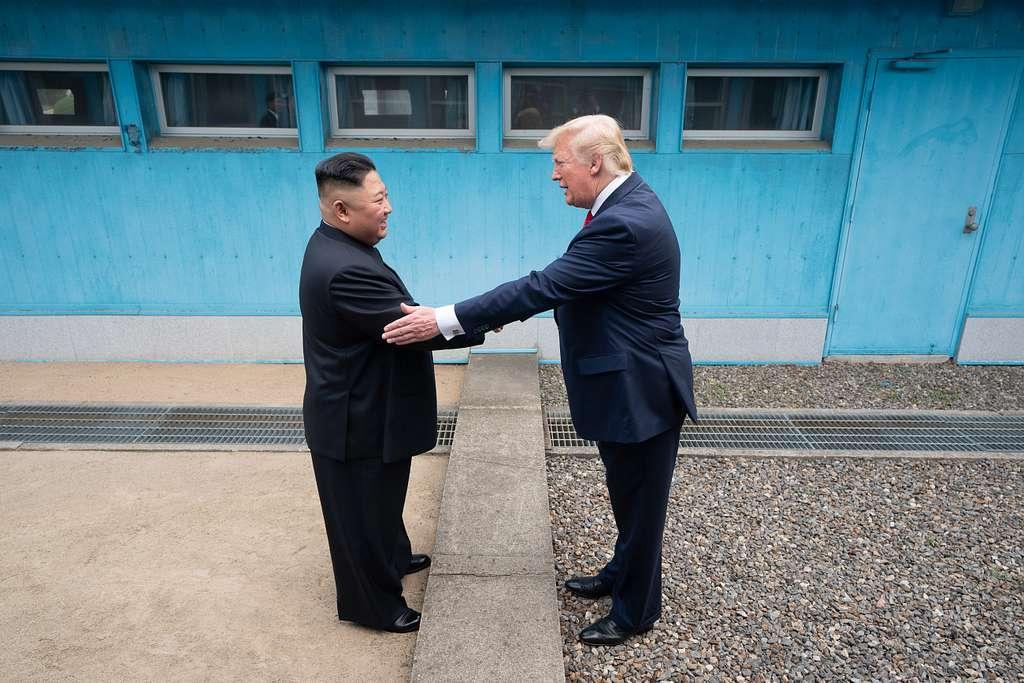
U.S. President Donald J. Trump Shakes Hands with Workers’ Party of Korea Chairman Kim Jong-un, 2019 (Flickr)
North Korea–Japan relations are strained due to Japan’s colonial occupation in the early 20th century and the abduction of Japanese citizens in the 1970s–1980s. Tokyo is one of the countries maintaining strict sanctions against Pyongyang. There are no diplomatic relations.
North Korea joined the United Nations simultaneously with South Korea in 1991. However, it has been subject to continuous sanctions due to human rights violations, ballistic missile tests, and nuclear activities. International Atomic Energy Agency (IAEA) inspectors have not been allowed into the country since 2009. The country dismisses UN Human Rights Council reports as “political manipulation” and rejects them.
North Korea’s security policy is based on the principle of “nuclear deterrence for regime survival.” The country conducted its first nuclear test in 2006 and is estimated to possess approximately 60–70 nuclear warheads as of 2023, including short-, medium-, and intercontinental-range missiles.
The 2022 law formally adopted the “right to preemptive nuclear strike” as official doctrine. This policy bases regime security on strategic weapons capacity rather than conventional defense.
The armed forces have a total personnel strength of approximately 1.2 million, equivalent to about 5% of the population. Internal intelligence and political control units play a key role in maintaining regime stability.
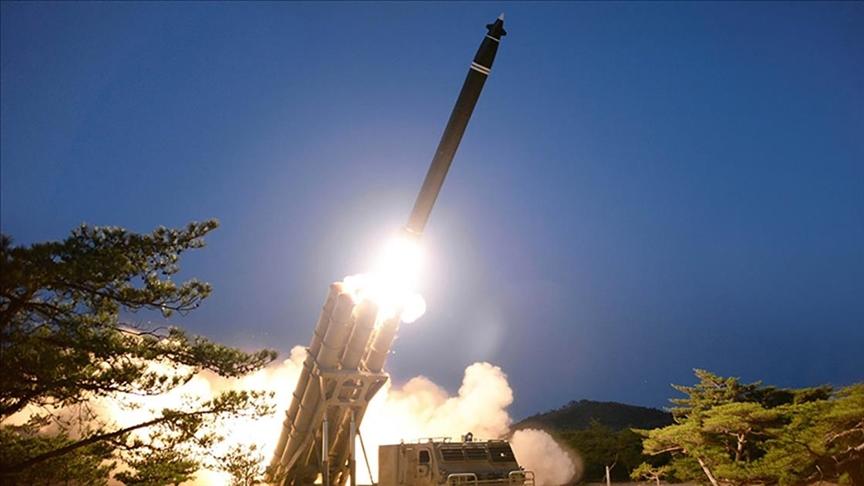
North Korea solid-fuel intercontinental ballistic missile tests (Anadolu Ajansı)
As of 2025, North Korea maintains diplomatic relations with 45 countries; however, most embassy activities are symbolic. It preserves historical solidarity ties with some former allies in Africa and the Middle East (Syria, Iran, Angola).
Pyongyang aims to establish its nuclear status as an undeniable reality to enhance its international bargaining power. This strategy also serves as the primary tool to legitimize the country’s isolation through its own security doctrine.
The Democratic People's Republic of Korea is one of the most militarized states in the world. As of 2025, its military structure forms the backbone of the ideological system. Under the “Songun” (military-first) principle, the armed forces are not merely a defensive instrument but also the primary vehicle for economic production, social education, and regime control.
North Korea’s military, known as the Korean People’s Army (KPA), consists of five main branches: ground, air, naval, strategic rocket, and special operations forces.
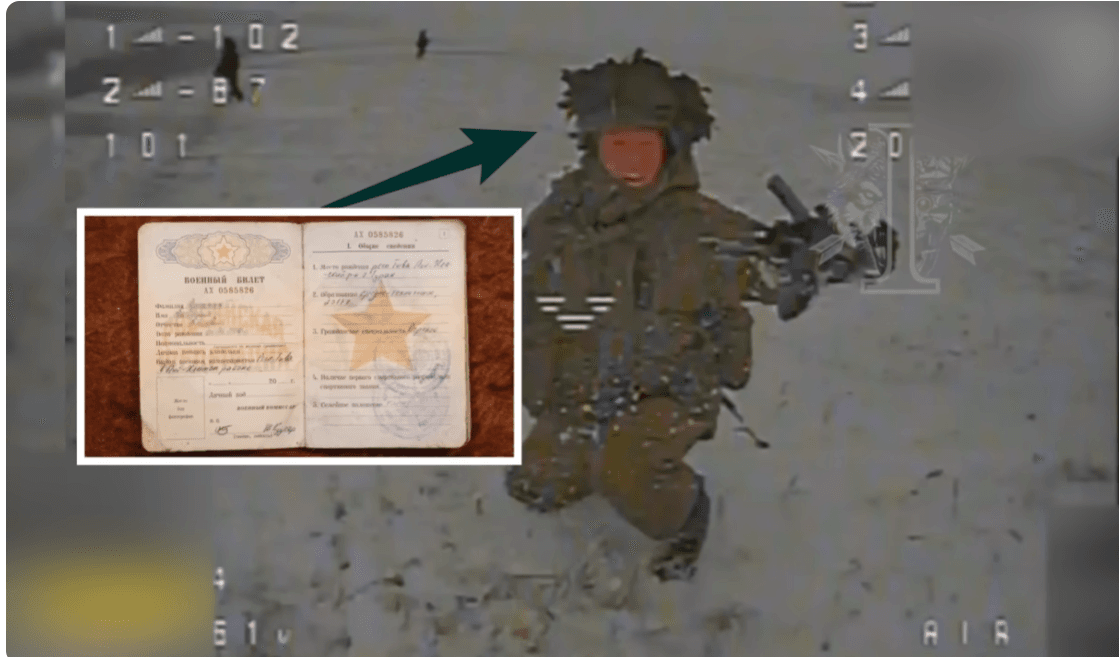
North Korean soldier identified in Russian forces with Ukrainian drones (Sinyor)
North Korea’s military strategy is based on utilizing its natural geography as defensive depth.
The ground forces, with approximately 1 million personnel, are the largest component. Their doctrine relies heavily on numerical superiority, defensive depth, and tunnel systems. Including paramilitary units (workers’ and youth militias), this number reaches approximately 5 million.
Ground units are trained not only for conventional warfare but also for “asymmetric warfare,” particularly through border-crossing tunnel systems, sabotage, and special operations, which play a vital role in the regime’s deterrence strategy.
The Korean People’s Air Force has approximately 110,000 personnel and around 800 aircraft, most of which are of Soviet and Chinese origin.
The North Korean Navy consists of approximately 60,000 personnel and around 430 vessels, focused on coastal defense.
North Korea’s strategic doctrine has shifted from conventional deterrence to nuclear deterrence since the 1990s.
This capability is defined in the country’s defense strategy under the principle of “preemptive nuclear strike.” Major nuclear facilities are located in Yongbyon, Punggye-ri, and Sinpo.
North Korea has approximately 200,000 special forces trained in sabotage, cyber operations, psychological warfare, and cross-border reconnaissance.
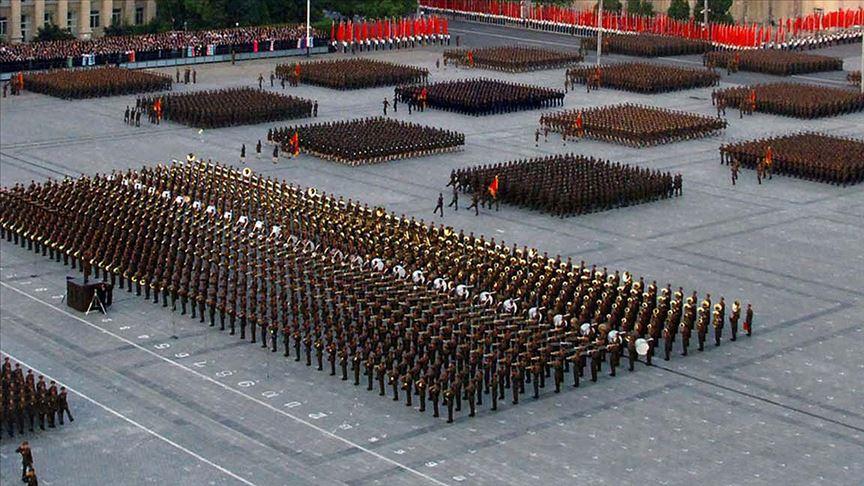
North Korean military parade (Anadolu Ajansı)
North Korea is largely self-sufficient in arms and munitions production. An estimated 200 or more defense industry facilities operate nationwide.
North Korea has revived technical sharing relations with China and Russia in the 2020s. It also maintains ballistic missile technology cooperation with countries such as Iran, Syria, and Myanmar.
Pyongyang has previously provided military training support to former allies in Africa and the Middle East (e.g., Angola, Uganda, Egypt). However, due to UN sanctions, most of these activities are now conducted covertly or indirectly.
Anadolu Ajansı. "’65. Yılında Kore Savaşı Sergisi’ açıldı." Anadolu Ajansı Foto Galeri. Accessed October 30, 2025.https://www.aa.com.tr/tr/pg/foto-galeri/65-yilinda-kore-savasi-sergisi-acildi-/2/167550.
Aytekin, Emre. “Kuzey Kore ‘askeri yükü’ en fazla olan ülke.” Anadolu Ajansı. Accessed October 30, 2025.https://www.aa.com.tr/tr/dunya/kuzey-kore-askeri-yuku-en-fazla-olan-ulke-/1697718.
BBC News. “Country profile: North Korea.” Accessed October 30, 2025.
Bajpai, Prableen. “How the North Korean Economy Works.” Investopedia. Accessed October 30, 2025.https://www.investopedia.com/articles/investing/013015/how-north-korea-economy-works.asp.
Central Intelligence Agency. *The World Factbook: Korea, North.* Washington, D.C.: CIA, 2025. Accessed October 30, 2025.https://www.cia.gov/the-world-factbook/countries/korea-north/
ClimeChart. "Pyongyang Climate Chart | Weather Overview of Pyongyang, North Korea." Clime Chart. Accessed October 30, 2025.https://www.climechart.com/en/climate-chart/pyongyang/north-korea.
Global Firepower. "2025 North Korea Military Strength." Accessed October 30, 2025.https://www.globalfirepower.com/country-military-strength-detail.php?country_id=north-korea.
Korkmaz, Dr. Hüseyin. 2025. “Çok KutupluDünyanın Inşası ve ŞİÖ.” Anadolu Ajansı. Accessed October 30, 2025.https://www.aa.com.tr/tr/analiz/cok-kutuplu-dunyanin-insasi-ve-sio/3678041
MapChart. “World Map – Simple.” Accessed October 30, 2025.https://www.mapchart.net/world.html.
Mercan, Ahmet Furkan. “Kuzey Kore, 2022’de 36 Günde 90’ı Aşkın Füze Fırlattı.” Anadolu Ajansı. Accessed October 30, 2025.https://www.aa.com.tr/tr/dunya/kuzey-kore-2022de-36-gunde-90i-askin-fuze-firlatti/2775219.
NASA. "Korea." NASA Visible Earth. Accessed October 30, 2025.https://visibleearth.nasa.gov/images/69679/korea.
National Archives and Records Administration. “Entertainers View the Kaesong Industrial Complex.” U.S. National Archives Catalog. Accessed October 30, 2025.https://nara.getarchive.net/media/entertainers-view-the-kaesong-industrial-complex-while-f2e85b.
National Archives and Records Administration. “Two North Korean Boys, Serving in the North Korean Army, Taken Prisoner in the Sindang-Dong Area by Elements of the 389th Infantry Regiment, Are Interrogated by a U.S. Soldier Shortly After Their Capture.” U.S. National Archives Catalog. Accessed October 30, 2025.https://catalog.archives.gov/id/531377.
National Diet Library of Japan. “国立国会図書館デジタルコレクション.” National Diet Library Digital Collections. Accessed October 30, 2025.https://dl.ndl.go.jp/ja/pid/766880/1/7.
Sinyor. “Ukrainian FPV Drones Mercilessly Wipe Out North Korean Soldiers One by One in a Shocking Attack.” YouTube. Accessed October 30, 2025.https://www.youtube.com/watch?v=9BQKfSHqRDk.
Stephan. “North Korea — Pyongyang, Kim Il-sung Square.” Flickr. Accessed October 30, 2025.https://www.flickr.com/photos/fljckr/1026554219/.
Store Norske Leksikon. “Nord-Koreas Historie [North Korea's History].” Store Norske Leksikon. Accessed October 30, 2025.https://snl.no/Nord-Koreas_historie.
The White House. “President Trump Meets with Chairman Kim Jong Un.” Flickr. Accessed October 30, 2025.https://www.flickr.com/photos/whitehouse45/48162701617/.
Türkiye Cumhuriyeti Dışişleri Bakanlığı. “Kore Demokratik Halk Cumhuriyeti (Kuzey Kore) Ülke Künyesi.” Accessed October 30, 2025.https://www.mfa.gov.tr/kuzey-kore-kunyesi.tr.mfa.
Türkiye Muharip Gaziler Derneği. "Kore Savaşı (Türk Tugaylarının Muharebeleri)." Accessed October 30, 2025.https://www.muharipgaziler.org.tr/kore-savasi.
Urumaxi Anthems. "National Anthem of North Korea (DPRK) - '애국가'." YouTube. Accessed October 30, 2025.https://www.youtube.com/watch?v=wMDx1BoI13M.
World Population Review. "North Korea Population 2025." Accessed October 30, 2025.https://worldpopulationreview.com/countries/north-korea.

North Korea (Democratic People's Republic of Korea)
Official Name | Democratic People's Republic of Korea | ||||||||
|---|---|---|---|---|---|---|---|---|---|
Form of Government | Unitary One-Party Socialist Republic | ||||||||
Date of Independence | 9 Eylül 1948 | ||||||||
Capital | Pyongyang | ||||||||
Head of State | Kim Jong-Un | ||||||||
Official Language | Korean | ||||||||
Common Languages | Korean (Munhwaŏ) | ||||||||
National Day | September 9 | ||||||||
Area | 120,538 km² | ||||||||
Total Population | 26.3 Million | ||||||||
Climate | Continental | ||||||||
GDP (Nominal) | 26 billion US Dollars | ||||||||
GDP per Capita | 1,261 US Dollars | ||||||||
Ethnic Groups | Korean majority, Chinese and Japanese minorities | ||||||||
Telephone Code | +850 | ||||||||
Internet Domain Code | .kp | ||||||||
Religious Structure | 73% Non-religious 13% Cheondoist 12% Shamanist 1.5% Buddhist 0.5% Other | ||||||||
No Discussion Added Yet
Start discussion for "North Korea (Democratic People's Republic of Korea)" article
National Anthem
History
Early Communities and Ancient Period
Medieval and Joseon Period
Modern Era and Japanese Occupation (1910–1945)
Founding of North Korea and the Korean War (1945–1953)
Juche Era and the Kim Dynasty (1953–1994)
Songun Policy and the Nuclear Era (1994–Present)
Geography
Borders and Neighbors
Mountains
Plains and Valleys
Rivers and Lakes
Climate
Economy
Key Economic Indicators (2023)
Sectoral Distribution
Foreign Trade
Foreign Investment and Business Environment
Energy and Transportation Infrastructure
Demography, Education, and Culture
Key Demographic Indicators (2025)
Population Distribution and Urbanization
Ethnic Composition
Religious Distribution
Education and Literacy Rate
Migration and Population Decline
Tourism
Main Tourist Sites and Activities
Foreign Policy and Security
Geopolitical Position and Security Perception
Relations with the People's Republic of China
Relations with the Russian Federation
Relations with South Korea
Relations with the United States
Relations with Japan
United Nations and International System
Security Doctrine and Nuclear Deterrence
Diplomatic Isolation and Regional Influence
Military and Defense Industry
Military Strength (2025)
Geographical and Strategic Position
Ground Forces
Air Force
Navy
Strategic Rocket Forces and Nuclear Capacity
Special Operations Forces
Defense Industry
Logistics and Mobilization Capacity
International Military Cooperation