


This article was automatically translated from the original Turkish version.
+1 More
News diet is the conscious management of the quantity, source, and duration of news consumed by an individual in order to protect mental health, optimize cognitive capacity, and cleanse oneself from information pollution. In the modern world, the rapid spread of information and the algorithmic structure of digital platforms leave individuals constantly under a “news bombardment.” This situation can lead not only to attention fragmentation but also to a psychological cycle known as “doomscrolling,” in which individuals become trapped in a loop of negative news. Like dietary regimens for physical health, a news diet aims to improve the quality and balance the quantity of consumed content to safeguard mental well-being.
The news diet can be practically implemented through four key steps:
The first step of the news diet seeks to enhance quality by narrowing the information ecosystem. Since unlimited sources of conflicting information lead to mental fatigue and loss of trust, individuals are advised to select only one trusted national and one trusted local source. This choice prevents wasting time on random social media feeds or clickbait headlines while ensuring awareness of global events and local developments. Limiting the number of sources acts as a filtering mechanism that prevents the brain from remaining in a constant state of alarm: “Is there a new threat?”
The second step transforms news consumption from an uncontrolled part of the day into a planned activity. It is recommended to limit news tracking to no more than two sessions per day, each lasting no longer than 30 minutes. The critical element in this planning is timing: negative information received in the early morning hours can disrupt motivation and mood for the rest of the day, while content consumed immediately before bedtime overloads the mind and reduces sleep quality. Choosing times that align with personal and professional responsibilities without disrupting biological rhythms helps restore news to its proper role as supplementary information rather than the center of life.
News consumption concludes with a deliberate self-evaluation, which constitutes the third step. At this stage, individuals should ask themselves three fundamental questions: “How much new information did I gain from this process?”, “Do what I learned directly affect my current life?”, and “How has my mood changed since consuming the news?” If the consumed content provides no new information and merely lowers morale and increases anxiety, this signals the need to adjust the duration or sources of news intake. This practice of self-assessment enables individuals to move beyond being passive recipients and become conscious, intentional regulators of their own information consumption.
The final step of the approach is designed to prevent the stressful effects of news from taking root in the mind. Immediately after consuming news, it is essential to transition to a physical or social activity that fully redirects focus away from news. Exercise, conversation with a friend, or watching an engaging film help the brain exit the stress cycle.
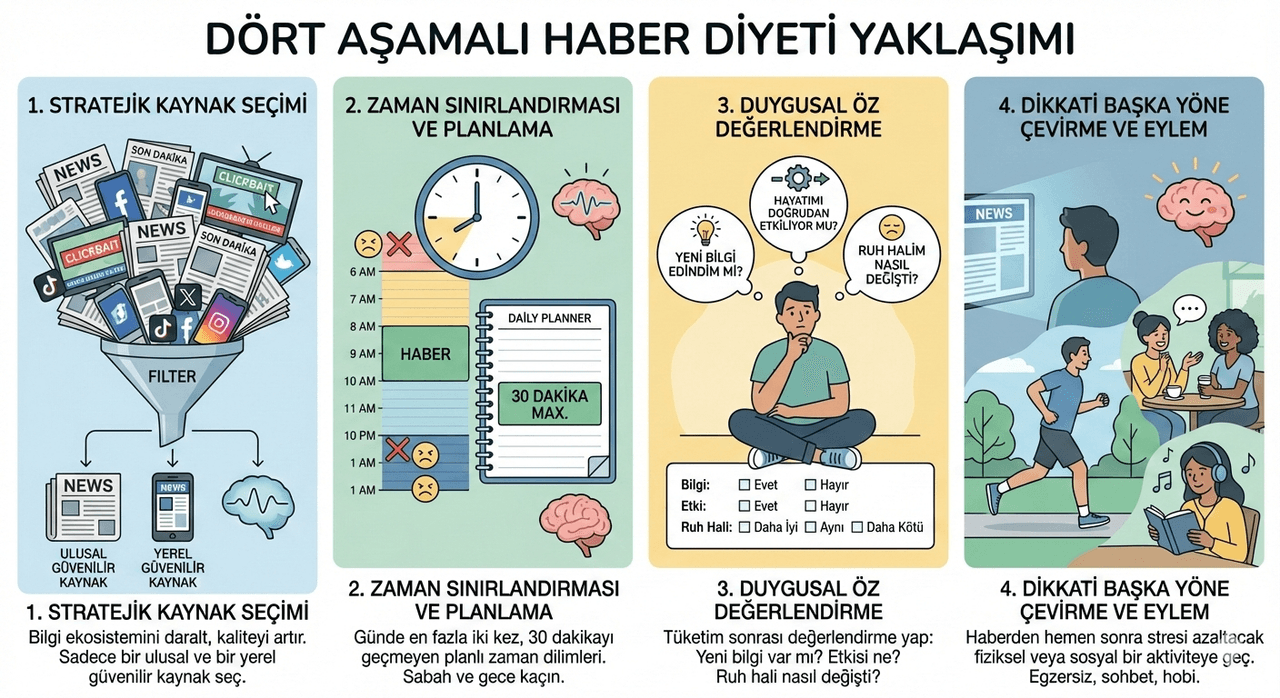
Visual Representing the Four-Step News Diet Approach (Generated by Artificial Intelligence.)
The information ecosystem consists of multiple layers including social media influencers, cable broadcasts, traditional newspapers, and local media. While social media platforms provide rapid access to information, their algorithmic design can trap users in “echo chambers,” triggering polarization and creating fertile ground for misinformation. Traditional and local news organizations, by contrast, typically operate within specific ethical guidelines and control mechanisms, delivering more verified information.
In a news diet, distinguishing whether content is an opinion piece or an objective news report and seeking sources with diverse perspectives enables a broader understanding of events. Social media platforms operate with algorithms that prioritize content likely to generate higher engagement; this structure causes individuals to encounter only news that aligns with their existing views, thereby creating echo chambers and filter bubbles.
For a healthy news diet, it is essential to differentiate between news and commentary. Traditional news organizations aim to report verified facts and adhere to principles of ethical journalism, whereas influencers and user-generated content are not bound by these standards. Therefore, the source, author, funding, and presentation style of news must be carefully evaluated.
A news diet also includes mitigating the effects of misinformation. Individuals must be aware of their own biases, consider potential consequences before sharing information, and compare multiple sources rather than relying on a single one. These are fundamental elements of this struggle. Accepting fallibility is viewed as a factor that strengthens critical thinking.
A news diet encourages individuals to prioritize content aligned with their interests and values. Local news, thematic publications, or sources focused on positive developments can offer a balanced media experience by reducing the information bombardment. Print media or long-form content further support more focused attention.
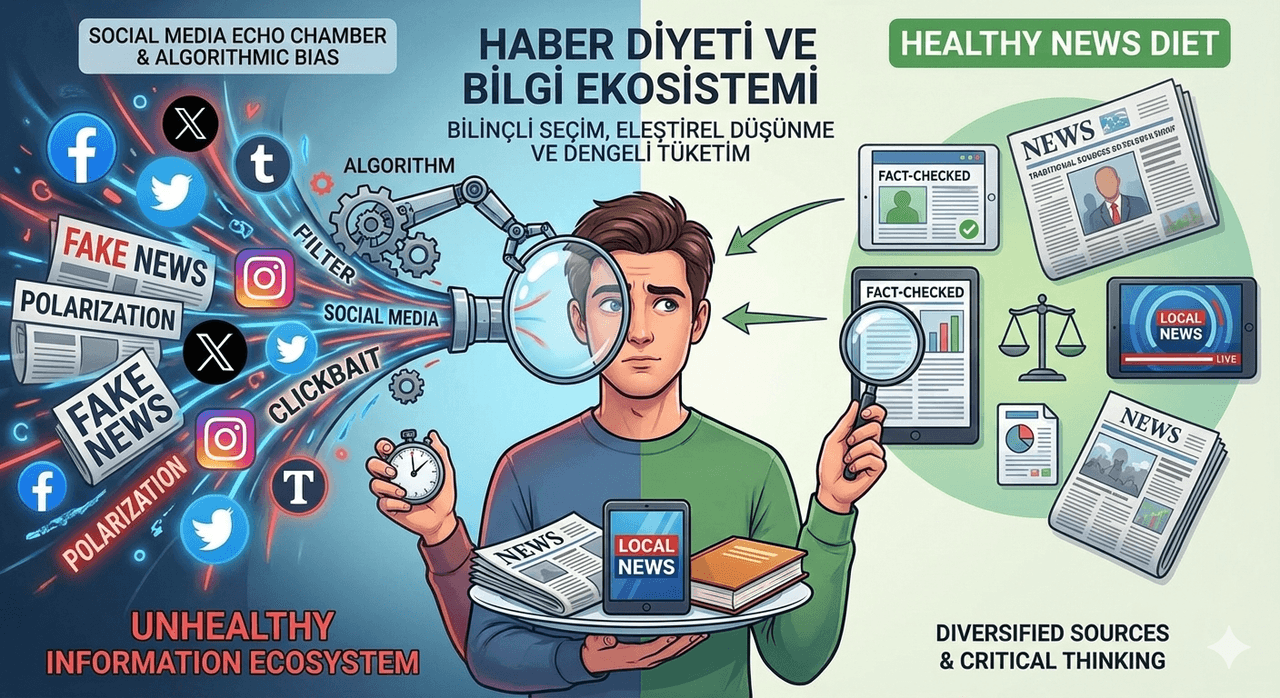
Visual Representing the News Diet and the Information Ecosystem (Generated by Artificial Intelligence.)
Problematic news consumption refers to the unhealthy escalation of an individual’s relationship with digital media and news flows, exceeding normal boundaries. Research by scholars at Texas Tech University defines this not merely as reading too much news, but as excessive preoccupation with news, attempting to alleviate negative emotions linked to news consumption by consuming even more news (doomscrolling), and experiencing a loss of agency over the process. 【1】 This behavioral pattern transforms the human need to understand world events into a compulsive act that threatens mental and physical health. Especially within the modern media ecosystem surrounded by “information pollution” and “echo chambers,” individuals unknowingly become trapped in a cycle that feeds their own anxieties.
Periods of high uncertainty such as natural disasters, economic downturns, election cycles, or international conflicts are when problematic news consumption is most intense. Although individuals turn to news out of an instinctive desire to control their environment and feel safe, repeatedly encountering the same stories provides no new information and instead intensifies existing tension. Particularly, social media algorithms amplify extreme viewpoints and fear-inducing content to maximize user engagement, increasing the frequency with which individuals are exposed to such material. Experts note that during this process, individuals lose the ability to distinguish between “news” and “news atmosphere” — emotionally manipulative posts — which exacerbates the psychological distress they experience. 【2】
Combating problematic news consumption begins with recognizing that this habit undermines quality of life. To break the cycle, physical and technological barriers known as “speed bumps” are recommended: keeping the phone in another room, disabling notifications, or deleting specific apps. Observing bodily reactions during news consumption and asking oneself, “Am I here to gain information or to fuel my anger?” helps create cognitive distance. Additionally, turning to nature activities, referred to as “touching grass,” or engaging in volunteer service during periods away from news reduces feelings of helplessness and redirects attention from destructive thoughts toward constructive action.
Excessive news consumption, particularly during crises and periods of uncertainty, generates psychological pressure on individuals. Physically, this may manifest as psychosomatic symptoms such as abdominal pain, muscle tension, and sleep disturbances. The behavioral pattern defined as “problematic news consumption” creates a vicious cycle in which individuals seek to soothe negative emotions by consuming even more news. This condition keeps the brain in a constant state of perceived threat, potentially leading to emotional exhaustion over the long term.
Happold, Madeline; Nimra Ahmad; Sireen Abayazid; and Sophie Grossman. “7 Ways to Cultivate a Healthy News Diet.” Cascade PBS. Accessed January 5, 2026.https://www.cascadepbs.org/news/2025/03/7-ways-cultivate-healthy-news-diet/
Hicks, Henry. “A Guide to Developing a Healthier News Diet.” pen.org. Accessed January 5, 2026.https://pen.org/a-guide-to-developing-a-healthier-news-diet/
McLaughlin, Bryan, Melissa R. Gotlieb, and Devin J. Mills. “Caught in a Dangerous World: Problematic News Consumption and Its Relationship to Mental and Physical Ill-Being.” *Health Communication* 38, no. 1 (2023): 1–11. Accessed January 5, 2026.https://www.researchgate.net/publication/362894450_Caught_in_a_Dangerous_World_Problematic_News_Consumption_and_Its_Relationship_to_Mental_and_Physical_Ill-Being
Ruggeri, Amanda. “The One Simple Change That Will Improve Your Media Diet in 2024.” BBC. Accessed January 5, 2026.https://www.bbc.com/future/article/20240207-the-one-simple-change-that-will-improve-your-media-diet-in-2024
UCLA Depression Grand Challenge – STAND. "Creating a Balanced News Diet." Accessed January 5, 2026.https://stand.ucla.edu/tips/news-diet
[1]
Madeline Happold, ; Nimra Ahmad; Sireen Abayazid; ve Sophie Grossman. “7 Ways to Cultivate a Healthy News Diet,” Cascade PBS, Erişim tarihi: 5 Ocak 2026, https://www.cascadepbs.org/news/2025/03/7-ways-cultivate-healthy-news-diet/
[2]
Madeline Happold, ; Nimra Ahmad; Sireen Abayazid; ve Sophie Grossman. “7 Ways to Cultivate a Healthy News Diet,” Cascade PBS, Erişim tarihi: 5 Ocak 2026, https://www.cascadepbs.org/news/2025/03/7-ways-cultivate-healthy-news-diet/

The Four-Step News Diet Approach
Strategic Source Selection
Time Limitation and Planning
Emotional Self-Assessment
Redirecting Attention and Taking Action
News Diet and the Information Ecosystem
Problematic News Consumption
Triggering Factors and Crisis Periods
Intervention Methods
Psychological and Physical Effects of News Addiction