

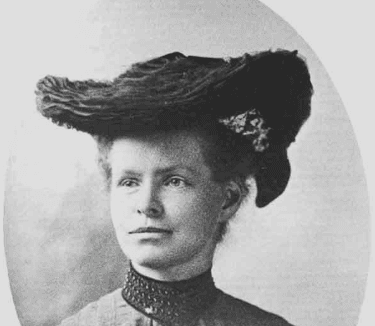
+2 More

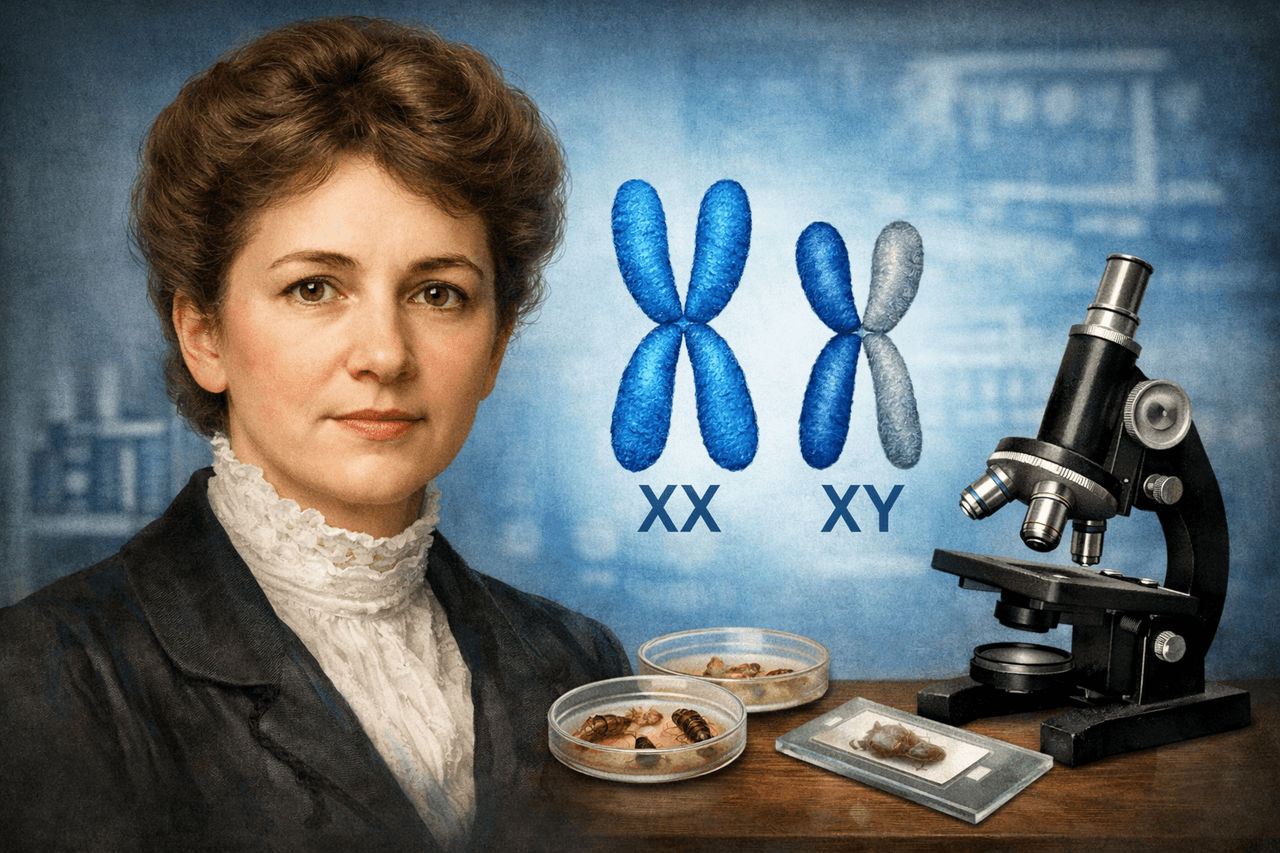
Nettie Stevens (Generated by Artificial Intelligence.)
Death | May 4, 1912 | ||||||||
|---|---|---|---|---|---|---|---|---|---|
Birth | July 7, 1861, Vermont, USA | ||||||||
Academic Institutions | Bryn Mawr College Stanford University | ||||||||
Field | Hereditary Biology Cytogenetics | ||||||||
Research Topic | Chromosome structure and inheritance in insects | ||||||||
Research Method | Microscopic chromosome examinations | ||||||||
Microscopic investigations conducted in the early 20th century revealed distinct chromosomal structures in male and female individuals and paved the way for understanding the genetic basis of biological sex. In this regard, Stevens is regarded as one of the founding figures of modern genetics.
Nettie Maria Stevens was born on 7 July 1861 in the state of Vermont in the United States of America. Despite limited access to educational opportunities, as was common for many women of her time, she attracted attention through her academic achievements. She supported herself in her early years by working as a teacher while simultaneously generating financial resources to continue her scientific education.
Stevens was admitted to Stanford University in 1896 where she pursued studies in biology. After completing her undergraduate degree in 1899, she decided to continue her academic career. She subsequently began graduate studies at Bryn Mawr College where she had the opportunity to work alongside leading scientists of the era. Focusing particularly on cytology and experimental biology, she conducted research on cell division and chromosome behavior.
In the early 20th century, the scientific community still lacked clarity on how sex was determined in living organisms. The debate centered on whether environmental factors or hereditary structures were decisive. Stevens undertook detailed microscopic examinations of insects to seek answers to this question.
In her research, Stevens examined chromosome behavior during cell division and identified clear structural differences between male and female individuals. These observations were of great significance because they demonstrated that sex was not random or environmentally determined but instead depended on specific biological mechanisms.
Through her studies on species of mealworm beetles, Stevens demonstrated that female individuals possessed two chromosomes of similar size while male individuals had one smaller chromosome among the pair. She scientifically identified these distinct structures as the sex chromosomes later named X and Y.
This discovery is recognized as one of the first strong pieces of evidence establishing that sex is determined by chromosomal foundations. Stevens’s work was evaluated alongside that of Edmund Beecher Wilson who conducted similar research during the same period, but Stevens’s findings stood out particularly for their experimental rigor and observational clarity.
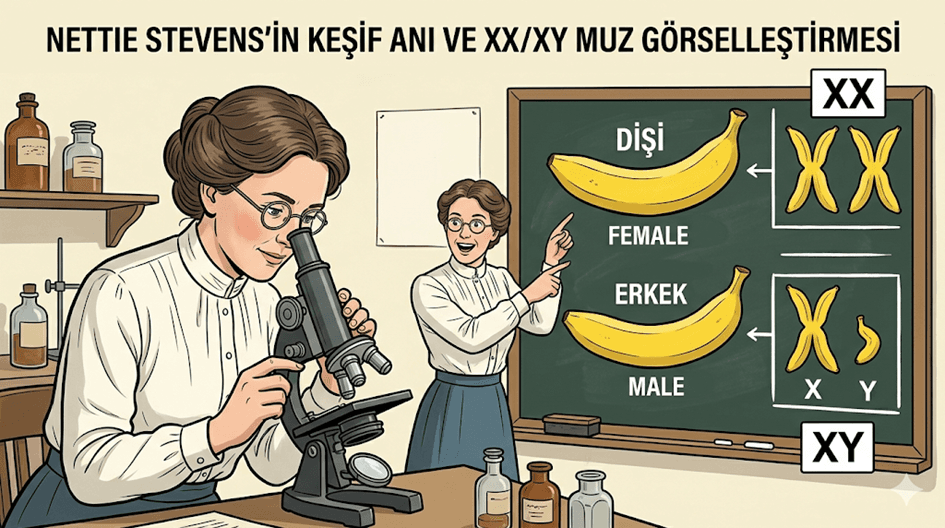
Discovery of XX and XY Chromosomes (Generated by Artificial Intelligence.)
Stevens’s research directly contributed to the development of chromosome theory and played a critical role in laying the foundations of genetics. Her identification of the Y chromosome’s role in sex determination has had long-term impacts not only in biology but also in medicine and genetic research.
Nevertheless, due to the structural barriers faced by women scientists in her time, Stevens did not achieve the full recognition her work deserved. Science historians emphasize that her contributions remained largely overlooked and were rendered less visible compared to those of her male colleagues.
Nettie Stevens died on 4 May 1912. Despite her relatively short academic career, her contributions to the development of genetics have proven enduring and provided a vital foundation for subsequent generations of scientists. Today, Stevens is remembered as one of the pioneering scientists who uncovered the chromosomal basis of sex.
Cold Spring Harbor Laboratory DNA Learning Center. "Biography: Nettie Maria Stevens (1861–1912)." Accessed March 16, 2026.
National Women’s History Museum. "Nettie Stevens." Accessed March 16, 2026. https://www.womenshistory.org/education-resources/biographies/nettie-stevens
Royal Society Publishing. “The Contributions of Nettie Stevens to the Field.” Accessed March 16, 2026. https://royalsocietypublishing.org/rstb/article/377/1850/20210215/108870
Scientific Women. "Stevens, Nettie." Accessed March 16, 2026. https://scientificwomen.net/women/stevens-nettie-102
The provided text contains only HTML markup and placeholder tokens (`https://dnalc.cshl.edu/view/16259-Biography-9-Nettie-Maria-Stevens-1861-1912-.html`, `https://dnalc.cshl.edu/view/16259-Biography-9-Nettie-Maria-Stevens-1861-1912-.html`) with no actual Turkish content to translate. There are no author names, titles, dates, or access information present. As per the rules, no translation is needed — the output should preserve the structure and placeholders exactly as given. **Output:** ```html
https://dnalc.cshl.edu/view/16259-Biography-9-Nettie-Maria-Stevens-1861-1912-.html
```

Nettie Stevens (Generated by Artificial Intelligence.)
Death | May 4, 1912 | ||||||||
|---|---|---|---|---|---|---|---|---|---|
Birth | July 7, 1861, Vermont, USA | ||||||||
Academic Institutions | Bryn Mawr College Stanford University | ||||||||
Field | Hereditary Biology Cytogenetics | ||||||||
Research Topic | Chromosome structure and inheritance in insects | ||||||||
Research Method | Microscopic chromosome examinations | ||||||||
Life and Education
Discovery of Chromosomes in Sex Determination
Identification of X and Y Chromosomes
Scientific Contributions and Significance
Death