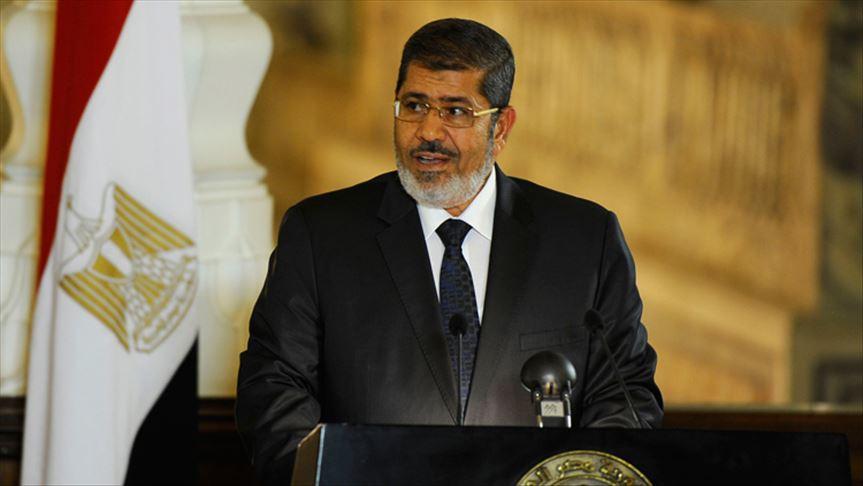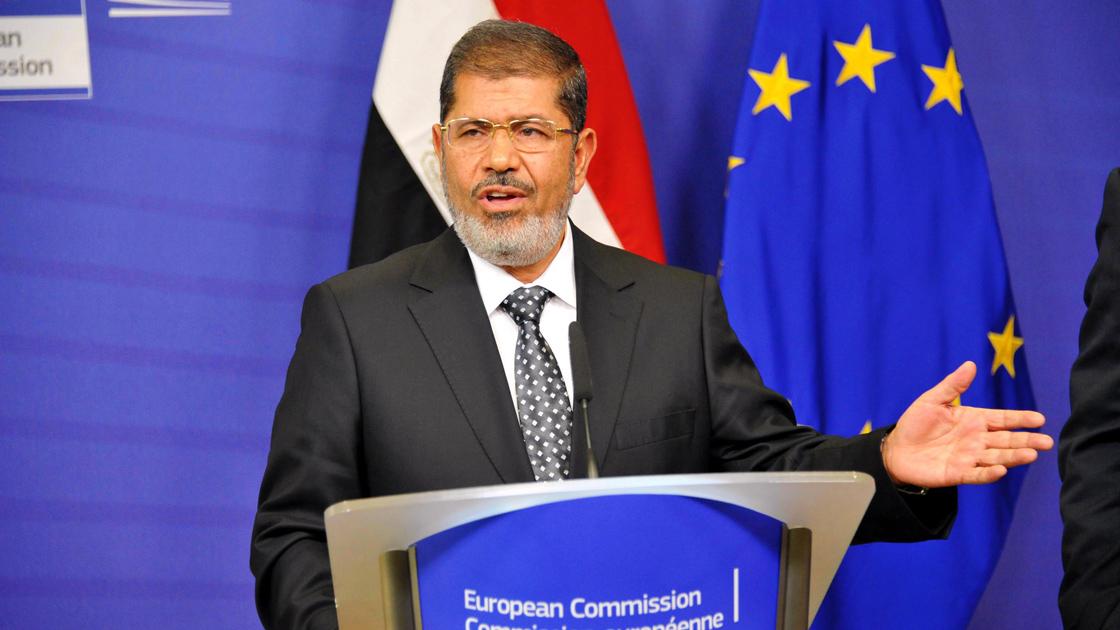

Muhammad Morsi
Title | Egypt's first democratically elected civilian president | ||||||||
|---|---|---|---|---|---|---|---|---|---|
Term of Office | 30 June 2012 – 3 July 2013 | ||||||||
Date of Birth | 20 August 1951 | ||||||||
Place of Birth | El Adva village, Sharqiya, Egypt | ||||||||
Date of Death | 17 June 2019 (aged 67) | ||||||||
Place of Death | Cairo, Egypt (courtroom) | ||||||||
Education | Cairo University (bachelor's and master's), University of Southern California (PhD, 1982) | ||||||||
Profession | Engineer, academic (professor) and politician | ||||||||
Political Party | Justice and Freedom Party (Muslim Brotherhood) | ||||||||
Children | Ahmed, Omar, Usama, Abdullah and Shaima | ||||||||
Muhammad Morsi is the first civilian president of Egypt to assume office through democratic means. As the first head of state without a military background, Morsi governed Egypt from 2012 to 2013 but was removed from power in 2013 following a military intervention.
Muhammad Morsi was born in August 1951 in the village of El Adwa in the Sharqia Governorate in northern Egypt. The eldest of five siblings he was the son of a farmer father and a homemaker mother. Morsi is married and has four sons named Ahmed Omar Usama and Abdullah and one daughter named Shaima. He completed his undergraduate studies between 1975 and 1978 at the Faculty of Engineering of Cairo University and later earned a master’s degree from the same university. He traveled to the United States to pursue his doctoral studies and completed his doctorate in engineering at the University of Southern California USC in 1982.
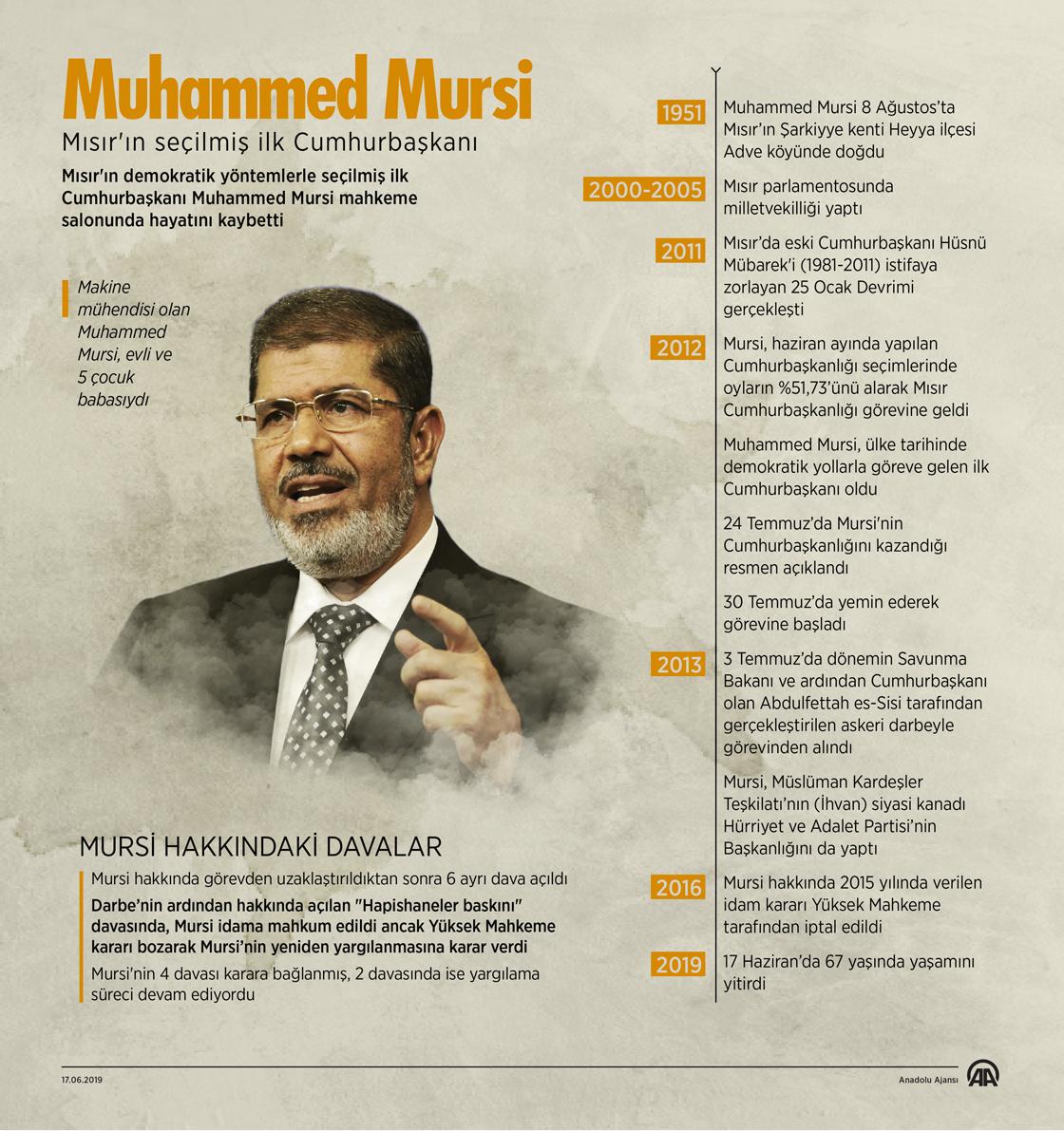
Egypt's first elected president, Mohamed Morsi - Anadolu Ajansı
After completing his doctorate Morsi served as an assistant professor at California State University Northridge CSUN in the United States from 1982 to 1985 during which time he also conducted research under NASA. In 1985 he returned to his home country Egypt and continued his academic career at the Faculty of Engineering of Zagazig University where he became a professor and served as dean until 2010.
Morsi began his political life within the Muslim Brotherhood movement. Due to the movement’s prohibition from participating legally in elections he ran as an independent candidate in the 2000 parliamentary elections and was elected as a member of the Egyptian People’s Assembly. He held this position until 2005 but failed to reenter parliament in the 2005 elections. In 2006 he was arrested and spent seven months in prison for supporting judges demanding reforms. By 2010 he had become a member of the Muslim Brotherhood’s governing board and its official spokesperson. During the mass protests that erupted in 2011 against the regime of Hosni Mubarak Morsi was arrested on 28 January but escaped from prison shortly afterward amid widespread prison breaks. Following the fall of Mubarak’s regime he was elected as the general president of the Freedom and Justice Party established by the Muslim Brotherhood on 30 April 2011.
The Muslim Brotherhood organization initially nominated Khairat el-Shater as its presidential candidate for the 2012 election but after Shater’s candidacy was disqualified Muhammad Morsi was elevated from the position of alternate candidate to the party’s official presidential nominee.【1】 In the first round of the presidential election held on 23–24 May 2012 Morsi received 5 764 952 votes approximately 24.7 to 25.5 percent of the total making him one of the two top vote-getters and qualifying him for the runoff.【2】
In the second round held on 16–17 June 2012 Morsi competed against Ahmed Shafik a former prime minister under the old regime. With a total of 25 577 511 valid votes cast and a voter turnout of 51.85 percent Morsi won the election by securing 51.73 percent of the valid votes 13 230 131 votes. His opponent Ahmed Shafik received 48.27 percent 12 347 380 votes.【3】 On 30 June 2012 Muhammad Morsi was sworn in and assumed office as Egypt’s first civilian president elected through democratic and transparent elections.
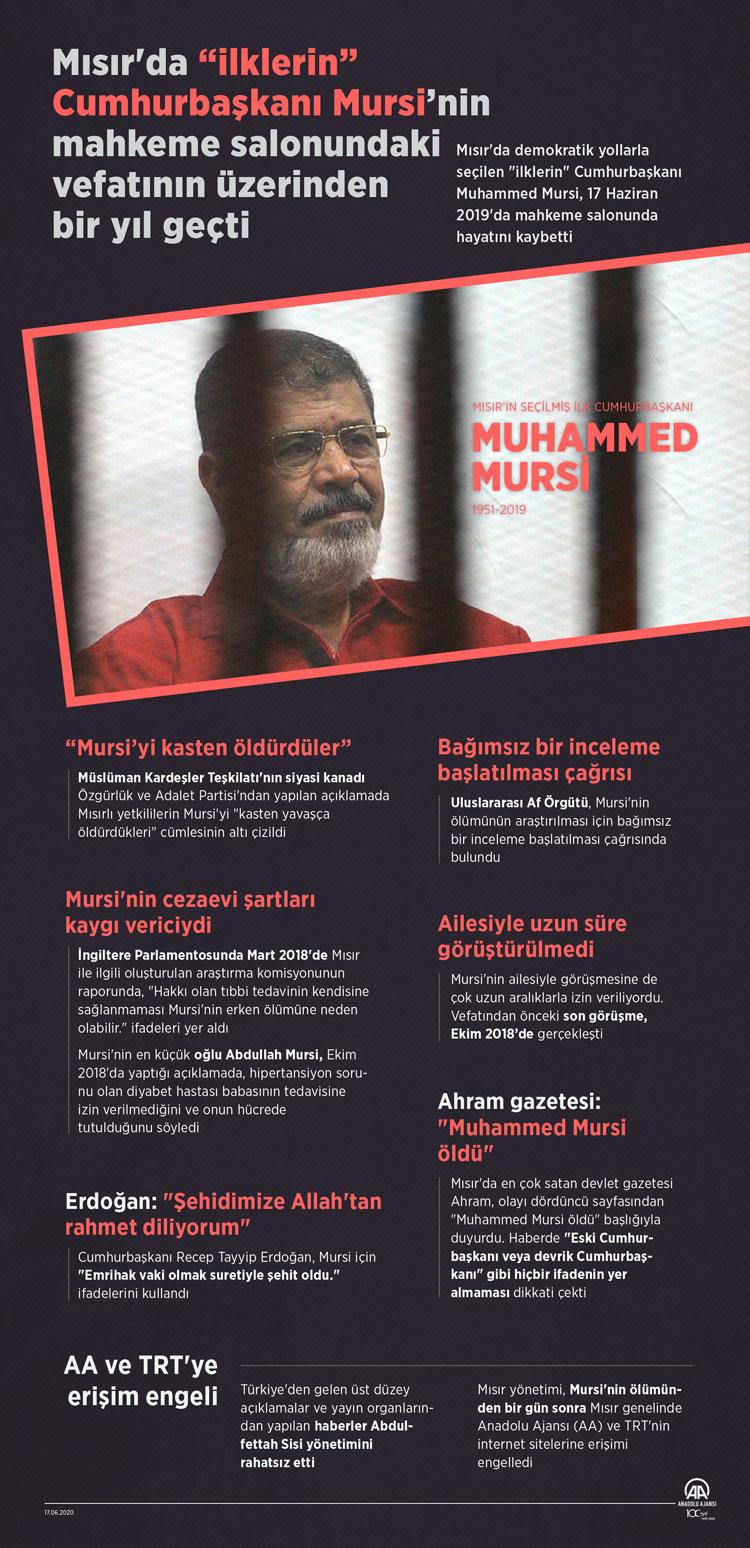
Vefatının ardından yaşananlar - Anadolu Ajansı
During his one-year term Morsi faced various disagreements with Egypt’s entrenched state bureaucracy. In August 2012 he forced the retirement of Hussein Tantawi the head of the Supreme Council of the Armed Forces and Minister of Defense in an effort to strengthen civilian authority. On 22 November 2012 he issued a constitutional declaration expanding his presidential powers and restricting oversight of state institutions. However amid intense public and opposition backlash and increasing political polarization he was forced to retract the decree. In December 2012 a new draft constitution was submitted to the public in a two-stage referendum and was approved with approximately 57 percent in the first stage and approximately 64 percent in the second stage.【4】
By 2013 opposition protests against Morsi’s administration intensified under the leadership of the Tamarod movement. On 30 June 2013 mass demonstrations took place across the country with Tahrir Square as the epicenter. In response the Egyptian military issued a 48-hour ultimatum on 1 July to resolve the political crisis. After Morsi refused to step down he was removed from office on the evening of 3 July 2013 in a military intervention led by then Defense Minister and Chief of Staff Abdel Fattah el-Sisi.【5】 Following the coup Adly Mansour the president of the Constitutional Court was appointed interim president and Morsi was arrested and taken to an undisclosed location.
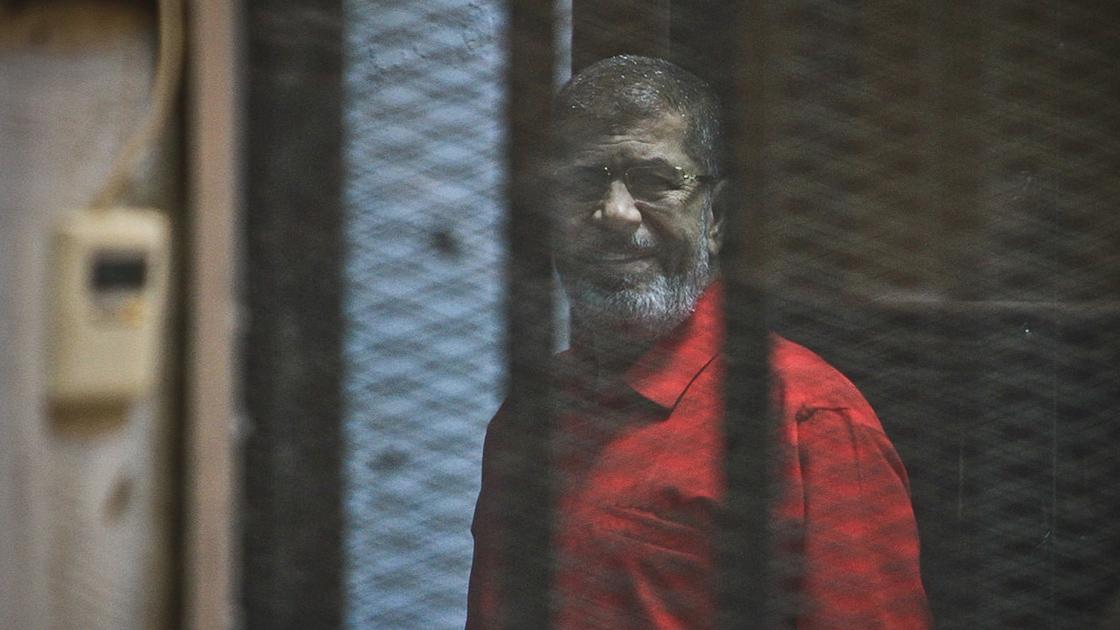
Muhammed Mursi - Anadolu Ajansı
After his removal from office six separate cases were brought against Muhammad Morsi on charges including espionage prison break incitement to violence sharing state secrets with Qatar and contempt of court. On 16 May 2015 he was sentenced to death in the prison break case but this ruling was overturned by the Court of Cassation in 2016. In other trials he received sentences of 20 years for the Ittihadiyya incident 25 years for espionage and 3 years for contempt of court totaling 48 years imprisonment.【6】
Throughout his court proceedings Morsi consistently maintained that he remained Egypt’s legitimate president and that the courts lacked jurisdiction over him. He was brought to court wearing a white prisoner’s uniform and held in soundproof glass cages. During his approximately six years in prison he was held in solitary confinement for 23 hours per day. His right to meet with his lawyers and family was severely restricted and he was permitted only a few brief visits in 2013 2017 and October 2018. Despite suffering from diabetes hypertension and liver and kidney failure his family and international civil society organizations repeatedly raised concerns about the lack of adequate medical care. Morsi himself declared during court sessions in 2015 May 2017 November 2017 and November 2018 that his life was in danger his health was critical and that he needed to be transferred to a hospital.【7】
Throughout his court proceedings Muhammad Morsi repeatedly asserted that the courts had no jurisdiction over him and that he remained Egypt’s legitimate president. During hearings he addressed the bench with statements such as “You are not a legitimate president I am the legitimate president your rulings are invalid” and declared that he did not recognize any authority or action taken after 3 July 2013.
Morsi occasionally addressed the Egyptian people during hearings declaring “We salute your peaceful revolution. The coup regime will fall and its leaders will be held accountable.” In response to the charges against him he stated “God is my witness. Throughout my term I never retreated from fighting corruption and crime. I have made mistakes and I have done right. But I have not betrayed and will never betray the trust placed in me.”
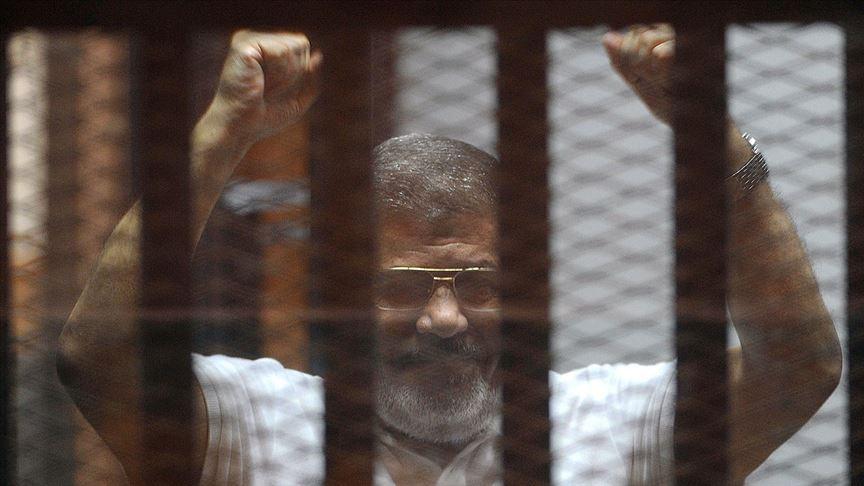
Mahkeme sırasında çekilmiş bir fotoğraf - Anadolu Ajansı
Morsi also directly raised criticisms about his imprisonment conditions and health in the courtroom stating regarding the glass cage “The reflections inside the cage cause dizziness. The lighting system makes me feel as if I am being tried in absentia. I cannot see the judges. I do not know whether they can see me. I can only hear fragments of what my defense team says. I have not met with my lawyers for months.” Regarding his health he said “I am not claiming to be ill my condition is serious. I will not waive my right to be examined in a private or public hospital outside the prison clinic.”
In his final defense on the day of his death Morsi protested the trial process saying “Until now I do not understand what has been happening in this court. I have not seen my lawyer. I have not seen the media. I do not see a court. The lawyer appointed by the court will not have the information necessary to defend me.” In his last words before his death Morsi said “I requested a closed hearing from the court. The court refused. That is the end of this court’s ruling. But I have secrets that will go with me to the grave for the sake of my country’s security safety and sovereignty.”【8】
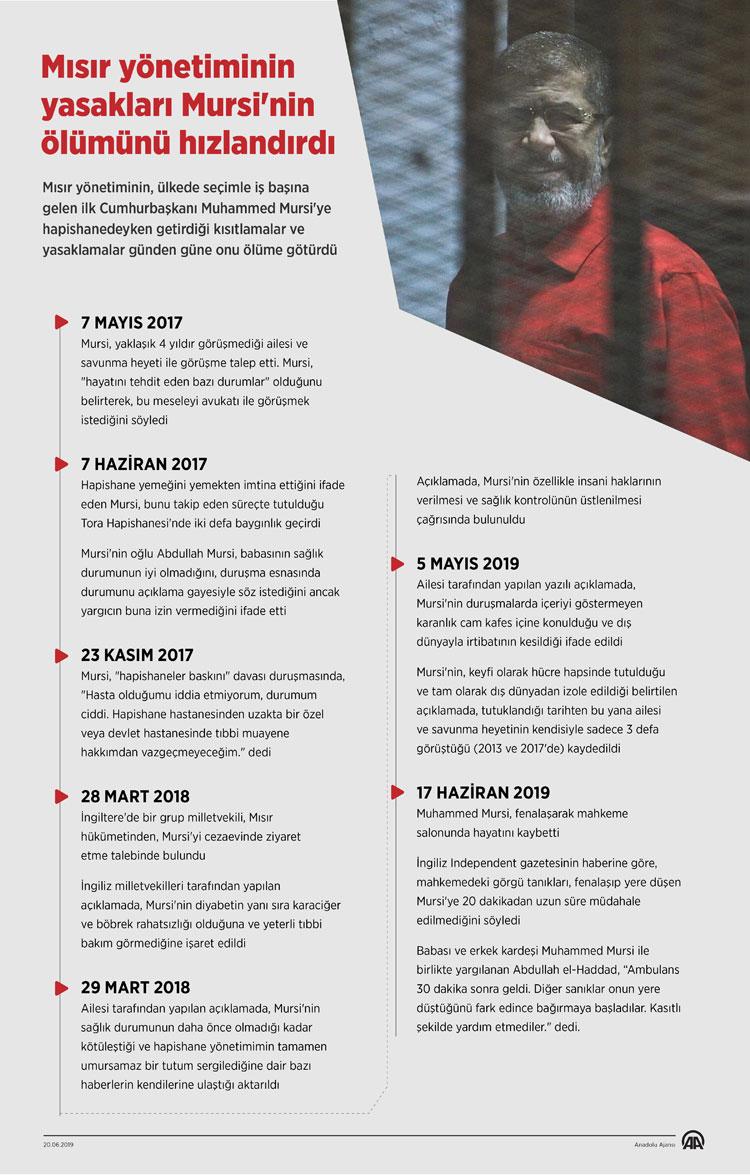
The process that led to Mursi's death - Anadolu Ajansı
On 17 June 2019 during a court session in Cairo related to the “Wadi al-Natrun prison escape and espionage on behalf of Hamas” case Morsi spoke for approximately five minutes before collapsing and falling to the floor inside the defendant’s cage. According to statements from other defendants and witnesses at the hearing no medical intervention was provided to Morsi for more than 20 minutes after he collapsed and the ambulance arrived at the scene approximately 30 minutes later. The official report issued by the Egyptian Public Prosecution stated that Morsi was brought to the hospital dead with no pulse or respiration and no signs of physical injury. Egypt’s state media announced his death in a brief and routine news bulletin without using any official title or position.
Muhammad Morsi’s funeral was held on 18 June 2019 at 05:00 local time in the Medinat Nasr district east of Cairo under heavy security measures. By decision of Egyptian authorities only Morsi’s wife children two siblings and lawyer were permitted to attend the burial. Requests by his family to hold mass mourning gatherings at their homes or elsewhere were denied by Egyptian authorities.
Morsi’s death in the courtroom sparked widespread international reaction. Institutions such as the United Nations Office of the High Commissioner for Human Rights Human Rights Watch and Amnesty International called for an international impartial and transparent investigation into the cause of death and allegations of medical neglect in prison. Following his death funeral prayers were held in absentia in Turkey Germany Austria Bosnia and Herzegovina Serbia and Gaza with tens of thousands of participants. Commemorative events and protest demonstrations were organized across these regions.
Anadolu Ajansı. "ABD'nin Önde Gelen İki Gazetesinde Mursi'nin Ölümü Yorumlandı." Anadolu Ajansı, June 19, 2019. Accessed June 16, 2026.
Anadolu Ajansı. "Avrupa Birliği'nden Mursi'nin Ailesine Taziye Mesajı." Anadolu Ajansı, June 18, 2019. Accessed June 16, 2026.
Anadolu Ajansı. "Avusturya'da Mursi İçin Gösteri." Anadolu Ajansı, June 21, 2019. Accessed June 16, 2026.
Anadolu Ajansı. "BM'den Mursi'nin Vefatına İlişkin Acil Soruşturma Çağrısı." Anadolu Ajansı, June 18, 2019. Accessed June 16, 2026.
Anadolu Ajansı. "Batının Mursi'nin Ölümü Karşısındaki Sessizliği Demokrasi Yalanlarını Gün Yüzüne Çıkardı." Anadolu Ajansı, June 22, 2019. Accessed June 16, 2026.
Anadolu Ajansı. "Belçika Başbakanının Eski Danışmanı Debeuf: Mısır Bürokrasisi Mursi Yönetiminin Aleyhinde Çalıştı." Anadolu Ajansı, June 17, 2019. Accessed June 16, 2026.
Anadolu Ajansı. "Berlin'de Mursi İçin Gıyabi Cenaze Namazı." Anadolu Ajansı, June 23, 2019. Accessed June 16, 2026.
Anadolu Ajansı. "Bosna Hersek ve Sırbistan'da Mursi İçin Gıyabi Cenaze Namazı." Anadolu Ajansı, June 19, 2019. Accessed June 16, 2026.
Anadolu Ajansı. "Cumhurbaşkanı Erdoğan Mursi İçin Kılınacak Gıyabi Cenaze Namazına Katılacak." Anadolu Ajansı, June 18, 2019. Accessed June 16, 2026.
Anadolu Ajansı. "Cumhurbaşkanı Erdoğan: Bunun Normal Bir Ölüm Olduğuna İnancım Yok." Anadolu Ajansı, June 18, 2019. Accessed June 16, 2026.
Anadolu Ajansı. "Cumhurbaşkanı Erdoğan: Mursi'nin Hayatını Kaybetmesini Seyreden İnsanlığı Kınıyorum." Anadolu Ajansı, June 18, 2019. Accessed June 16, 2026.
Anadolu Ajansı. "Cumhurbaşkanı Yardımcısı Oktay: Mursi Herkes İçin Bir Bayrak ve Sembole Dönüşmüş Durumda." Anadolu Ajansı, June 19, 2019. Accessed June 16, 2026.
Anadolu Ajansı. "Cumhurbaşkanımız Muhammed Mursi Aramızdan Şehit Olarak Ayrıldı." Anadolu Ajansı, June 20, 2019. Accessed June 16, 2026.
Anadolu Ajansı. "Fotoğraflarla Muhammed Mursi." Anadolu Ajansı, 2019. Accessed June 16, 2026.
Anadolu Ajansı. "Görgü Tanıkları: Mursi'yi Ölüme Terk Ettiler." Anadolu Ajansı, June 19, 2019. Accessed June 16, 2026.
Anadolu Ajansı. "Mursi 6 Yıl Boyunca Yavaşça Öldürüldü." Anadolu Ajansı, June 21, 2019. Accessed June 16, 2026.
Anadolu Ajansı. "Mursi Hayatını Tehdit Eden Durumlar Olduğunu Söylemişti." Anadolu Ajansı, June 17, 2019. Accessed June 16, 2026.
Anadolu Ajansı. "Mursi Savunmalarında Neleri Haykırdı?" Anadolu Ajansı, June 18, 2019. Updated June 20, 2019. Accessed June 16, 2026.
Anadolu Ajansı. "Mursi'nin Filistin Direnişine Verdiği Destek Unutulmayacak." Anadolu Ajansı, June 22, 2019. Accessed June 16, 2026.
Anadolu Ajansı. "Mursi'nin Filistin Direnişine Verdiği Destek Unutulmayacak." Anadolu Ajansı, June 22, 2019. Accessed June 16, 2026.
Anadolu Ajansı. "Mursi’nin Oğlundan Evlerde Gıyabi Cenaze Namazı Kılınması Çağrısı." Accessed June 16, 2026.
Anadolu Ajansı. "Mursi’nin Vefatından Sorumlu Olanlar İşkenceyle Cinayetten Hesap Vermeli." Accessed June 16, 2026.
Anadolu Ajansı. "Mısır Makamları Mursi’nin Taziye Merasimine İzin Vermedi." Accessed June 16, 2026.
Anadolu Ajansı. "Mısır Yönetiminin Yasakları Mursi’nin Ölümünü Hızlandırdı." Accessed June 16, 2026.
Anadolu Ajansı. "Mısır’da Mursi’nin Devrildiği 3 Temmuzdaki Askeri Darbenin Öteki Yüzü." Accessed June 16, 2026.
Anadolu Ajansı. "Mısır’da İlklerin Cumhurbaşkanı Mursi’nin Mahkeme Salonundaki Vefatının Üzerinden Bir Yıl Geçti." Accessed June 16, 2026.
Anadolu Ajansı. "İhvan: Mursi’nin Vefatıyla İlgili Uluslararası Bir Soruşturma Açılana Kadar Rahat Etmeyeceğiz." Accessed June 16, 2026.
Bloomberg HT. "Mısır’da Seçimleri Muhammed Mursi Kazandı." Accessed June 16, 2026.
SDE (Stratejik Düşünce Enstitüsü). "Muhammed Mursi Kimdir?" Accessed June 16, 2026.
TRT Haber. "Demokrasiye Adanmış Bir Ömür: Muhammed Mursi." Accessed June 16, 2026.
TRT Haber. "Muhammed Mursi Vefat Etti." Accessed June 16, 2026.
Telci, İsmail Numan. "Muhammed Mursi: Kararlı Bir Duruş, Gururlu Bir Mücadele ve Onurlu Bir Ömür." Accessed June 16, 2026.
İLKHA. "Mısır’ın Seçilmiş İlk Cumhurbaşkanı Şehid Muhammed Mursi." Accessed June 16, 2026.
[1]
Anadolu Ajansı. “Mısır’da Mursi’nin Devrildiği 3 Temmuzdaki Askeri Darbenin Öteki Yüzü.” Anadolu Ajansı, 3 Temmuz 2020. Erişim tarihi: 16 Haziran 2026.
[2]
TRT Haber. “Demokrasiye Adanmış Bir Ömür: Muhammed Mursi.” TRT Haber, 17 Haziran 2019. Erişim tarihi: 16 Haziran 2026.
https://www.trthaber.com/haber/dunya/demokrasiye-adanmis-bir-omur-muhammed-mursi-419691.html
[3]
Bloomberg HT. “Mısır’da Seçimleri Muhammed Mursi Kazandı.” Bloomberg HT, 24 Haziran 2012. Erişim tarihi: 16 Haziran 2026.
https://www.bloomberght.com/misirda-secimleri-muhammed-mursi-kazandi-1168579
[4]
TRT Haber. “Demokrasiye Adanmış Bir Ömür: Muhammed Mursi.” TRT Haber, 17 Haziran 2019. Erişim tarihi: 16 Haziran 2026.
https://www.trthaber.com/haber/dunya/demokrasiye-adanmis-bir-omur-muhammed-mursi-419691.html
[5]
Anadolu Ajansı. “Mursi Savunmalarında Neleri Haykırdı?” Anadolu Ajansı, 18 Haziran 2019. Erişim tarihi: 16 Haziran 2026.
https://www.aa.com.tr/tr/dunya/mursi-savunmalarinda-neleri-haykirdi/1507288
[6]
Anadolu Ajansı. “İhvan: Mursi’nin Vefatıyla İlgili Uluslararası Bir Soruşturma Açılana Kadar Rahat Etmeyeceğiz.” Anadolu Ajansı, 1 Temmuz 2020. Erişim tarihi: 16 Haziran 2026.
[7]
Anadolu Ajansı. “Mısır’da İlklerin Cumhurbaşkanı Mursi’nin Mahkeme Salonundaki Vefatının Üzerinden Bir Yıl Geçti.” Anadolu Ajansı, 17 Haziran 2020. Erişim tarihi: 16 Haziran 2026.
[8]
TRT Haber. “Muhammed Mursi Vefat Etti.” TRT Haber, 17 Haziran 2019. Erişim tarihi: 16 Haziran 2026.
https://www.trthaber.com/haber/dunya/muhammed-mursi-vefat-etti-419690.html

Muhammad Morsi
Title | Egypt's first democratically elected civilian president | ||||||||
|---|---|---|---|---|---|---|---|---|---|
Term of Office | 30 June 2012 – 3 July 2013 | ||||||||
Date of Birth | 20 August 1951 | ||||||||
Place of Birth | El Adva village, Sharqiya, Egypt | ||||||||
Date of Death | 17 June 2019 (aged 67) | ||||||||
Place of Death | Cairo, Egypt (courtroom) | ||||||||
Education | Cairo University (bachelor's and master's), University of Southern California (PhD, 1982) | ||||||||
Profession | Engineer, academic (professor) and politician | ||||||||
Political Party | Justice and Freedom Party (Muslim Brotherhood) | ||||||||
Children | Ahmed, Omar, Usama, Abdullah and Shaima | ||||||||
Early Life Family and Education
Academic and Political Career
2012 Presidential Election
Presidency and Removal from Office
Trial Process and Imprisonment Conditions
Statements and Defense in Court
Death and Aftermath