


This article was automatically translated from the original Turkish version.
Mind mapping is a graphical presentation technique developed by individuals to visualize, organize, and recall information about knowledge. This structure, in which concepts and ideas branch out from a central core idea, supports the externalization of perceptions, memories, and knowledge present in the individual’s mind. Mind maps are used as a tool that supports cognitive functions across diverse fields, from individual learning processes to urban memory analyses.
The mind mapping technique evolved as a product of learning psychology and visual memory-based approaches. Tony Buzan systematized this technique in the second half of the 20th century, aiming to enhance information retention by integrating visual elements into learning processes. Buzan’s proposed method asserts that organizing information not only verbally but also visually deepens learning. This approach targets the simultaneous activation of the brain’s analytical and creative functions.
According to Buzan, colors, symbols, and keywords strengthen mental association and are effective in transferring information from both short-term and long-term memory. Therefore, mind maps employ not only words but also graphical elements, geometric shapes, silhouettes, and symbols.
Mind maps are structured with branches radiating outward from a central concept placed at the core. Each branch represents a sub-concept and can be further subdivided into more detailed sub-branches. This structure creates a non-linear, hierarchical, and multi-layered network that makes relationships between concepts visible. The following expression formats are used when creating a mind map:
When used together, these elements activate both the verbal and visual processing areas of the brain simultaneously.
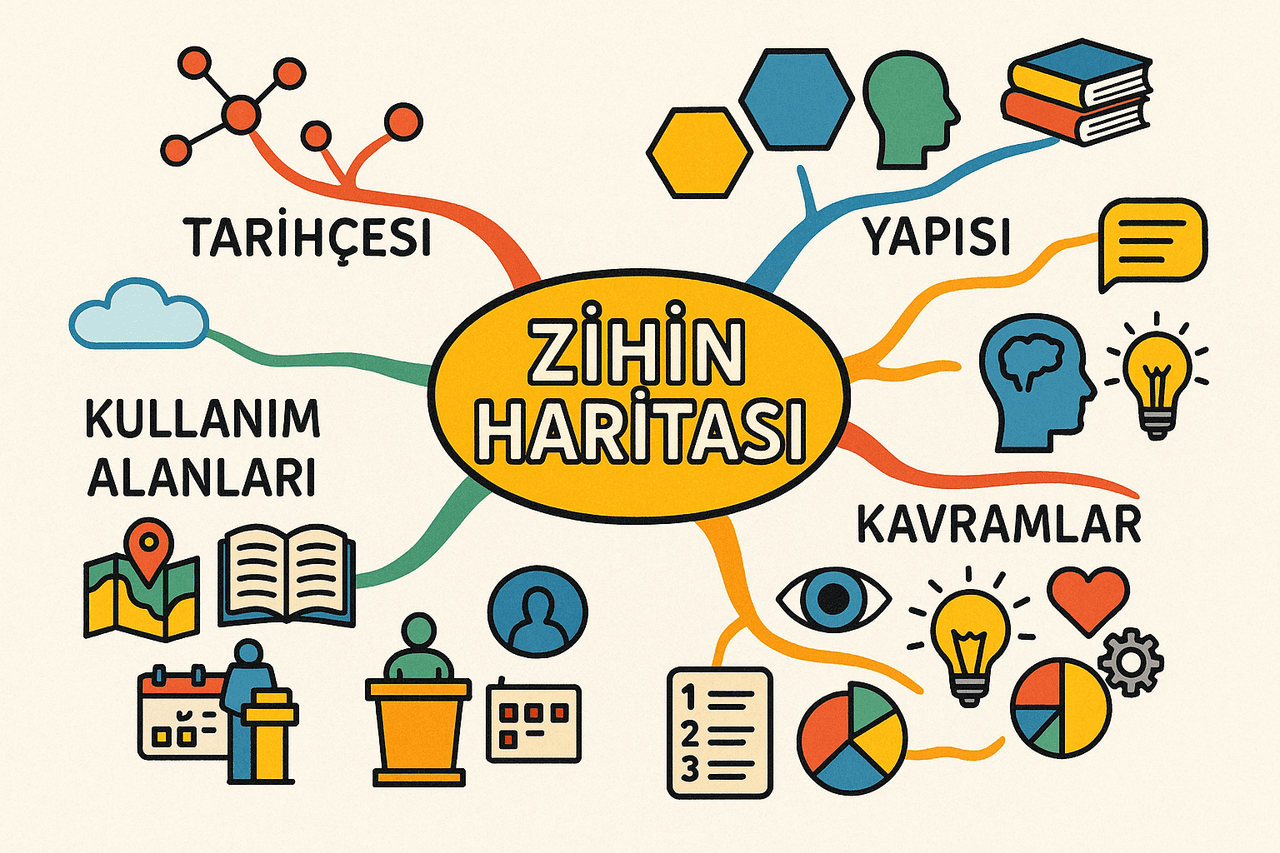
Zihin Haritası (Yapay Zeka ile Oluşturulmuştur.)
In the context of urban studies and perceptual mapping, Kitchin and Fotheringham identified three fundamental clustering methods. These methods aim to generate common or individual urban images from individuals’ mental representations:
These techniques are particularly important in urban memory studies for analyzing how individual experiences merge with social images.
Mind maps are used as tools for information management and analysis across a wide range of fields:
Mind maps serve as an effective tool for analyzing individuals’ relationships with the city. These maps aid in understanding urban identity through spatial orientation, cultural connections, and the visual expression of personal experiences. For example, in the case of Eskişehir, locations such as Porsuk Creek, Cer Workshop, and Odunpazarı Houses emerge prominently in the mind maps of long-term residents, whereas university students’ maps are largely confined to campus surroundings and shopping areas. This difference illustrates how emotional and functional relationships between individuals and the city are reflected in their maps.
The following steps are followed when creating a mind map:
This process encourages both analytical and intuitive thinking.
Mind mapping is a powerful technique that deepens the relationship with information, makes conceptual connections visible, and maps an individual’s thought world. Developed under the leadership of Tony Buzan, this approach has a multidisciplinary application ranging from individual learning processes to urban planning. Mind maps, which combine graphical structure with intuitive organization, are regarded as effective tools in fostering individual awareness and shaping collective memory.
Öztürk, Ayşen Çelen. “Eskişehir’in Geçmişteki ve Bugünkü Kent Belleğinin Zihin Haritaları Üzerinden Okuma Denemeleri.” *Kent Araştırmaları Dergisi* 7, no. 20 (September 2016): 856–880. Accessed May 10, 2025.https://dergipark.org.tr/en/download/article-file/466335
Şeyihoğlu, Ayşegül, Yavuz Akbaş, and Ayça Kartal. Uygulama Örnekleri ile Coğrafya Eğitiminde Kavram ve Zihin Haritaları. Ankara: Pegem Akademi, 2012. Accessed May 10, 2025.

Historical Development
Structure and Visual Components
Kitchin & Fotheringham’s Clustering Methods
Applications
Education and Learning
Business and Organizational Contexts
Urban Memory and Urban Planning
The Process of Creating a Mind Map
Cognitive and Pedagogical Advantages of Mind Mapping