This article was automatically translated from the original Turkish version.
Location | Bursa Ulu Camii Osmangazi - Bursa / Türkiye | ||||||||
|---|---|---|---|---|---|---|---|---|---|
Patron | Yıldırım Bayezid | ||||||||
Dating | H. 802 / M. 1399–1400 | ||||||||
Material | Walnut tree | ||||||||
Technique | Kündekâri, low relief, cage carving, mother-of-pearl inlay | ||||||||
Artist (Signature) | Dakku son of Abdülaziz son of Hacı Mehmed | ||||||||
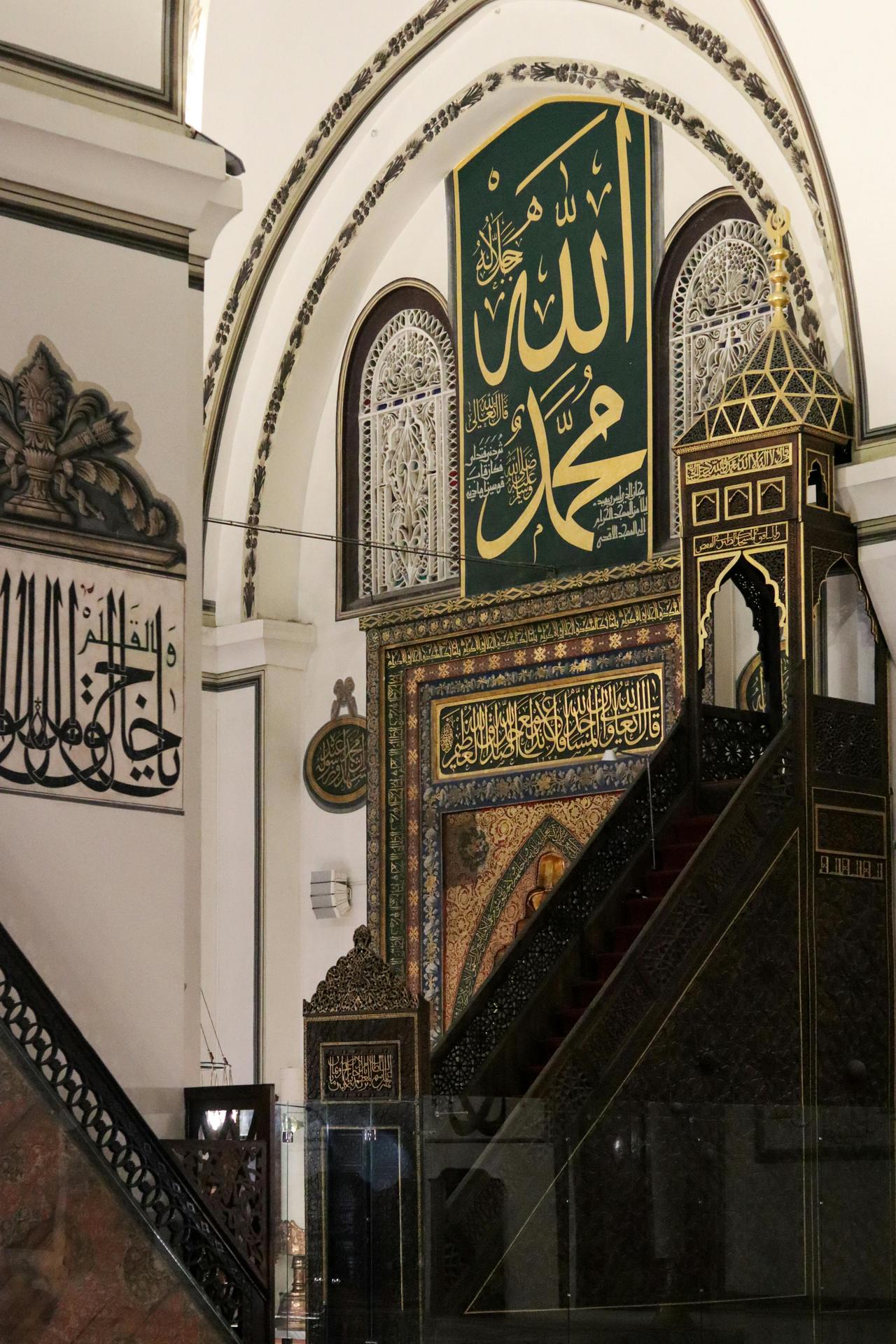
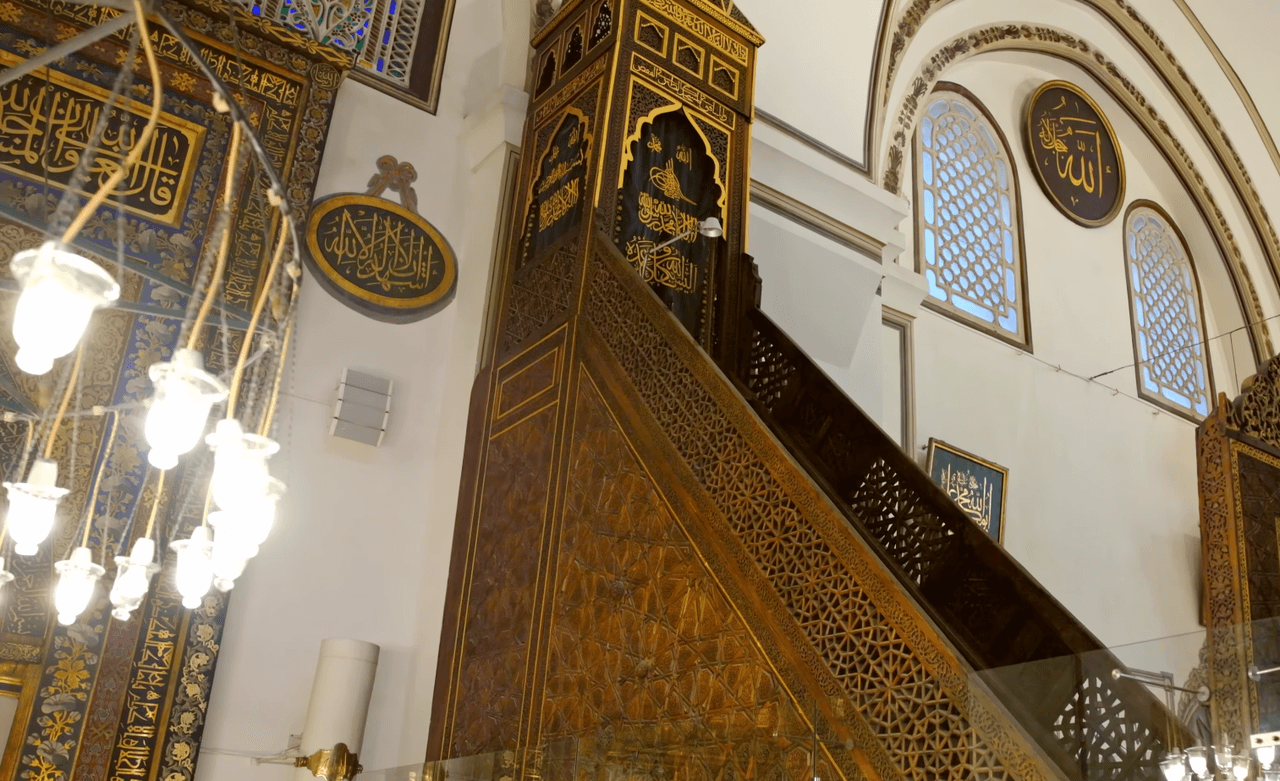
Minbar of Bursa Ulu Camii is a wooden architectural element located within the Bursa Ulu Camii, constructed during the reign of Yıldırım Bayezid. Made from walnut wood and crafted using the kündekâri technique, it is regarded as one of the foremost examples of wooden minbar art in Anatolia due to its geometric and botanical ornamentation, the combined use of multiple techniques, and its rich compositional diversity.
The minbar is the work of the master craftsman Hacı Mehmed, son of Abdülaziz, son of Dakku. Its construction technique and decorations reflect examples of kündekâri, low relief carving, and latticework carving, showing similarities with stonework of the period.
Minbar of Bursa Ulu Camii (Hayalhanem İstanbul)
The Bursa Ulu Camii and its minbar are part of the architectural activities of Yıldırım Bayezid (1389–1402), a ruler whose reign marked a critical phase in the Ottoman state’s transition from a principality to an empire. During this period, the Ottomans established dominance over Anatolian beyliks, achieved significant territorial gains in the Balkans, and consolidated their legitimacy through military victories such as the Battle of Nicopolis. Following these developments, Yıldırım Bayezid requested the title “Sultanü’l-Rum” from the Abbasid caliph in Cairo.
Yıldırım Bayezid undertook large-scale construction projects in centers such as Edirne, Bergama, and Bursa. In Edirne he commissioned a zaviye bearing his name; in Bergama, a large congregational mosque; and in Bursa, an extensive külliye. This külliye comprised a mosque, zaviye, imaret, hamam, two medreses, a darüşşifa, and a zaviye for the Kazerunî dervishes. The Bursa Ulu Camii, situated at the center of this complex, is the most comprehensive structure among these constructions.
Although the architect of the mosque is not definitively known, it is believed to have been designed by Hacı Alâaddin and Ömer b. İbrahim. These two architects also worked on the külliye commissioned by Yıldırım Bayezid during his princely period in Mudurnu and on the Edirne Eski Camii. The construction of the mosque was affected by the political and economic instability following the Battle of Ankara (1402) and the ensuing Interregnum; the building was completed by Yıldırım Bayezid’s sons.
The Bursa Ulu Camii minbar was commissioned by Yıldırım Bayezid in 802 AH (1399–1400) as part of this era’s architectural program. The inscription on the minbar reads:
"Mimma umile bi resmi’s-sultâni’l-muazzam Bayezid bin Murad Han bi-tevfîkihi sene semân mie ve isneyn."
(This minbar was constructed in the year 802 by the command of the exalted Sultan Bayezid, son of Murad Han, by the grace of God.)【1】
Additionally, the name of the craftsman appears on the railing panels of the western face of the minbar. According to this inscription, the minbar was made by Hacı Mehmed, son of Abdülaziz, son of Dakku. The direct inscription of the artisan’s name on the minbar is noteworthy in the context of contemporary practices.
The minbar of Bursa Ulu Camii is one of the most advanced and monumental examples of kündekâri technique in Anatolian Turkish woodworking. All components of the minbar are made entirely of walnut wood and assembled using a mortise-and-tenon system without nails or adhesive.
The entire surface of the minbar is adorned with geometric patterns and botanical motifs executed in the kündekâri technique. Decorative elements incorporate low relief carving, latticework carving, and mother-of-pearl inlay. Geometric designs feature star motifs with eight to fourteen points; the simultaneous use of stars with different numbers of points on the same surface enables rich compositional variety. Some stars are formed with straight strips, others with curved strips shaped like circular arcs, and some central bosses are rendered as hemispherical protrusions.
The surface ornamentation includes classical botanical motifs such as rûmî, palmette, kıvrıkdal, hatayi-style lotus, and bud forms. These decorations are intricately rendered using both relief carving and latticework techniques. The structure is regarded not only as a furnishing for a place of worship but also as one of the foremost examples of early Ottoman wooden art, distinguished by its technical craftsmanship and aesthetic composition.
Although structurally similar to the western facade, the eastern facade exhibits greater complexity in ornamentation density and compositional variety. The techniques of kündekâri, low relief carving, and latticework carving are all employed here in combination.
At the base border of the pulpit, a rhythmic arrangement of three-leaf flowers with serrated tips is surrounded by segmented rûmî motifs. These motifs are designed in a bowl-like form with veined surfaces.
The triangular tympanum is covered with a geometric arrangement based on broken-line systems composed of nine-, ten-, and twelve-pointed stars. Some star centers are emphasized with hemispherical bosses, while some arms are shaped as circular arcs. The intervening surfaces are decorated with rûmî and palmette-scrolls; certain areas feature mother-of-pearl inlaid geometric motifs.
On the eastern facade, above the pulpit base, a horizontal rectangular panel is positioned. This panel is divided into three pointed arches arranged side by side. Within each arch opening, segmented rûmî, scroll motifs, lotus forms, and three-leaf palmettes are carved in low relief.
The rectangular panel beneath the pulpit platform features a broken-line geometric arrangement composed of eleven-, nine-, and ten-pointed stars. The eleven-pointed star at the bottom is larger than the others. The spaces between the stars are filled with rûmî and palmette-scrolls. The panel is framed by a border composed of segmented rûmî motifs with spiral ends.
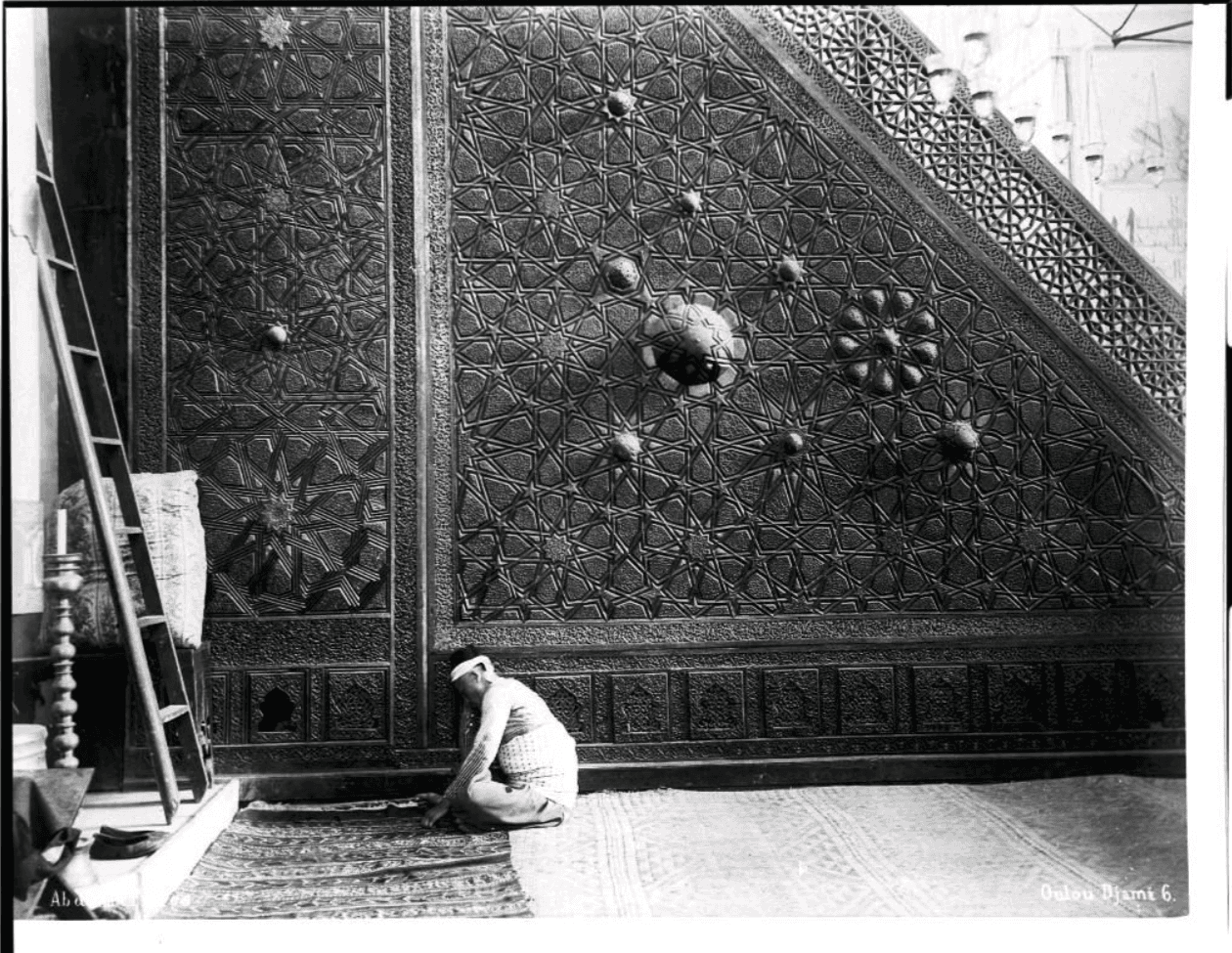
Eastern Facade of the Minbar of Bursa Ulu Camii, II. Abdülhamid Collection (Bursa Municipality City Archive)
The pulpit railing is crafted using the latticework carving technique. The openwork, bordered by botanical motifs at the top and bottom, consists of a twelve-pointed star arrangement inscribed within a hexagon. The eastern facade stands out as one of the richest sections of the minbar, particularly in terms of motif diversity, ornamentation density, and technical variety.
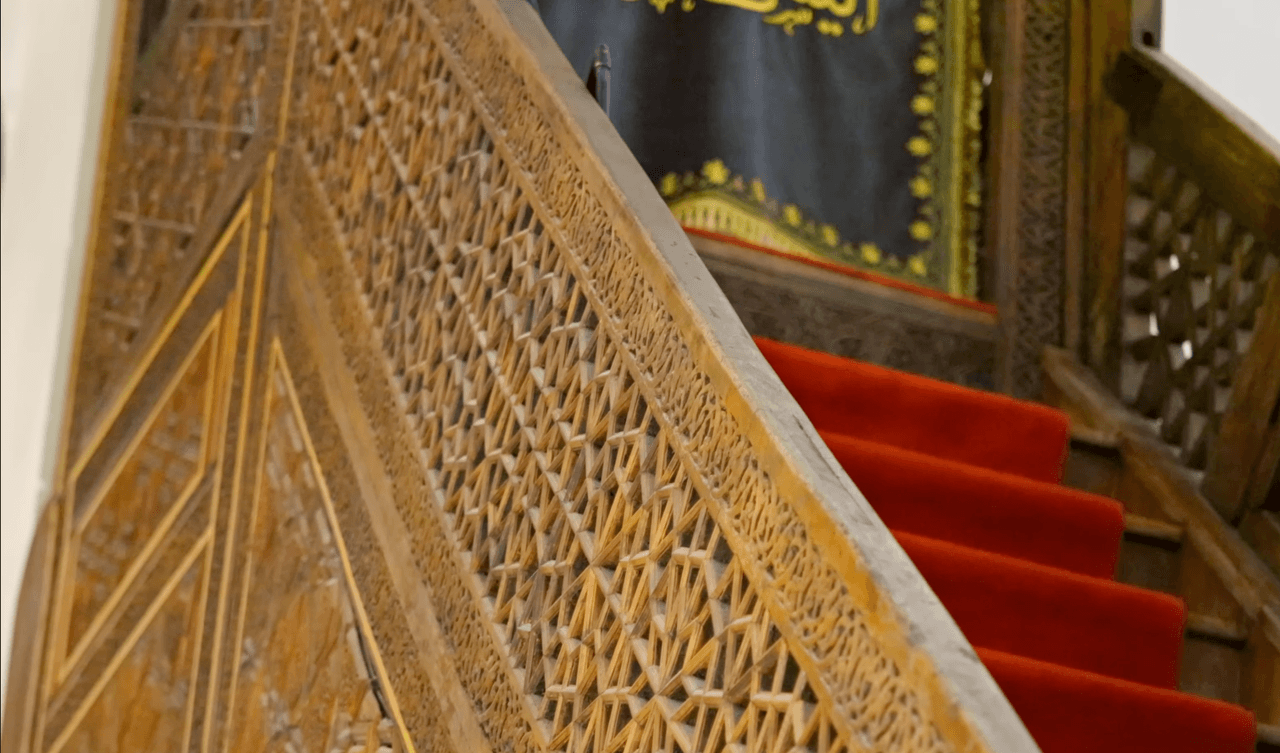
Railing Detail (Hayalhanem İstanbul)
The western facade consists of the base plinth, triangular tympana, and panels beneath the pulpit platform. This facade contains a total of fifteen recessed niches with segmented arches. The niches are framed by botanical borders composed of rûmî-palmette combinations at the top and bottom. The rûmî and palmette motifs in these borders are arranged in closed forms surrounding three-leaf palmettes; the leaf surfaces are serrated, veined, and shaped with triangular profiles.
The triangular tympanum is adorned with an infinite geometric pattern based on a broken-line system, featuring twelve- and eight-pointed stars as dominant motifs. Some star centers are raised as bosses, while some arms are shaped as circular arcs. The hexagonal surfaces between the stars are decorated with segmented rûmî and three-leaf palmettes. The bosses feature palmettes crowned with rûmî stems and circular rosettes.
The rectangular panel beneath the pulpit platform features a geometric arrangement of fourteen-, thirteen-, eleven-, and nine-pointed stars arranged vertically. At the center of the lowest fourteen-pointed star, a seven-pointed star made of mother-of-pearl inlay is placed. The spaces between the stars are filled with relief-carved rûmî-palmette motifs. Above this panel, a horizontal band bears the phrase “Mülk Allah’ındır” (The sovereignty belongs to God), repeated three times in kûfi script and gilded.【2】 Above the inscription band, another panel contains a closed geometric arrangement composed of ten-pointed stars.
The railing of the western facade consists of six panels.
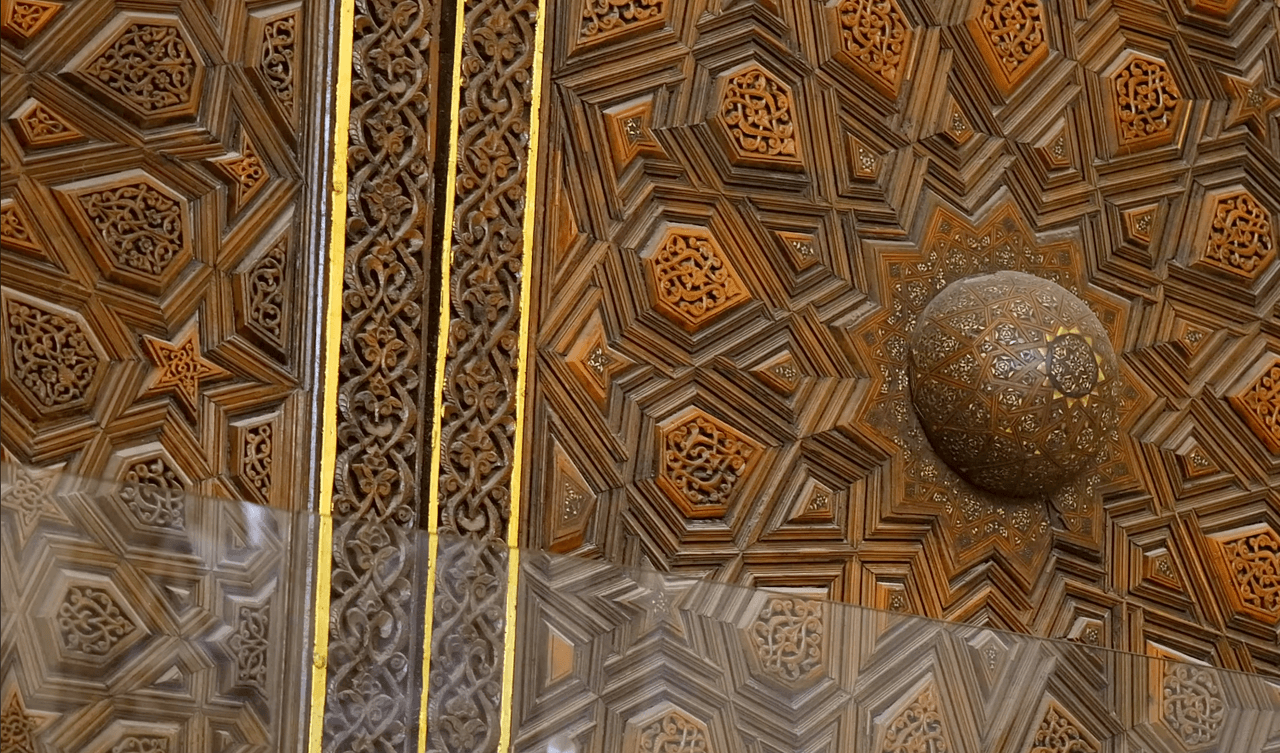
Close-up of Western Facade (Hayalhanem İstanbul)
Some studies have associated the star arrangements on the eastern triangular surface with cosmological interpretations or conceptions of the universe, even drawing parallels between the star compositions and the solar system. However, no direct or historically verifiable correlation can be established between these geometric decorations and their philosophical underpinnings. The presence of eight distinct star forms on the same plane enhances the artistic composition, but it remains uncertain whether these arrangements were intended to convey symbolic meanings or were primarily designed to achieve visual balance.【3】
Various conceptions of the structure of the universe were proposed in medieval Islamic thought. For instance, Ibn Sina and his contemporaries described the universe as composed of nine celestial spheres, while the Ikhwān al-Ṣafā argued that the motions of these spheres occurred in perfect circular cycles. Similarly, the Ottoman thinker Davud-i Kayserî noted in his commentary on Muhyiddin-i Arabî’s work that the universe consisted of nine spheres; Yazıcızâde Ahmed Bîcân elaborated on this classical celestial model in his work Dürr-i Meknûn. However, no definitive evidence links the star compositions on the minbar to these cosmological doctrines.
Even if one assumes that the minbar was planned according to such a cosmological scheme, it remains unclear whether this plan originated with the patron or the artisan. On the other hand, since the minbar represents the person delivering the sermon, it is plausible that symbolic meanings were intentionally assigned to this arrangement.
Evliya Çelebi’s writings contain no direct references to such interpretations, suggesting that some of these readings may be later scholarly constructs rather than historically grounded understandings. Within this context, art historians have also evaluated the potential symbolic meanings of the minbar’s geometric and botanical compositions alongside its aesthetic unity and technical mastery.
Some assessments have suggested that certain star-like arrangements on the minbar may be linked to astronomy. In 2017, former Bursa Mayor Recep Altepe invited astronomy experts to the city, asserting that the solar system had been depicted on the minbar and that this composition was connected to scholars such as Kâdîzâde-i Rûmî and Molla Fenârî. According to Altepe, the solar system was represented on the minbar, constructed in 1399—approximately 230 years before Galileo’s discoveries—and that Pluto, discovered in 1930, is also depicted on it.
Dr. Bülent Yaşarsoy, former Astronomy Advisor at the former Bursa Science and Technology Center, noted that the shapes on the minbar resemble celestial bodies but stated that a scientific correlation between these forms and actual planets has not yet been established.
Anadolu Ajansı. "Yeni keşfedilen gezegenlerin ipuçları Ulu Cami minberinde." Accessed December 2, 2025.https://www.aa.com.tr/tr/bilim-teknoloji/yeni-kesfedilen-gezegenlerin-ipuclari-ulu-cami-minberinde-/758466
Aşçı, Taner, Toktaş, İhsan, and Halil Aksoy. “Bursa Ulu Camii Minberi Köşk Korkuluğu Geometrik Deseninin Ürün Tasarımında Kullanımına Yönelik Bir Uygulama.” *Journal of Architecture, Arts and Heritage (JAH)* 3, no. 1 (2024): 73–82. Accessed December 2, 2025.https://dergipark.org.tr/en/download/article-file/3666922
Bayrakal, Sedat. “BURSA ULU CAMİİ MİNBERİ İRAN ŞAHI’NIN HEDİYESİ Mİ?” *Düzce Üniversitesi Sosyal Bilimler Dergisi* 11, no. 2 (2021): 299–307. Accessed December 2, 2025.https://dergipark.org.tr/en/download/article-file/1771343
Bursa Kent Arşivi. “Bursa Ulu Camii Mihrabı ve Minberi.” Şehir Kütüphanesi Bursa Belgeliği Koleksiyonu. Accessed December 2, 2025.https://bbbkentarsivi.bursa.bel.tr/DefaultContentViewer?content_id=23345&wsName=GAMOS&dfOpener=%5CTab%3DDLV&v=-1243609257Default/
Danktaş, Mustafa, and Osman Eravşar, eds. *Sanat Tarihi Araştırmaları Prof. Dr. Haşim Karpuz’a Armağan.* Kayseri: Kıvılcım Kitabevi, 2007.
Efe, Beyza. “Bursa, Türkiye JPG.” Pexels. Accessed December 2, 2025.https://www.pexels.com/tr-tr/fotograf/isik-parlak-acik-hafif-8206012/
Hayalhanem İstanbul. "Bursa Ulu Camii'nin Gizemli Tarihi Ve İnanılmaz Sırları." YouTube, 17:38. Accessed December 2, 2025.https://www.youtube.com/watch?v=ex-wVp2h-IE
Küskü Gündüz, Sema. “Bir Sanatçı, İki Minber: Manisa Ulu Cami (1376) ve Bursa Ulu Cami (1399) Minberleri Üzerinden Düşünceler.” *Turkish Studies* 16, no. 7 (2021): 155–176. Accessed December 2, 2025.https://isamveri.org/pdfdrg/D03262/2021_7/2021_7_KUSKUSG.pdf
T.C. Bursa Valiliği. "Ulucami; Osmanlı İmparatorluğu Döneminde Yapılmış Bütün Camilerin Atası." T.C. Bursa Valiliği Resmi Web Sitesi. Accessed December 2, 2025.http://www.bursa.gov.tr/ulucami
[1]
Mustafa Danktaş, ve Osman Eravşar, ed. Sanat Tarihi Araştırmaları Prof. Dr. Haşim Karpuz’a Armağan, Kayseri: Kıvılcım Kitabevi, 2007, syf 298, https://www.academia.edu/49356381/Bursa_Ulu_Camii_Minberi
[2]
A.e, syf 296
[3]
A.e, syf 300

Location | Bursa Ulu Camii Osmangazi - Bursa / Türkiye | ||||||||
|---|---|---|---|---|---|---|---|---|---|
Patron | Yıldırım Bayezid | ||||||||
Dating | H. 802 / M. 1399–1400 | ||||||||
Material | Walnut tree | ||||||||
Technique | Kündekâri, low relief, cage carving, mother-of-pearl inlay | ||||||||
Artist (Signature) | Dakku son of Abdülaziz son of Hacı Mehmed | ||||||||
No Discussion Added Yet
Start discussion for "Minbar of Bursa Ulu Camii" article
Historical Background
General Features of the Minbar
Eastern Facade
Western Facade
Art Historical and Symbolic Layers
Contemporary Interpretations and Astronomical Debates